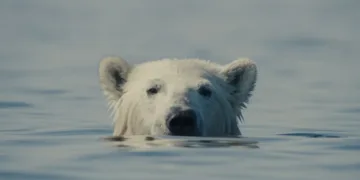






















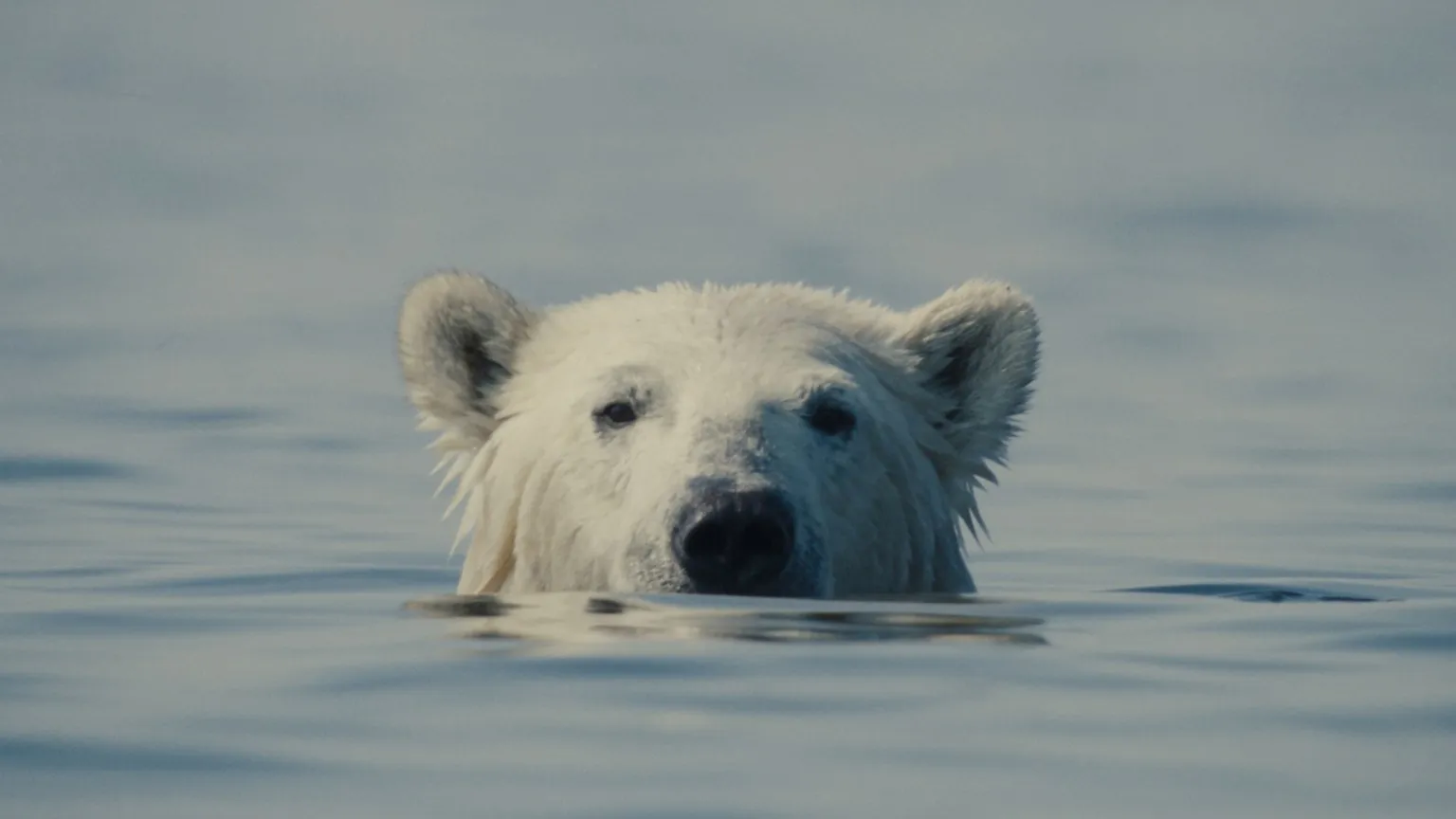

Churchill, Manitoba, sits as a solitary outpost on the rim of Hudson Bay. The town occupies a geographic extreme, where a suburban grid runs up against an unforgiving white expanse. Each autumn brings an odd kind of pilgrimage: a remote place turning into an international stage for migration and spectatorship. Tourists arrive by the busload, long lenses ready, treating the Arctic’s apex predator as a curated sightline.
The lived texture of the place resists that postcard framing. Climate shifts have blurred the old lines between species, pushing polar bears inland to rummage through human refuse. A bear becomes a “nuisance” the moment it steps onto pavement.
Churchill’s economy feeds on the bears’ presence, and its daily life reels from the threat that presence carries. The town moves on a seasonal rhythm of high-stakes coexistence. Children walk to school with the knowledge that one wrong turn can end in a lethal encounter. Churchill runs on paradox, profiting from an animal it must repeatedly drive away in order to keep living.
The Chiaroscuro of the Arctic Tundra
Directorial duo Jack Weisman and Gabriela Osio Vanden refuse the sentimental polish associated with traditional nature films. Their images speak in the grammar of the psychological thriller, all tension and proximity. The camera, riding a steadicam, glides alongside its subjects with a closeness that feels uncomfortably intimate. Teeth register as jagged texture. Breath becomes crystalline condensation suspended in freezing air. That technical precision shrinks the comfortable distance a viewer expects, replacing it with the sensation of being pressed up against the scene.
Light behaves in an expressionistic mode. Snow reads as blinding whiteness, then the frame snaps under the harsh artificial glare of sirens and flashing strobes. Intrusion becomes a visual argument. Sound follows the same logic. The track trades the fantasy of wilderness quiet for a cacophony of human interference.
Cristóbal Tapia de Veer’s score pulses with fast-pitched, muscular anxiety, tightening the film’s grip each time it surges. The absence of talking-head interviews matters here. The film commits to observation, forcing the audience into the bear’s orbit, then refusing to offer an easy human translation. The camera tracks with relentless focus, echoing the motion of a noir figure pursued through a cold, indifferent city. The tundra becomes the alleyway. The siren becomes the streetlamp. The dread stays.
Narratives of Survival and Sovereign Rights
The documentary’s moral weight gathers around the voice of the late Mike Tunalaaq Gibbons. His narration brings an Inuit perspective that complicates a familiar Western conservation story. Tourists arrive looking for a majestic icon, a figure placed at a safe distance and framed as something to be saved. For the local Inuit community, the bear stands as a formidable carnivore with a real capacity to kill. The resulting ideological friction runs through every image, like a hairline crack spreading across the frame.
Gibbons speaks about hunting as survival and heritage, a tradition that chafes against the tourism industry’s sanitized expectations. Churchill depends on the spectacle, while the night demands patrols and the constant vigilance of wildlife officers. The film records forced intimacy between people and predator, a closeness produced by circumstance rather than choice. Families speak from the aftermath of attacks that took loved ones.
Children learn rules that treat night as a restricted zone, a time when the town’s geometry becomes hazardous. The documentary keeps returning to the disparity between those who watch the bears for leisure and those who share domestic space with an animal capable of viewing them as prey. The gap between lens and lived risk never closes, and the film has the decency to let that discomfort remain.
The Mechanical Purgatory of Wildlife Management
Churchill’s efforts to govern nature take the shape of bureaucracy under pressure, a system that starts to resemble a nightmare with forms attached. Deterrence arrives in jarring, violent measures. Fireworks explode as tools. Sirens blare at volumes that have reportedly left some bears permanently deaf. When a bear is caught, it goes to a specialized bear jail, then sedation, then relocation. The process carries a grim efficiency that feels designed for paperwork, not for life.
The imagery turns surreal. A limp, thousand-pound predator lifted by helicopter hangs in the air like a broken icon. The spectacle reverses itself: humans now stage-manage the bear as cargo. The film finds a profound sadness in the footage of a bear waking in a remote, unfamiliar landscape. Its eyes hold a confusion that reads like a loss of agency, a consciousness snapped loose from any stable ground.
These management systems appear as temporary patches laid over systemic failure. The land remains contested, with no party able to claim total sovereignty. Still, the bears persist as clever survivors. They learn the logic of traps. They outsmart barriers. The cycle becomes pursuit and evasion, grimly rhythmic, with tension built through pacing and sound until the audience feels the same trapdoor sensation: pressure, release, pressure again. The film offers no easy ethical resolution, and that refusal lands as its hardest truth.
Nuisance Bear is a visually arresting documentary that premiered at the Sundance Film Festival on January 24, 2026, where it won the prestigious Grand Jury Prize in the U.S. Documentary Competition. Expanding on the directors’ 2021 short of the same name, the feature explores the harrowing and complex relationship between polar bears and the residents of Churchill, Manitoba. Following its festival run, the film was acquired by A24 for wider distribution. As of February 2026, it is appearing in select festival screenings and remains one of the most talked-about documentaries of the season, offering a philosophical look at environmental collision and indigenous stewardship.
Full Credits
Title: Nuisance Bear
Distributor: A24, Documist, Rise Films
Release date: January 24, 2026
Rating: TV-MA (Festival Rating)
Running time: 90 minutes
Director: Gabriela Osio Vanden, Jack Weisman
Writers: Gabriela Osio Vanden, Jack Weisman
Producers and Executive Producers: Michael Code, Will N. Miller, Teddy Leifer, Joe Karetak, Eric Anoee, Nicole Stott, Emily Osborne, Harry Go, Nicole Quintero Ochoa, Moudhy Al-Rashid, Sam Frohman, Alex Pritz
Cast: Mike Tunalaaq Gibbons
Director of Photography (Cinematographer): Gabriela Osio Vanden, Jack Weisman, Michael Code, Sam Holling, Ian Kerr, Jack Gawthrop
Editors: Andres Landau
Composer: Cristóbal Tapia de Veer
The Review
Nuisance Bear
Nuisance Bear is a chilling, masterfully captured portrait of a world where the wild has been cornered by the suburban. It replaces sentimental conservation tropes with the tense, rhythmic pulse of a psychological thriller. By centering the animal's perspective amidst a cacophony of sirens and helicopters, the film exposes the mechanical coldness of our coexistence. It offers no easy comfort or political scapegoats, leaving the viewer instead with a haunting meditation on displacement. It is a vital, visual achievement in modern documentary filmmaking.
PROS
- Stunning, high-proximity cinematography
- Intense, atmospheric score by Tapia de Veer
- Nuanced inclusion of Indigenous perspectives
- Evocative, "fly-on-the-wall" storytelling
CONS
- Occasional repetition of footage
- Shies away from direct political critique
- Narrative structure feels thin for a feature
- Emotional "gut-punch" twist feels slightly out of place