





























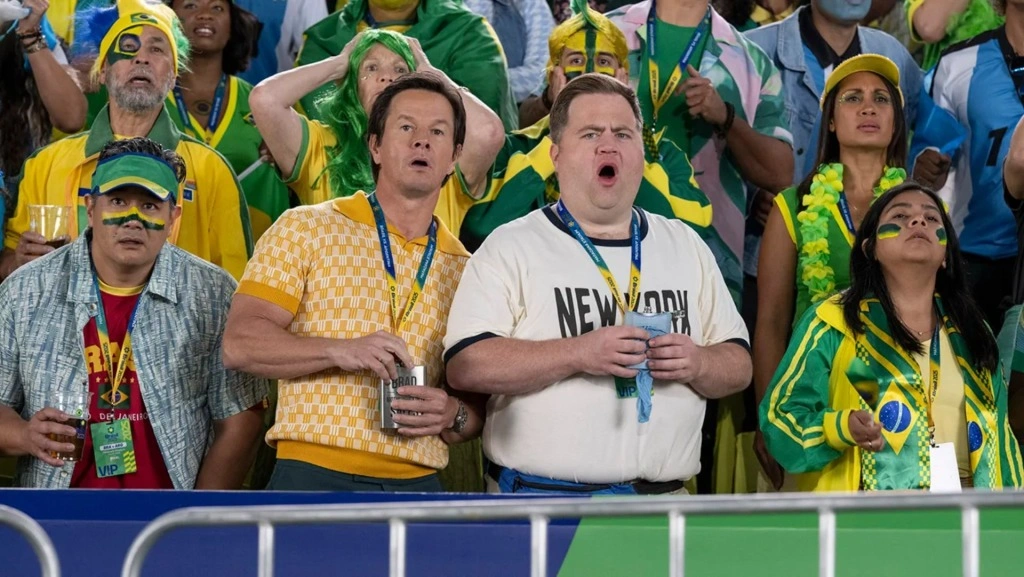

The cinematic cycle has a way of circling back to its oldest bodily obsessions. Peter Farrelly, after spending recent years in the vicinity of prestige drama, turns back toward the grubby mechanics of gross-out comedy with a film built around the Testicle Sentinel, a product that converts male panic into a sales pitch. The gadget exists as a form of personal protection for the supposed “superspreaders” of germs, a piece of pseudo-science that becomes the engine for an international branding push.
Brad and Elijah, the salesmen driving this scheme, occupy a space where corporate panic meets sports spectacle. Once they rename the item Balls Up, the idea sheds its clinical costume and embraces a cruder, crowd-pleasing identity. That rebrand says plenty. A complicated idea gets stripped down, flattened, and sold back as a joke fit for mass consumption, which is a pretty familiar ritual in commercial culture.
The film moves from the antiseptic atmosphere of a marketing office to the messier sprawl of Rio de Janeiro. Along the way it tracks two men whose failure at work snowballs into something close to diplomatic embarrassment. They become “Los Estupidos,” a label that marks them as unwelcome guests, public nuisances, and walking proof that arrogance travels well.
Farrelly’s film presents itself as a contemporary gross-out picture shaped by streaming-era economics, a movie with little interest in subtlety and a near-total fixation on anatomical slapstick. That focus gives it a kind of purity, if one wants to be charitable. Or a kind of tunnel vision, which feels nearer the mark.
The Domino Chain of Commercial Calamity
The structure runs on escalation. One mistake triggers another, then another, until a workplace blunder mutates into something with national repercussions. The story begins inside Regal Blue Condom Co., where Elijah arrives with a sweat-drenched presentation and Brad counterbalances him with a sales style built on swagger, aggression, and a thoroughly exhausting version of masculinity.
They land a sponsorship deal tied to the 2025 World Cup with startling speed, though the victory has the instability of cheap scaffolding. Brad’s refusal to respect personal limits pushes Santos, a Brazilian official, into collapse after nine years of sobriety. The scene sketches a recognizable American pathology: the conviction that closing a deal excuses any damage done to the person standing across the table. Commerce, here, becomes a moral solvent.
From there the movie tips into debauchery. Naked balcony leaps and cocaine-driven partying wreck the agreement almost immediately and get Brad and Elijah fired. Their dismissal leaves them holding VIP tickets, a parting gift that feels like a corporate joke with ugly aftershocks.
Access remains intact even after they have helped poison the event around them. In that sense, the film stumbles into a pointed observation about professional failure in systems built to reward bravado. Some people keep the perks even after torching the room.
The stadium sequence converts office farce into public disaster. At the final match between Brazil and Argentina, the pair spill onto the field during a tense moment. A drunken fight with a mascot, shaped in a way that recalls the product they have spent the film trying to sell, leads them to sabotage a decisive goal. At that moment the movie abandons any lingering corporate satire and becomes a chase picture.
Brad and Elijah bolt into the Amazon, which the film treats less as a living place than as a loose string of comic hazards. One of those hazards involves the candiru, the vampire fish said to follow a urine stream back to its source. That gag leads to a graphic medical extraction performed by a deeply unwilling companion, which is the film in miniature: panic, humiliation, and the body turned into hostile terrain.
Then comes the “cocaine alligator” episode, a sequence clearly designed to hitch itself to recent animal horror-comedy trends. Brad’s reference to an earlier film in that lane introduces a self-aware wink, though the wink carries a faintly desperate quality, like material seeking validation from another movie’s existence. The karaoke scene, built around a shrill take on a Gotye song, offers a brief break from the barrage of physical torment.
Later, capture by a cartel leader forces the protagonists to swallow their own specialty condoms for use as drug mules. The idea has a grim comic symmetry. Their invention, built as a tool of protection, becomes equipment for a different black-market form of protection. The movie rarely achieves that kind of circularity, which may be why the moment lands at all.
Creatine Hubris and the Sweat-Soaked Inventor
Mark Wahlberg plays Brad as a monument to smug self-assurance, the kind of man who seems convinced that a firm handshake is a moral philosophy. His performance draws on what could be called a “creatine personality,” a mode of being defined by physical confidence, eye-contact intensity, and slogans mistaken for inner substance. Brad has no stable ethical center.
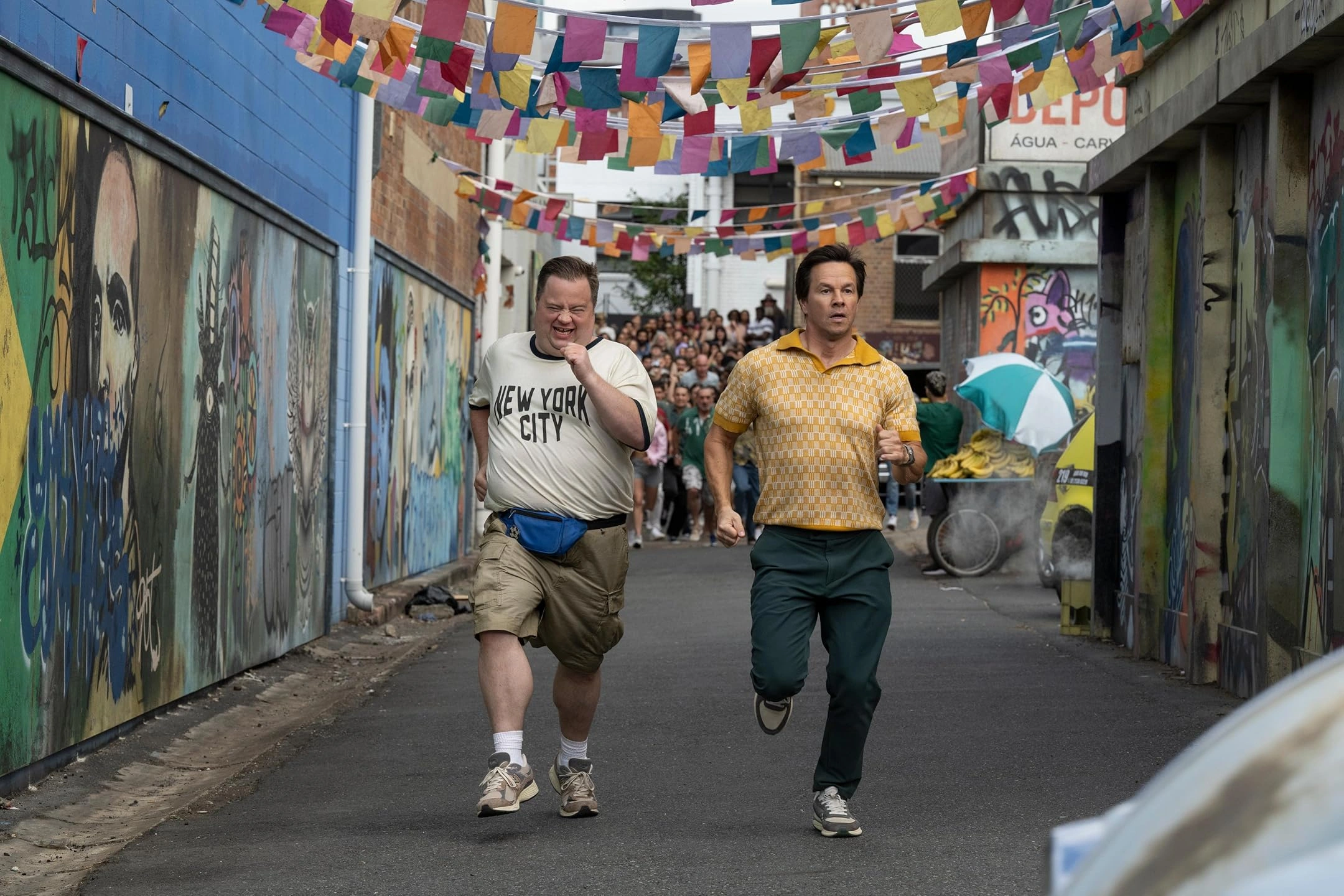
His casual disregard for Santos’s sobriety makes that plain. He functions as a straight man in structural terms, though he is hardly stable enough to qualify as straight in temperament. His main purpose is to endure bodily punishment that undercuts his self-image as a tough figure.
Because of Wahlberg’s action-hero baggage, the spectacle of Brad frantically trying to remove a vampire fish from his anatomy carries the shape of self-parody. He complains, spirals, and flails. Yet he keeps a certain likability in defeat, which is probably the performance’s main saving grace.
Paul Walter Hauser gives Elijah a frazzled, panicked rhythm that the film badly needs. He excels at what might be called “flopsweat acting,” a style grounded in visible discomfort and a sense that the soul inside the body is perpetually scrambling for an exit.
Elijah is the mercurial designer, gifted with technical skill and burdened with zero social ease. His responses to pressure create several of the film’s few clean comic beats. The character changes very little across the story. He remains a man in survival mode, driven less by growth than by the hope of outlasting the fallout from his own ideas.
Their shared dynamic depends on friction. They are set up as opposite temperaments, though the script never gives that relationship the warmth or generosity that often makes mismatched pairings enjoyable. Their connection grows out of mutual disaster and a relentless stream of anatomical gags.
The odd-couple setup feels stale here, weighed down by banter that seldom pauses long enough for reflection or even basic human texture. Watching them together becomes an exercise in endurance. The film keeps asking the audience to follow two men trapped inside their own obnoxious feedback loop, and the request grows less appealing as the runtime stretches on.
Phonetic Chaos and the Corporate Matriarch
The supporting players commit hard to the film’s absurdity, which helps in scattered moments. Benjamin Bratt, playing Santos, turns out to be a welcome surprise. He drops his customary poise and plays a man whose life spins off course after one glass of wine.

His physical work during the debauchery scenes generates some of the movie’s livelier passages, and his evident fitness gives the chaos an odd elegance. He moves through humiliation with remarkable ease. There is something faintly tragic in that too, since Santos functions as one of the film’s clearest examples of collateral damage produced by American carelessness.
Sacha Baron Cohen appears as Pavio Curto Bündchen, a cartel boss whose comic identity rests almost entirely on sound. His accent becomes a kind of phonetic storm, all warped vowels and brass-instrument blare. The audience is pushed into hearing texture before meaning. Humor emerges from language collapsing into noise. It is a broad choice, plainly, though broadness is the native climate of this film.
Molly Shannon plays the head of the condom company as a boss defined by limited self-awareness and limitless profanity. She helps set the film’s coarse corporate mood, treating employees with a brand of politically incorrect contempt that feels lifted from an earlier comedy cycle. Her part is small, built from brief explosions. Even so, she leaves a mark, partly because Shannon understands how to weaponize vulgarity with comic precision.
The environmental-activist detour introduces Eric André and turns its sights on a familiar version of Western eco-consciousness. The sexually ravenous female activist who happily kills poachers arrives as a stock figure, and the film’s treatment of women in this stretch is bleakly consistent with the rest of its worldview.
Female characters are used as sexualized figures, obstacles, or agents of disruption. They are rarely allowed any interiority. They flash in, create chaos, and vanish. That pattern gives the picture a strangely antique quality, like a comedy excavated from an era less interested in women as people than as functions in a male panic machine.
The Regressive Lens of the Ugly American
Farrelly’s solo effort signals a clean return to the crotch-oriented instincts associated with his earlier career. The 104-minute runtime feels sluggish, largely because the pacing drifts. Scenes hang in the air, sweating and waiting for laughs that arrive late or fail to arrive at all.
Farrelly appears interested almost exclusively in the protagonists’ genitals, and that single-minded fixation drains the film of motion. A peculiar streaming-comedy inertia settles over the whole thing, the familiar sensation of characters standing around in polished locations while jokes strain for lift-off.
The script from Rhett Reese and Paul Wernick works from a noticeably uninspired register. The gags lean on easy targets such as literal bananas and swallowed condoms. The dialogue has some spice, though it circles the same notes again and again.
References to other screenplays, including the nod to the bear on cocaine, create an impression of anxious self-awareness. The writers seem to know the material is derivative, and that knowledge hangs over the film like a nervous tic. Self-consciousness can sharpen comedy. Here it often feels like a confession.
The movie’s approach to cultural stereotype is blunt to the point of hostility. Brazil appears as a place populated by deranged sports fans and corrupt officials, all filtered through an “Ugly American” lens that assumes viewers will share the protagonists’ contemptuous gaze.
The location functions as decorative chaos, not as a setting with texture or specificity. It exists to absorb tired jokes. That choice matters. Comedies of national embarrassment can sometimes expose the arrogance of their central figures. This one seems far less certain of its target, and at times it slips into reproducing the same cynicism it ought to be skewering.
Its treatment of women is harsher still. Female characters are reduced to clichés with dialogue that keeps pushing them back toward sexual utility in relation to the male leads. The result feels regressive in a stale, joyless way. Any hope that the film might achieve the rude energy of something genuinely unruly evaporates. What remains is a product of the straight-to-streaming age, engineered to fill time and shelf space. The loose narrative turns the experience into a series of sealed-off set-pieces, each one gasping for comic oxygen.
Place-Faking and Sonic Elegance
Brazil on screen is built through fabrication. The production took place in Australian studios, and the synthetic quality of the jungle and stadium becomes visible with some regularity. Familiar landmarks such as Christ the Redeemer are inserted as digital markers to certify the setting.
That place-faking deepens the film’s sense of unreality. The production design works hard to mimic South American spaces through cluttered, gaudy sets, though the effort often calls attention to itself. One begins to sense the movie assembling its world from surfaces alone, which fits the broader emptiness of the enterprise.
The CGI alligator stands out as a polished effect that never feels necessary. It enters like a digital gatecrasher in a film that would have gained far more from tactile, physical comic business. The prosthetic props linked to the central invention appear constantly and serve as the dominant visual symbols of the movie’s fixation. Farrelly keeps returning to them with near-religious dedication. The image system is simple, blunt, and relentless.
Dave Palmer’s musical work introduces one of the picture’s few pleasing tensions. Vintage bossa nova and samba drift through scenes of raunch and panic, lending the action a polished musical sheen that clashes sharply with what is happening on screen.
The contrast has genuine comic potential. Elegant music accompanies the sight of grown men shoving condoms down their throats. Palmer’s score gives the chase scenes a rhythmic shape and brings a degree of sophistication missing elsewhere. For stretches, the soundtrack seems to belong to a cleverer movie that wandered into the wrong theater.
The World Cup final effects strive for scale, though they cannot disguise how little substance sits beneath the noise. Sound and image combine into a slick exterior wrapped around material that feels thin and quickly exhausted. On a technical level, the film accomplishes a narrow set of goals with competence. As an experience, it fades fast. The memory of it dissolves almost as soon as the credits begin, which may be the final joke, intentional or otherwise.
The action-comedy film Balls Up premiered globally yesterday, April 15, 2026. Directed by Peter Farrelly, the movie follows two marketing executives, played by Mark Wahlberg and Paul Walter Hauser, whose disastrous sponsorship pitch leads to an international scandal during the World Cup in Brazil. You can currently stream the film exclusively on Prime Video.
Where to Watch Balls Up (2026) Online








Full Credits
Title: Balls Up
Distributor: Amazon MGM Studios, Prime Video
Release date: April 15, 2026
Rating: R
Running time: 104 minutes
Director: Peter Farrelly
Writers: Rhett Reese, Paul Wernick
Producers and Executive Producers: David Ellison, Dana Goldberg, Don Granger, Andrew Muscato, Rhett Reese, Paul Wernick
Cast: Mark Wahlberg, Paul Walter Hauser, Benjamin Bratt, Eva De Dominici, Daniela Melchior, Molly Shannon, Sacha Baron Cohen, Eric André, Chelsey Crisp, Karan Soni
Director of Photography (Cinematographer): John Brawley
Editors: Sam Seig
Composer: Dave Palmer
The Review
Balls Up
Balls Up exists as a hollow echo of the gross-out era. It trades genuine comedic structure for a series of anatomical incidents. The film highlights a specific American commercial myopia (the belief that any product can be sold through sheer aggression). While Paul Walter Hauser offers a physical performance of significant sweat, the narrative lacks the structural integrity to support its weight. It functions as a synthetic artifact of the streaming age. It is a cinematic cul-de-sac.
PROS
- Paul Walter Hauser’s intense physical commitment to the role.
- Benjamin Bratt’s energetic abandonment of his typical dignity.
- The sonic elegance of the vintage bossa nova score.
CONS
- Reliance on repetitive and regressive anatomical gags.
- Fragmented narrative structure that fails to build momentum.
- Cynical portrayal of foreign cultures and limited female roles.
- A runtime that feels excessive for the material provided.