



























Bitter Christmas is Pedro Almodóvar’s 24th feature film, and his first Spanish-language production since Pain & Glory (2019). After his English-language experiment with The Room Next Door, this is a genuine homecoming: a director back in the language and cultural setting he has spent four decades making unmistakably his own. Released in Spain in March 2026, the film carries considerable international expectation, with Cannes widely anticipated as its next destination.
The title is, fittingly for a film so preoccupied with the instability of meaning, a little misleading. Bitter Christmas spans multiple seasons; “Christmas” reads more as an emotional register: the particular ache of occasions that deliver something other than what they promise.
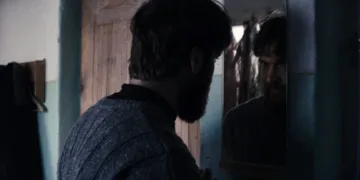
The film’s structure is a Russian nesting doll. Director Raúl (Leonardo Sbaraglia) is in a creative slump, writing a screenplay about another director, Elsa (Bárbara Lennie), whose story becomes the film we are watching. Almodóvar places surrogates of himself at every level of this construction, making autobiography both the engine and the subject. The result is melodramatic, self-conscious, impeccably designed, and genuinely funny with a regularity that the title does not prepare you for.
The Vampire at the Typewriter
The nested structure of Bitter Christmas is the argument, not merely a formal flourish. Raúl’s present-day creative struggle frames Elsa’s story, set in 2004, a year Almodóvar has cited as pivotal in his own artistic evolution. Elsa’s world then opens outward: her boyfriend, her friends, their grief, infidelities, and anxieties all feed into a film that keeps returning to a single uncomfortable question: who owns these stories?
That question reaches its sharpest point in a confrontation between Raúl and his longtime assistant Mónica (Aitana Sánchez-Gijon), in which she accuses him of vampirism. Almodóvar does not soften the charge. The film is genuinely self-critical: Raúl, and by extension Almodóvar, is shown to be emotionally extractive, inclined to bend other people’s realities toward the shape his fictions require.
The film raises the question of fiction as a healing tool, and it arrives at an honest, uncomfortable answer: sometimes it cannot heal, and the storyteller’s conviction that it can is a form of vanity. A line of dialogue, “the ending of a story sometimes imposes itself without the writer controlling it,” reads as much as confession as dramatic device.
Familiar Almodóvar preoccupations appear throughout: mourning and loss, female solidarity under pressure, irrational desire, creative paralysis. What feels fresher is the directness with which Almodóvar frames his own complicity in the suffering he documents and fictionalises. He is not flattering himself here, and that discomfort gives Bitter Christmas its unusual charge, connecting it to Pain & Glory and Bad Education as part of a consistent late-career project of self-examination, while going further than either.
The Women Who Carry It
Bárbara Lennie’s performance as Elsa is the film’s emotional center, and one of the finest pieces of acting in recent Spanish cinema. She plays a cult filmmaker sidelined into advertising, suffering from migraines and panic attacks on the anniversary of her mother’s death, and she carries all of this with extraordinary restraint. Lennie communicates Elsa’s interior life through the smallest physical signals: a held breath, a shift of the eyes, the suggestion of an expression that never quite arrives. It is the kind of performance that rewards close attention.
Leonardo Sbaraglia, as Raúl, handles a less sympathetic role with considerable skill. The character is recognisably an Almodóvar surrogate: decorated, restless, emotionally acquisitive. Sbaraglia finds the specific charm and vanity that makes such a person both magnetic and difficult to excuse, and his scenes with Aitana Sánchez-Gijon gain in retrospect once the film’s self-critical dimension comes fully into focus.
Sánchez-Gijon, as Mónica, has appeared in earlier Almodóvar films in more limited capacities. Here she is given genuine room to work, and the confrontation scene is the film’s moral climax. She earns every second of it.
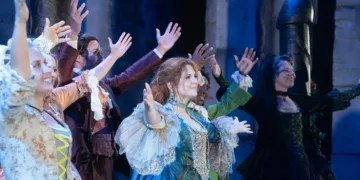
The supporting cast includes Vicky Luengo as the anxious Patricia, Milena Smit as Natalia, and Patrick Criado as Beau, a fireman by day and a stripper by night. His full routine to a Grace Jones track is a flash of the more anarchic Almodóvar, one the film’s later intensity largely sets aside. Rossy de Palma and Carmen Machi appear briefly in the opening passages, providing warmth before the film deliberately withdraws it.
What the Eye Sees, What the Ear Hears
DoP Pau Esteve Birba’s cinematography is one of the film’s consistent pleasures. The Madrid interiors are colour-coded with precision: saturated hues that function almost as emotional notation, letting you read the temperature of a scene before a word is spoken. The volcanic landscapes of Lanzarote, where Mónica reconnects with her own sense of self, offer a striking counterpoint. They are lunar, stripped back, oddly liberating against the domestic richness that dominates elsewhere.

Alberto Iglesias’s score is omnipresent, and self-consciously so. The swooning strings carry echoes of earlier Almodóvar collaborations, including Talk to Her, a choice that mirrors the film’s interest in repetition and memory. Longtime fans will catch the references. There are moments where the orchestral weight tips toward the overwrought, and a quieter scene would occasionally serve the material better.
The device of Raúl’s screenplay appearing onscreen in bold colours is a Brechtian touch that keeps the viewer aware of the film’s constructedness: a visual reminder that everything being watched is authored, shaped, and reconsidered in real time.
Bitter Christmas exists largely inside its own world, with little air from outside Almodóvar’s own preoccupations, and that hermeticism can occasionally feel airless. The final act extends past a natural endpoint, something the director acknowledges with a knowing joke, though the acknowledgment does not fully dissolve the problem.
Directed by the legendary Pedro Almodóvar, Bitter Christmas (originally titled Amarga Navidad) is a 2026 Spanish tragicomedy that explores themes of grief, creativity, and gender. The story follows an advertising director, Elsa, who struggles to process the death of her mother during the holiday season, eventually seeking solace on the island of Lanzarote. The film premiered theatrically in Spain on March 20, 2026, and is scheduled for international screenings at the 2026 Cannes Film Festival. In the United States, the film is distributed by Sony Pictures Classics, while UK audiences can watch it through Curzon. It will also be available for streaming on the platform Movistar Plus+ following its theatrical run.
Where to Watch Bitter Christmas (2026) Online
Full Credits
Title: Bitter Christmas (Amarga Navidad)
Distributor: Warner Bros. Pictures (Spain), Sony Pictures Classics (USA), Curzon (UK), Movistar Plus+ (Streaming)
Release date: March 20, 2026
Rating: R
Running time: 111 minutes
Director: Pedro Almodóvar
Writers: Pedro Almodóvar
Producers and Executive Producers: Agustín Almodóvar, Esther García
Cast: Bárbara Lennie, Leonardo Sbaraglia, Aitana Sánchez-Gijón, Victoria Luengo, Patrick Criado, Milena Smit, Quim Gutiérrez, Rossy de Palma, Carmen Machi
Director of Photography (Cinematographer): Pau Esteve Birba
Editors: Teresa Font
Composer: Alberto Iglesias
The Review
Bitter Christmas
Bitter Christmas is Almodóvar at his most exposed and most rigorous. The film's willingness to implicate itself in the very behaviour it critiques gives it a moral seriousness that his recent work has been building toward. Lennie is revelatory, the craft is immaculate, and the central confrontation is among the finest scenes he has ever staged. The final act overstays its welcome, and the film's sealed interior world will test those outside its frequency. A demanding, rewarding piece of cinema from a director still asking hard questions of himself.
PROS
- Bárbara Lennie delivers a career-best performance
- Bold, genuinely self-critical examination of artistic ethics
- Stunning colour design and Lanzarote cinematography
- Funnier and lighter than expected
- The Raúl/Mónica confrontation is an instant Almodóvar classic
CONS
- The final act extends past its natural endpoint
- The hermetic, inward-facing world can feel airless
- Iglesias's score occasionally overwhelms quieter moments
- Some supporting characters feel underserved