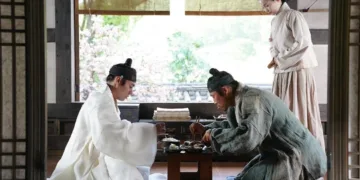
























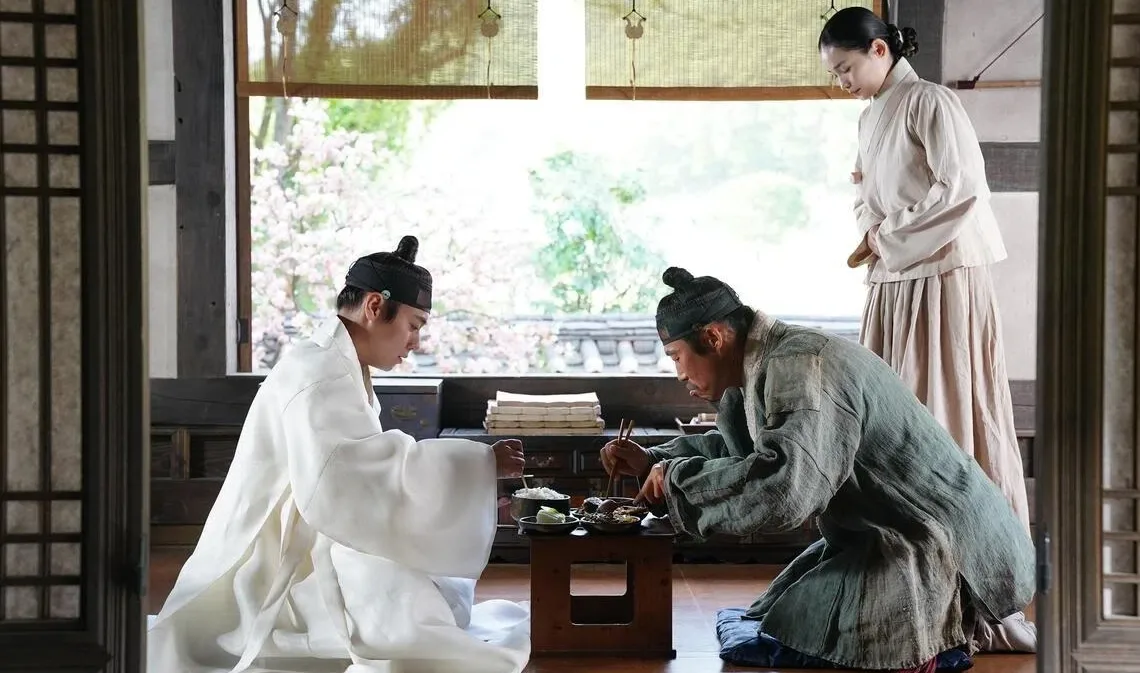

In 1457, the Joseon Dynasty lurched into a brutal transfer of power, the sort of dynastic correction that tends to arrive with a blade in hand, when Grand Prince Suyang took the throne from his nephew, Yi Hong-wi. The young king is sent away to Cheongnyeongpo, a village marked by exhaustion and want, where the soil looks spent and hunger feels permanent.
Eom Heung-do, the village chief played by Yoo Hae-jin, meets this political exile with the instincts of a man trained by deprivation. He reads banishment as an economic event. A noble guest might bring rice, meat, and other provisions, and some fraction of that wealth might spill into the lives of his starving neighbors. The calculation is harsh. It is human too.
Then Prince Nosan arrives and collapses the fantasy. No formidable aristocrat appears, no heavy presence carrying courtly authority and material benefit. The villagers get a gaunt, pallid teenager, a figure who seems half erased already. He carries a royal catastrophe in his body, though official history tends to compress such suffering into a neat line or two. From there, the film begins its close study of proximity, forcing a discarded ruler and an impoverished community into the same cramped moral space.
The Alchemy of Mutual Dependency
The drama draws its strength from the slow wearing down of the barrier between peasant and monarch. Yoo Hae-jin gives Heung-do a restless, nervous force, shaping him first as a man who hustles through scarcity and later as someone startled by the return of his conscience. The performance moves from larger physical business into something quieter and steadier, with tension still humming under the surface. Across from him, Park Ji-hoon plays the deposed king with an almost spectral stillness.
He presents a boy pinned in place by survivor’s guilt, and that burden grows heavier each time another protector disappears. At first, the king treats his own existence like dead weight. The friction this creates is one of the film’s strongest dramatic engines. Heung-do’s outlook changes once the boy stops registering as a source of provisions and begins to register as a son.
Han Myeong-hoe, played by Yoo Ji-tae, hangs over the story with an icy exactness. He functions as the engineer of isolation, a figure who carries the capital’s violence into the mountain air. Jeon Mi-do gives the film emotional ballast as Mae-hwa, the maid who becomes a maternal presence for the young king at the precise moment his sense of self starts to fray under peasant life.
The cast builds a network of feeling that gives the film its shape. What might have remained a conventional historical piece turns into a study of chosen kinship, built through silence, care, and the hesitant recognition that hierarchy cannot fully extinguish shared human need. The Joseon order still stands, of course. Yet the film keeps worrying at its logic, exposing how fragile rank can look once hunger and grief move into the room.
Gastronomy as a Language of Survival
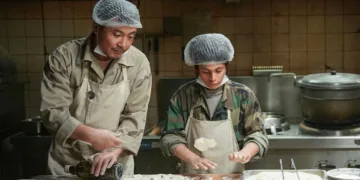
Food operates as the chief medium of exchange in Cheongnyeongpo. The film uses eating, refusing, serving, and withholding as forms of speech. Early on, the king’s despair appears through his rejection of the villagers’ modest meals. That refusal produces a grimly funny pattern, since the royal portions keep finding their way into the stomachs of the couriers assigned to deliver them.
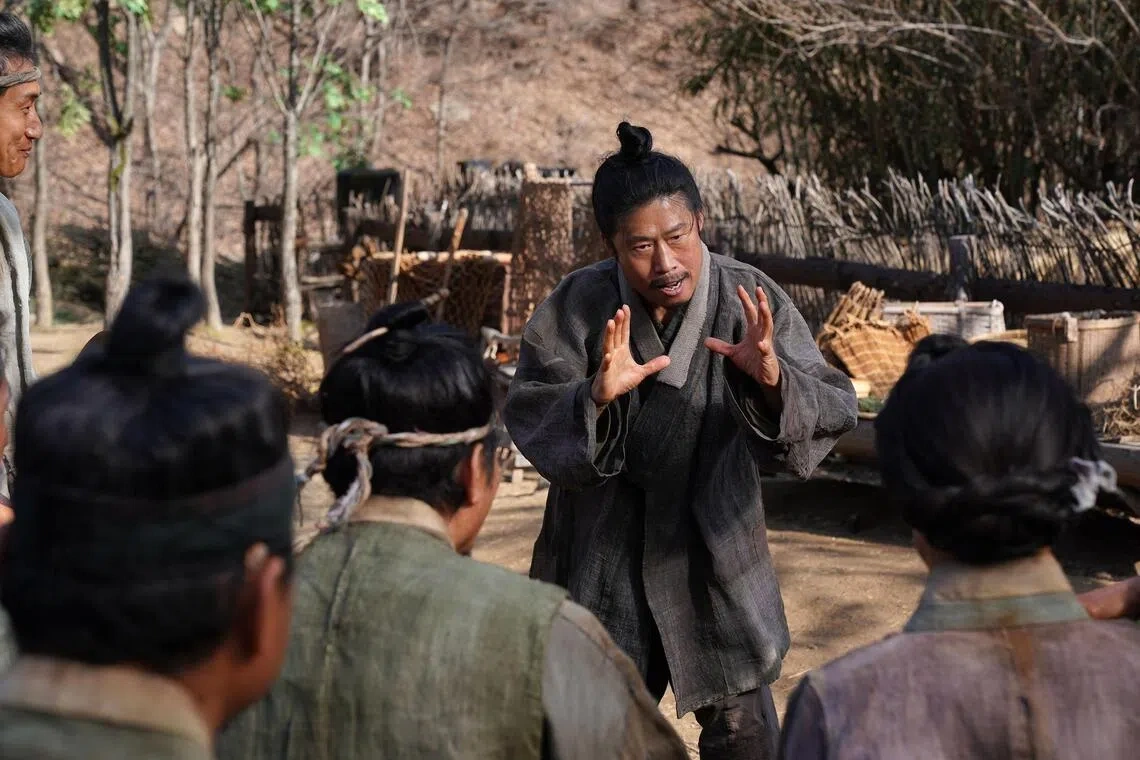
Their indigestion becomes a recurring joke, a small slapstick rhythm inside an otherwise lean and sorrowful setting. Then the mood shifts hard. The tale of a flustered village chief trying to feed his royal guest darkens into something closer to paranoid melodrama, almost noir in spirit, as the political weather in the capital turns and the village comes under threat.
At that stage, eating stops being routine and becomes an assertion of life itself. When Yi Hong-wi accepts a meal, the act marks his decision to remain present in his own existence. The emotional turn lands because the film has done the patient work beforehand. Meals become a running measure of the bond between keeper and kept, though even that phrasing feels unstable by then.
Their relationship hardens under pressure, and the food on the table starts to register the pressure too. Through these exchanges, the film links the court’s distant luxury to the dirt floor of the village. Hunger levels rank with merciless efficiency. Titles lose some of their force when the body keeps making the same ancient demand. There is a touch of irony here, maybe even historical sarcasm. Dynasties argue over legitimacy; empty stomachs do not care.
The Visual Texture of Erasure
Choi Young-hwan films the landscape with a plainspoken clarity that feels rooted in time and place. The cinematography avoids the polished glow common in many period productions. What fills the frame instead are rough surfaces, hard ground, and the worn physical reality of a remote settlement.
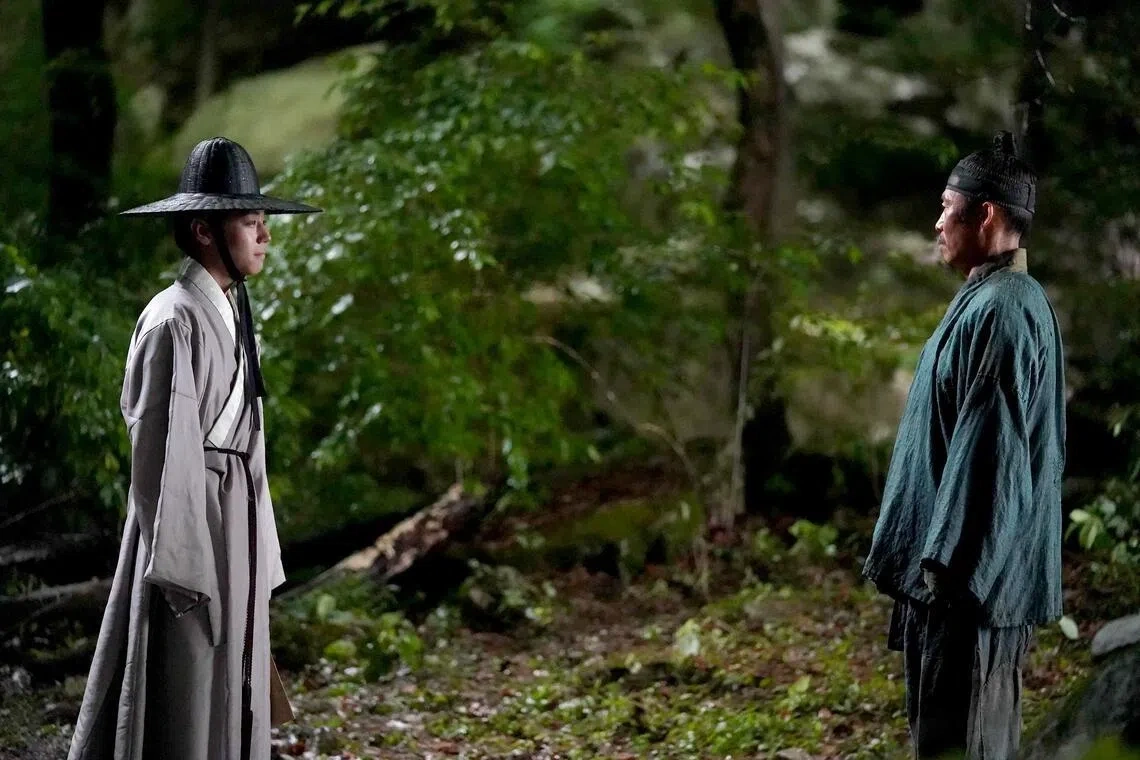
The faces matter too. The cast looks credible inside the period, free of the cosmetic polish and filtering that can make historical drama feel oddly contemporary. That choice gives the rural hardship an immediate physical presence. A few visual effects break the spell. The digital tiger and deer feel imported from a weaker production, and their artificiality is easy to spot against the care visible everywhere else in the design.
The film’s most affecting image gathers around the village tree. Wooden tags hang from it, each carrying the name of an illiterate villager written in Hangul, and the gesture turns naming into a civic act. When Yi Hong-wi’s tag appears beside Eom Heung-do’s, the image cuts through royal hierarchy with startling force. He stands there as a named person, not a failed sovereign or a discarded historical problem.
That matters. History, especially court history, has a habit of preserving the winners and thinning everyone else into shadows. The film pushes against that habit. It treats naming as resistance and memory as a contested space. By attending to the quiet lives cast into the wake of a coup, the director restores dignity to people political violence tries to rub out. The mourning at the end lands with unusual force. It stays heavy, and it lingers.
Released in South Korea on February 4, 2026, The King’s Warden has quickly ascended to become the second most-watched film in Korean cinema history, recently surpassing 16 million admissions. Directed by Jang Hang-jun, this historical drama reimagines the 1457 exile of the young King Danjong, focusing on his poignant and unlikely friendship with a local village chief. The film saw limited international theatrical releases in the United Kingdom, Ireland, and the United States throughout February and March 2026. It is currently available in theaters globally through distributors Showbox and K-Movie Entertainment.
Where to Watch The King’s Warden (2026) Online






Full Credits
Title: The King’s Warden
Distributor: Showbox
Release date: February 4, 2026
Rating: 12 (South Korea)
Running time: 117 minutes
Director: Jang Hang-jun
Writers: Jang Hang-jun, Hwang Seong-gu
Producers and Executive Producers: Jang Won-seok, Lim Eun-jeong, Park Yun-ho
Cast: Yoo Hae-jin, Park Ji-hoon, Yoo Ji-tae, Jeon Mi-do, Kim Min, Park Ji-hwan, Lee Joon-hyuk, Ahn Jae-hong
Director of Photography (Cinematographer): Choi Young-hwan
Editors: Heo Seon-mi
Composer: Dalpalan
The Review
The King’s Warden
The King’s Warden succeeds through its refusal to romanticize the misery of its subjects. It treats hunger as a political actor and exile as a slow dissolution of the self. While the digital wildlife distracts (a clear case of "CGI-intrusion"), the human chemistry between Yoo Hae-jin and Park Ji-hoon grounds the melodrama in something resembling truth. It is a somber reflection on how history erases the individual.
PROS
- Lead actors deliver performances with profound emotional range.
- Visual texture feels grounded in the era without modern filters.
- Thematic exploration of class through the lens of nourishment.
CONS
- Digital rendering of the tiger and deer is noticeably poor.
- Tonal shifts from comedy to tragedy feel abrupt.
- Female character arcs lack sufficient depth.