



















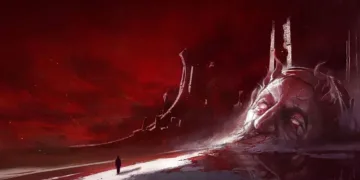
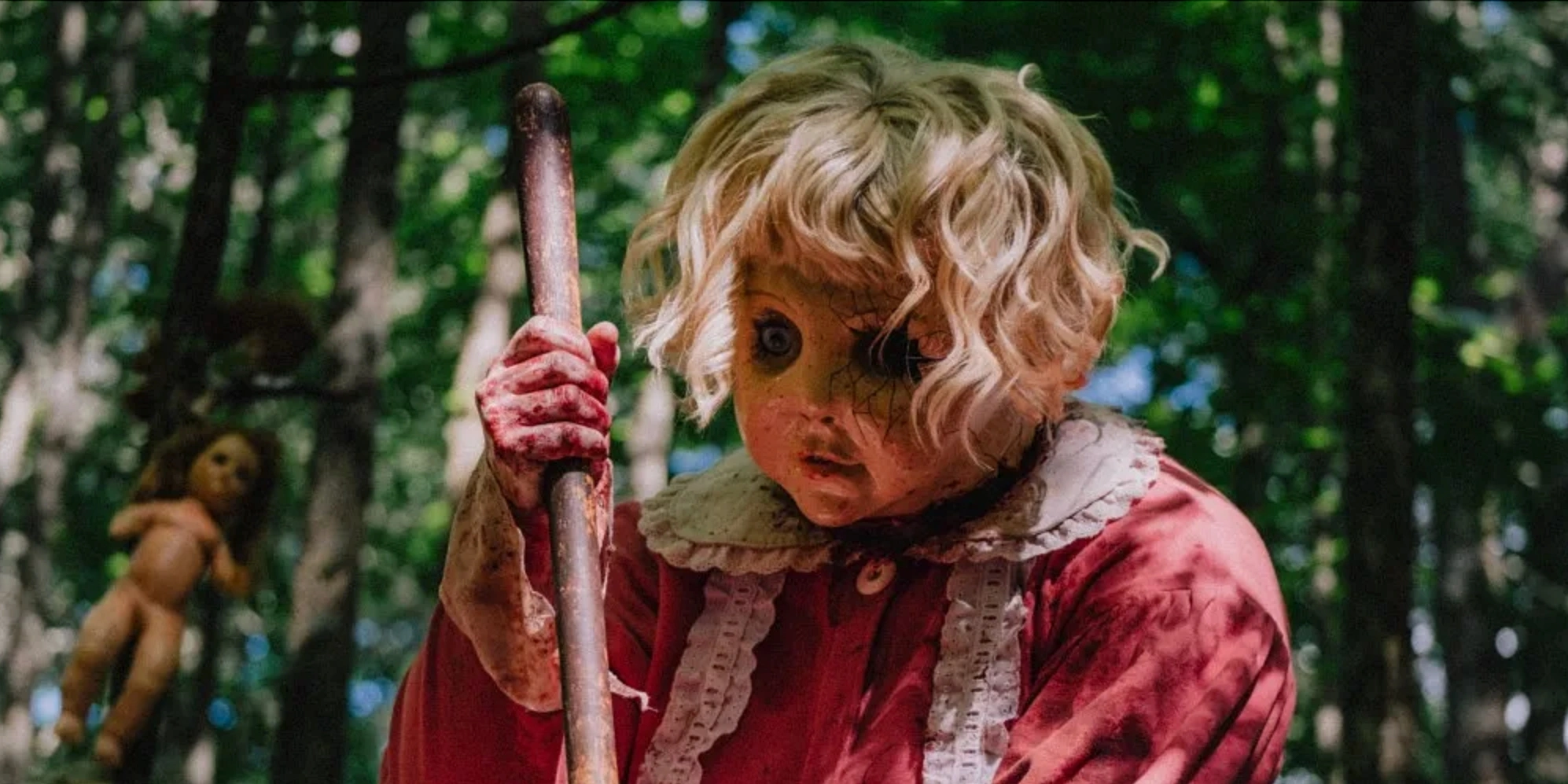

The Tennessee woods open like a stage claimed by an ancient hunger. Macy and Chase step into that green silence in search of a brief shelter from the pressures waiting outside it. Chase carries a ring in secret, holding close the shape of a future he hopes to offer. Macy moves with a heavier private question. She wonders what it would mean to become a mother to a child who belongs to another life.
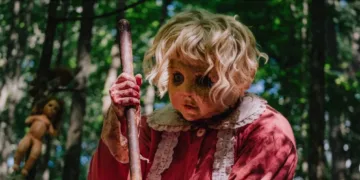
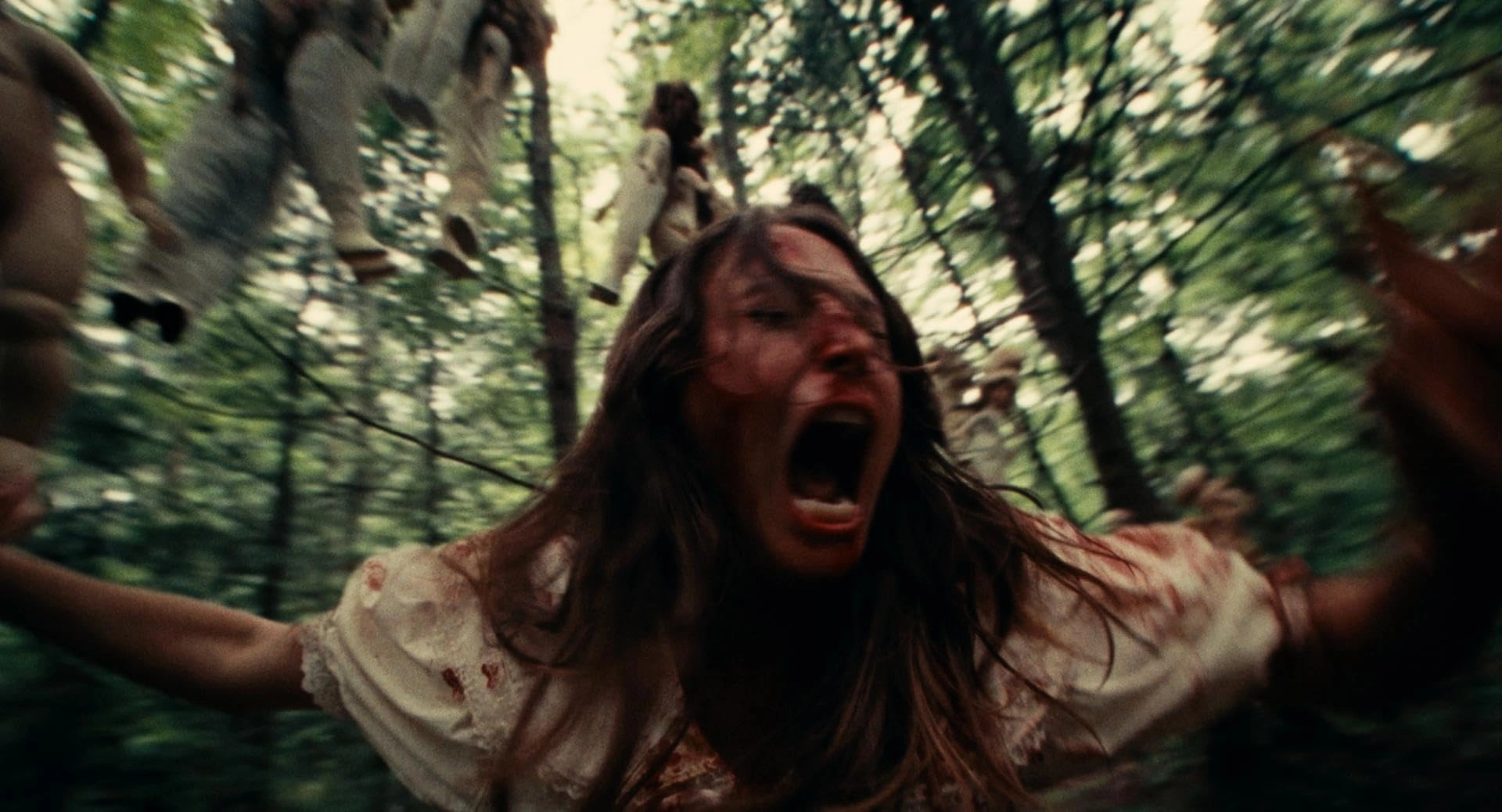
Their path leads them past porcelain faces pinned to trees, dolls hanging there like relics from some buried rite. Then Dolly arrives. A towering body in a ceramic mask tears through the stillness and splits their world apart. Chase is struck down with a shovel. Macy wakes inside a house given over to rot, dolls, and the debris of childhood. Her adulthood is taken from her piece by piece.
She is placed in a crib. Rod Blackhurst frames the body as a vessel through which identity can be damaged, reduced, and nearly erased. Survival comes with mutilation of the self. The bright walk through the hills collapses into a suffocating struggle to remain human. Macy fights for personhood inside a house that handles her like an object meant for someone else’s fantasy.
The Abrasive Gaze of the Super 16mm
Justin Derry shoots on Super 16mm, and the image carries a thick abrasion that feels physical. The texture clings to the screen. Time seems soaked into the frame itself. The look recalls the grindhouse cinema of the 1970s and gives the impression that the film stock is aging before our eyes.
A strange tension emerges when that worn visual field meets the occasional drone shot. Those aerial images arrive like a foreign presence, too modern for the world the film has summoned. They disturb the period haze. Blackhurst also turns to iris transitions, drawing the eye inward toward selected horrors.
Those circular closures create pressure. Vision narrows. Space contracts. The Tennessee woods glow with a false gentleness, full of light that conceals threat. The movement from the open hills into the shadowed dollhouse feels like a descent through layers of spiritual confinement. The landscape mirrors an inward collapse. What begins with the promise of intimacy and romance hardens into a wooden prison, ancient in mood, stained with neglect.
The Flesh as a Site of Resistance
Fabianne Therese gives a performance shaped by bodily depletion. She begins as a woman carrying the ambiguities of adult life. She is reduced, by the film’s brutal logic, to a being organized around endurance. Her eyes register the mental corrosion that comes from being treated as an infant.
Civilization falls away from her slowly, and the process leaves a wound deeper than bruises. Seann William Scott steps into severe suffering with startling force. His scenes of injury hold a palpable physical truth. He gives pain a humiliating fragility, and the body appears frighteningly easy to destroy.
Max the Impaler commands attention through presence alone. The performance is almost entirely nonverbal, yet every movement lands with intent. Each sound opens a small window into a broken consciousness. Max shapes Dolly as a monster built from mass, damage, and arrested feeling. Ethan Suplee appears briefly and shifts between modes with slippery ease. His presence widens the atmosphere of corruption. It suggests a nearby world full of ruin, half hidden among the trees.
The Architecture of Regressive Terror
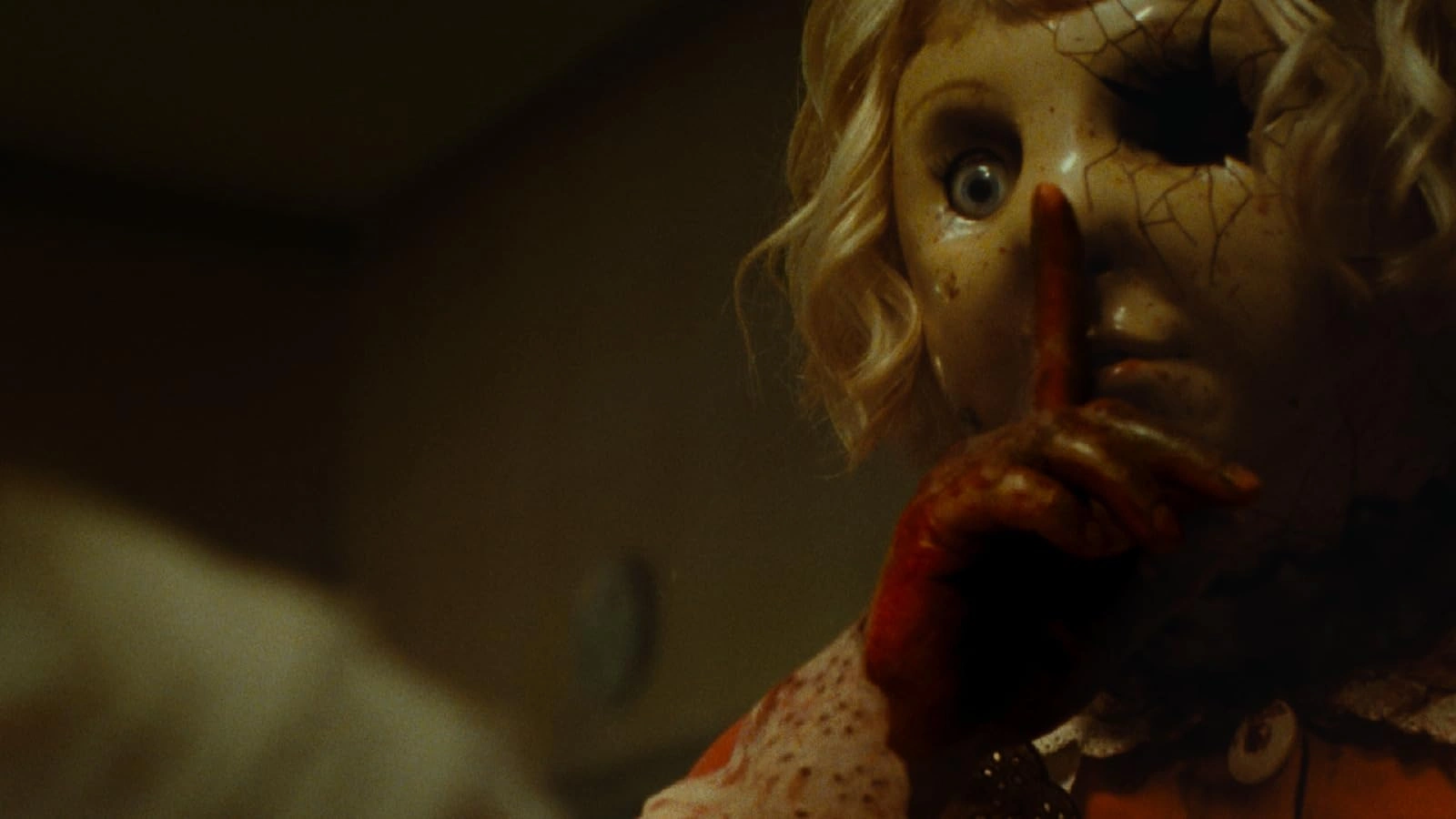
Ashley K. Thomas locates horror in the vulnerability of flesh. The shovel attack involving Scott is staged with a clinical chill, and the facial prosthetics carry a painful realism. The film keeps returning to the fact that the body tears easily. Dolly’s mask becomes one of its most haunting images.
A single blue eye looks out from the porcelain blankness, and that fixed stare suggests a mind trapped inside an endless childhood instant. The blond wig resting over such a massive figure intensifies the dissonance. The uncanny takes on weight, muscle, breath. The dollhouse stands as a filthy shrine. Dolls crowd the space.
Rusted tools wait in corners. Diapers and pacifiers become instruments of psychic violation. Objects tied to care acquire the force of domination. The whole house feels governed by a damaged biological command. Family, in this place, has curdled into a weapon.
The Biological Trap and the Ghost of Hooper
The film breaks itself into chapters bearing titles such as Fight and Mother. These headings impose order on the carnage and direct attention toward the ideas moving beneath the violence. Motherhood pulses through the film like a dark rhythm that never loosens its grip. Macy dreads the burden of caring for a child. Dolly kills under the pressure of a warped maternal desire.
The collision between them gives the film its psychic charge, since each woman is tied to a separate terror of domestic life. Blackhurst threads references to Tobe Hooper through the picture. The Hooper Mine sign stands as an open gesture toward genre ancestry. The chase scenes follow a catch-and-release rhythm that keeps dread active, then withholds relief.
By the end, the film reaches toward the grammar of 1970s horror and leaves survival stained with uncertainty. Escape remains spiritually incomplete. Autonomy feels temporary, fragile, always under siege. Macy struggles to keep hold of her own name inside a place that wants to rename her as a daughter. The credits suggest that the cycle continues. Trauma lingers here like a force that refuses burial.
Following its world premiere at Fantastic Fest in late 2025, Dolly arrived in theaters across the United States and the United Kingdom on March 6, 2026. Directed by Rod Blackhurst, this grit-soaked slasher has quickly become a standout for fans of practical horror and 1970s-style grindhouse aesthetics. As of April 2026, you can experience the film’s claustrophobic terror in participating cinemas or stream it through Shudder. It is also available for digital rental and purchase on major platforms such as Amazon Prime Video.
Where to Watch Dolly (2026) Online










Full Credits
Title: Dolly
Distributor: Independent Film Company, Shudder, IFC Films, Vertigo Releasing, Blue Finch Film Releasing
Release date: March 6, 2026
Rating: R
Running time: 82 minutes
Director: Rod Blackhurst
Writers: Rod Blackhurst, Brandon Weavil
Producers and Executive Producers: Rod Blackhurst, Joseph C. Grano, Noah Lang, Bryce McGuire, Justin Oakey, Ross O’Connor, Isaiah Smallman, Betty Tong, Esteban Sanchez
Cast: Fabianne Therese, Seann William Scott, Ethan Suplee, Max the Impaler, Russ Tiller, Kate Cobb, Michalina Scorzelli, Eve Blackhurst
Director of Photography (Cinematographer): Justin Derry
Editors: Justin Oakey
Composer: Nick Bohun
The Review
Dolly
Dolly acts as a grim mirror to biological imperatives we often ignore. It explores the terror of losing oneself to the needs of another. The work occasionally stumbles over its own genre homages. Still, the tactile filth and physical weight of the performances create a haunting experience. It remains a piece of visceral discomfort that interrogates the price of autonomy.
PROS
- Tactile Super 16mm cinematography.
- Grisly and effective practical makeup.
- Commanding physical performances from the lead actors.
- An unsettling atmosphere of biological regression.
CONS
- Pacing slows during the second half.
- Visual friction between film grain and drone shots.
- Character logic occasionally falters to serve the plot.