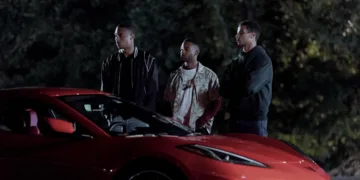




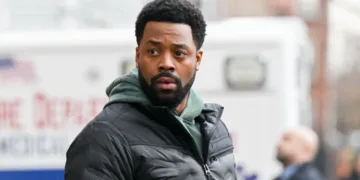
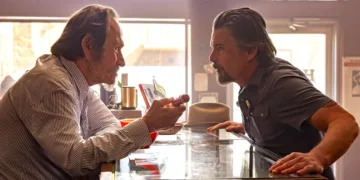


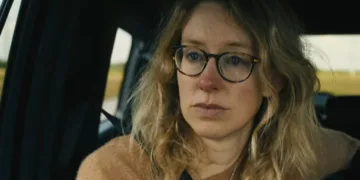

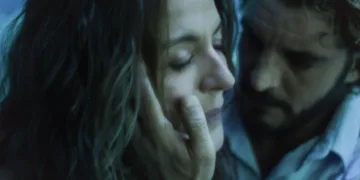
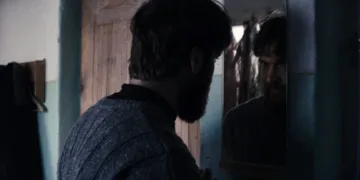









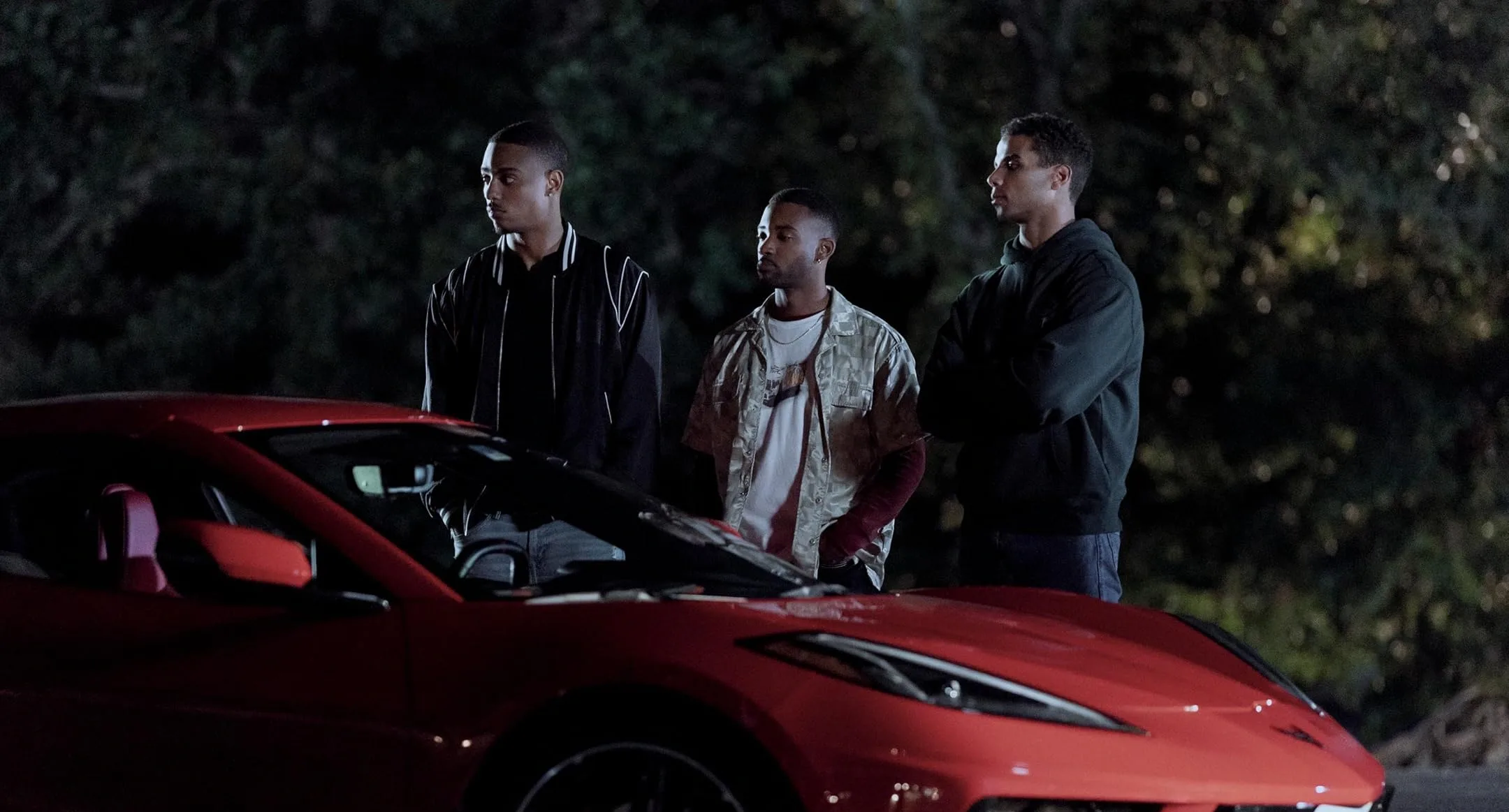
The Gates arrives as a survival thriller built on the cramped tension of rural Texas. The story tracks three friends, Derek, Kevin, and Tyon, whose plan for a party gives way to a fight to stay alive. A huge traffic jam pushes them onto a detour that leads to Creekview Hills, an exclusive gated community.
The neighborhood is 99% white, and that fact shapes the film’s visual design and social pressure from the moment the three Black protagonists enter it. The story jolts forward when they stop at a mansion looking for help and witness a murder. They see the local pastor, Jacob, kill a woman, and the danger sharpens the instant Jacob sees them.
Director John Burr leans on a familiar structural hook. The film opens on Derek, blood-stained and holding a gun, then cuts to a title card that sends the story back eight hours to the start of the night. It is a recognizable device, yet it serves a clear purpose here.
The film announces its endpoint before tracing the chain of choices, traps, and misjudgments that lead there. That structure places pressure on the opening stretch, since the audience is waiting for the image promised at the start to return. Burr uses that pressure to define Creekview Hills as a closed system, one where strangers are read as threats on sight.
That idea gives the film its strongest narrative engine. The gates matter as physical barriers, yet the story keeps pointing to the people behind them as the real mechanism of control. The neighborhood’s polished surfaces and rigid suspicion create a setting where the protagonists are trapped by architecture, social status, and race at the same time. The film stays locked onto that premise with admirable clarity.
Character Dynamics and Social Friction
The story moves through the friction among Derek, Kevin, and Tyon. Derek is an aspiring lawyer from a wealthy background, and he holds tight to his faith in the legal system and institutional protection. Kevin pushes against that faith with a harder, more skeptical view shaped by distrust of law enforcement.
Tyon works as the link between them, keeping the group from splitting apart too early. Those differences are not decorative character notes. They drive the plot. Each argument about what to do next grows from their class positions, their expectations of authority, and their sense of what survival demands.
Once they enter Creekview Hills, the film builds its scenes around a series of hostile encounters that expose the racial logic of the setting. A group of white teenagers pressures Kevin to rap, turning him into a spectacle for their amusement. Later, the threat becomes far uglier when a father calmly tells his child to point a weapon at the three men. These moments are written with a bluntness that fits the film’s method. The script does not circle around racial profiling or the fear of being dismissed by authority. It states the danger plainly and lets the situation do the rest.
The friends’ disagreements keep that danger emotionally active. Derek’s belief that innocence should matter starts to look painfully fragile as the night goes on. Kevin’s cynicism gains force with each locked exit and each failed appeal to reason. Tyon’s role as mediator becomes harder to sustain once the community closes ranks. Much of the film places the trio in the shadows of immaculate lawns and large homes, hiding from people who see them as intruders before hearing a word they have to say.
That visual pattern reinforces the story’s central pressure point. Their innocence offers no reliable protection. Their friendship is tested by fear, exhaustion, and the growing recognition that the system Derek trusts has already turned against them.
What works here is the way character conflict feeds the thriller mechanics. The debates never feel detached from the chase. They are the chase, in a sense, because each choice emerges from clashing assumptions about power and safety. The film understands that a night like this would not simply reveal fear. It would expose the fault lines that were already present.
The Antagonist and the Facade of Respectability
James Van Der Beek gives the film its steadiest performance as Pastor Jacob, and the role depends on his ability to make calmness feel sinister. Jacob is violent from the start, yet he carries that violence behind a surface of local respectability. He is a church leader, the husband of a prominent politician, and a central figure in Creekview Hills.
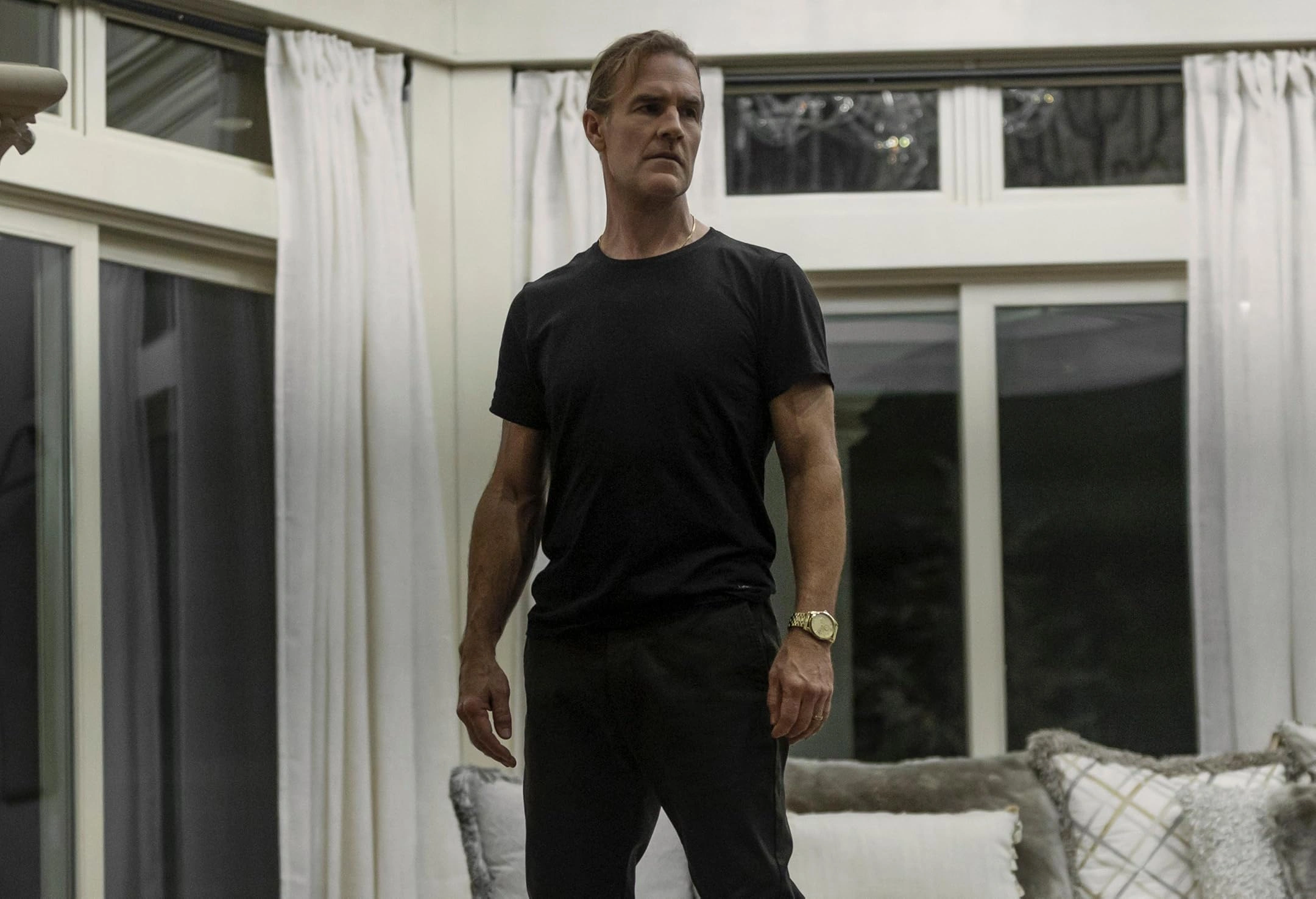
The film sketches his appearance in telling ways. He has a weathered look, a man bun, and a customized pickup truck, details that give him an off-kilter presence before his full menace comes into view. The scraggly hair functions as a small signal that something about this community leader is out of joint.
Jacob’s real power comes from social standing. Once the three friends witness the murder, he turns the neighborhood into an instrument. He frames them as dangerous intruders, shields his own image, and pulls his neighbors into the pursuit. The residents follow his lead with almost no hesitation, choosing shared identity and property over truth. That pattern gives the character weight beyond simple villainy. Jacob does not need to overpower the protagonists alone. He knows the community will do much of that work for him.
Van Der Beek plays him through quiet control. Soft whispers and shifts in his eyes carry much of the threat. The performance starts from restraint, then grows rawer as the night wears on and Jacob becomes more frantic. That progression helps the character avoid feeling static. He begins as someone who believes he can shape every perception around him. As events slip from that grip, panic enters the performance and gives it new energy.
The film is sharpest in its treatment of respectability as cover. Jacob thrives because Creekview Hills is already arranged to trust him and fear the people he accuses. His authority carries something close to sacred force inside that community. The story presents him as a man frightened by exposure and cushioned by status, which makes him persuasive as an antagonist. He feels dangerous because the system around him keeps validating his version of reality.
Technical Execution, Pacing, and Aesthetic
The film’s visual design rests heavily on cinematographer Ray Huang’s work. He applies noir lighting to Southwestern suburbia and turns otherwise plain spaces into something menacing. Deep shadows and strong contrast keep the mood tense even inside bright interiors. That choice serves the story well, since the film wants every home, lawn, and driveway in Creekview Hills to feel charged with risk. The polished order of the neighborhood never reads as safe.
The pacing is less steady. At 98 minutes, the film can feel weighed down by repeated hiding sequences. Its structure becomes episodic as Derek, Kevin, and Tyon move from one house and one resident to another. That gives the tension an uneven rhythm. Certain encounters land with real force, then the film drifts during longer passages of evasion. The one bad night template is still effective here, though the shape of the screenplay leaves noticeable lulls.
The serious tone holds throughout. Burr keeps the film focused on danger and dread, with no interest in comic release. That decision gives the material a somber urgency that suits its subject. The script treats racism and class directly and keeps metaphor in the background. At times that directness gives scenes a hard edge. At other points it leaves the writing feeling a bit too plain. Still, the film knows what it wants to say and says it without hedging.
Supporting turns from Sofia Hublitz and Brad Leland add some definition to the neighborhood, even if the dramatic weight stays with the central trio and Van Der Beek. The early “eight hours earlier” title card creates tension quickly, yet it also tells the audience that the story will spend time catching up to its opening image. That trade-off is part of the film’s method. It gains a strong hook and gives away a measure of momentum.
The resolution brings in law enforcement, which creates an uneasy fit with the film’s earlier treatment of institutional distrust. That choice stands out. It does not sink the film, though it does complicate the logic of what came before.
Burr’s direction stays functional through all of this, keeping attention on the immediate danger of the night. The result is a thriller with a clear thematic target, a solid antagonist, and a structure that works in bursts. When the film locks character conflict, social tension, and physical danger into the same scene, it is at its strongest. When it falls back on repetition, the momentum slips.
The Gates premiered in select theaters on March 13, 2026, marking a significant and somber release as the final film of actor James Van Der Beek, who passed away in February 2026. Directed by John Burr, the thriller explores themes of race, power, and systemic distrust through the lens of three friends trapped in an affluent gated community. Currently, as of April 2026, the film is primarily available in select theaters and is expected to move to digital rental and purchase platforms following its exclusive theatrical window.
Where to Watch The Gates (2026) online








Full Credits
Title: The Gates
Distributor: Lionsgate Premiere
Release date: March 13, 2026
Rating: R
Running time: 98 minutes
Director: John Burr
Writers: John Burr
Producers and Executive Producers: Nancy Leopardi, Ross Kohn, Gary Glushon, Michael Cassutt, John Harris, J. Todd Harris, Kamala Avila-Salmon, Arlie Day, Mike Page, Andy Dube, Courtney Henggeler, Eric Belgau, Damian Horan, David Gendron, Ali Jazayeri, Viviana Zarragoitia, Mason Gooding
Cast: Mason Gooding, Algee Smith, Keith Powers, James Van Der Beek, Sofia Hublitz, Kylr Coffman, Elle Evans, Brad Leland, Aliyah Celeste, Rob Gallavan, Natacha Ellie
Director of Photography (Cinematographer): Ray Huang
Editors: Daysha Broadway
Composer: Jongnic Bontemps
The Review
The Gates
The Gates attempts a sharp look at racial and class divides through a standard survival lens. The central performances and visual atmosphere are strong. However, the repetitive structure and predictable plot hinder the tension. It functions as a somber character study of a villainous leader but struggles to maintain momentum. The result is a film with clear intentions that occasionally lacks the propulsive energy needed to fully realize its ambitions.
PROS
- Chilling performance by James Van Der Beek.
- Grounded work by Mason Gooding.
- Effective noir lighting by Ray Huang.
- Direct handling of social biases.
CONS
- Repetitive pacing during the middle act.
- Predictable narrative progression.
- Inconsistent logic for character decisions.
- Abrupt final resolution.