






















Marco Petry’s Eat Pray Bark plays as a political farce, and a fairly pointed one. The film opens on the brittle nature of public image. Ursula, played by Alexandra Maria Lara, suffers a catastrophic hot mic disaster after voicing a virulent dislike of dogs. In this world, pets carry the aura of sacred icons, so the remark lands like civic blasphemy. Her answer is immediate and opportunistic: she adopts Brenda, a rowdy dog, and retreats to the Tyrolean mountains in hopes of saving her career.
The Reisinger Inn becomes a house of canine penance. Ursula arrives among a cluster of mismatched owners, all supervised by Nodon, a trainer who leans on Celtic wisdom while addressing behavioral drift. The inn runs as a tech-free sanctuary, which gives the film its central device. Human beings are stripped of their screens and left with themselves, a punishment that feels minor until it does not.
Their pets run through the Austrian Alps while their owners are pushed toward self-recognition. The idea is plain and faintly severe: the animals register human failure with unnerving accuracy. The film handles that idea with a light touch, keeping the drama mild and the tone airy. This German production prefers softness to abrasion. It offers gentle diversion for viewers drawn to canine behavior, and the open locations give the story a natural playground.
Pedigree Archetypes and the Shamanic Mirror
Ursula is written as a cynical careerist, a pantsuited Sisyphus hauling her reputation uphill. She treats Brenda as a political shield and reinvents herself with a wig and the name Urschie. The disguise has no persuasive power because Brenda refuses to perform obedience on command. The dog functions as a biological truth-teller, dragging Ursula toward her own hypocrisy and her irritation at life without technology.
Babs and Torsten stand for social fragility in two forms. Babs is an insecure extrovert, and her massive dog externalizes her inability to establish limits. Torsten operates as raw ego set loose. He uses the leash as an instrument, yanking Babs toward uncomfortable social exposure.
Ziggy and Helmut carry their domestic discord through Lady Gaga, a Yorkie who becomes the site of accumulated resentment. Helmut has reached the end of his patience with the biting. Ziggy treats the dog like royalty. Hakan fits the Stoic Repressed mold, and his German Shepherd, Roxy, wears a muzzle that reads as a blunt image of his own silenced life and buried pain.
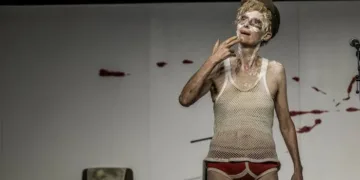
Nodon arrives as the film’s strangest construction, a kind of Hyper-Gallic-Thor with shamanic ambitions. Rurik Gislason plays him as a catalytic figure draped in leather pants and turquoise jewelry. He looks like curated primitivism made flesh. He dismisses standard training methods and replaces them with armchair psychology, which gives his scenes a faintly comic eco-masculinity.
He claims to be the reincarnation of a Celtic healing god, and the film lets that claim hover somewhere between mysticism and performance art. Ancient force never quite enters the room. Stagecraft does. This group of owners forms a bestiary of modern neuroses, each one built from a single dominant trait and sent through a corrective process. The film has trouble giving them depth, yet the actors do workable things inside a thin script. Gislason, in particular, is enjoyable in short flashes.
Digital Asceticism and the Mechanics of Canine Catharsis
The Reisinger Inn imposes digital asceticism with stern simplicity. Phones disappear. Screens vanish. A technological vacuum opens, and the characters are left sitting with themselves, which the film treats as a spiritual exercise and a social experiment. Inside that space, the Tent of Truth becomes a secular confessional. The owners sit cross-legged and disclose old wounds, speaking in the emotional vocabulary the script has provided for them.

The film’s governing idea is canine reflectivity. The animals remain stable while the humans generate disorder. That gives the pet-owner bond a specular quality. A quiet dog attached to a loud owner points toward buried repression. A wild dog attached to a timid owner points toward failed self-command. The script treats the animals as unfiltered mirrors, and that device is familiar. Cinema has returned to it many times. Here, it works as a clean shorthand for human behavior, even if it never reaches much complexity.
The third act introduces a mudslide, a crisis designed to force cooperation at exactly the required moment. Ursula, still trying to do business, hides her phone and slips back toward her old habits. The mudslide flattens status for a brief stretch, which gives the group a temporary equality forged by inconvenience. Bill Kaulitz appears later in a surreal cameo that punctures the mountain retreat with celebrity absurdity.
His arrival signals the return of the image-world Ursula came from. The plot remains paper-thin throughout. The film is content to use animals as vessels for human repair, sending the characters toward their demons so they can patch up the future. Self-discovery is the official currency here, and the exchange rate is not flattering. The film accepts its own obviousness. Emotional depth stays limited. Sympathy does too, since these characters never gain enough density to invite deep investment.
Alpine Indifference and the Aesthetics of the Abs
The Alps dominate the film with geological indifference, shrinking the human commotion beneath them. The cinematography leans on wide, open framing, producing a neat spatial irony: towering peaks surrounding petty crises. Naturalistic lighting gives the farce a tactile world to stand in. The Tyrolean landscape does much of the labor. Watching the dogs race through open land carries easy pleasure, and the scenery often distracts from the thinness of the plot.

Nici Zinell’s costume design for Nodon pushes him toward Ethno-Kitsch. Leather, tunics, and adornment produce an aura of manufactured authenticity. Ursula’s wig serves a similar purpose in miniature, a flimsy disguise attached to a damaged public self. Nodon, for his part, looks excellent against postcard scenery. When he poses at the base of an Alp, the film seems half aware of its own joke. Human majesty and landscape majesty compete for the same frame.
The soundtrack has a Quasi-Enya spiritual haze before swerving toward George Michael and Kiss. The effect is tonal whiplash, yet the oddness has some charm. The original German audio plays far better than the English dub, which sounds uncanny and rhythmically wrong, as if human speech were being imitated by something that has studied conversation without living it. The film’s lack of profanity and violence makes it suitable for families. It moves with the ease of an undemanding comedy and keeps a simple, kind-hearted temperament.
Featherweight Farce and the Architecture of the Happy Ending
Eat Pray Bark is a featherweight farce with little appetite for grit. It stays mild, earnest, and easy to take. The 90-minute running time helps and hurts. It keeps the material from swelling past its capacity, yet it leaves little room for texture. What remains is pleasant enough.
The characters stay close to archetype, and the resolution follows a familiar finding-yourself pattern. That predictability gives the film comfort-watch energy. Its view of humanity is kind, if schematic, and the happy ending arrives exactly where one expects it.
Bill Kaulitz’s late appearance gives the final stretch a bizarre little aftertaste. Ursula’s original political gaffe still does the sharpest satirical work in the film. Her remark about dogs is treated with the gravity of treason, which says plenty about public opinion and the strange moral scale of image culture.
The film meanders with a relaxed, almost sleepy rhythm from scene to scene. Its human-animal connection plotline rarely lands with force, and the subplots feel lifeless at times. Still, the film has a mild entertainment value, with passing moments of conflict and small bonding breakthroughs that may satisfy undemanding viewers. The repair of the human-canine relationships comes quickly and simply. The experience is shallow, yet the setting carries real appeal. The location gives difficult people and their animal anxieties a striking place to unfold.
Eat Pray Bark (Original title: Eat Pray Bark – Therapie auf vier Pfoten) premiered on Netflix on April 1, 2026. This German comedy follows a diverse group of pet owners who retreat to the Tyrolean mountains for an intensive dog-training course led by a charismatic guru. As the sessions progress, the participants realize that their dogs’ unruly behaviors are merely reflections of their own unresolved personal issues and neurotic tendencies. The film is currently available for streaming worldwide on Netflix.
Where to Watch Eat Pray Bark (2026) Online


Full Credits
Title: Eat Pray Bark
Distributor: Netflix
Release date: April 1, 2026
Rating: PG-13
Running time: 1 hour 31 minutes
Director: Marco Petry
Writers: Jane Ainscough, Marco Petry, Hortense Ullrich
Producers and Executive Producers: Viola Jäger, Marina Schiller, Nina Rothemund
Cast: Alexandra Maria Lara, Rúrik Gíslason, Devid Striesow, Doğa Gürer, Anna Herrmann, Kerim Waller, Martin Leutgeb, Brigitte Kren, Yvonne Yung Hee Bormann, Bill Kaulitz
Director of Photography (Cinematographer): Marc Achenbach
Editors: Knut Hake
Composer: Annette Focks
The Review
Eat Pray Bark
Eat Pray Bark serves as a lightweight exploration of the political animal trope. It relies on Alpine vistas and Rurik Gislason's physique to mask a paper-thin script. The central premise of human dysfunction mirroring canine behavior offers mild amusement. The lack of emotional depth prevents the film from being truly memorable. It remains a harmless, family-friendly distraction. It satisfies those seeking scenic escapism.
PROS
- Stunning cinematography of the Tyrolean Alps
- Earnest, family-friendly tone
- Rurik Gislason’s charismatic presence
- Naturalistic use of real locations
CONS
- Predictable and one-dimensional character arcs
- Wretched English dubbing
- Lack of genuine emotional resonance
- Thin satirical commentary on public image