



























Boris guides tourists through the spray of Iguazu Falls, and the roar of the water shapes the rhythm of his days in Misiones. That routine fractures with the arrival of Julián. Boris’s father disappeared twenty eight years earlier. He was a pilot who kept a second family hidden, and he comes back carrying a terminal diagnosis. Boris meets him with raw anger and regards him like an apparition that has stepped into the wrong life.
The film leans hard on the falls as an image of emotional violence, turning the landscape into a visible form of the son’s abandonment. The story opens in a movement from distance to physical conflict, which gives the family drama an abrasive pitch from the start. The Argentine setting carries its own dramatic weight. It speaks to a regional history marked by fractured homes, while the dying parent story reaches for recognition beyond Misiones through a familiar melodramatic frame.
Generational Friction and Stylistic Contrast
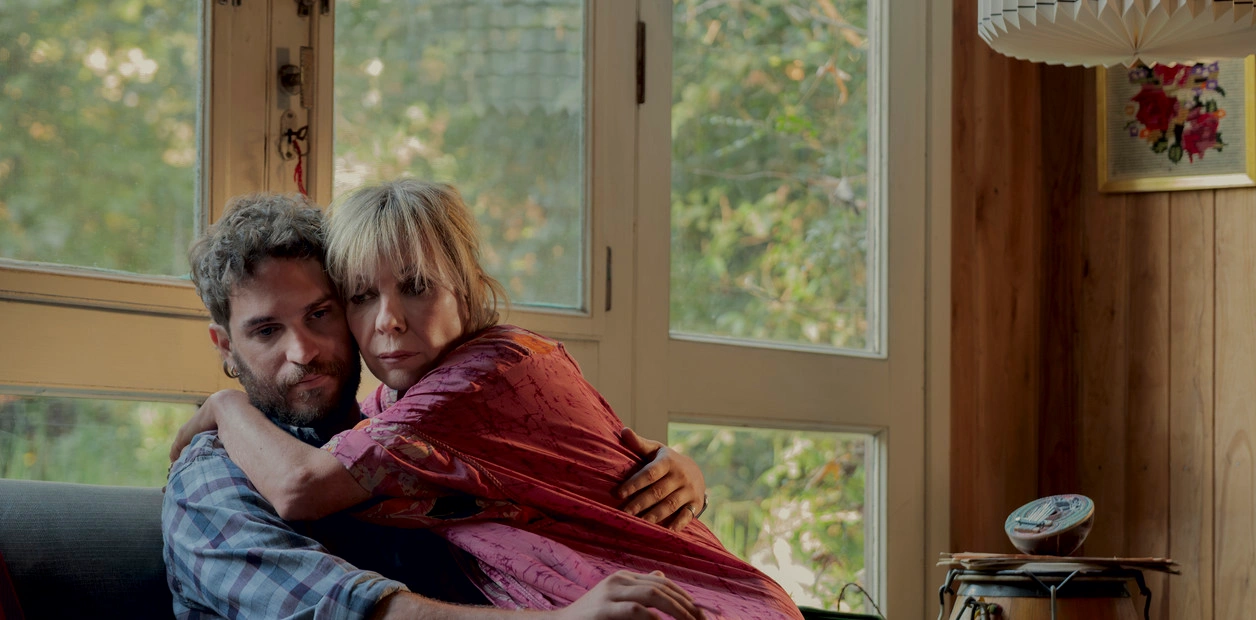
Matías Mayer plays Boris as a man who never stops speaking. He names each feeling, explains each reaction, and gives the sense of someone reciting his own psychology. Oscar Martínez meets that approach with a quieter register as Julián. He builds the character through pauses, glances, and small bodily shifts, shaping the image of a man bent under guilt. Inés Estévez gives Leticia a lighter touch that can sharpen in an instant. She brings warmth into a reunion built out of gray moods, and her frank way of speaking plants the film on steadier ground.
The tension between Mayer and Martínez suggests two performance traditions sharing the same frame. One style lives on the surface and pushes outward. The other works through restraint and accumulation. That divide echoes a generational split inside South American screen acting. The older mode trusts the force of a look. The younger one seems shaped by the speed and directness associated with streaming-era storytelling. The dinner scene gives these actors room to play a real conversation.
Two adults sit across from each other and try to cross years of damage. Leticia holds that space together. She carries the knowledge of someone who lived through the collapse of an earlier life, and her humor functions as a survival habit. Her mention of her dog Friday places a small pulse of daily life inside all the pressure. Moments like that keep the air from turning stale. The performances sustain the film through passages where the script circles in place.
The Telenovela Influence and Scripted Emotion
The screenplay favors explanation. Characters announce their pain again and again, and that choice strips away the privacy of feeling. Julián’s hidden family and his illness become devices that rush Boris and Julián into contact. The narrative then moves through repeated arguments, followed by softer exchanges, and the pattern starts to feel cyclical. Brief anecdotes about hospitals and police visits enter the film, yet they pull attention away from the central wound.

A telenovela sensibility runs through these scenes. The drama arrives in repeated beats, each one aimed at a clear emotional response. That structure gives the viewer little interpretive space. The film spells out the cause of each tear and treats terminal illness as a familiar engine within global melodrama.
Here the device plays like a shortcut, a way to force intimacy without earning it through patient development. Silence would have served this material better, since the script is strongest whenever speech recedes and the actors are left to carry the history in their faces. The side material adds bulk without adding force.
Infidelity, death, memory, and the future all pass through the film, and the accumulation weakens the father and son relationship that should anchor everything. A moralizing tone begins to take hold. Forgiveness and guilt are framed with the flat certainty of self help language. From there, the film drifts toward soap opera. The closeness expected from a chamber drama slips away, and the movie starts lecturing the audience.
Spectacle Over Narrative in the Final Act
The camera treats Iguazu National Park as a major expressive resource. The falls are undeniably beautiful, and their use fits a pattern seen in Argentinian films seeking international visibility. The landscape gives the story scale, placing private pain against a monumental natural image.
At times, though, the film begins to resemble a travel program, because the frame gives the water more attention than the people standing beside it. The cinematography works at a basic level, though it never develops a distinctive visual sensibility. During the last thirty minutes, the rhythm accelerates so sharply that the story’s internal logic starts to break.
Boris’s change in attitude toward his father arrives with startling speed. The writing cannot support that turn. He suddenly speaks about spirits and weighty ideas, and those lines do not match the man the film has spent an hour building. He sounds as though he has stepped out of another script.
The visual approach remains functional in a way that recalls the cutscenes of a narrative adventure game. Space guides the eye toward the next destination, and here that destination is the next emotional cue. The waterfalls also act as a physical limit around the characters, narrowing their range and pressing them into confrontation.
The third act exposes the film’s deepest weakness. Boris moves from hatred to peace without enough dramatic groundwork, so the character’s logic collapses. His abrupt turn toward philosophy feels imposed from outside the story, a gesture toward depth that the preceding scenes have not secured. Late jokes attempt to lighten the heavy atmosphere, though the tonal shift lands awkwardly. The sense left behind is of a director uncertain about the precise shape of the material. That uncertainty keeps the film from becoming the intimate father and son study it seems to seek.
The Giant Falls premiered on Netflix on April 1, 2026, as an original Argentinian production. This drama directed by Marcos Carnevale is available for streaming exclusively on Netflix. The story centers on Boris, a tour guide at the Iguazu Falls, whose stable life is disrupted when his father reappears after nearly three decades. The film explores themes of forgiveness and family secrets against the backdrop of one of the world’s most famous natural landmarks.
Where to Watch The Giant Falls (2026) Online


Full Credits
Title: The Giant Falls
Distributor: Netflix
Release date: April 1, 2026
Rating: TV-MA
Running time: 100 minutes
Director: Marcos Carnevale
Writers: Marcos Carnevale
Producers and Executive Producers: Marcos Carnevale, Rocío Gort, Martin Kweller, Ignacio Rey
Cast: Matías Mayer, Oscar Martínez, Inés Estévez, Johanna Francella, Luis Luque, Silvia Kutika, Alexia Moyano
Director of Photography (Cinematographer): Horacio Maira
Editors: Alberto Ponce
Composer: Iván Wyszogrod
The Review
The Giant Falls
The film offers a sturdy exploration of Argentinian family dynamics set against a striking natural backdrop. It benefits from the anchored performances of its veteran cast. However, the narrative choices lean heavily on melodrama and sudden character shifts. These elements weaken the emotional impact of the father and son reunion. The script prioritizes explanation over subtlety. While it captures the friction of abandonment, it misses the opportunity for a deep study of reconciliation. It remains a functional piece of regional cinema that relies on familiar genre tropes.
PROS
- Strong lead performances from Oscar Martínez and Inés Estévez.
- Cinematography captures the scale of the Iguazu Falls.
- Moments of grounded adult conversation between the leads.
CONS
- Reliance on melodramatic plot devices.
- Explanatory dialogue that leaves little for the audience to interpret.
- Sudden character shifts in the final act.