



























If It’s Tuesday, It’s Murder arrives as a polished take on the current return of the ensemble whodunnit. This Spanish series places the familiar mechanics of a closed-circle mystery in Lisbon, a city presented through bright daylight, worn facades, and pockets of unease. The plot follows a group of tourists on a week-long trip that sours almost as soon as it begins.
They arrive on Monday and settle into a decaying hotel marked by a troubled history. By Tuesday morning, the holiday has turned into an investigation after Fernando Paredes is found dead. Local police move quickly and classify the death as a heart attack, yet four people in the group read the scene differently. Their love of detective fiction pushes them to investigate on their own. Spread across seven episodes, the series maps each installment to a day of the trip.
That design gives the story a steady pressure, since these amateur investigators have to uncover the truth before the return to Madrid. The show mixes familiar mystery devices with dark comic notes. That tone recalls recent international successes and the quieter mystery mode associated here with parallel cinema, where character observation carries as much weight as the crime itself. A cast of established Spanish actors gives the suspect pool energy and shape.
The Temporal Mechanics of Mystery
The series builds its mystery through a firm day-by-day structure, with each episode covering a single day. The movement begins with the group’s arrival on Monday and reaches its first major shock on Tuesday morning. Fabio and Alicia find Fernando Paredes dead in a hotel bathtub.
From that moment, the series lays out several details that make the amateur sleuths doubt the official account. They see a missing hair dryer and unusual marks on Fernando’s arm. Those clues immediately place them at odds with the investigating officer, who accepts a straightforward explanation based on natural causes. The friction between official certainty and amateur suspicion gives the narrative its drive.
Each new day brings information that alters the direction of suspicion inside the group. The week-long format works like a ticking clock, since the characters know their bus leaves at the end of the trip. That time limit keeps the mystery moving without forcing artificial detours. The series also uses occasional fourth-wall breaks, letting characters speak directly to the camera about their reasoning or their private knowledge.
This choice opens the investigation to the viewer and gives the puzzle a participatory quality. The writing stays close to classical mystery principles, keeping the clues in view and guiding the audience through the case with clarity. That clean construction gives the show a rhythm that feels rooted in genre tradition, yet the presentation carries a lighter, contemporary touch.
The Amateur Sleuths and Their Hidden Motives
The investigation is carried by the “Famous Five,” a loose alliance made up of four tourists and a young observer. Fabio Torres enters the story already marked by suspicion, since his first scene shows him changing out of a blood-stained shirt. Alicia becomes the group’s sharpest mind, driven by careful observation and a refusal to accept the police report at face value.
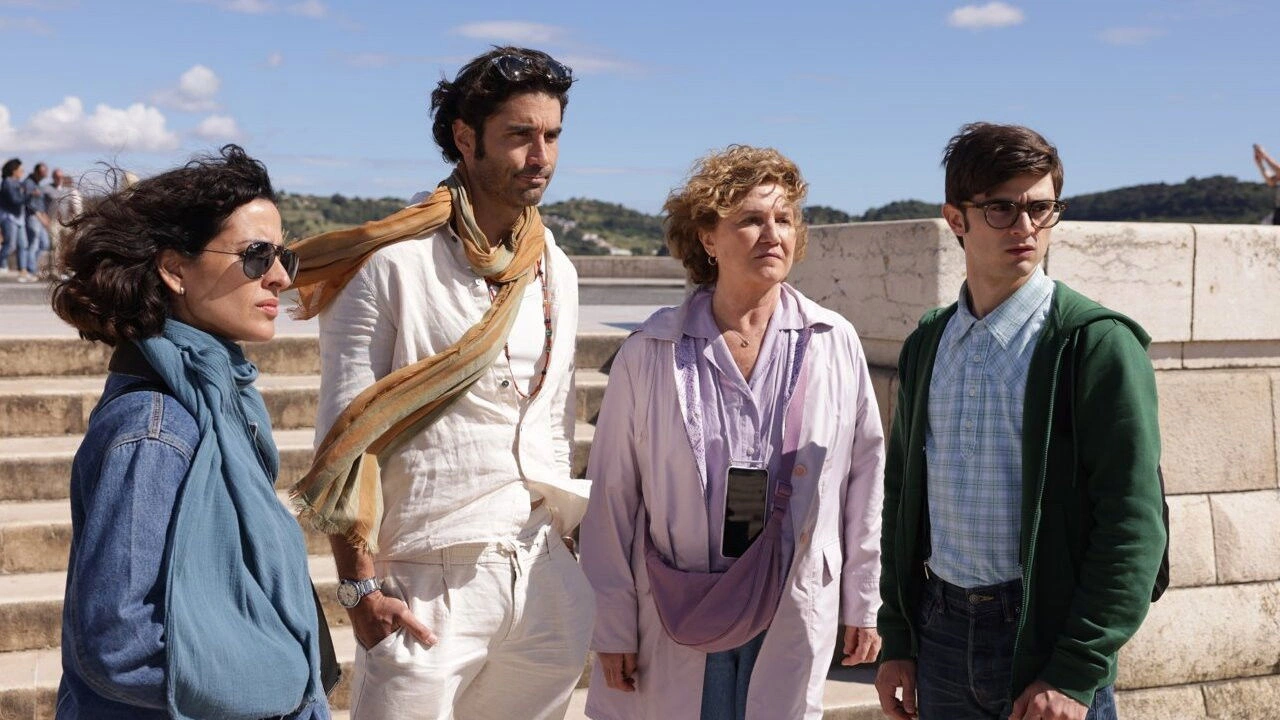
Pura contributes through her camera, recording the trip from her own angle while carrying private reasons for coming to Lisbon. Daniel, a neurodivergent young man, notices precise details that escape the others, giving the group a different way of seeing the case.
These people begin as strangers, and the series keeps their partnership unstable by making secrecy part of the group dynamic. Every alliance feels provisional because each person is holding something back. The tour party around them supplies a full field of suspects. One family moves through constant arguments, and two friends devote their attention to Lisbon’s nightlife.
Everyone on the trip has an undisclosed reason for being in Portugal, and that shared concealment fills the hotel with suspicion. The structure of the ensemble carries echoes of classic Bollywood whodunnits through its layered personalities and its sense that every interaction may hide another motive. Inma Cuesta and Álex García anchor this uncertainty with performances that give emotional weight to the buried histories inside the group. Their work helps the hidden truths register as genuine pressure points in the drama rather than simple mystery devices.
Architectural Shadows and Dark Comedy
Lisbon shapes the series at every level, serving as a vivid setting for the investigation. Much of the action unfolds inside a rundown hotel that once operated as a brothel, and that past gives the building an abrasive, uneasy texture. Early in the series, the Museum of Crime appears as an important location.
Its display of the preserved head of the historical killer Diogo Alves immediately sets the tone for the show’s dark humor. Creator Carlos Vila, joined by directors Salvador Calvo and Abigail Schaaff, holds the series to a clear visual identity. Narrow streets and fading grandeur frame the action, and the city’s worn beauty mirrors the concealed histories carried by the tourists.
The supporting figures inside the hotel add to the comic edge. Members of the staff are drawn with eccentric touches that lift the mood without breaking the mystery. Cristina, the tour guide, manages the group through a mix of professional exhaustion and personal turmoil. The series leans toward character-based comedy instead of sustained tension, finding much of its appeal in how these travelers interact inside a temporary living space charged with distrust.
Across all seven episodes, the acting remains steady enough to keep the puzzle engaging as new information comes to light. The production’s strongest quality lies in how it holds together Portugal’s scenic surfaces, the grim history of the hotel, and the private secrets each traveler has brought along.
This television series reached audiences on March 31, 2026. Viewers can watch the episodes on the Hulu streaming platform in the United States or through Disney+ in international markets. The story focuses on a group of Spanish tourists in Lisbon who must identify a killer within their party after a traveler dies during the first night of their trip.
Where to Watch If it’s Tuesday, it’s Murder Online


Full Credits
Title: If It’s Tuesday, It’s Murder
Distributor: Disney Platform Distribution, Hulu, Disney+
Release date: March 31, 2026
Rating: TV-MA
Running time: 41-50 minutes
Director: Salvador Calvo, Abigail Schaaff
Writers: Carlos Vila
Producers and Executive Producers: Luis Ferrón, Sofía Fágregas, Gonzalo Salazar-Simpson, Javier Pascual, Pablo Barinaga, Margarida Adonis
Cast: Álex García, Inma Cuesta, Ana Wagener, Biel Montoro, Pedro Casablanc, Luisa Gavasa, Carmen Ruiz, Belén López
Director of Photography (Cinematographer): Ángel Amorós, André Szankowski
Editors: Jaime Colis, Óscar Nieto Colino
Composer: Federico Jusid
The Review
If it's Tuesday, it's Murder
If it’s Tuesday, it’s Murder delivers a rhythmic mystery that honors the foundations of the genre. The choice to set the drama in a decaying Lisbon hotel adds a sense of European grit that contrasts with the ensemble's comedic friction. It reflects the character-focused puzzles of Indian parallel cinema where social dynamics are vital to the crime. The performances and the daily structure keep the momentum high. It serves as an entertaining entry for fans of classic investigations.
PROS
- Innovative seven-day episodic structure.
- Strong performances from the Spanish ensemble cast.
- Atmospheric use of Lisbon’s historic architecture.
- Nuanced portrayal of neurodivergent observation.
CONS
- Heavy reliance on traditional genre tropes.
- Occasional fourth-wall breaks feel unnecessary.
- Limited exploration of dark thematic elements.