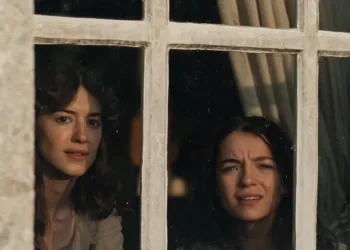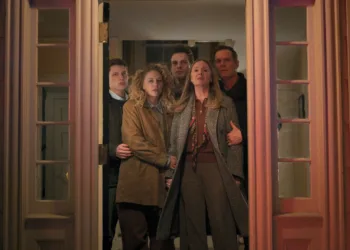

















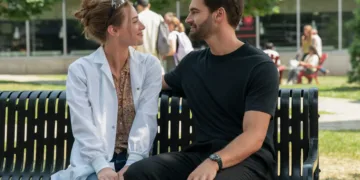












Mint follows Shannon, a twenty two year old living inside the stalled routines of her father’s criminal empire. In the brown scrubland of a Scottish town, the story opens at a deserted train station, where Shannon has a life altering encounter with Arran.
The premise carries the outline of a crime thriller, yet Charlotte Regan directs it into something stranger and far more intimate, shaping the series as a surreal study of domestic life and forbidden romance. Shannon moves through a world ruled by her fearsome father Dylan, her mother Cat, and her grandmother Ollie.
Their family remains tied to a violent syndicate that Dylan abruptly decides to leave. That choice sets off a chain of events that forces each of them to face a history stained by violence. The series places its attention on the emotional interior of its characters, leaving the usual heist mechanics and police work in the background. What emerges is a portrait of a family that profits from misery and still reaches for flashes of unguarded joy.
Deconstructing the Tragic Cycle of the Clan
The series draws on a classic tragic framework to shape a contemporary criminal drama, tracing the collision between two rival clans and the damage that follows. Shannon and Arran meet at the railway station and form an immediate connection that carries the force of fate.
That feeling soon runs into the demands of loyalty once Shannon discovers Arran belongs to a rival family. The characters move through a world governed by inherited obligation, caught inside a cycle that predates them and keeps tightening around them.
Regan removes familiar genre fixtures from the frame. Undercover agents do not drive this story, and meticulously plotted robberies do not supply its momentum. Dylan’s sudden retirement from the syndicate unsettles the family’s fragile sense of safety, and the series turns that disruption inward.
Criminal action gives way to psychological pressure. The romantic haze surrounding Shannon and Arran gives way to a story about power and historical trauma. Dylan’s brutality surfaces in the “party games” he imposes on his associates, a detail that makes his quietness feel ominous instead of reassuring.
That method pushes against the industry’s appetite for spectacle and bloodshed, turning its gaze toward the ruin these lives leave behind. The narrative pulls apart the “hard man” archetype that has long occupied British media, exposing the fear, emptiness, and inherited damage beneath the pose. With the heist machinery stripped out, the viewer sits in the boredom and dread of criminal life.
That choice points to a wider shift in television storytelling, especially on streaming platforms that give slower, character focused work room to breathe inside familiar genres. The tension lives in silence, pauses, and rooms thick with unease. Scene after scene asks how much of a person comes from inheritance and how much can still be shaped through choice.
Trauma and the Evolution of the Female Gaze
The central cast grounds the series’ surrealism and brings the women’s shifting power within the family into sharp focus. Emma Laird plays Shannon with bolshie swagger and a kind of naive purity. Her life has no hobbies, no career, and very little space that belongs to her. She waits to fall in love, treating that hope as her main occupation in a world that offers few other avenues.
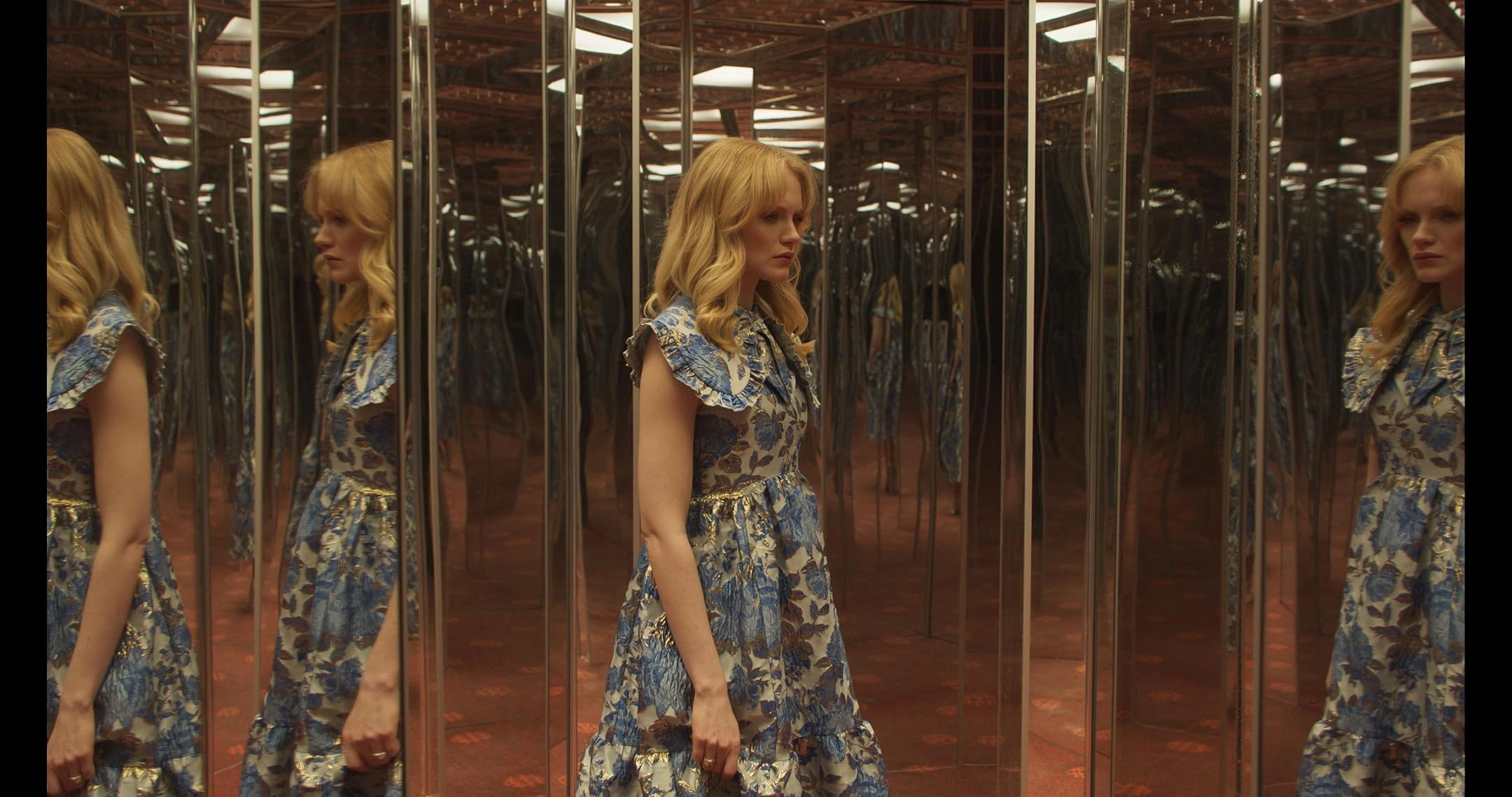
Laura Fraser plays Cat as a woman confined within an arranged criminal marriage, surviving by turning that life into a romanticized story she can bear to inhabit. Lindsay Duncan gives Ollie a severe wit and a skeptical edge, then lets fear show through the cracks. Her performance carries the dread that Shannon may be walking straight into the same disaster that shaped earlier generations. Together, these women map out different forms of survival inside a patriarchal culture built on violence.
The men receive equally careful treatment. Sam Riley’s Dylan appears as a figure worn down by warped masculine ideals, carrying the weight of his crimes in the set of his body and the fatigue in his face. Benjamin Coyle-Larner plays Arran with remarkable restraint, communicating almost everything through silence and expression. His eyes do the work that many scripts hand to speeches.
The casting points toward a richer screen image of working class men, one that allows fragility, stillness, and uncertainty to exist beside threat. Laird and Coyle-Larner create the emotional grounding the series needs, giving its stranger flourishes something solid to rest on. Their quiet scenes feel fully earned.
The exchanges among the three generations of women frame trauma as an inheritance passed down like family property. The show takes issue with an industry habit that leaves gangsters’ wives and daughters at the edges of the frame. Here, their inner lives carry the dramatic weight. That shift matters. It changes the moral perspective of the story and widens the genre’s sense of who gets to occupy the foreground.
The Visual Dissonance of Magical Realism
Charlotte Regan’s direction moves between gritty realism and high concept fantasy with striking confidence. The series reaches for magical realism through images of characters floating in mid air and sparks erupting during moments of intimacy. Those sparks from industrial machinery turn attraction into something visible and physical, giving shape to feelings that the characters struggle to name. Visual ruptures, including Dylan brandishing a broadsword, break the expected grammar of a grounded crime drama.
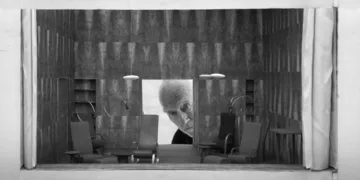
The cinematography works through a collage of textures and formats. Grainy VHS and Super 8 images sit beside sculptural compositions and Kubrick style zooms. The rough brown scrubland clashes with the beauty of the dreamlike passages, and that clash produces its own tension. Regan uses this impressionistic mode to pull the viewer into the characters’ torment, giving the mundane world a charged, cinematic intensity.
That aesthetic places a seductive surface over the ugliness of gangland life. By filtering violence through stylization, Regan also pushes the audience to think about the way crime is consumed as entertainment. The choice breaks from the realism often attached to Scottish and British working class stories. This visual language argues that desolate places still contain imagination and beauty.
It also speaks to a growing television tendency in which directors with music video instincts bring lyricism and formal play into serial storytelling. The frame feels carefully built for mood and sensation. Information matters, yet feeling carries equal weight. Texture, from film grain to the flicker of light, gives the series a tactile charge.
Working Class Joy and the Sonic Pulse of Resistance
The series refuses the familiar script of working class misery. Charlotte Regan sets out to find joy and happiness in a setting that television often treats as purely bleak. That energy runs through the series even as tragedy gathers around the characters, pushing back against the cultural habit of linking poverty with an absence of beauty.
Patrick Jonsson’s score is central to that effect. The soundtrack uses tracks such as Moses Sumney’s “Doomed” to deepen the atmosphere of gathering disaster. A crackle of electricity returns as a recurring sound motif, tying the characters’ feelings to the spaces they inhabit. Sound carries as much expressive force as the writing, building an atmosphere that feels old and current at the same time.
The finale circles back to the story’s Shakespearean foundations through a tense resolution. It studies people trying to step away from the histories that shaped them. The show suggests that joy itself can serve as resistance inside a cycle of violence that keeps trying to reproduce itself. Mint points toward a television future in which genre labels carry less weight than emotional honesty and visual daring.
It also reflects a movement toward personal, auteur driven work on streaming platforms that are willing to take formal risks. By looking at the domestic life of a crime family, the series pushes viewers to think about systems of power and the human lives caught inside them. The ending withholds easy reassurance and stays with the messiness of real social experience. That perspective gives British television a sharp jolt, proving that old stories can be reimagined through a profound change in point of view.
Mint premiered as a highly anticipated eight-part series on BBC One and BBC iPlayer yesterday, April 20, 2026. Created by the acclaimed filmmaker Charlotte Regan, the drama offers a stylized, darkly comic look at a Scottish crime family. The narrative follows Shannon, the daughter of a powerful gang leader, as she navigates a forbidden romance with a member of a rival clan. All episodes were made available for streaming on iPlayer simultaneously with the television broadcast, and the series is distributed internationally by BBC Studios.
Full Credits
Title: Mint
Distributor: BBC One, BBC iPlayer, BBC Studios
Release date: April 20, 2026
Rating: TV-MA
Running time: 60 minutes
Director: Charlotte Regan
Writers: Charlotte Regan
Producers and Executive Producers: Angus Lamont, Theo Barrowclough, Jolyon Symonds, Tessa Ross, Juliette Howell, Rebecca Ferguson, Charlotte Regan
Cast: Emma Laird, Benjamin Coyle-Larner, Sam Riley, Laura Fraser, Lindsay Duncan, Lewis Gribben, Neil Leiper, Connor Newall, Lucy Howard
Director of Photography (Cinematographer): Christopher Sabogal
Editors: Mdhamiri Á Nkemi
Composer: Patrick Jonsson
The Review
Mint
Mint succeeds by prioritizing emotional honesty over genre expectations. Charlotte Regan transforms a familiar crime premise into a lyrical exploration of family and choice. The visual style provides a necessary counterpoint to the underlying violence, presenting a vision of working class life that refuses to be defined by misery. While the pacing feels slow at points, the depth of characterization and striking cinematography make it a significant entry in modern British television. It challenges our consumption of crime as entertainment.
PROS
- Stunning visual language using VHS and Super 8 textures.
- Powerful performances from Emma Laird and Sam Riley.
- Subversion of typical gangster drama tropes.
- Integration of magical realism into a gritty setting.
CONS
- Slower pacing might alienate fans of high action thrillers.
- High level of surrealism occasionally masks the plot.
- Certain narrative elements feel slight compared to the visual ambition.