


















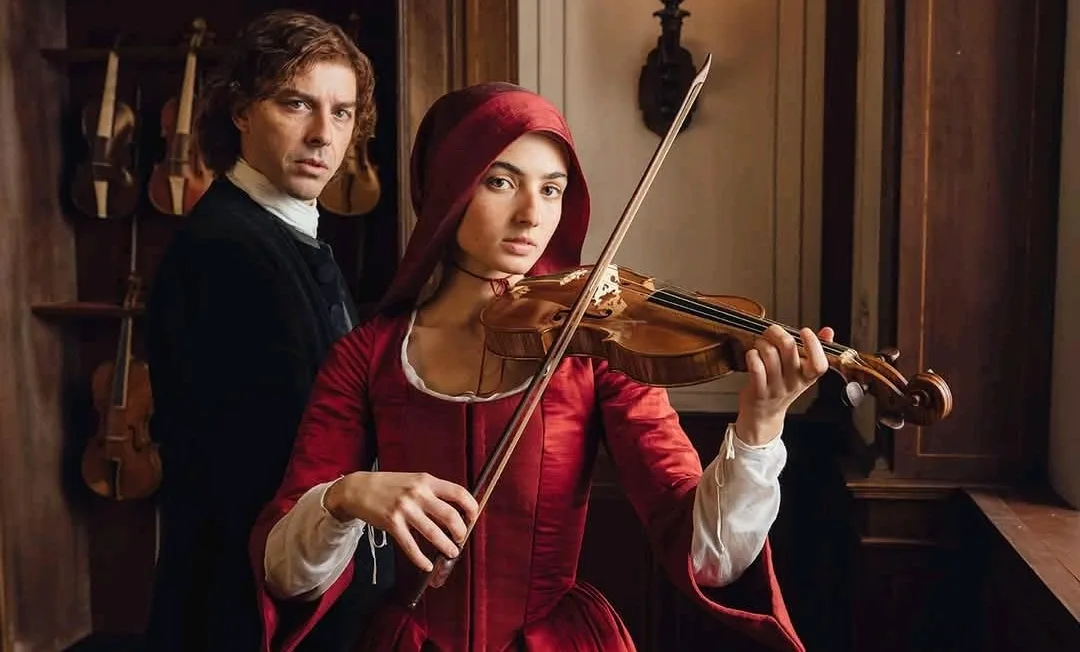

Venice in the early eighteenth century emerges as a city built from sinking stone and hushed water, a place where every corridor seems to remember sorrow. Inside the Ospedale della Pietà, music carries the value of survival. Joy feels distant. Cecilia passes through this cloistered world like an apparition, shaping her life through letters addressed to a mother whose absence has the force of a wound.
Order rules every surface of this place, and the prioress defines its moral climate with chilling clarity when she drowns kittens in the canal. That casual cruelty fixes the film in a realm stripped of softness. Sentiment has no shelter here. Then Antonio Vivaldi arrives, a priest marked by bodily weakness and a career that has settled into fatigue. He enters this enclosed purgatory to guide a choir made up of the forgotten.
Cecilia’s artistic awakening begins to stir under his gaze, though dread never loosens its grip. A soldier waits beyond the walls. The war’s end opens the path to her confinement within domestic life. Marriage hangs over her violin like a sentence already written. She lives in a brittle interval, suspended between the voice of her instrument and the hard social will that treats her as a temporary vessel for sound.
Shadows Behind the Gilded Screen
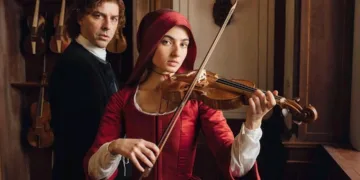
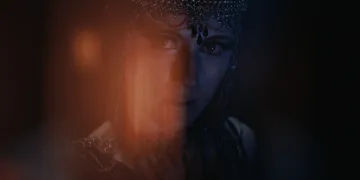
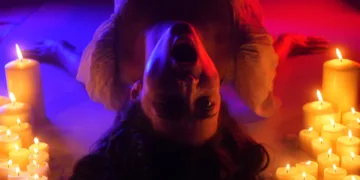
Damiano Michieletto shapes this world through the dense, starved light of a Baroque painting. Darkness gathers at the frame’s edges, and candlelight leaves small amber traces on the faces of the orphans. Their masks and plain gowns give them the air of sacred phantoms, images held in place between devotion and erasure. That anonymity reaches its sharpest form during performance.
A metal grille stands between the musicians and the nobles who come to absorb their talent. The sound travels freely. The laboring bodies remain hidden. Through that division, the girls become commodities concealed in plain sight. Fabio Massimo Capogrosso’s score carries the same inward strain. His original music meets Vivaldi’s compositions and gives shape to the cries and murmurs these women must bury in daily life.
Changes in the auditory field steer the film with quiet force. Rhythmic bursts of celebration in the streets announce the end of the war, yet they toll through Cecilia’s life like funeral music. Those sounds break into the orphanage and drag reality behind them. The design of sound creates a nearly physical claustrophobia, binding state victory to private ruin. One begins to wonder if beauty itself serves as a veil drawn across the bars of the cage.
The Architecture of Mastery and Submission
The relationship between Cecilia and Vivaldi moves along a different line from the familiar shape of mentorship. Vivaldi is glasslike, frail in his lungs, uncertain in social position, and unable to occupy the role of rescuer. He gives Cecilia a reflective surface in which she can finally see her own gift. He recognizes her brilliance because public adoration holds no charm for her.
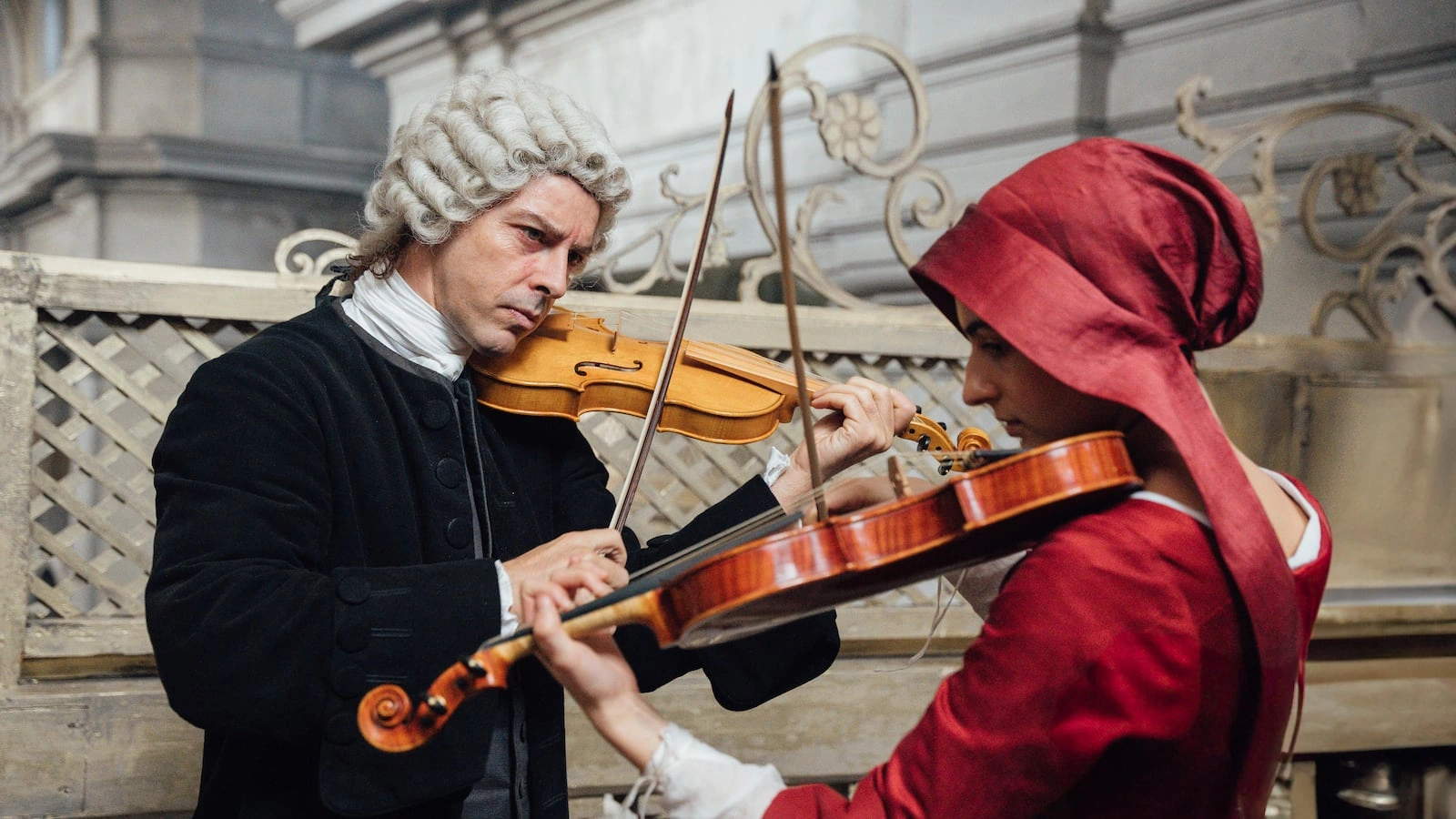
Their bond deepens in the quiet intervals between notes. A violin duel with her rival Laura becomes a fierce display of hierarchy inside the Pietà. In that scene, the girls seem to fall like red dominoes, years of discipline pressed into a single instant of desperate proof. Tecla Insolia bears this dread through a performance built on remarkable stillness. Her eyes carry an old hunger, the kind that resists speech because language would make it smaller.
Facing this fragile flowering of art stands the fiancé, a soldier who embodies the fixed structure of male authority. He comes from a battlefield where commands carry absolute force. He sees Cecilia as territory. His presence makes clear that talent cannot shield a woman from a man who reads silence as respect. The pain of this dynamic lies in Vivaldi’s impotence. He awakens something in Cecilia, though he lacks the strength to rise against the tide that threatens to close over her.
The Transgression of the Instrument
The film lays bare a society whose pleasures rest on the quiet agony of the dispossessed. The Ospedale della Pietà functions as a marketplace of bodies, preparing orphaned girls for marriage with the chill efficiency reserved for livestock. Inside that machinery, art takes on the force of spiritual arson. The violins and bows handed down by their captors become instruments through which the girls announce that they exist.
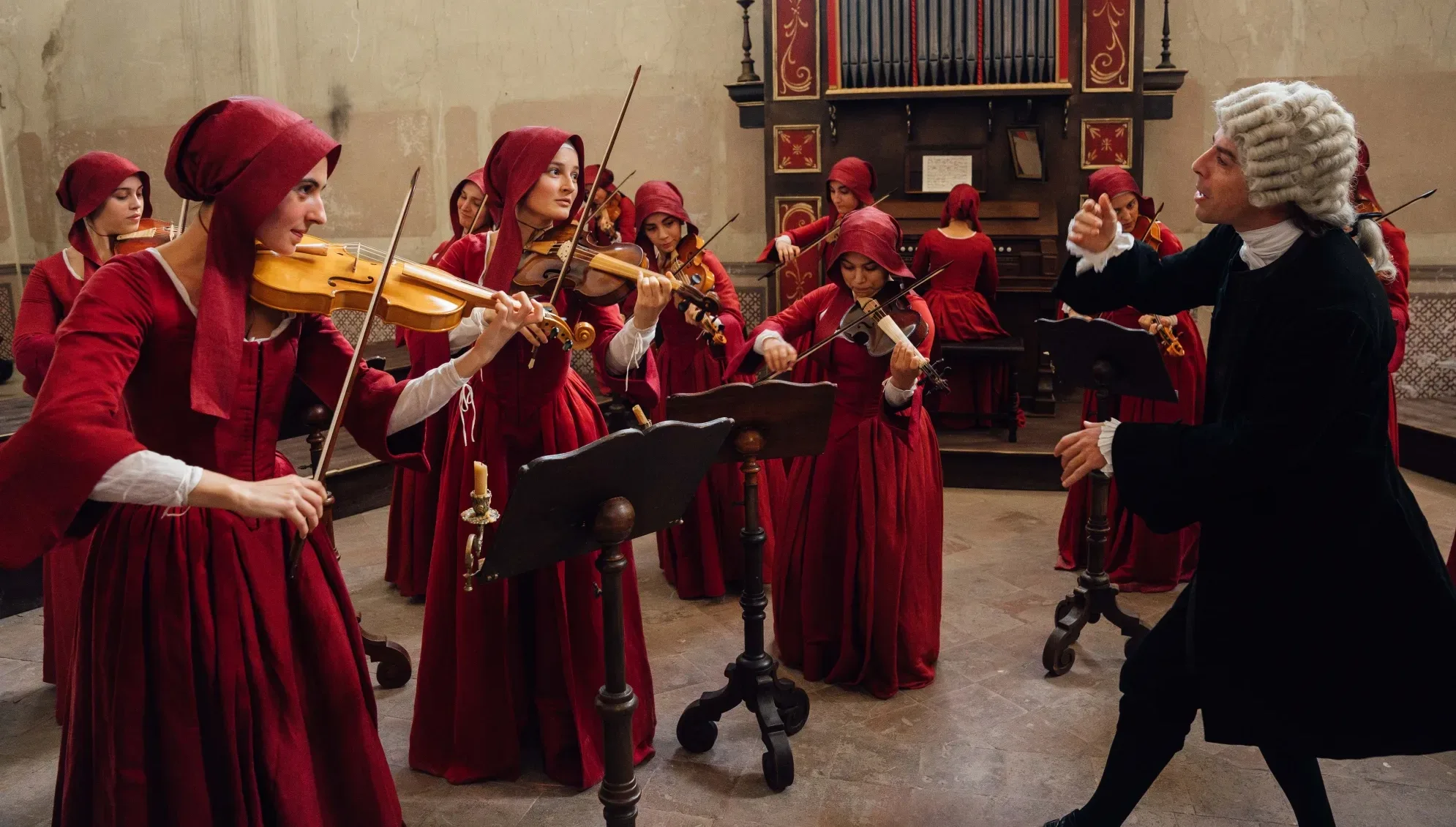
Music gives them a language for rebellion. Once Cecilia sees that her future leads straight into silence, she makes a radical choice. She wounds her own reputation and puts her body at risk in order to destroy the marriage meant to extinguish her voice. Her act turns social self-destruction into the only form of ownership available to her.
The film ties this struggle for agency to abandonment, which lingers everywhere like a second climate. When Cecilia comforts a woman reunited with her lost daughter, the moment exposes the hollow ache in her own history. She witnesses a miracle meant for someone else, and the distance between witness and participant feels abyssal. Freedom here demands a violent shedding of the past.
Cecilia casts aside the emblems of oppression and the ghosts attached to her lineage. She moves toward a future that offers no promises, though it grants her release from the status of commodity. The final images leave the world cold and indifferent to her suffering, yet something essential has come into tune. She has reached the frequency of her own soul, and the film leaves that discovery trembling in the air, unresolved and painfully alive.
Primavera is a 2025 historical drama that follows the life of Cecilia, a gifted violinist living in an 18th-century Venetian orphanage. Her world transforms when the ambitious composer Antonio Vivaldi arrives to teach the young women of the Ospedale della Pietà. The film had its world premiere at the Toronto International Film Festival on September 6, 2025, and began its theatrical run in Italy on Christmas Day of that same year. As of today, April 21, 2026, the film is preparing for its United Kingdom premiere on April 24, 2026, where it will be distributed by Curzon. Viewers can watch the film in cinemas during its scheduled release windows or access it through specialized digital platforms such as Curzon Home Cinema following its theatrical debut.
Full Credits
Title: Primavera
Distributor: Warner Bros. Entertainment Italia, Diaphana Distribution, Curzon, Paradise City Sales
Release date: September 6, 2025, December 25, 2025, April 24, 2026
Rating: 15
Running time: 111 minutes
Director: Damiano Michieletto
Writers: Ludovica Rampoldi, Damiano Michieletto, Tiziano Scarpa
Producers and Executive Producers: Nicola Giuliano, Francesca Cima, Carlotta Calori, Viola Prestieri, Marc Missonnier
Cast: Tecla Insolia, Michele Riondino, Andrea Pennacchi, Fabrizia Sacchi, Valentina Bellè, Stefano Accorsi, Hildegard De Stefano, Cosima Centurioni, Federica Girardello, Rebecca Antonaci, Chiara Sacco
Director of Photography (Cinematographer): Daria D’Antonio
Editors: Walter Fasano
Composer: Fabio Massimo Capogrosso
The Review
Primavera
Primavera functions as a chilling examination of art as both a cage and a key. It avoids the easy warmth of a traditional biopic. It chooses to focus on the cold reality of eighteenth-century Venice. The music feels like a scream behind a mask. It is a haunting work that demands we acknowledge the price of the beauty we consume.
PROS
- Stark Baroque lighting creates a visual experience akin to a living painting.
- Tecla Insolia delivers a performance of profound internal power and silence.
- The score successfully bridges historical accuracy with modern emotional weight.
- The script avoids common tropes by depicting the unflinching harshness of the era.
CONS
- The slow, deliberate pacing may alienate those seeking traditional narrative momentum.
- Brutal opening imagery regarding the kittens creates a high barrier for sensitive viewers.
- Vivaldi remains a secondary figure, which might disappoint viewers expecting a composer-centric story.
- Some plot points regarding the war and marriage feel slightly underdeveloped.