
























![Kingdom Hearts Collection [I-III] Review](https://gazettely.com/wp-content/uploads/2026/10/Kingdom-Hearts-Collection-I-III-1-360x180.webp "Kingdom Hearts Collection [I-III] Review: KHII Holds Steady as Newer Entries Fluctuate 37")





Season 2 pushes One Piece out of introduction and into motion. The Straw Hat crew reaches the Grand Line, and the series answers that arrival with a world that feels larger, stranger, and far more volatile. Islands appear like separate planets with their own weather, customs, and dangers. The story keeps the buoyant energy that made the first season work, yet it carries a harder edge now, one shaped by ambition, loss, and the weight of unfinished dreams.
What makes the season so persuasive is the way it holds wonder and peril in the same frame. Pirates, Marines, outlaws, and royal intrigue all jostle for attention, while the show keeps returning to the same simple human pulse beneath the spectacle: these people are chasing a life they chose, and the world keeps testing that choice. The result feels confident, vivid, and fully at home in its own heightened register.
A Map Drawn in Episodes
The season has the shape of a voyage rather than a line of plot points. Loguetown, Reverse Mountain, Whiskey Peak, Little Garden, and Drum Island each arrive with their own texture, their own mood, and their own little ecosystem of danger. That structure gives the season room to breathe. One stop may lean into political tension, another into comic chaos, another into mythic scale, and another into grief dressed as adventure. The show keeps moving, but it never feels mechanically rushed.
Baroque Works gives the season a spine. Around that organization, each island becomes a variation on the same larger theme: the Grand Line is a place where ordinary categories break down. Loyalty becomes a question. Power becomes a performance. Even information feels unstable, passed through rumor, intimidation, and legend. The writing understands that a pirate story works best when the destination matters less than the pressure each place exerts on the travelers.
The season also benefits from the confidence to let tone shift without snapping apart. A scene can begin in bright comic mischief and end in real sorrow. A location can look playful at first glance and then reveal an undercurrent of menace. That elasticity gives the season its momentum. It is adventurous television that knows how to let a single island carry both spectacle and consequence.
A Crew Becoming a Crew
The Straw Hats feel more settled here, and that matters. Season 1 built the group through introductions and declarations. Season 2 lets them exist as a unit, one that jokes, trusts, and irritates in familiar rhythms. The result is a sharper sense of family. They are still individuals with separate drives, but now those drives sit inside a shared emotional grammar.
Luffy remains the center of gravity. His optimism is still extreme, almost reckless, yet the season frames it as a kind of moral stubbornness. He does not merely hope for impossible things. He behaves as though hope is the correct response to a world built to mock it. That gives the character a strange authority. He is absurd, yes, but the series keeps proving that absurdity can be a method of faith.
Zoro’s arc carries a harder texture. His effort to recover from defeat and press forward gives the season a sense of discipline. He is a fighter defined by restraint as much as force, and the show makes that visible in the way he carries himself. Nami, by contrast, remains the crew’s quiet anchor. She reads situations with practical intelligence and emotional clarity. Her presence steadies scenes that might otherwise drift into pure fantasy.
Usopp’s material is especially strong. The season treats heroism as something he has to define rather than inherit. That choice suits him. His bravery feels earned because it grows out of fear rather than the absence of it. Sanji, meanwhile, helps sustain the group’s chemistry. He contributes a mix of swagger, irritation, and warmth that keeps the crew’s banter lively.
The new additions widen the emotional field. Vivi gives the season a direct line into political stakes and communal responsibility. Chopper, though, is the standout. He is both a visual challenge and an emotional one, and the show meets that challenge with rare assurance. He fits the tone, yet he also alters it, bringing vulnerability and sweetness into a world already full of loud personalities. The casting across the board feels committed, and that commitment makes the heightened world feel inhabited rather than assembled.
Painted Seas, Living Surfaces
The season’s production design deserves real attention because it does something many fantasy series struggle to do: it makes excess feel organized. Practical sets, makeup, hair, costuming, and digital effects all work in tandem instead of competing for attention. That unity gives the show its unusual texture. It looks embellished, but never careless.
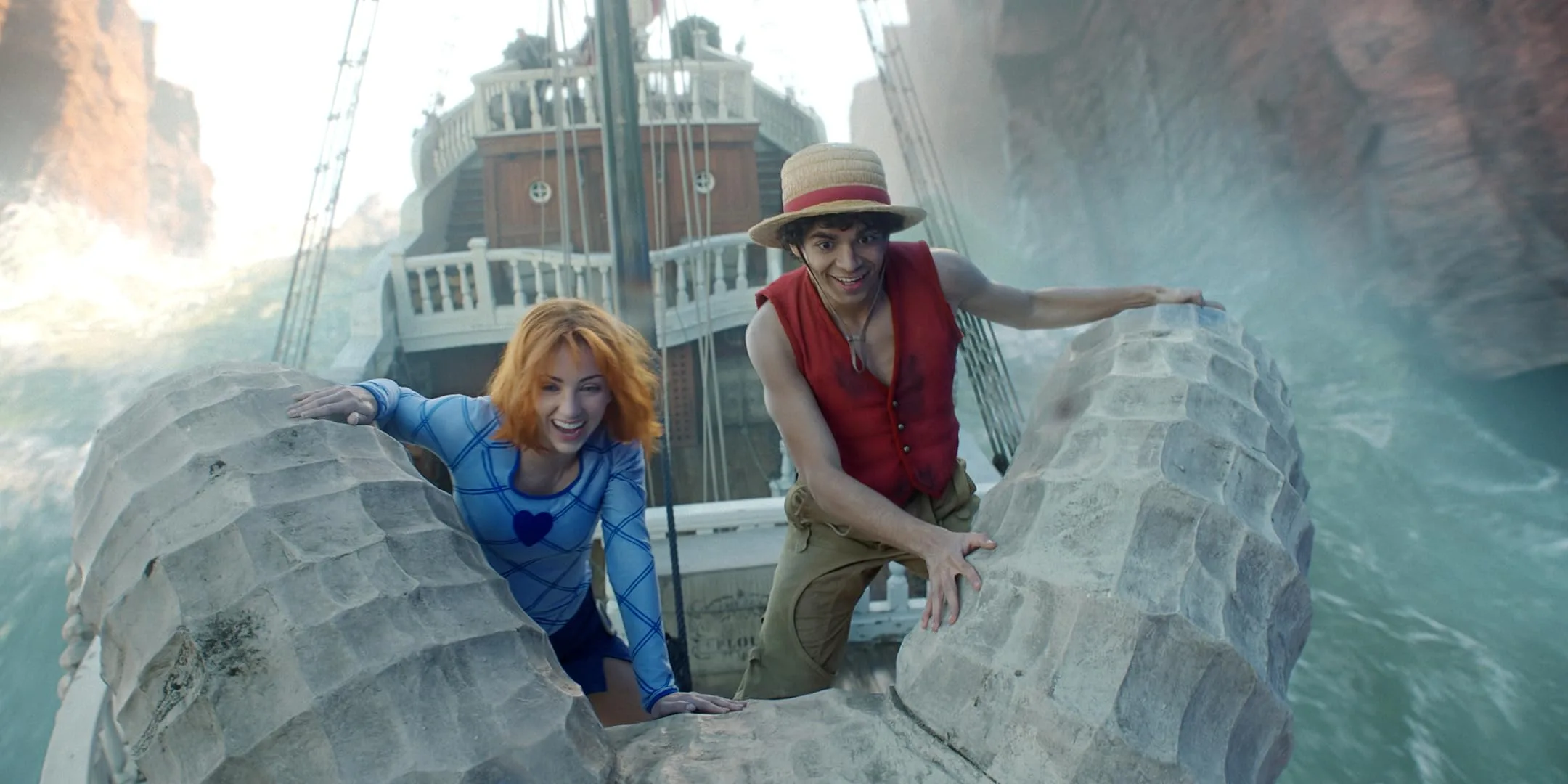
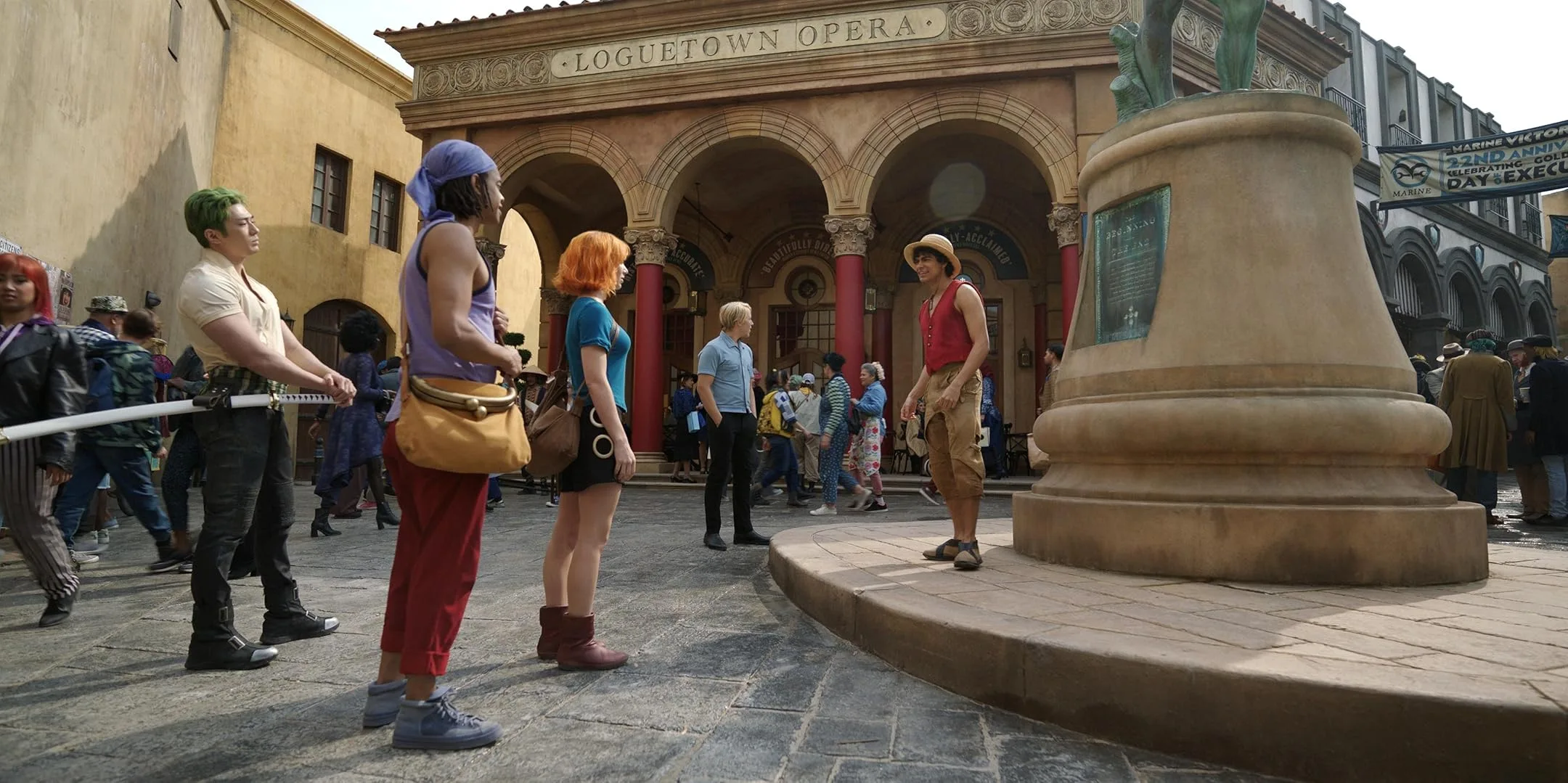
Each major location has a distinct visual language. Loguetown feels dense with history and public memory. The winter spaces around Drum Island carry a colder emotional temperature. Other islands lean into scale, oddity, and myth, as if the geography itself were designed to test the limits of live action. The visual world is bright, sometimes almost aggressively so, yet that brightness serves the material. One Piece has always thrived on exaggeration, and the show understands that flattening the palette would dull the entire project.
The same applies to creatures and powers. Translating those ideas into live action is a constant risk, and the season does not hide that risk. Some effects are cleaner than others. Some digital touches remain a little rough at the edges. Yet the larger accomplishment is clear. The show keeps finding ways to make improbable figures and transformations feel part of one coherent world. Chopper is the clearest proof of that, a character who could easily have become a technical novelty and instead arrives as a genuine emotional presence.
What makes the design work so well is that it never treats strangeness as decoration alone. Every costume, every exaggerated silhouette, every strange skyline feels tied to a culture, a power structure, or a local myth. The world looks invented, and it also looks inhabited. That balance is rare.
Swords, Tears, and Cartoon Gravity
The action lands best when it is rooted in character. Sword fights carry physical clarity. Large group clashes have momentum. Zoro, in particular, benefits from choreography that lets his style read cleanly and decisively. The show knows how to stage movement so that even when the scale grows wild, the viewer can still follow the logic of a blow, a dodge, a stand, a break.
Luffy’s action remains a trickier proposition, since the character’s elasticity is central to his identity and difficult to render with complete force in live action. The season handles that problem with a mix of restraint and invention. At times the show seems to pull back from his powers, then finds moments where their oddness clicks. The result is uneven in small patches, yet still honest to the challenge.
The emotional material gives the season its deepest charge. It understands that one of the franchise’s great strengths is its ability to make large, comic, almost ridiculous gestures carry real feeling. Family, loss, memory, and duty are everywhere here. Bonds between parents and children matter. Bonds between comrades matter. Bonds that have already been broken still shape the present. The story keeps returning to loneliness and to the way people build purpose from whatever remains after separation.
That emotional range is what allows the silliness to hit with force. A talking reindeer can be funny in one moment and wrenching in the next. A pirate captain can look like a living joke and still stand in for the stubbornness that keeps a dream alive. The season trusts those tonal shifts. It lets scenes of tenderness unfold without apology, then turns around and throws the crew into absurd danger with no loss of conviction.
The adaptation choices help too. Reordering and expanding material gives the television version a cleaner sense of causality and lets character beats arrive with better shape. It also gives the season a broader historical feel, as if the story were laying down a map of future significance while keeping the present tense vivid. That choice can irritate purists, but on screen it gives the world a thicker pulse.
Bigger Horizons, Sharper Edges
Season 2 leaves the crew in a stronger position, with larger conflicts waiting beyond the frame and deeper alliances already taking shape. It opens doors rather than closing them. New rivalries are seeded. New loyalties are tested. The Grand Line no longer feels like a promise alone. It feels like a system of pressure that will keep shaping these characters in harsher ways.
The season does carry a few limitations. At times the plot crowding can blunt a character beat. A few stretches move with less grace than others. Some members of the ensemble get less room than they deserve. Yet these are pressure points, not fatal flaws. The show still knows how to keep its focus where it belongs: on longing, on camaraderie, on the strange dignity of chasing an impossible horizon.
What stands out most is the confidence. This is a difficult property made legible without losing its wildness. The season respects the chaos of the material and gives that chaos form, color, and feeling. It turns spectacle into atmosphere and atmosphere into story.
The second season of the live-action “One Piece” series, titled “Into the Grand Line,” premiered on Netflix on March 10, 2026. Following the success of its debut, the new season continues the high-seas adventure of Monkey D. Luffy and his Straw Hat crew as they navigate the treacherous waters of the Grand Line and face the criminal organization Baroque Works. The season is available for streaming exclusively on Netflix, covering fan-favorite story arcs including Loguetown, Drum Island, and the introduction of the iconic doctor Tony Tony Chopper.
Where to Watch One Piece Season 2 Online


Full Credits
Title: One Piece Season 2
Distributor: Netflix
Release date: March 10, 2026
Rating: TV-14
Running time: 45–60 minutes per episode
Director: Marc Jobst, Diego Gutierrez, Tim Southam
Writers: Matt Owens, Ian Stokes, Steven Maeda, Eiichiro Oda
Producers and Executive Producers: Matt Owens, Steven Maeda, Marty Adelstein, Becky Clements, Chris Symes, Marc Jobst, Diego Gutierrez, Tim Southam, Tetsu Fujimura, Eiichiro Oda, Joe Tracz
Cast: Iñaki Godoy, Emily Rudd, Mackenyu, Jacob Romero, Taz Skylar, Charithra Chandran, Mikaela Hoover, Callum Kerr, Julia Rehwald, Lera Abova, David Dastmalchian, Joe Manganiello, Katey Sagal
Director of Photography (Cinematographer): Nicole Hirsch Whitaker, Michael Wood, Trevor Michael Brown
Editors: Kevin D. Ross, Tessa Verfuss, Eric Litman, Tirsa Hackshaw, Adam Pearson, David C. Cook
Composer: Sonya Belousova, Giona Ostinelli
The Review
One Piece Season 2
One Piece Season 2 deepens the show’s emotional pull, widens its world with real swagger, and turns its cast into a true ensemble. The production design, action, and creature work give the season a vivid pulse, while its sincerity keeps the fantasy grounded. A few stretches feel crowded and Luffy’s powers still do uneven work in live action, yet the season remains a rich, heartfelt adventure.
PROS
- Strong ensemble chemistry and character growth
- Lush worldbuilding with memorable locations
- Chopper and other visual effects impress
- Balances humor, heart, and adventure well
CONS
- Some pacing drag in the middle
- Luffy’s powers can feel limited in live action
- A crowded story leaves a few characters with less room







