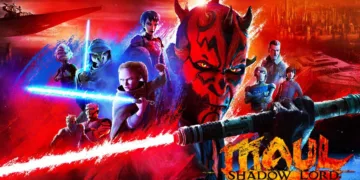























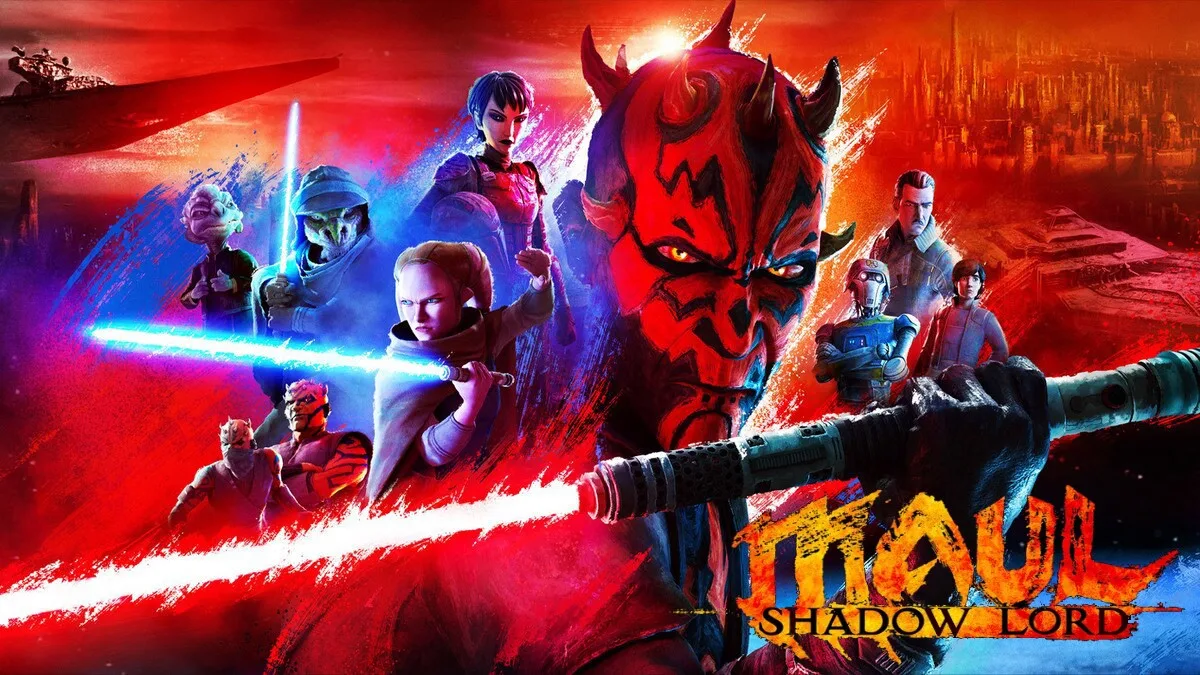

Star Wars: Maul – Shadow Lord arrives with a premise that sounds almost too neat for its own good: take one of the saga’s most visually striking villains, drop him into the unstable first years of Imperial rule, and let him claw his way back through the underworld. The surprise is how often the series earns that setup. Set roughly a year after The Clone Wars finale, the show plants Maul on Janix, a neon-scarred city planet where crime syndicates, local law enforcement, displaced survivors, and looming Imperial control grind against each other like bad gears.
This is Star Wars filtered through a crime drama lens, with bank jobs, turf wars, prison breaks, and police pressure driving the plot. The tone is harsher than much of the franchise’s animated output, less interested in swashbuckling charm than dread, hunger, and decay. Janix helps sell that shift. It feels crowded, bruised, and morally airless. Even the skyline looks like it needs a shower.
At the center is Maul, rebuilding his syndicate and circling a young Jedi survivor named Devon Izara as a possible apprentice. The series’ strongest hook comes from its refusal to launder him. He remains a creature of pain, vanity, and obsession. The show knows a clean redemption arc would be a catastrophic own goal.
The Monster Still Bites
Centering Maul is a gamble, and Shadow Lord is smart enough to treat that gamble with caution. The series works best when it remembers that Maul is dangerous in a very particular way. He is patient, manipulative, vain, and driven by grievance so old it has started to calcify. He moves through Janix like a bad memory with a lightsaber. That presence matters. Star Wars villains often run on scale and iconography. Maul runs on injury and spite, which is far more fun to watch.
The show gets another thing right. It never asks the audience to mistake opposition to the Empire for moral clarity. Maul may be pointed at targets viewers dislike, yet his motives remain selfish. He wants power, revenge, control, and proof that he still matters. That keeps the series from falling into the antihero trap that has flattened many franchise villains into moody merch.
Still, Shadow Lord spends much of its first stretch holding him at arm’s length. The method has clear value. Mystery gives Maul weight. He enters scenes like a ritual, all threat and silhouette and carefully rationed menace. Yet there are moments when the restraint feels slightly overmanaged, as if the series is worried that too much access might puncture the legend. By the back half, it starts to loosen its grip and the material improves. Trauma, abandonment, humiliation, and the psychic wreckage left by Sidious begin to surface. Suddenly Maul stops feeling like a premium action figure with anger issues and starts resembling an actual character again.
That tension gives the season its main dramatic question. Is distance the source of Maul’s power, or is this the one time Star Wars should have gone deeper and let him bleed on the page a little? The answer seems to be both. The mystique still plays. The deeper passages play better.
Sam Witwer does much of the heavy lifting here, and he does it with relish. His vocal performance is shaped around whispers, growls, stretched syllables, and a cadence that turns threat into ceremony. Maul sounds like he is savoring every scar in the room. Even in scenes where the writing keeps his motives partially veiled, Witwer gives him theatrical force. He does not merely speak the lines. He stalks through them.
Built Like a Heist, Paced Like a March
One of the series’ clearest formal choices is its preference for a single sustained story across the season. This is less a string of adventures than a long pressure cooker. That gives Shadow Lord momentum and helps it feel closer to a serialized crime saga than a mission-of-the-week animated entry. It also creates a few pacing headaches. Ten short episodes land in an awkward pocket. The season is too compressed for full sprawl, yet too extended for pure propulsion. You can feel the gears shifting.
Janix does much of the structural work. The planet gives the show a lived-in frame for cops-and-crooks storytelling that Star Wars has flirted with before but rarely committed to this directly. The bank robbery, the police investigations, the criminal rivalries, the prison break mechanics, and the shadow of Imperial arrival all feed a narrative built on pressure from every side. It is a good setting for Maul because it turns his rise into something tactile. He is not merely plotting in a throne room. He is manipulating a civic ecosystem already close to collapse.
The stronger stretches arrive when the show lets its three main vectors intersect: Maul’s schemes, Lawson’s pursuit, and Devon’s vulnerability. Those turning points have bite. The weaker passages tend to repeat beats of pursuit, surveillance, or temptation without adding enough new shape. The series occasionally gives the impression that it is circling its target rather than striking it. A stand-alone flashback chapter or one sharper detour into Maul’s crew might have helped. This is a story that could use one or two strategic breaths.
For viewers steeped in The Clone Wars, the emotional texture lands harder. The history is baked in. Newcomers can still follow the underworld plot, since the show has a sturdy chase-thriller spine, but some of the character weight arrives preloaded. Shadow Lord does not demand homework, though it certainly rewards it. In modern franchise television, that is practically a kindness.
The People in Maul’s Wake
For all the title’s promise, the season’s emotional hinge is Devon Izara. She gives the series a pulse beyond power struggles and cool poses. As a young Jedi survivor trying to exist after the collapse of the order that defined her future, Devon embodies the series’ bleakest idea: what happens to a person trained for purpose when history deletes the institution that gave that purpose shape? It is a strong angle, and the show treats it with patience.
Maul’s interest in Devon works because it is built on manipulation rather than sudden conversion. He senses fear, anger, dislocation, and the ache of stolen direction. He presses on those wounds carefully. Her slide is framed as erosion, not a switch being flipped. That makes the dynamic more unsettling and far richer than a simple good-versus-evil tug-of-war. Gideon Adlon gives Devon enough edge and instability to keep her from feeling like a stock innocent.
Dennis Haysbert’s Eeko-Dio-Daki serves as the series’ moral ballast. His pacifist instincts and steady decency create a useful contrast with Devon’s frustration. Through him, the show asks one of its sharper questions: in a hostile galaxy, is survival an act of wisdom or a form of surrender? He is less flashy than the surrounding players, which is precisely why he matters.
Brander Lawson, though, may be the season’s smartest addition. Wagner Moura plays him with a worn, grounded authority that gives the series an anchor outside Maul’s orbit. Lawson is a detective trying to preserve local order and keep Imperial influence from swallowing Janix whole. He also has a separated wife tied to the Empire, a son at home, and a life that feels shaped by compromise rather than destiny. That detail matters. It gives Shadow Lord a procedural thread and a domestic texture rare for Star Wars, especially in animation. Lawson often feels like a co-lead. Some viewers may want fewer detours away from Maul, yet the show is stronger for giving itself a human-scale counterweight.
The secondary cast helps keep Janix alive. Richard Ayoade’s Two Boots brings dry comic timing without puncturing the mood. Chris Diamantopoulos makes Looti Vario a pleasingly slippery operator, the kind of man who looks like he would sell you out for a sandwich and then complain about the bread. Rook Kast adds texture to Maul’s operation, even if the series leaves some of that potential on the table. The Inquisitors and Imperial agents add dread with efficient brutality. They do not need many flourishes. Sometimes a system is scarier than a personality.
Neon Ruin, Moral Rot
If Shadow Lord has one element that feels immediately locked in, it is the animation. This is some of the strongest visual work Star Wars animation has produced. The upgraded 3D character models move with greater weight and fluidity, and the painterly textures in the backgrounds give Janix a bruised nocturnal character that suits the story. Neon bleeds into grime. Light catches on metal and rain and smoke. The city often looks half hand-painted, half digitally haunted.

The direction of the action is strong because it understands that set pieces need dramatic charge. The opening chase announces that with confidence. Robberies, pursuits, and lightsaber confrontations are staged with speed and clarity, and the editing usually knows when to tighten the rhythm or hold on a beat long enough for dread to settle. The sound design helps too. Engines, blaster fire, and lightsabers hit with satisfying force, yet the quieter moments matter just as much. Silence and echo become part of the mood. Janix rarely sounds safe.
The series also benefits from animation’s freedom in scale and motion. It can move faster, frame larger, and make action feel physically expressive in ways that recent live-action Star Wars projects have sometimes struggled to match. There is no sense of a production nervously protecting the furniture.
Its tonal register is harsher than the franchise norm, with violence, criminal politics, and spiritual damage given unusual weight. That darkness is rooted in character and setting, not surface grit. These people are living through political collapse, lost purpose, and moral corrosion. Revenge passes for direction. Manipulation starts to resemble intimacy. Pain masquerades as destiny. The Empire makes smaller monsters appear useful, though never safe.
That is where Shadow Lord is most compelling. When visual craft, emotional damage, and moral pressure lock together, the series feels sharp and alive. When it grows too careful with Maul himself, it turns him back into iconography. Star Wars has spent years mistaking familiarity for power. This show comes close to remembering the difference. The real test is still ahead: can it stop admiring Maul’s shadow long enough to tell us what is left inside it?
Star Wars: Maul – Shadow Lord is an animated television series that premiered on Disney+ on April 6, 2026. Set roughly a year after the conclusion of the Clone Wars, the series explores the journey of the former Sith Lord, Maul, as he navigates the early reign of the Galactic Empire. The story follows his efforts to rebuild his criminal syndicate while crossing paths with a disillusioned Jedi Padawan named Devon Izara. New episodes are released weekly on Mondays, leading up to a two-part finale on May 4, 2026, in celebration of Star Wars Day.
Where to Watch Star Wars: Maul – Shadow Lord Online

Full Credits
Title: Star Wars: Maul – Shadow Lord
Distributor: Disney+
Release date: April 6, 2026
Rating: TV-MA
Running time: 22–30 minutes per episode
Supervising Director: Brad Rau
Writers: Matt Michnovetz (Head Writer), Dave Filoni
Producers and Executive Producers: Dave Filoni, Matt Michnovetz, Brad Rau, Athena Yvette Portillo, Carrie Beck, Josh Rimes
Cast: Sam Witwer, Gideon Adlon, Wagner Moura, Richard Ayoade, Dennis Haysbert, Chris Diamantopoulos, Vanessa Marshall, David W. Collins, Stephen Stanton, A.J. LoCascio
Editors: Andrew Barrer
Composer: Kevin Kiner, Sean Kiner, Deana Kiner
The Review
Star Wars: Maul - Shadow Lord
Star Wars: Maul - Shadow Lord turns a risky character study into a tense, visually arresting crime saga. Its finest stretches pair stunning animation, sharp atmosphere, and a genuinely sinister Maul, even if the season sometimes withholds too much from its title figure and drifts through parts of the middle. Still, it brings menace, weight, and a welcome adult edge to Star Wars animation.
PROS
- Striking animation and city design
- Sam Witwer’s commanding voice work
- Devon and Lawson add depth
- Strong crime-thriller atmosphere
- Action scenes carry real tension
CONS
- Maul stays too opaque early
- Midseason pacing can drag
- Some story beats repeat
- Crew dynamics need richer detail







