




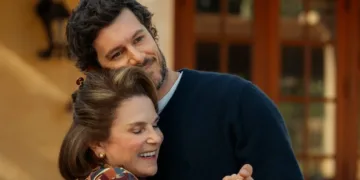







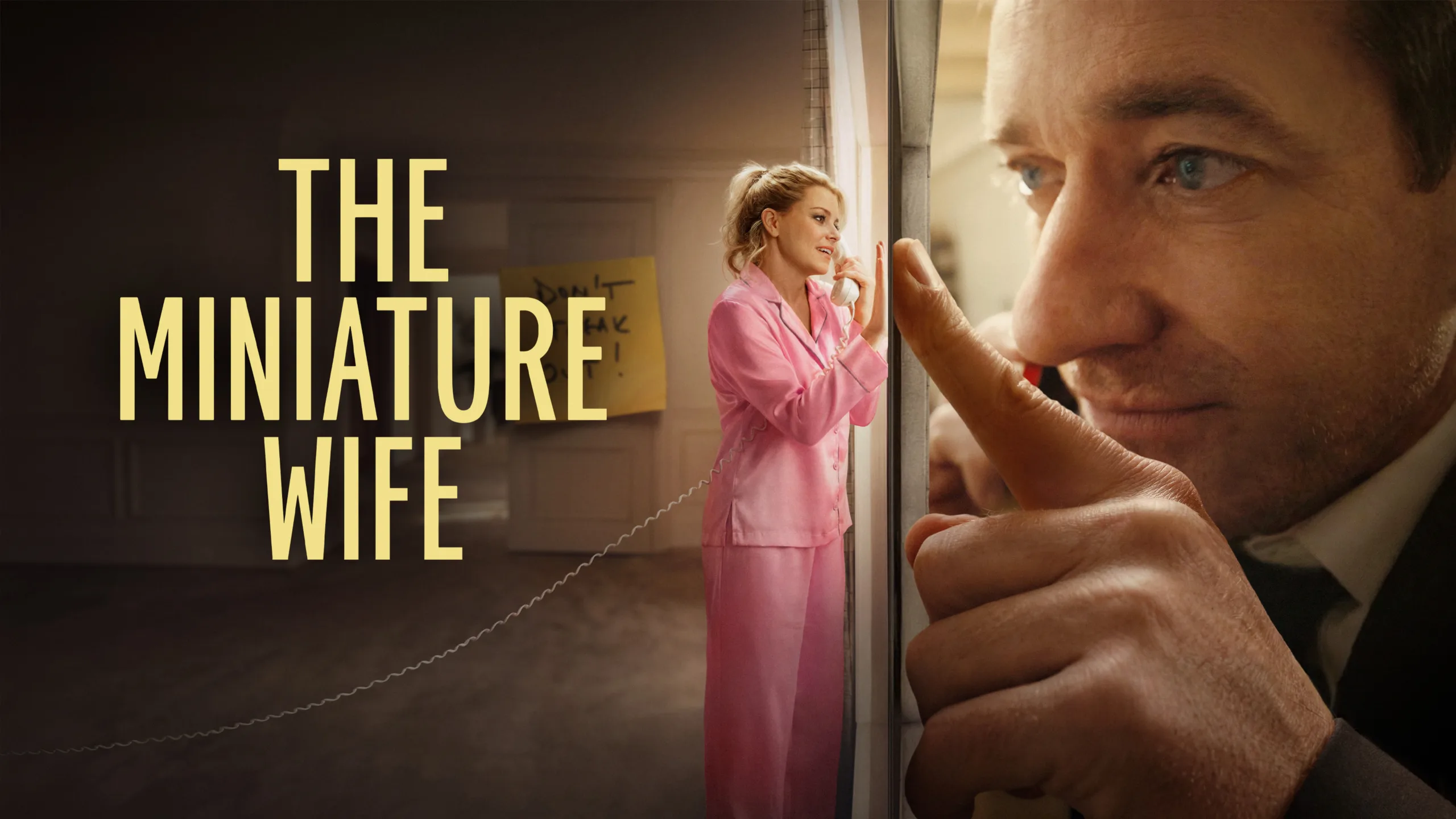

The Miniature Wife is a 10-episode Peacock dramedy created by Jennifer Ames and Steve Turner, adapted from Manuel Gonzales’ short story of the same name. Lindy Littlejohn (Elizabeth Banks), a Pulitzer Prize-winning novelist who has not published in years, is accidentally shrunk to six inches tall by her scientist husband Les (Matthew Macfadyen) during a heated marital argument. The shrinking is literal. It is also, the show makes clear from its opening frames, a metaphor so pointed it practically announces itself.
The series occupies the crossroads of marital satire and absurdist sci-fi comedy, recalling The War of the Roses in its portrait of two people locked in spectacular mutual destruction, and channeling the playful high-concept energy of Honey, I Shrunk the Kids for a decidedly adult audience. It carries greater psychological weight and thematic intent than either of those reference points alone suggests.
The show is often funny, occasionally sharp, and anchored by two lead performances that remain watchable even when the writing around them is not. The gap between what The Miniature Wife is reaching for and what it actually lands is real, and worth examining closely.
A Marriage in Miniature: Premise, Tone and World-Building
The Littlejohn marriage is already fracturing before anything remotely scientific happens. Twenty years in, they perform an annual ritual of mutual optimism, “new year, new us,” that neither of them believes anymore. Les is in pursuit of a Nobel Prize, developing an agricultural miniaturization formula that would shrink crops for efficient transport before restoring them at point of sale. Lindy, whose debut novel won the Pulitzer and whose follow-up has never arrived, is teaching creative writing at a local college and quietly unraveling. The marriage runs on competing egos and accumulated resentment. The accidental shrinking, triggered by a toy truck remote control knocked during an argument, is the kind of absurd domestic detail that feels exactly right for the world this show inhabits.
Once Lindy is six inches tall, the stakes sharpen. Les has no reversal formula. Life, parenthood, and professional obligation continue at full scale around her. The trap is now both marital and literal.
The show’s tonal identity is one of its more interesting qualities. It operates in a register that mixes satirical absurdism with thriller-adjacent momentum, grounded just enough by genuine emotional stakes to feel anchored. The production design reinforces this consistently: lab spaces bathed in sickly yellows and greens, interchangeable assistants in red coats, oversized goggles and toy-truck gadgetry. It is a heightened world, and it announces itself as such. Tilt-shift photography on exterior shots quietly reminds viewers that everyone in this story is operating within a system designed to make them feel small, Lindy included. That is a smart visual choice.
The central metaphor, Les literally locking Lindy in a dollhouse replica of their home while citing her safety, is stated plainly and dramatized with a straight face. The show is at its most incisive when it lets that image speak without editorializing. It editorializes too often.
Small Screen, Large Personalities: Performances and Chemistry
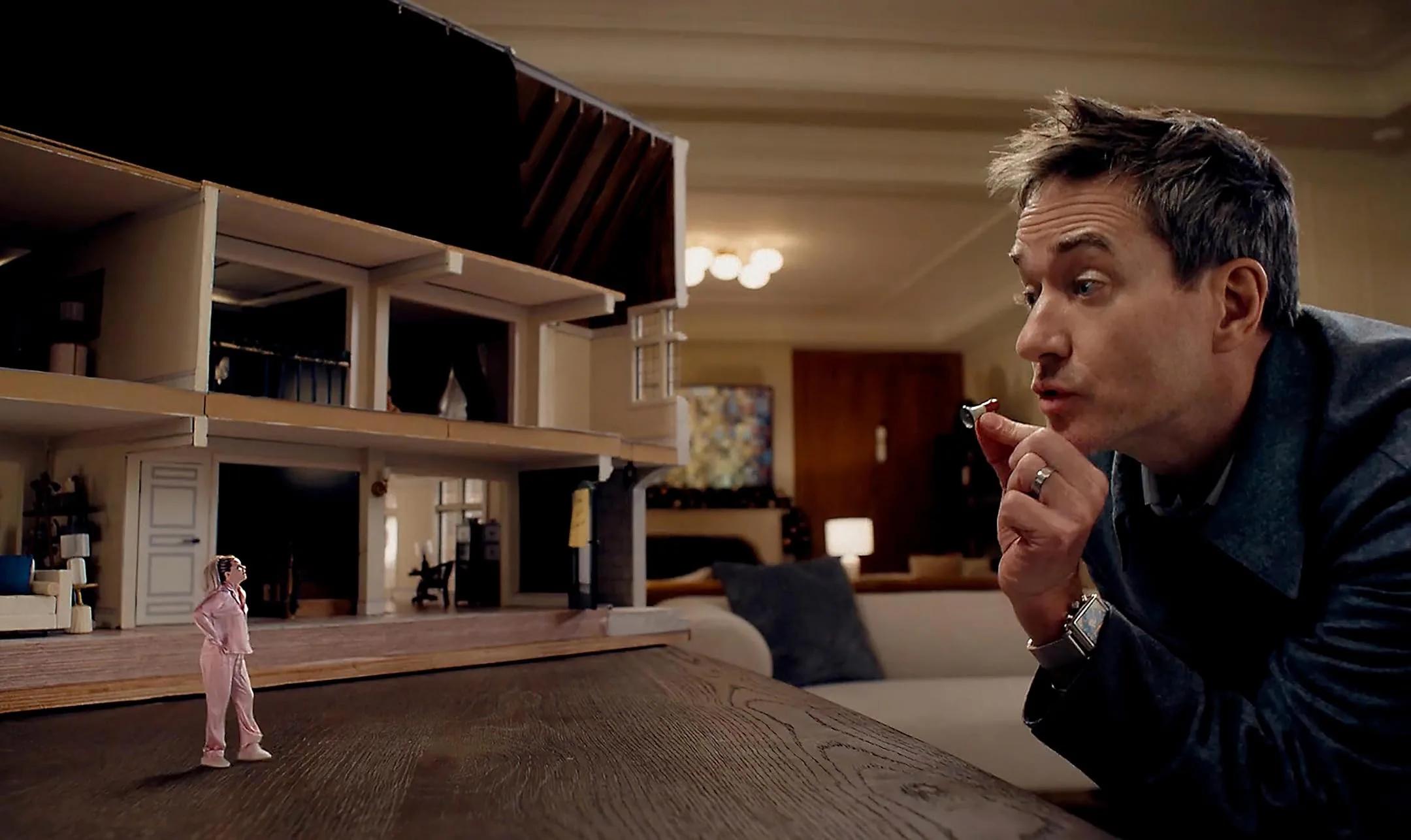
Elizabeth Banks carries the heavier burden of the two leads, and by a considerable margin. The physical demands of the role are significant: most of her performance involves acting against green screen, oversized props, inanimate objects, and a fully equipped miniature dollhouse. She handles the broad comedy with evident ease, scaling countertops, facing down a housefly, shouting through a loudhailer at a husband who has reduced her to a housepet-sized inconvenience. The physical work is impressive and, for the most part, she makes it look effortless.
The more revealing work comes from what Banks does with a character who is genuinely difficult to root for. Lindy plagiarizes a student’s short story, conducts an emotional affair with a colleague, and has largely retreated from her daughter’s life long before the shrinking begins. Banks does not soften these edges or ask for sympathy she has not earned. That honesty is what keeps Lindy watchable across ten episodes. The structural frustration is that the role forces her to shout so relentlessly that her quieter, more textured instincts rarely get space to breathe.
Matthew Macfadyen, meanwhile, is comfortably in familiar territory. Les is pompous, self-pitying, and prone to toddler-grade tantrums at the first sign of professional adversity. His previous invention, a genetically modified tomato that tasted of “old Band-Aids,” is a single detail that does the work of an entire character study. Macfadyen holds Les’s contradictions with his usual precision: the man is both buffoon and bully, and it is never entirely clear which the show intends us to take seriously. That ambiguity is interesting, and the writing does not always honor it.
The practical logistics of filming a size-difference narrative mean that Banks and Macfadyen share genuine screen time far less often than the premise implies, and the show is poorer for it. Their chemistry, on the rare occasions it surfaces, is worth the wait.
The supporting cast compensates with energy and specificity. O-T Fagbenle brings warmth to Richard, Lindy’s emotionally devoted colleague and inadvertent plagiarism accomplice. Zoe Lister-Jones plays Vivienne, Les’s scientific overseer, with the clipped efficiency of someone who suspects everyone around her is an idiot and has the data to confirm it. Her comedy is bone-dry, and she is a genuine asset. Ronny Chieng’s eccentric investor Hilton arrives with gleeful man-child chaos. Sofia Rosinsky’s Lulu mirrors her parents’ worst qualities with the conviction of someone who has had no other role models. Sian Clifford is sharp and magnetic as Lindy’s literary agent, and substantially underused, a pattern that recurs across the show’s handling of its peripheral characters.
Ten Hours, One Short Story: Writing, Structure and Pacing
Manuel Gonzales’ source material is lean and economical, a short story built around a single sharp idea. Expanding that to ten episodes of roughly forty minutes each is a structural challenge, and The Miniature Wife meets it only partially. The pilot, directed by Greg Mottola, establishes tone and stakes with confidence. The central conceit is introduced efficiently, the characters are positioned clearly, and the absurdist register is set without confusion.
Then the subplots arrive, and the show’s confidence begins to waver.
The plagiarism storyline, in which Lindy’s student’s work is submitted to The New Yorker under her name, is a genuinely sharp idea. It connects directly to Lindy’s creative paralysis, her hunger for validation, and the question of whose voice gets amplified and why. The show raises it and largely abandons it to procedural cleanup, with Sian Clifford’s agent Terry doing most of the damage control while Lindy remains indisposed. A mid-season detour into Terry’s romantic life compounds the problem, padding a stretch of episodes that are already losing altitude.
Lulu’s storyline is a variation on the same issue. She functions as a reflection of her parents’ dysfunction, inheriting their arrogance, their talent, their blindness, but the writing treats her as a plot device rather than a character with her own gravity. The idea is there. The space to develop it is not.
The show finds its footing again in episode nine, titled “Janet Reno,” a tonal swerve into full screwball that lands with more energy than anything in the preceding three episodes. The pivot works because it commits completely, with runaways, revelations, and a genre abandon that the rest of the season had been too cautious to attempt. It re-energizes the finale, which closes the Littlejohn marriage on a note that is deliberately ambiguous and appropriately unresolved.
The structural lesson is visible in hindsight. The Miniature Wife works best in concentrated bursts of absurdity and emotional honesty. Stretched across ten episodes, the seams show. A tighter season, perhaps seven or eight episodes, might have felt like a complete statement.
Made Small: Themes and Ambition
The show’s central argument is direct: men diminish women to feel powerful, and women develop expertise at surviving environments built to limit them. Les literally locks Lindy in a dollhouse for her own safety. The image is unambiguous. What distinguishes The Miniature Wife from a simpler parable is that it does not position Lindy as a clean victim. She participates actively in her own diminishment, and she diminishes others. She plagiarizes her student. She prioritizes her need for literary validation above her daughter’s need for a present parent. The cycle runs in both directions, and the show is at its most honest when it acknowledges this without flinching.
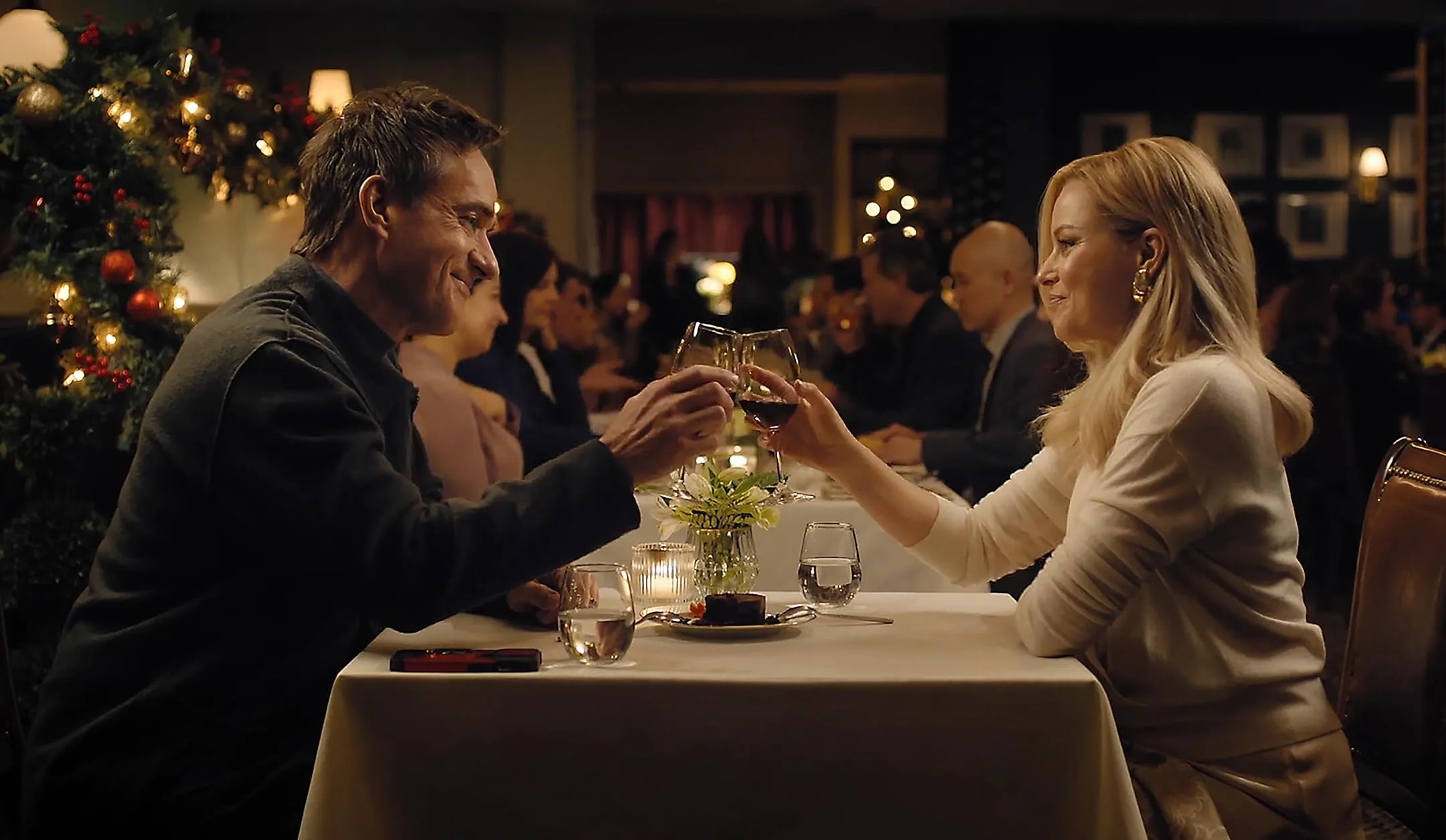
The second major strand concerns narcissism as relational glue. Both Littlejohns are defined by their hunger for recognition: Lindy for literary prestige, Les for scientific glory. The show proposes, with some conviction, that this shared obsession is what holds the marriage together as much as it erodes it. The characters around them orbit the same pathology: Hilton performs wealth as a substitute for significance; Richard confers adoration as a way of borrowing Lindy’s reflected light; Lulu inherits the pattern wholesale.
The generational thread is the quietest element of the series, and at moments the most affecting. Lulu is her parents’ worst tendencies dressed in younger clothes, and the show treats this as tragedy rather than punchline. It is the one idea that deserved the most room and received the least.
The Art of Feeling Small: Technical Craft and Visual Design
The practical and digital work required to situate Banks convincingly in a full-sized world is largely successful. Sequences involving furniture-scaling, a domestic housefly confrontation, and the intricacies of the dollhouse interiors are executed with genuine wit. The visual gags earn their place and often carry more thematic freight than the dialogue surrounding them.
The CGI compositing is less consistent, particularly in wider shots where the integration of scale feels unconvincing. More practical set construction in these moments would have strengthened the illusion considerably.
The production design elsewhere is strong. The retrofuturistic lab aesthetic, red coats, oversized goggles, toy-truck remotes, gives the show a visual identity that anchors its satirical tone. The dollhouse itself is a production design highlight: a miniature replica of the Littlejohn home that functions simultaneously as comic set piece and pointed symbol. The tilt-shift exterior photography is quietly effective, a low-cost visual shorthand that earns its repetition across the season.
The Miniature Wife premiered on April 9, 2026, as a surreal sci-fi comedy-drama that explores the volatile power dynamics of a marriage pushed to the extreme. Based on the short story by Manuel Gonzales, the series follows Les Littlejohn, a scientist whose miniaturization experiment goes awry, accidentally shrinking his wife, Lindy, to just six inches tall. As the couple navigates this literal and metaphorical imbalance of power, the show blends sharp wit with a dark, domestic tension. Audiences can currently stream the entire first season on Peacock in the United States, while viewers in the UK and Ireland can find it on Sky Atlantic and the NOW streaming service.
Where to Watch The Miniature Wife Online


Full Credits
Title: The Miniature Wife
Distributor: Peacock, Sky Atlantic, NOW, Sony Pictures Television
Release date: April 9, 2026
Rating: TV-MA
Running time: 30–45 minutes
Director: Greg Mottola, Bertie Elwood, Fernando Frias
Writers: Jennifer Ames, Steve Turner, Marisa Wegrzyn, Vivian Barnes, Hiram Martinez, Suzanne Heathcote
Producers and Executive Producers: Jennifer Ames, Steve Turner, Michael Aguilar, Michael Ellenberg, Lindsey Springer, Elizabeth Banks, Matthew Macfadyen, Greg Mottola, Suzanne Heathcote
Cast: Elizabeth Banks, Matthew Macfadyen, O-T Fagbenle, Zoe Lister-Jones, Sofia Rosinsky, Sian Clifford, Ronny Chieng, Aasif Mandvi, Rong Fu, Steven McCarthy, Tricia Black
Director of Photography (Cinematographer): Adrian Peng Correia, Steve Cosens
Editors: Heather Persons, Daysha Broadway, Trevor Ambrose, Curt Lobb
Composer: Isobel Waller-Bridge
The Review
The Miniature Wife
The Miniature Wife is a show with a genuinely sharp idea at its center, two committed lead performances, and enough wit in its best moments to remind you what it could have been at full stretch. The adaptation strains under the weight of ten episodes, and too many subplots sketch themes without following through. Banks is the reason to watch. The writing is the reason to wish it had been braver. A flawed but sporadically rewarding series.
PROS
- Elizabeth Banks delivers a physically and emotionally demanding performance with consistent conviction
- The central metaphor is bold, direct, and dramatically fertile
- Strong supporting cast, particularly Zoe Lister-Jones and O-T Fagbenle
- Distinctive visual identity with sharp production design
- Episode 9 proves the show capable of real creative daring
CONS
- Significant padding across the middle episodes
- Banks and Macfadyen share too little genuine screen time
- Several subplots raise strong ideas and abandon them
- CGI compositing is inconsistent
- The script cannot fully commit to either Les's menace or his comedy