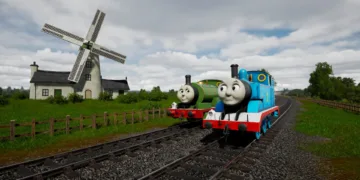































Applying the strict technical demands of a rail simulator to a setting built around talking engines produces an odd, effective piece of software. Dovetail Games uses Unreal Engine to build a standalone version of the Island of Sodor, shifting away from the hard industrial texture of modern freight routes into the bright, polished identity of the Thomas & Friends brand.
The result is a detailed digital playground where locations such as Ffarquhar Station land with clean visual definition. The roster includes Thomas, Percy, Gordon, Emily, and Diesel, with Toby included in the standard version. James is available through the Deluxe Edition or DLC.
The presentation carries the look of a children’s toy line, while the mechanical layer asks for real attention. The game works as an entry-level simulator for players drawn to model railroading, sitting between casual play and the heavier demands of the main Train Sim World series. It treats Sodor as a training ground for the fundamentals of train operation. The friendly faces on the engines do little to soften the discipline required. The game expects players to learn how these machines move, stop, and respond under pressure.
Precision Controls and Simulation Depth
The control scheme demands focus from the start. R2 handles acceleration, L2 applies the brakes, and L1 and R1 control the reverser for direction. The D-Pad manages passenger doors. Those inputs sound approachable on paper, yet the game builds tension through timing, weight, and distance. A small error can turn a simple station approach into a messy overshoot.
Two control modes shape the player’s workload. Simple mode lets you control speed through basic trigger pressure. Simulation mode places direct responsibility on the regulator lever, forcing constant attention to speed and momentum. That choice gives the game a clear skill curve. Players who treat the engines like arcade vehicles will learn very quickly that Sodor has little patience for sloppy braking.
Physics carry much of the challenge. Heavy loads increase stopping distance, so station stops need to be planned hundreds of yards ahead. Misreading your speed can send you past the target marker or into a derailment at junctions. This is where the game feels closest to a proper rail simulator. It asks players to think ahead, read the track, and respect the mass behind the engine.
Perspective also changes the experience. The first-person cab view feels authentic because visibility is restricted to small portholes. That limitation makes navigation tougher than third-person or free-camera play. From inside the cab, Sodor feels narrow, controlled, and slightly stressful. Outside the cab, the stations open up. You can walk around, interact with objects, and flip track switches by hand.
That ability to leave the engine matters. Walking through stations gives the world a stronger sense of scale, a quality that disappears when you remain locked behind the controls. Yard work becomes physical in a simple, readable way. You drive, stop, step out, adjust the track, and return to the cab.
The loop feels grounded compared with a basic rail game. Add the sassy freight cars pushing against the engine and the controller haptics delivering the rumble, and the act of managing a train becomes a patient technical routine.
Operational Variety Across Sodor
The game offers a large amount of content for players willing to settle into its rhythm. Story Mode includes eight narrative chapters, with missions built around specific tasks such as coupling freight cars or fetching water for a thirsty engine. Mark Moraghan narrates these sections, giving them the feel of interactive episodes from the show. The structure is simple, clear, and well suited to the brand.

Timetable mode is the main workhorse, containing over 250 unique services. These tasks focus on daily railway duties across Sodor. You carry passengers, move cargo, and work under tight schedules. Each job receives a grade based on accuracy and punctuality, which gives routine trips a measurable performance target. The game turns ordinary rail labor into a series of small tests.
The engines also have distinct practical roles. Gordon and Emily can reach speeds of 80mph, making them useful for faster runs. Other engines fit better into yard shunting. That mechanical separation gives the roster purpose beyond character recognition. Choosing an engine changes how a job feels, especially once stopping distance, route layout, and cargo weight enter the equation.
Free Play provides the widest flexibility. You can place any engine at any location, then adjust the weather and season. Heavy rain and thick snow affect how the rails feel and how the engine responds to braking. These conditions give familiar routes a different texture, especially for players who care about precision. The game’s weather options support its long-term appeal by changing the handling demands without changing the basic route.
Collectors have 80 items to find, split into 20 conductor hats, 20 whistles, 20 paintings, and 20 books. Many of these require leaving the main route and exploring on foot. The Platinum trophy adds another layer of commitment by rewarding completion of every tutorial and story chapter.
Finishing all 250 timetable services is a serious time investment. Estimates suggest that seeing everything could take over 1000 hours once all weather combinations are counted. The content volume gives the simulation enough movement to avoid feeling frozen in place.
Sensory Fidelity and Technical Friction
The presentation captures much of the series’ charm through strong audio work. The classic theme music plays in the menus, and Mark Moraghan’s narration gives the story missions a polished tone. Steam whistles and engine hums carry convincing weight. The sound design helps sell the idea that these bright, friendly engines still operate like heavy machinery.
Visually, Unreal Engine gives Sodor a bright, clean look. The engines have a specific facial design that recalls the original models, which helps the game maintain its connection to the source material. Photo mode lets players capture the landscape with maximum graphical settings, and the best shots have the crisp quality of a carefully arranged model railway.
Several design choices create friction. Dialogue and cutscenes cannot be skipped, which becomes irritating after a failed mission. Restarting a task means sitting through the same long introduction again. That repetition hits hardest during tougher objectives, where a failed run can already feel punishing.
The user interface also lacks polish. Information bubbles often overlap on the screen. Speed warnings and destination markers can block vital signals. Distance indicators can mislead the player because they do not always account for the full length of the train being pulled. You may believe you have enough space to stop while the rear of your train is blocking a junction. For a game built around precision, that kind of communication problem can be costly.
Technical bugs appear from time to time. The camera can freeze during the switch from driving to walking. Some characters clip through passenger car floors. Trains can drift during cutscenes. If an engine rolls past a stop signal while a scene plays, the mission fails immediately. These issues force players to handle sessions with extra caution.
The world also shows visible seams. Passengers may walk through doors or walls. Invisible barriers keep you from wandering too far into the woods. These problems do not erase the strength of the simulation layer, yet they point to a game that needed extra refinement before release. Sodor feels charming, structured, and surprisingly demanding, with enough rough edges to remind you that even a cheerful railway can run into signal trouble.
The Review
Thomas & Friends: Wonders of Sodor
Wonders of Sodor succeeds in translating a beloved children’s license into a functional, detailed rail simulator. It offers substantial content for those who enjoy the mechanical precision of train operation. Technical hurdles like unskippable cutscenes and overlap in the interface detract from the experience. While the polish lacks in specific areas, the core simulation remains strong for railfans. It serves as a competent entry point for newcomers to the genre.
PROS
- High-fidelity visuals with Unreal Engine
- Professional narration and sound design
- Technical simulation depth
- Extensive library of timetable services
CONS
- Unskippable cutscenes and dialogue
- Cluttered user interface
- Occasional camera and collision bugs
- Difficulty level exceeds child-friendly branding







