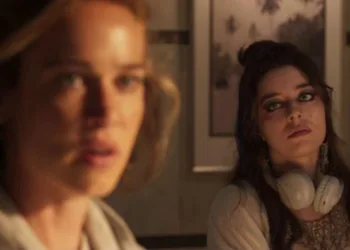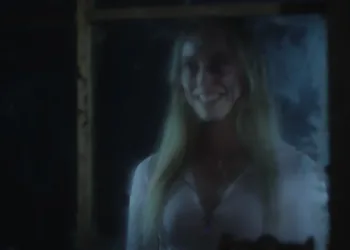


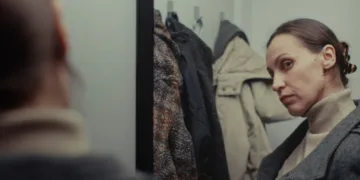














Aina Clotet’s directorial feature debut, Alive (Viva), arrives in contemporary Catalan cinema with its eyes fixed on the body as a failing republic. The film follows Nora, a forty-year-old woman whose inner architecture cracks while the world around her dries into dust.
Clotet, a veteran actor who has worked in the industry since childhood, moves behind the camera and remains before it, taking the lead role with the nervy commitment of someone staging a private body-apocalypse. Nora’s crisis begins with a medical terror: a new growth appears in her remaining healthy breast, raising the threat of a cancer recurrence after a previous partial mastectomy.
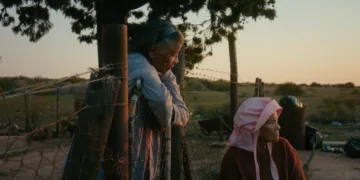
That personal emergency unfolds during an unrelenting drought in Catalonia, and the landscape becomes a cruel diagnostic chart. The parched terrain reflects Nora’s mental dehydration, her sudden awareness that finitude has entered the room and taken a chair. Clotet resists tidy setup mechanics.
She places the viewer inside panic at once, where climate emergency and bodily emergency share the same grammar: scarcity, heat, waiting, dread. It gives the film a civic charge, turning private illness into an image of a culture trained to ration water, time, and denial.
The Clock in the Lab and the Growth in the Flesh
The screenplay, written by Clotet with Valentina Viso, rests on a sharp piece of biological irony. Nora works in a high-tech research facility devoted to cellular aging and the extension of human life. She studies how existence might be prolonged for the species, yet she refuses a diagnostic biopsy for herself. The contradiction is almost too perfect, which may be the point. The woman who reads cells cannot read her own terror.

Nora rejects the clean protocols of modern medicine and chooses frantic evasion. She hurls herself into reckless behavior, guided by the belief that her biological clock has begun its final, rude countdown. Late-capitalist life asks everyone to manage risk, optimize health, track the body, and behave like a well-maintained appliance. Nora’s rebellion feels like existential self-vandalism, a refusal to become the obedient patient-consumer. Call it body-clock capitalism, with a nervous breakdown attached.
Her home turns this entrapment into visual language. Long strips of sticky flypaper hang from the ceilings, heavy with dead and buzzing insects. Nora watches them as captive omens. Their suspended bodies mirror her own paralysis while she waits for a doom she refuses to name.
Romantic Antagonisms and Fractured Priorities
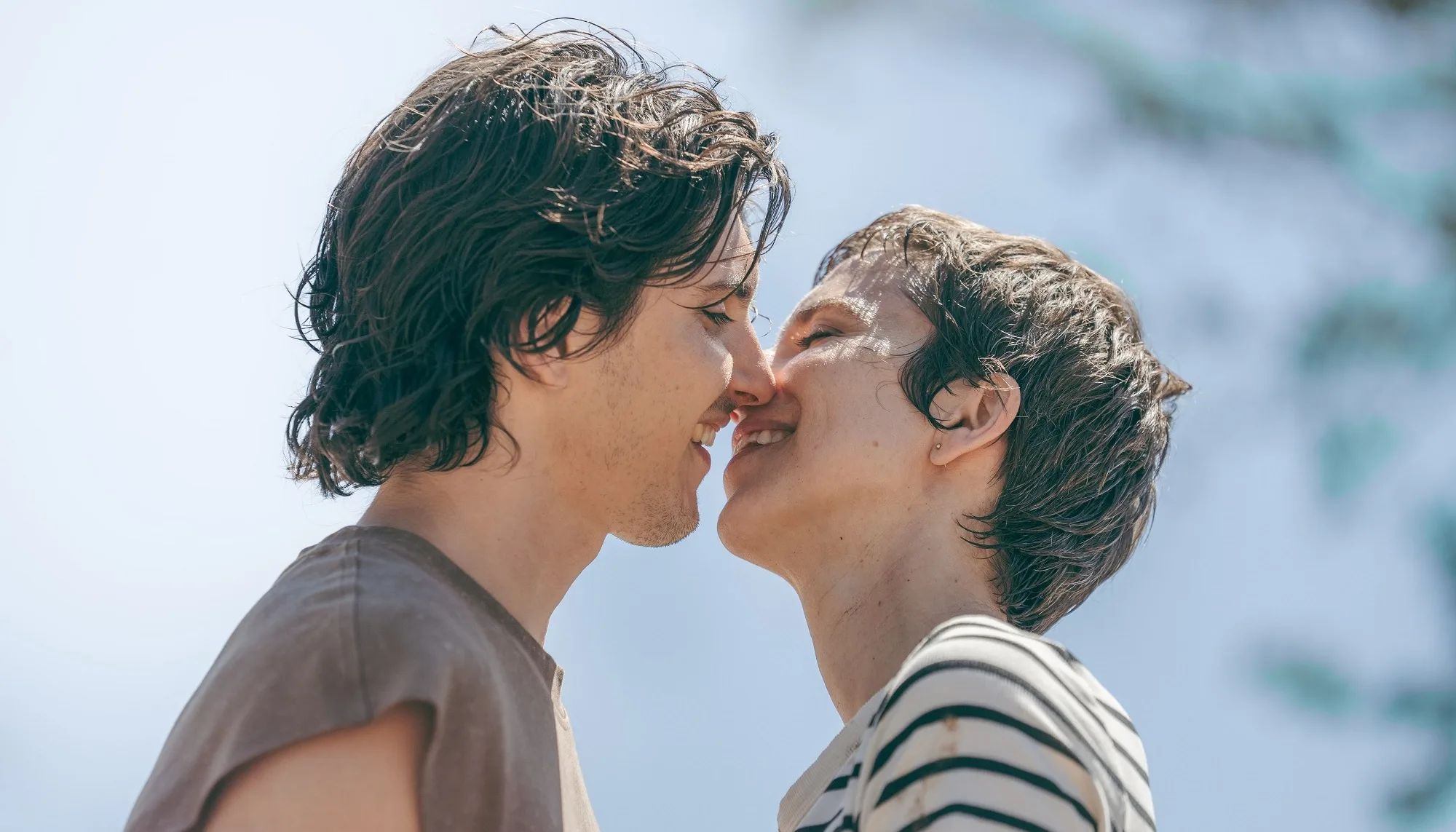
Nora’s domestic life splits into two behavioral poles. Tom, played with earthy restraint by Naby Dakhli, is her steady, eco-conscious partner, the man who stayed with her through her first cancer treatments. He signifies survival, and his stability also keeps pointing back to her prior frailty. Max, played by Marc Soler with volatile energy, is a twenty-year-old aggressive admirer whose blunt attraction gives Nora a temporary exit from mortality’s waiting room.
Clotet’s performance has a scraped-raw force. She plays Nora with gritty honesty, letting the character’s self-destructive impulses remain abrasive. We watch a mature professional choose sex beside a greasy box of cold pizza with a literal puppy of a man. Undignified. Horribly funny. Painfully human.
At times, Max resembles a panic hallucination wearing hormones. His volatility soon restores some human reality, while his function remains close to an archetype of youth. The film sketches him thinly, which makes him useful as a symptom.
Around Nora, other anxieties gather through minor figures: her heavily pregnant friend Ari, her therapist mother Sònia, and Zeymey, a competitive rival at work. Each person pressures her already crowded world, pulling her between the cold comfort of safety and the reckless charge of immediate sensation.
The Inverted Gaze and Structural Simplification
The film announces its visual grammar with the opening shot of a breast compressed for a mammogram. The tight clinical framing strips the image of erotic coding and forces the audience to face physical vulnerability through a gaze emptied of traditional male possession.
The cinematography stays especially sharp through the first half. When Nora receives disruptive sexual text messages at her laboratory desk, the camera slowly rotates until the frame turns completely upside down. It is blunt, elegant, and a little mischievous: inner dislocation made architectural.
The film’s tone grows unstable as it moves forward. It lurches between clinical medical drama and low-key slapstick farce, sometimes with impressive nerve. A playful mud fight between Nora and Max shifts into aggression, catching the grimy overlap of pleasure and panic. Laura Santos gives the film strong support through muted production design. The visual world remains grounded in the reality of a severe regional heatwave, steering clear of speculative science-fiction stylization.
My main complaint sits in the final act, where information-heavy montage sequences have characters explain their emotional states with dispiriting directness. The choice flattens the rich psychological contradictions built earlier and guides the film toward a neat resolution it barely earns.
Alive is a Catalan comedy drama that recently celebrated its world premiere at the 79th Cannes Film Festival on May 14, 2026, competing in the Critics’ Week parallel section. The production focuses on a forty-year-old biology researcher named Nora who experiences a profound personal crisis following a breast cancer diagnosis. Viewers interested in watching the production can catch its theatrical release in Spain starting June 19, 2026, where it will be distributed by Caramel Films, while Haut et Court will handle its upcoming distribution across France.
Full Credits
Title: Alive
Distributor: Caramel Films, Haut et Court, Loco Films
Release date: May 14, 2026, June 19, 2026
Running time: 110 minutes
Director: Aina Clotet
Writers: Aina Clotet, Valentina Viso
Producers and Executive Producers: Edmon Roch, Jan Andreu, Marc Clotet, Aina Clotet, Marta Baldó
Cast: Aina Clotet, Marc Soler, Naby Dakhli, Lloll Bertran, Zaida Pérez, Guillermo Toledo, Josh Zuckerman, Sau-Ching Wong
Director of Photography (Cinematographer): Nilo Zimmermann
Editors: Aina Calleja
Composer: Clara Aguilar
The Review
Alive
Aina Clotet delivers a raw, uncompromising exploration of bodily autonomy and existential panic. The film establishes a stark visual language, confronting medical taboos directly while maintaining a sharp focus on its flawed protagonist. Its chaotic shifts into low comedy occasionally disrupt the emotional stakes, and the third-act reliance on expository dialogue feels overly simplistic. For its unvarnished performances and striking regional atmosphere, it remains an admirable piece of filmmaking.
PROS
- A courageous, unvarnished lead performance by Aina Clotet.
- Striking cinematography, highlighted by the symbolic inverted framing.
- Uncompromising thematic framing of female health and physical alteration.
- Muted, realistic production design that effectively mirrors psychological drought.
CONS
- Abrupt stylistic lurches into low-key farce that soften the dramatic impact.
- A formulaic domestic setup involving predictable romantic poles.
- An oversimplified final sequence relying on heavy explanatory montages.