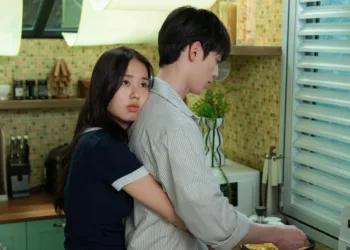




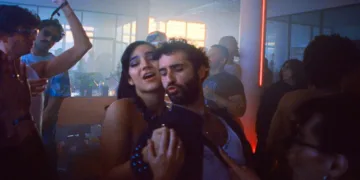


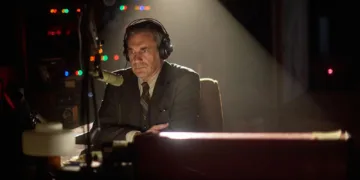


















Cinema often casts the domestic servant as a spectral remnant, a figure left wandering through nineteenth-century rooms and costume-drama memory. Radu Jude cuts through that historical fog by dragging Octave Mirbeau’s 1900 text into the chill glare of contemporary France.
In this French-language feature, the camera faces Gianina, an impoverished Romanian immigrant employed as housekeeper and nanny in a wealthy Bordeaux home. Jude sets aside his familiar hyper-kinetic provocations and works in a hushed, disciplined register. That restraint reshapes the material, giving the film a severe clarity.
It studies how affluent European life still depends on precarious foreign labor, polished by money and softened by polite speech. Earlier screen versions turned the story toward period decadence. Jude’s version exposes a present-tense crisis.
Gianina cleans, cooks, tends to the child Louen, absorbs casual insults from her employers, and sends her wages home to Romania. The film argues, with quiet force, that class hierarchy has survived every fashionable language of progress.
Domestic Monotony and the Formalist Stage Split
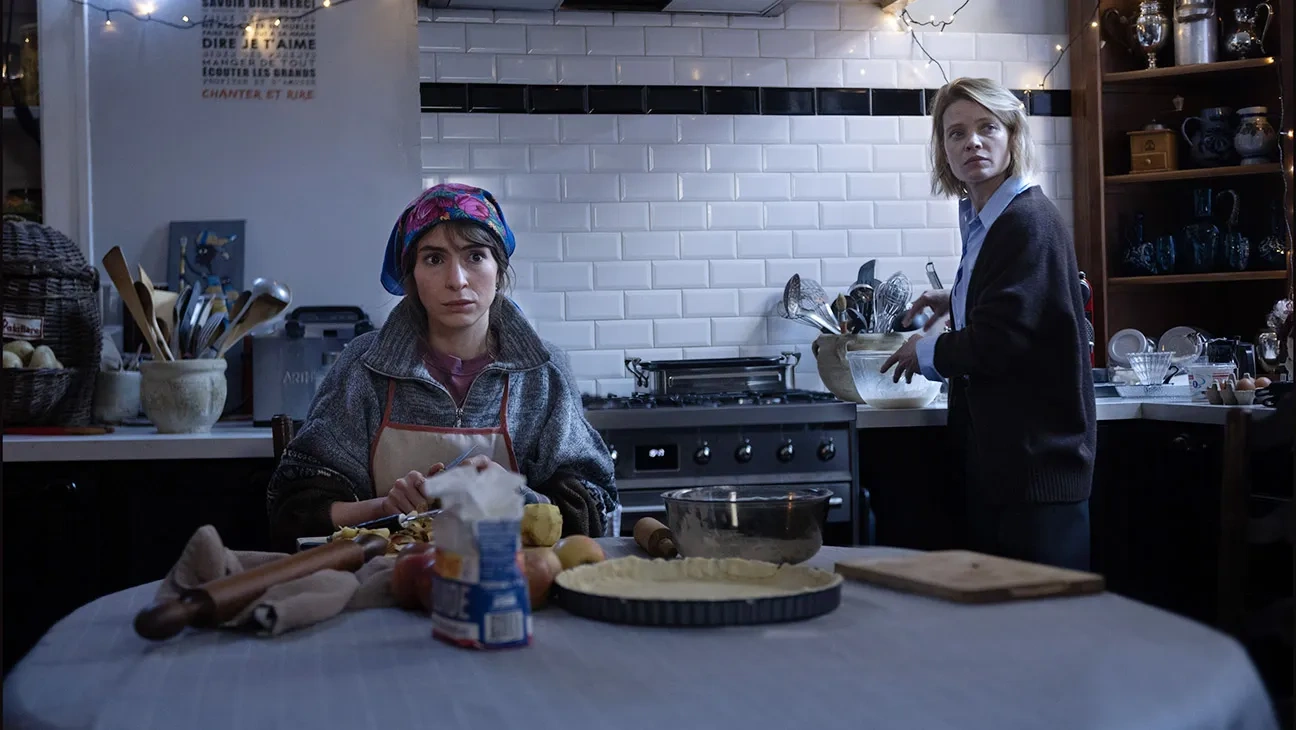
The film’s structure depends on a sharp formal split between domestic repetition and stylized theatrical performance. Gianina’s workdays unfold in brutal compression. Hours vanish in seconds, leaving behind fragments of labor: vegetables peeled, floors scrubbed, meals prepared, a spoiled child managed.

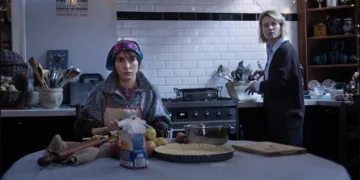
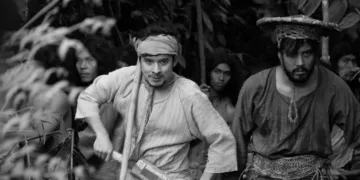
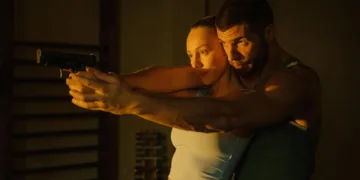
The monotony has a drained, ritualistic quality, as if the house consumes her time and returns nothing. Against this routine, Jude places a meta-fictional thread. During her spare hours, Gianina rehearses an amateur stage adaptation of Mirbeau’s novel, directed by a fellow Romanian migrant who selected her for the authenticity of her immigrant background.
This stage material gives Jude a clean conceptual partition. The novel’s sexually charged and scandalous elements are placed inside the bare theater space. The main film narrative concentrates on the quieter violence of everyday capitalism: the lowered gaze, the swallowed insult, the rearranged schedule, the wage sent across borders.
Gianina’s alienation becomes painfully visible through her dependence on mobile phone video calls. Her conversations with her mother and young daughter, Maria, show family life reduced to a glowing screen and unstable connection.
The story covers three months leading toward Christmas, a span that deepens her longing to return to her village. That hope collapses after the sudden arrival of the child’s grandmother, when her employers alter their plans and treat Gianina’s personal life as a minor inconvenience.
The Veneer of Progressive Affection
Ana Dumitrașcu gives the film its bruised human pulse. Her performance is natural, watchful, and emotionally precise, carrying quiet vulnerability beside a dry, sarcastic edge. Small acts of resistance flicker through her body and voice, especially when she mutters curses at the demanding child under her breath.
Those private insults become scraps of autonomy inside a household that grants her little room to speak. Her grounded presence is set against her employers, Pierre and Marguerite, played by Vincent Macaigne and Mélanie Thierry.
Pierre brings an ugly comic charge to the film. He uses passive-aggressive tactics to stretch Gianina’s working hours, presenting selfish demands as flattering appreciation. His condescension sharpens when he tells her to change traditional Romanian folktales, asking for happy endings that smooth away the somber realities of her heritage for the comfort of a rich child.
Marguerite, an icy university professor, represents self-absorption in cultivated form. Her polite, intellectual language becomes a screen for indifference to her employee’s welfare. Jude studies the social hypocrisy built into these modern figures with surgical calm.
They imagine themselves as enlightened and progressive, yet Gianina’s life becomes disposable whenever their comfort is at stake. Their liberal values operate as décor, covering an old master-servant relation newly dressed in the language of humanism. The film examines the gulf between self-image and conduct, showing how care can become a vocabulary for control.
Fixed Frames and Fixed Realities
Cinematographer Marius Panduru films the Bordeaux estate in sharp, fixed medium shots. The static compositions dominate the domestic scenes and the bare theater stage, creating a rigid visual order that seems to trap everyone within assigned positions.
That stiffness is answered by the raw, broken texture of Gianina’s mobile phone footage during her solitary walks through the city. One of the film’s strongest images occurs at Bordeaux’s famed Water Mirror. The beauty of the reflection intensifies her displacement, placing a lonely worker inside a foreign landscape of wealth, tourism, and municipal grandeur.
The film holds a finely judged tonal balance, moving through abrasive slapstick comedy, melancholy, and quiet anger. Jude threads political digressions through the theatrical rehearsals, letting characters debate history, Eastern European political shifts, Communism, Maoism, and the legacy of Ceausescu, with beheading returning as a recurring motif. The swift resolution resists the comfort of tidy character development or emotional settlement.
Jude studies systemic exploitation through multiple cinematic forms, letting structure carry the wound. The abrupt final movement leaves the central conflicts unresolved. Its refusal of comfort has a moral purpose: the exploitation of labor remains present, intimate, and ordinary. In the final frames, wealth still requires the servant’s humanity to fade from view.
The Diary of a Chambermaid premiered in May 2026 at the Cannes Film Festival within the Directors’ Fortnight section. Following its festival run, the film is scheduled for theatrical distribution across European cinemas through SBS Distribution and Independența Film. Audiences can catch the feature during upcoming international film festival screenings or inside select art-house theaters and subsequent digital platforms later this year.
Full Credits
Title: The Diary of a Chambermaid
Distributor: SBS Distribution, Independența Film
Release date: May 15, 2026
Running time: 94 minutes
Director: Radu Jude
Writers: Radu Jude, Octave Mirbeau
Producers and Executive Producers: Saïd Ben Saïd
Cast: Ana Dumitrașcu, Vincent Macaigne, Mélanie Thierry, Marie Rivière, Ilinca Manolache, Sofia Ioana Dragoman, Liliana Ghiță, Amélie Prévot, Louve Proust, Louen Bouteiller
Director of Photography (Cinematographer): Marius Panduru
Editors: Cătălin Cristuțiu
Composer: None
The Review
The Diary Of A Chambermaid
Radu Jude succeeds in stripping away historical distance, exposing the raw machinery of modern economic exploitation. By trading his usual chaotic energy for quiet observation, he delivers a biting critique of progressive European hypocrisy. Ana Dumitrașcu provides an exceptional anchor for this unsparing social anatomy. The abrupt structure might alienate traditional narrative expectations, yet the sharp conceptual framework makes the film a vital piece of modern political cinema.
PROS
- Ana Dumitrașcu delivers a grounded, naturally sharp lead performance that balances vulnerability with silent resistance.
- The formal split between the domestic grind and the theatrical stage serves as a brilliant conceptual framework.
- Cinematographer Marius Panduru utilizes crisp, striking static camera setups to emphasize household power dynamics.
- The script treats the polite language of the employers with razor-sharp dark comedy.
CONS
- The theater rehearsal sequences lean into repetition, slowing down the narrative momentum.
- The abrupt narrative resolution leaves major character arcs unfulfilled.
- Dense intellectual digressions might alienate viewers seeking an emotional narrative connection.