


















In the flat, hushed reaches of northern France, Bavincourt rests within the Artois region like a place caught under old weather. Its land bears the memory of coal mining and endless agricultural horizons, carrying the dense fatigue of economic stagnation. Here, Maxence Voiseux places his documentary feature Gabin, expanding from his earlier midlength chronicle of the Jourdel family, The Heirs.
The film fixes its gaze on Gabin Jourdel across ten years, following him from an eight-year-old boy into an eighteen-year-old standing near departure. Time gathers slowly in Voiseux’s frame. Childhood becomes duration, and duration becomes pressure.
History appears as a quiet current pulling the body forward before the mind can name its own desire. The film studies existence as something rooted in soil, labor, family, inheritance, and the heavy air of a place that has already decided too much.
Flesh and Field: The Inherited Battleground
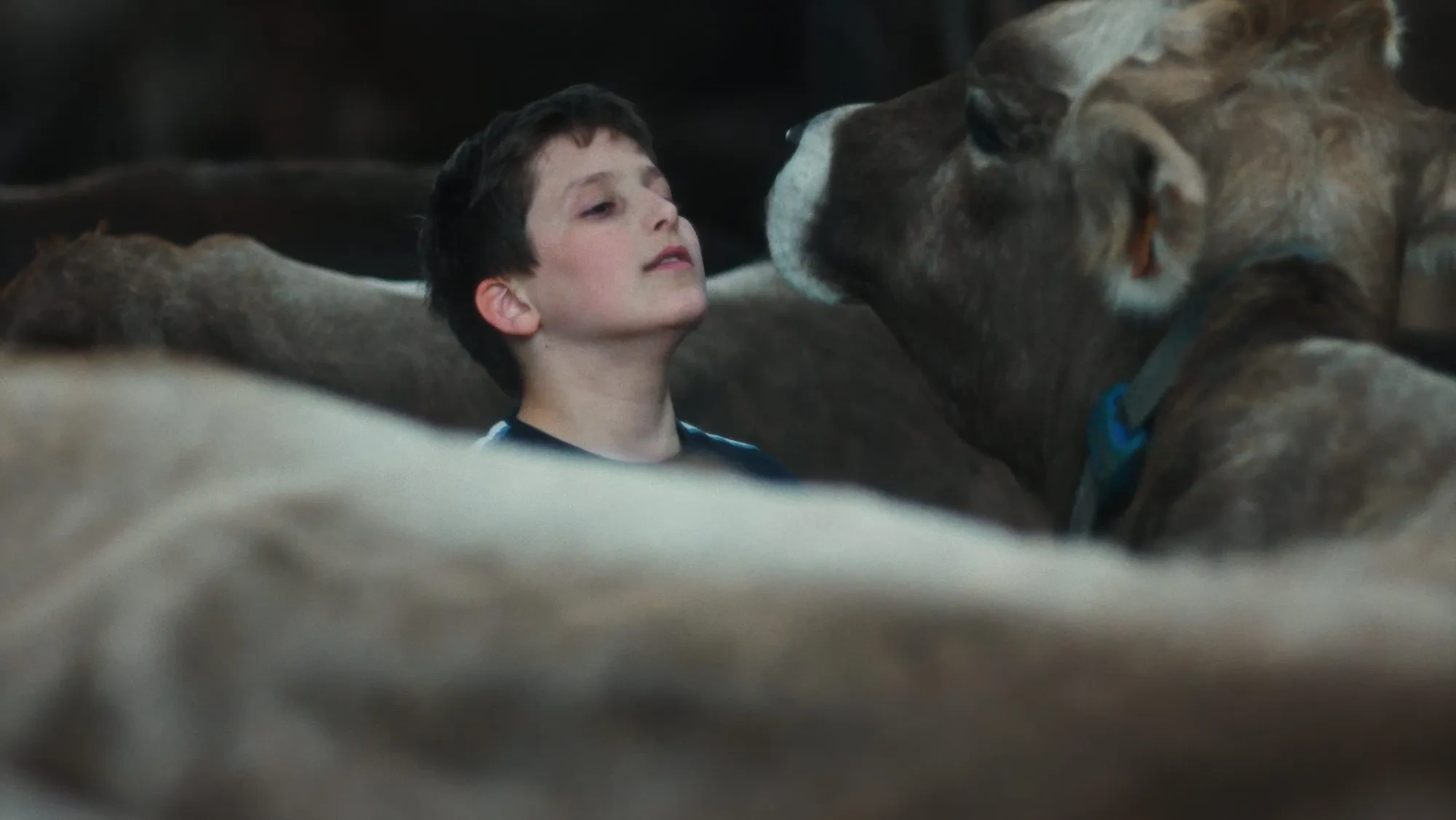
The home in Gabin becomes a psychic field of struggle, divided by the primal terms of life and death. Gabin is held between the work of his parents, and that split gives shape to his inner condition. His mother, Patricia, cares for living dairy cattle under severe financial strain. With her, Gabin’s affection is tender, physical, nearly speechless. He touches the animals gently and seems to find, in their warmth, a form of shelter the world rarely grants him.
Dominique, his father, occupies a harsher realm. He is a traditional butcher who expects his youngest son to inherit the trade, apron and blood included. His authority arrives as command, pressure, and threat, reaching the point where he says he will burn the business down if Gabin refuses the apprenticeship.
That paternal despair later turns inward through Dominique’s self-imposed retreat to an orthodox monastery, a gesture that reveals spiritual loneliness as much as discipline. Around these demands, Gabin finds quieter forms of survival. Lilou, his school friend, remains a steady confidante.
Catherine, his tutor, helps him face the frustrations of a diagnosed working memory deficit and gives him an emotional space where thought can breathe. Through them, Voiseux observes a modern youth trying to form a self under archaic generational weight. Gabin’s question is terrible in its simplicity: accept a legacy of slaughter, or move toward an unwritten life.
The Confines of the Frame: Geographies of Stasis
Voiseux gives this burden a visual grammar of pressure. The restrictive Academy aspect ratio closes around the characters, making the frame feel almost tactile in its compression. Space becomes fate. The village’s limited economic choices appear in the narrowness of the image, where the eye is held inside a tight field of possibility.

Against the flat horizontal landscape, two vertical structures rise with strange severity: a ruined church and a concrete communications tower from the 1950s. They cut into the low sky like mute signs of spiritual and technological escape, each one promising ascent, each one standing in silence.
The camera remains nearly invisible in these rooms and fields, recording intimate family crises with no glance toward the lens. The result is realism stripped to its raw surface, a cinema of faces before performance has time to harden. Years pass through smooth temporal editing, with ellipses carrying the film across large chronological distances.
Adolescence arrives in sudden physical shocks, yet the narrative line holds. When Gabin reaches his late teens, the film’s visual life changes during a shepherding apprenticeship. The tight images open into green, wide mountain landscapes. The release of space feels like a release of being, a brief answer to the horizontal cage of childhood.
Horns in the Void: The Flight from Legacy
Sound deepens the film’s atmosphere of melancholy. Nicolas Rabaeus’s score uses a spare, horn-forward arrangement with a breathy texture, filling silence with mournful air. Those sounds seem to come from inside Gabin’s isolation, as if the house itself had learned to exhale grief.
Much of the film’s force lies in the unsaid. Voiseux trusts quiet glances, heavy expressions, and pauses that carry thought before language can enter. The farewell between Gabin and Lilou draws its power from that restraint, holding the sorrow of parting through silence rather than melodramatic speech.
Gabin’s movement toward an agricultural boarding school and then into high-altitude shepherding gives the film its clearest break from inherited expectation. His ascent into the mountains becomes an existential movement, a climb away from the butcher shop’s predetermined cycle and from the father’s demand that blood become destiny. Leaving Bavincourt’s flat terrain, Gabin steps into a future that has no fixed shape yet. The uncertainty remains. Freedom, in Voiseux’s film, is fragile, exposed, and unfinished. Yet it belongs to him.
The documentary feature Gabin celebrated its world premiere on May 14, 2026, screening at the Cannes Film Festival within the prestigious Directors’ Fortnight section. As a fresh festival debut, the film is currently circulating through international festival venues and is not yet available on commercial streaming platforms or in general theaters. Following its festival run, the movie will be released to wider audiences through its French distributor, Arizona Distribution, with international distribution handled by Lightdox.
Full Credits
Title: Gabin
Distributor: Arizona Distribution, Lightdox
Release date: May 14, 2026
Running time: 105 minutes
Director: Maxence Voiseux
Writers: Maxence Voiseux
Producers and Executive Producers: Cécile Lestrade, Elise Hug, Ulla Lehmann, Andrea Roggon, Palmyre Badinier, Pauline Gygax, Max Karli
Cast: Gabin Jourdel, Patricia Jourdel, Dominique Jourdel, Lilou Duflos, Catherine Ranson
Director of Photography (Cinematographer): François Chambe, Martin Roux
Editors: Pascale Hannoyer, Natali Barrey
Composer: Nicolas Rabaeus
The Review
Gabin
Maxence Voiseux crafts a profound meditation on temporal decay and generational entrapment. The film isolates a fragile human consciousness against the silent weight of a dying landscape. By treating the passage of time as an invisible, sculpting force, the director captures the melancholy of an inherited life slipping away. The structural patience rewards those willing to sit with the weight of quiet desperation. It remains an evocative, challenging look at youth resisting an assigned destiny.
PROS
- The meticulous use of the Academy ratio visually reinforces the thematic entrapment of the protagonist.
- The patient, decade-long observational approach captures genuine physical and psychological transitions.
- The understated acoustic score by Nicolas Rabaeus beautifully mirrors the character's internal melancholy.
- The cinematography honors the dignity of the subjects without succumbing to sentimental presentation.
CONS
- The severe temporal ellipses occasionally disrupt the narrative flow for viewers seeking traditional progression.
- The heavy, stagnant atmosphere might alienate audiences accustomed to dynamic storytelling.
- The harsh juxtaposition between agricultural slaughter and pastoral life occasionally feels heavy-handed.