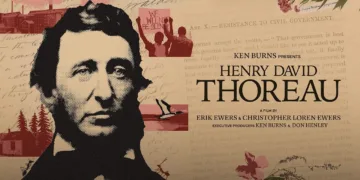





























The three-part PBS documentary Henry David Thoreau offers a sweeping biographical portrait of an American icon whose public image has often been sealed inside a handful of polished aphorisms. Directed by brothers Erik and Christopher Loren Ewers and executive produced by Ken Burns and Don Henley, the three-hour production gives flesh, weather, temper, and urgency to the man behind the prose.
It carries viewers into nineteenth-century Concord, Massachusetts, a place rendered here as fertile ground for intellectual rebellion. George Clooney narrates with calm authority, guiding the audience through the life of a writer, philosopher, naturalist, and fierce activist. The series moves beyond a plain ledger of historical dates.
It studies how one life helped shape global movements across nearly two centuries. Many viewers arrive through classroom memories of Walden or Civil Disobedience. The film reaches toward the alert, restless mind behind those texts. By placing Thoreau inside his physical and social world, the documentary frames him as a radical spirit whose practice of deliberate living still carries a sharp challenge for the modern age.
The Arc of a Deliberate Life
The narrative follows the full span of Thoreau’s forty-four years, beginning with his early formation as a protégé of Ralph Waldo Emerson. The first episode clarifies the intellectual debt he owed to Emerson while tracing the arrival of a distinct, independent voice.
Much of the series’ middle section turns toward the famous Walden Pond experiment that began in 1845. The directors treat this period as an interval of disciplined thought, close study, and scientific attention. The cabin emerges as a place of concentration, a modest structure built for focus and clarity.
The series then moves into his later years with a different charge. This phase presents Thoreau as a practical worker, earning a living as a surveyor and contributing innovations to his family’s pencil factory. His life grows steadily political as the Civil War approaches. The documentary follows his development into a radical abolitionist who recognized a kindred spirit in John Brown.
The movement from the quiet woods to the front lines of moral resistance gives the portrait its breadth. The peaceful reflections at the pond and the heated language of antislavery politics belong to the same evolving life, shaped by principle and sharpened by action. By the time the series reaches his early death, the bond between his naturalistic studies and his fierce defense of human rights has become clear.
Sensory History and the Voice of the Past
The documentary’s visual language draws on archival materials and carefully composed cinematography. The viewer sees ink on Thoreau’s actual journals and the grain of nineteenth-century typeset pages. These fragments of history appear beside wide views of the Massachusetts landscape.
Slow pans across Walden Pond create a meditative stillness. Rapid modern footage then gives Thoreau’s warnings about industrial acceleration a present-tense charge. The effect is pointed without becoming blunt, allowing the past to press against the present with quiet force.
The soundscape carries equal weight. Jeff Goldblum voices Thoreau with hushed wonder and reflective curiosity. He sets aside familiar mannerisms and finds a tone of intellectual discovery. Ted Danson gives Ralph Waldo Emerson a grounded presence. Meryl Streep voices Margaret Fuller and other female contemporaries, lending shape and immediacy to figures who could have remained distant names.
These performances make the historical record feel inhabited. Scholars and writers, including Michael Pollan and Rebecca Solnit, add modern commentary that connects the nineteenth century to present concerns. Their insights turn the film into a conversation across time. Through scholarly interpretation and artistic recreation, the series makes philosophy feel active, tactile, and alive. Its attention to sensory detail builds a world of ink, wood, water, paper, and argument.
The Moral Weight of the Natural World
The series gives sustained attention to the meeting point between individual conscience and collective responsibility. It recounts Thoreau’s refusal to pay his poll tax, an act of protest against the government’s support of slavery and the war in Mexico.
That defiance led to a night in jail and later to the creation of Civil Disobedience. The film links his transcendentalist understanding of nature to the foundations of the modern environmental movement. His devotion to the wild becomes spiritual resistance and political practice, a way of seeing the world that rejects a society organized around material gain.
The documentary also treats Thoreau’s imperfections with necessary clarity. It notes the accidental burning of three hundred acres of Concord woods, an incident that damaged his standing among neighbors. It acknowledges that his retreat to the woods included frequent visits to his family home for laundry and meals.
These details give human texture to a figure often polished into sainthood. The production also highlights his advocacy for indigenous cultures and his direct participation in the Underground Railroad. It presents him as a man guided by moral law above civil legislation.
His prose emerges as a blueprint for purpose amid a profit-driven society. The series argues that his 1854 writings still hold a necessary critique of our own material obsessions. In its final chapter, the documentary makes a forceful case for Thoreau as a thinker whose relevance grows wherever injustice, speed, and accumulation threaten the inner life.
This documentary premiered on PBS in April 2026. It is currently available for viewing on the PBS app and through the PBS Passport streaming service. The production provides a broad look at the life of the American naturalist and author. Viewers can watch the three installments to see a thorough account of his time at Walden Pond and his later years as an outspoken abolitionist. The filmmakers use archival images and modern cinematography to capture the locations that inspired his most famous works.
Where to Watch Henry David Thoreau Online








Full Credits
Title: Henry David Thoreau
Distributor: PBS
Release date: April 20, 2026
Rating: TV-PG
Running time: 180 minutes
Director: Erik Ewers, Christopher Loren Ewers
Writers: David Blistein
Producers and Executive Producers: Ken Burns, Don Henley, Julie Coffman, Erik Ewers, Christopher Loren Ewers
Cast: George Clooney, Jeff Goldblum, Ted Danson, Meryl Streep, Tate Donovan, Michael Pollan, Rebecca Solnit, Pico Iyer
Director of Photography (Cinematographer): Christopher Loren Ewers
Editors: Erik Ewers, Lucas S.V. Ewers, Andrew S.V. Ewers
Composer: David Cieri
The Review
Henry David Thoreau
This documentary succeeds in stripping away the legendary status of a hermit to reveal a flawed yet deeply engaged citizen. It treats his writing with intellectual respect while grounding his philosophy in the physical realities of 19th-century life. The production offers a meditative experience that asks us to reconsider our relationship with both the state and the natural world. It is a necessary portrait of a man who viewed his life as an experiment in truth. The result is a profound meditation on the cost of integrity in a noisy world.
PROS
- Stunning nature cinematography and visual depth.
- Nuanced vocal performances that humanize historical figures.
- Detailed exploration of Thoreau's radical abolitionist activities.
- Strong scholarly commentary from diverse experts.
CONS
- Slow pacing that requires significant viewer patience.
- Repetitive use of limited archival photography.
- Heavy reliance on modern visual metaphors.