























Belvedere presents itself as a working terrain where rural survival carries the weight of ritual punishment. Inside the old stone limits of the family estate, Le Giuggiole, the land produces grapes and debt with equal discipline. The vineyard carries labor, inheritance, and adult obligation; it has little use for postcard prettiness. Elisa, a thirty-four-year-old single mother, drives this domestic mechanism with clenched efficiency.
Her life has become a continual act of triage: managing her teenage daughter Linda, holding together a heritage business, and keeping feeling at a survivable distance. She has turned her heart into a fortified account book. Solvency comes first. Desire waits outside the gate, probably with a bill in hand.
That strained balance cracks when Michele arrives. A Milanese financial consultant and childhood friend, he brings metropolitan arithmetic into Elisa’s ancestral refuge. His paperwork for a possible sale makes him a threat before he can become anything else.
The estate becomes the site of a moral and economic reckoning, where preservation faces the clean brutality of market logic. Their shared past sharpens every exchange. Belvedere turns the vineyard into a battlefield of memory and necessity, with history underfoot and the future arriving in a suit.
The Ledger of Affection and Performance
Matilde Gioli gives Elisa a grounded severity that feels lived in. She steers clear of airy romantic softness and builds the character through maternal grit, fatigue, and the quiet tragedy of desires deferred until they barely know their own names. Elisa has converted tenderness into responsibility. Gioli makes that conversion visible in posture, tempo, and the guarded stillness of a woman who has learned to survive by narrowing her emotional field.
Cristiano Caccamo’s Michele has a useful roughness. He is handsome, yes, yet the performance gives him petulance, hesitation, and an indecisive edge that unsettles the expected romantic outline. The chemistry between Elisa and Michele burns slowly through sour old jokes and silences thickened by years. It feels terrestrial, rooted in shared damage and practical irritation.
The supporting cast widens the emotional reach of the household. Amanda Campana gives Giada a sober gravity, making the younger sister feel like the family’s moral compass and a serious guardian of the land’s legacy. Linda avoids stock teenage rebellion and carries an observational intelligence that frequently surpasses the adults around her. She feels recognizably adolescent: alert, wounded, and several steps ahead in the household’s unspoken arguments.
The dialogue catches the chaotic rhythm of Italian domestic life. Characters interrupt, overlap, and hide vulnerability beneath ordinary chatter and household noise. The result has cultural specificity and familial friction. These exchanges avoid theatrical polish and lean into the raw texture of a family under pressure.
The Chiaroscuro of Heritage and Sound
Valerio Evangelista films the Tuscan setting with technical discipline, stripping the landscape of sugary travelogue sheen. The hills and limestone surfaces of Belvedere feel tactile, shaped by weather, work, and inheritance. Late-afternoon dinners glow in soft amber light, suggesting an era dimming at the edges. The lighting gives the family estate a gentle chiaroscuro: warmth on the table, shadow in the ledger.
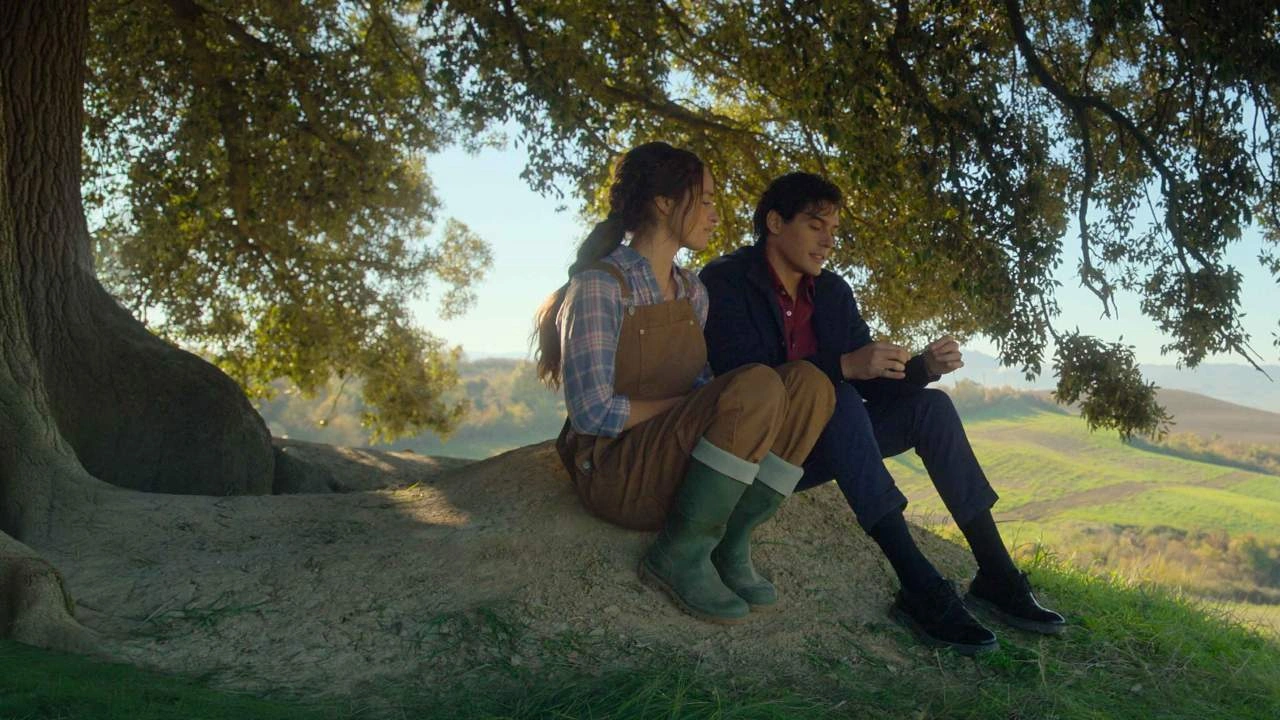
Director Laura Chiossone keeps the drama measured. She restrains the material before it can spill into melodrama and uses a visual grammar tied to the characters’ physical bond with the land. The camera frames the village as a lived-in place. People work here. People pay taxes here. Romance has to share space with municipal reality, a famously unglamorous co-star.
The soundscape carries equal specificity. The melodic cadence of the Tuscan dialect anchors the film culturally and emotionally. The English dubbing creates a jarring break for international audiences. Vocal performances fail to match the actors’ physical movements, producing a distancing effect that weakens the performances. The original language version reveals richer sonic texture, allowing rhythm, breath, and regional speech to support the emotional design.
The music guides the film’s shifts with restraint. It avoids the heavy-handed cues common in weaker romances and lets feeling emerge through pace and atmosphere. The film remains accessible through these presentation flaws. Its sincerity holds.
The Economics of the Heart and Structural Pacing
The narrative studies the paradox of independence. Elisa has built self-reliance into armor, and that armor has become a private cell. Her struggle lies in loosening those defenses while preserving the identity they helped her build. The film reaches its strongest register when legacy collides with liquidity.
A dinner-table debate over Le Giuggiole becomes the dramatic peak, framing the estate as gift and burden at once. The scene gives financial trauma a domestic shape. It understands how working-class anxiety enters the room, sits down, and asks who will pay.
The structure has less assurance in its opening movement. The early stretch carries a heavy load of exposition, subplots, and secondary characters, giving the first twenty minutes a crowded density that takes time to settle. The middle act loses momentum when the central tension briefly thins. The resolution supplies a satisfying emotional beat, yet it feels slightly too arranged. Earlier scenes honor mess, contradiction, and adult compromise. The ending arrives with a tidiness that weakens some of that grounded weight.
The film works best when it trusts the maturity of its premise. It speaks to viewers who understand love as a negotiation with history, debt, family, and the small humiliations of practical life. Its lighthearted moments sit beside real emotional pressure. The result is comforting, textured, and quietly alert to the price of staying rooted.
The Italian romantic comedy No Place to Be Single premiered worldwide on Prime Video on May 8, 2026. Based on the bestselling novel by Felicia Kingsley, the film is set against the picturesque backdrop of the Tuscan village of Belvedere in Chianti. It follows Elisa, a single mother managing her family’s vineyard, whose life is complicated by the return of a childhood friend and the high-stakes financial pressures threatening her estate. You can stream the film exclusively on Amazon Prime Video.
Where to Watch No Place to Be Single (2026) Online


Full Credits
Title: No Place to Be Single
Distributor: Prime Video, Amazon MGM Studios
Release date: May 8, 2026
Rating: A (Italy), 15+ (International)
Running time: 1 hour 43 minutes
Director: Laura Chiossone
Writers: Alessandra Martellini, Giulia Magda Martinez, Matteo Visconti
Producers and Executive Producers: Paola Lucisano, Federica Lucisano, Fulvio Lucisano
Cast: Matilde Gioli, Cristiano Caccamo, Amanda Campana, Sebastiano Pigazzi, Cecilia Dazzi, Margherita Rebeggiani, Marco Cocci, Bebo Storti, Francesco Turbanti, Pietro Resta
Director of Photography (Cinematographer): Valerio Evangelista
Editors: Luciana Pandolfelli
Composer: Ratchev & Carratello
The Review
No Place to Be Single
The film succeeds by anchoring its romance in the exhausting reality of debt and domestic labor. While the pacing occasionally falters and the dubbing disrupts the sensory experience, the performances offer a grounded maturity. It treats its characters as adults with mortgages rather than caricatures of desire. It avoids the typical sweetness of the genre to provide something terrestrial.
PROS
- Matilde Gioli’s grounded and weary performance.
- Tactile, non-commercial cinematography by Valerio Evangelista.
- Authentic, overlapping dialogue that mimics real familial energy.
- A mature exploration of self-reliance as an emotional defense.
CONS
- Distracting English dubbing synchronization issues.
- An overstuffed introductory act with too many secondary characters.
- A perceptible dip in pacing during the middle act.
- A resolution that feels convenient and lacks previous grit.