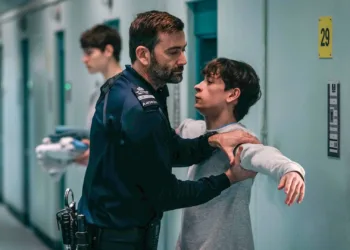
















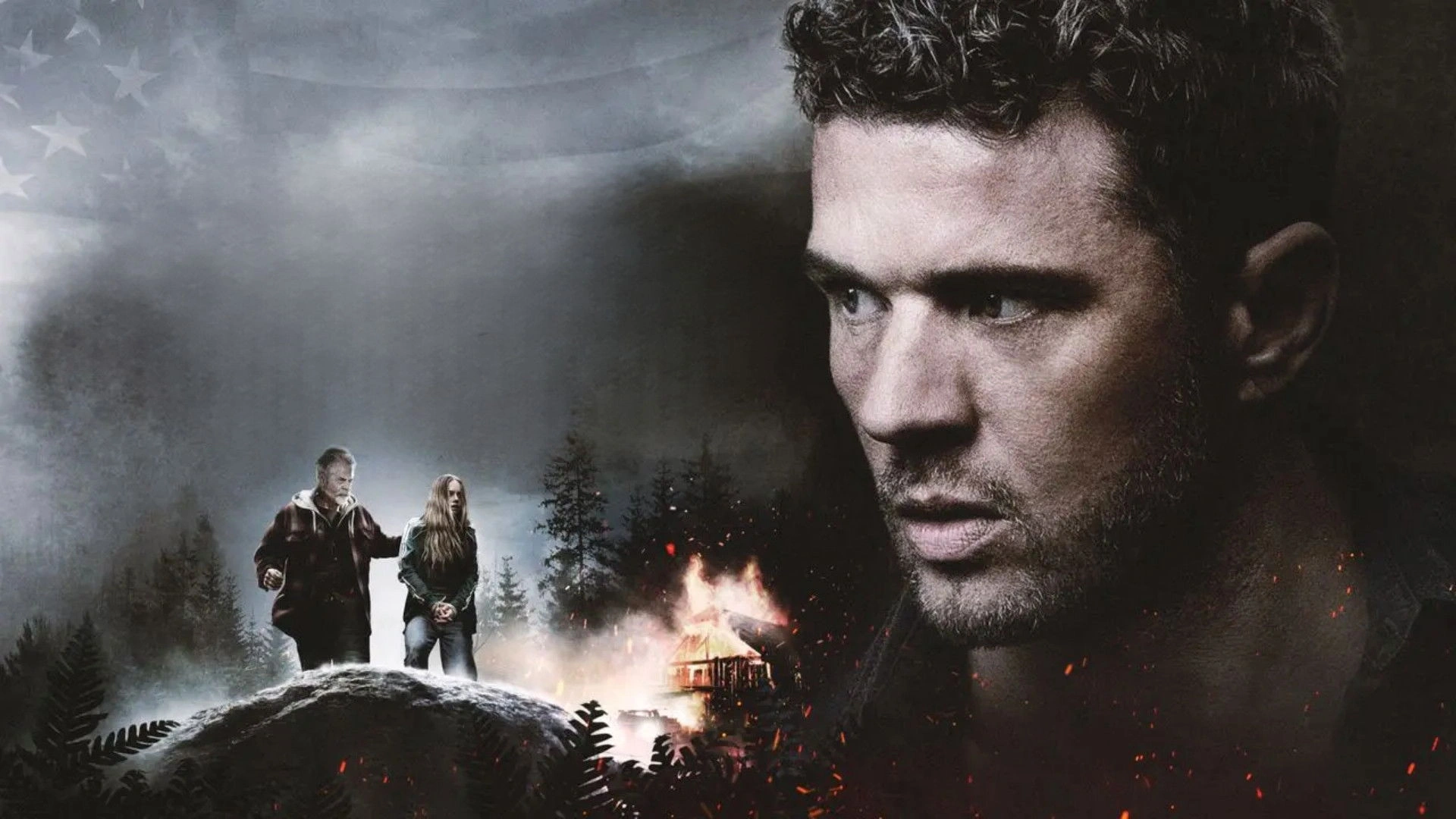

The film begins with a prison gate framed in cold, expressionistic severity, a slab of institutional geometry that could have wandered in from a neo-noir with bad sleep habits. Danny steps through it as a figure shaped by absence. His release marks a passage from enclosed punishment into a volatile, open-air purgatory. The setup has the shape of a secular pilgrimage.
Danny plans to escort his daughter, Alex, through university campus tours, turning a road trip into a tactical bid for repair. The car becomes a narrow chamber of withheld speech, carrying a father’s violent history beside a daughter’s uncertain future. Reconciliation sits in the passenger seat, tense and underpacked.
The shift from quiet family drama to survivalist nightmare arrives fast at a secluded campsite. The pastoral calm of the American countryside proves a surface, thin as stage paint. Shadows lengthen in the woods. Hooded zealots appear, treating Danny and Alex as prey.
The film pivots with absolute force. A college tour becomes a survival exercise, and the landscape hardens into a kill zone. The domestic friction of the first act gives way to primal combat against a sect that rejects the modern world. Danny discovers that his old skills retain value in this new economy. A grim exchange rate, naturally.
The Physicality of Regret and Survival
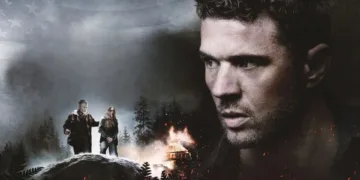
Ryan Phillippe builds Danny from the bodily cost of his past. He plays him as a weary warrior, grounded and vulnerable. His movement carries carceral gravity, as if the sentence remains stored in muscle and joint. Phillippe suggests a man who spent years measuring the failures of his life inside a cell, then carried those calculations into daylight. The soldierly skill is grounded in decay. His knees ache during a sprint. His breath catches. The body keeps accounts.
Phillippe’s physical presence communicates exhausted conviction. He strips away glossy genre swagger and works in grit, fatigue, and lived-in intensity. Danny survives through skill, pain, and grim purpose. The performance gives the violence an ethical murk. The same history that damaged his family becomes the mechanism that may save Alex. Protection and harm share a lineage here, a nasty bit of moral bookkeeping.
Amélie Hoeferle gives Alex the necessary counterweight. She is written as an intelligent young woman, alert and equipped with a sharp survival instinct. Her exchanges with Danny carry justified resentment, shaped by his long absence. That friction gives the film emotional pressure before the weapons come out. Once the threat arrives, Alex’s intelligence turns operational. She becomes an active participant in the nightmare, reading danger with increasing precision.
Their bond develops through forced violence and mutual recognition. Trust is built in dirt, panic, and bruised silence. The film frames them as two people decoding each other under pursuit, with the underbrush serving as cover and confessional. Family therapy, apparently, needed fewer couches and far worse lighting.
Vancouver Noir and the Tactical Aesthetic
Adam Davidson gives the Vancouver wilderness a visceral visual syntax. The cinematography uses a crisp, grim palette that drains comfort from the setting. Forest space becomes claustrophobic. Frames press Danny and Alex against dense foliage, creating the sensation of constant surveillance. The woods watch them. Chiaroscuro enters through branches, shadow, and narrowing sightlines, while the expressionistic framing turns natural space into a psychological trap.
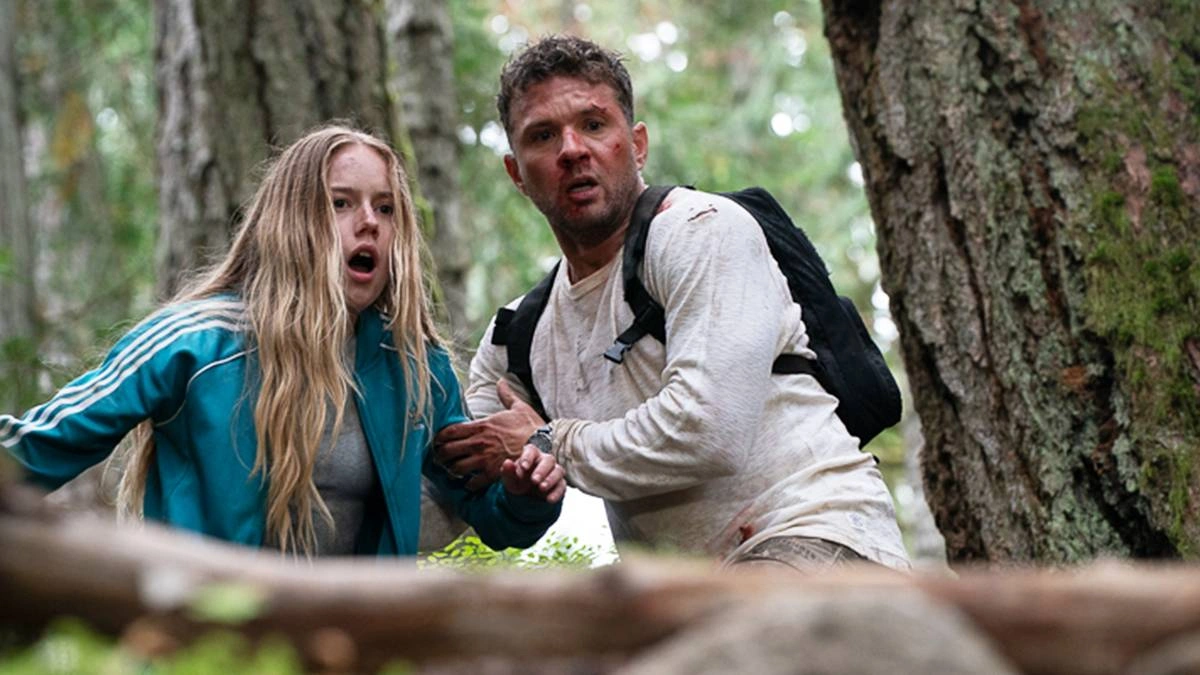
Davidson’s tactical choice to remove firearms from the main action shapes the film’s physical grammar. Combat depends on primitive tools: bows, arrows, and knives. The result is raw, close, and desperate. Distance collapses. Every encounter feels governed by breath, reach, impact, and bad luck. The camera stays near the struggle, catching heavy breathing, dirt, and the brutal friction of survival. Motion matters here; the film favors proximity and pressure over clean spectacle.
Sound design supplies much of the dread. It manipulates audience perception with precise acoustic threats. The vibration of a crossbow string carries lethal promise. Gravel crunching under a boot announces danger with awful clarity. These cues create dread stronger than digital explosions.
Practical stunt work gives the action weight. Car collisions land with a sense of real mass. The fights are messy and unchoreographed, matching the frantic scrambling of people trying to stay alive. The aesthetic reinforces a bleak view of survival in an unforgiving world. Violence exhausts everyone. Sensible, really.
Sectarian Horror in a Serialized World
The antagonists embody radical isolation pushed into sectarian horror. Abigail Dixon leads the group with quiet, grandmotherly malice. C. Thomas Howell offers aggressive zealotry as a leader fixated on community survival. Their ideology rests on a grim biological imperative. They hunt young women to sustain their closed society. The motive gives the chase an existential chill and deepens the kidnapping setup.
The cult operates inside a world of its own construction. It reflects the bubbles that define modern social fragmentation, taken to a murderous extreme. Their rejection of the modern world becomes a doctrine of control, reproduction, and predation. Identity here is tribal, enclosed, and violently enforced. Danny’s violent capacities become the means of rescue, giving his arc its ethical gray zone.
The “Chapter One” designation places the film within a serialized frame. It carries the weight of a prologue while giving this encounter a self-contained arc. The story reaches a temporary end in a remote cabin. The ending is abrupt, leaving several threads for the second chapter. That structure reflects the current streaming landscape, where films often behave like episodic content built for immediate consumption.
The movie works as a calculated step toward a mid-budget thriller universe, concentrating on the tension between Alex’s resentment and Danny’s protective instincts. The final moments leave the characters catching their breath inside a partly resolved narrative. The violence has paused. It has unfinished business.
One Mile: Chapter One premiered on February 20, 2026, as part of a unique simultaneous digital release alongside its sequel. This high-stakes survival thriller stars Ryan Phillippe as a retired special forces operative whose attempt to reconnect with his estranged daughter during a college road trip takes a dark, violent turn. The film was shot on location across Vancouver Island, utilizing its dense wilderness to heighten the sense of isolation and dread. Currently, the movie is available to watch on major digital platforms, including Paramount Movies, Prime Video, and Fandango at Home.
Where to Watch One Mile: Chapter One Online










Full Credits
Title: One Mile: Chapter One
Distributor: Paramount Global Content Distribution, Republic Pictures
Release date: February 20, 2026
Rating: R
Running time: 86 minutes
Director: Adam Davidson
Writers: John Hlavin, T.J. Brady, Rasheed Newson, Josh Senter
Producers and Executive Producers: Aaron Kaplan, Brian Morewitz, Michael Lohmann, Jaiden Kaplan, Ryan Phillippe, John Hlavin, Chad Oakes, Michael Frislev, Adam Davidson
Cast: Ryan Phillippe, Amélie Hoeferle, C. Thomas Howell, Sage Linder, Sara Canning, Richard Harmon, Beverley Elliott, Phil Burke, Anthony Timpano
Director of Photography (Cinematographer): Pascal Combes-Knoke
Editors: Rich Walters
Composer: Mark White
The Review
One Mile: Chapter One
This film serves as a lean, tactile exercise in survival that avoids the digital bloat of contemporary action cinema. It trades high-concept artifice for the grit of practical stunt work and low-tech weaponry. Ryan Phillippe anchors the narrative with a weary, carceral intensity. His performance pairs well with the film's claustrophobic visual style. While the serialized structure leaves some thematic threads hanging, the result is a focused study of paternal redemption through violence. It is a grim, effective entry in the neo-noir thriller tradition.
PROS
- Ryan Phillippe’s grounded, physical performance provides a sense of weary conviction.
- The commitment to practical effects and tactical, low-tech action creates a raw atmosphere.
- Amélie Hoeferle avoids typical teenage tropes, offering a character with sharp survivalist instincts.
- The Vancouver wilderness is utilized to create a claustrophobic, noir-inflected setting.
CONS
- The "Chapter One" structure leads to an abrupt ending that feels like an incomplete movement.
- Occasional logic gaps in character decision-making disrupt the established realism.
- The initial pacing is slow while established family drama takes precedence over the thriller elements.