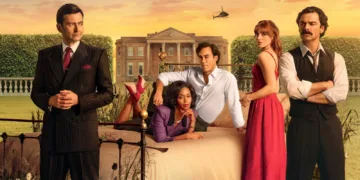





















Rivals Season 2 drops us back into the fictional county of Rutshire, that sun-bleached fantasy version of the Cotswolds where champagne flows, horses are well-groomed, and marriages are alarmingly negotiable. Picking up shortly after Season 1’s gold-statuette cliffhanger, the show resumes its sprawling soap with the late Dame Jilly Cooper’s bonkbuster source material as scripture. Cooper, who passed in October 2025, served as executive producer and worked on these scripts before her death, a fact that lends the season quiet posthumous weight.
Showrunner Dominic Treadwell-Collins and writer Laura Wade remain in the saddle. The series streams on Hulu stateside and on Disney+ internationally. The setting shifts to 1987, a UK general election year saturated with hairspray, Silk Cut smoke, and the political nervous energy of late-Thatcher Britain.
The episode count has bumped from eight to twelve, split into halves with a hybrid release pattern (three episodes upfront, then weekly drops). The Corinium versus Venturer franchise war rolls on, tangled with affairs, betrayals, and electoral maneuvering. The texture has shifted. This run is glossier, darker, and emotionally meaner than its predecessor.
Crisis Bonks and Class Warfare
Tony Baddingham (David Tennant) survives Cameron Cook’s (Nafessa Williams) gold-statuette swing with a scar, a black eye, and a thirst for retribution. He returns to Corinium intent on dismantling Venturer piece by piece, deploying his tabloid arm and a new gossip show called Uncensored, fronted by Sarah Stratton (Emily Atack) and journalist Beattie (Annabel Scholey), as weaponry. The election subplot tightens around Rupert’s seat as MP for Chalford and Bisley, with Tony and Beattie working to surface enough past scandal to bury him before polling day.
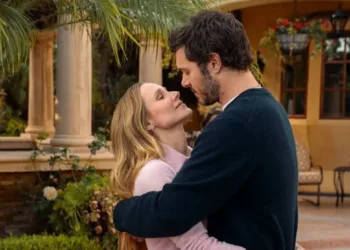
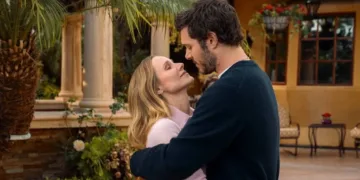
The romantic carnage runs in parallel. Rupert (Alex Hassell) and Taggie (Bella Maclean) barely manage a kiss before Rupert agrees to shelter a blood-spattered Cameron at his Devon cottage. The chaotic affair that follows pulls the rug out from under Taggie before her relationship has properly begun, a cruel little symmetry the show handles with surprising gravity.
Declan O’Hara (Aidan Turner) watches his marriage to Maud (Victoria Smurfit) crumble as her stage career flowers, including a striking turn in A Doll’s House that doubles as a thematic mirror for her own walk-out. Freddie Jones (Danny Dyer) and Lizzie Vereker (Katherine Parkinson) continue their tender, slow-motion fall, hampered by spouses and children they refuse to abandon. Their thread is the season’s quietly bruising centerpiece, a study in adult cowardice and adult longing.
Sarah Stratton shoulders the heaviest material. An unexpected pregnancy collides with her husband Paul’s reelection campaign and Tony’s chilling pressure over her “little inconvenience,” a phrase that captures the casual menace of the era with appalling economy. Valerie Jones (Lisa McGrillis) keeps the social-climbing comedy aerated with her gloriously tacky new house.
The canvas widens. Hayley Atwell arrives as a recast Helen Gordon, Rupert’s American ex-wife, with Rupert Everett as her new husband Malise, who happens to be Rupert’s former showjumping coach. The introduction of Rupert’s children, Marcus and Tabitha, opens up the man’s pre-Rutshire history. Sidelined Season 1 players get real arcs: Luke Pasqualino’s Bas Baddingham, Gary Lamont’s closeted Charles Fairburn, and Lara Peake’s Daysee processing trauma from her Season 1 assault. Material from Polo, Cooper’s follow-up novel, gets folded in, including a pair of twin polo players whose synchronized full-frontal pool dive arrives within the opening minutes. A thesis statement of sorts.
The Ensemble as Engine
David Tennant has fully unbuttoned his Tony Baddingham this time around. He chomps cigars, gloats over schemes, and operates with the gleeful malevolence of a Restoration comedy villain wandered into prestige television. The character flattens a touch into caricature, losing some of the layered menace of Season 1. The performance is so committed and so watchable that the trade feels worth it. His confrontations with Cameron, his manipulation of Sarah, his orchestrations against Rupert, all hum with predatory intelligence.
Alex Hassell is the season’s biggest revelation. Where Season 1 used him primarily as a smirking object of the female gaze (a creative choice that quietly inverted decades of how the camera tends to treat women in soaps), Season 2 cracks him open. The political scandal and the arrival of his ex-wife and children grant Hassell heavier dramatic notes, and he plays them with wounded tenderness I did not expect. His scenes with Taggie carry a gut-punch intimacy. His scenes with Helen reveal a damaged ex-husband and absent father who has spent years performing untouchability.
The women rise this season, and the show is better for it.
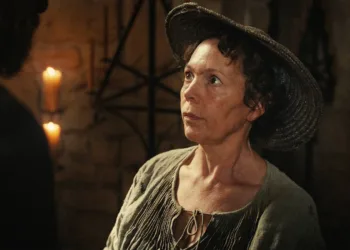
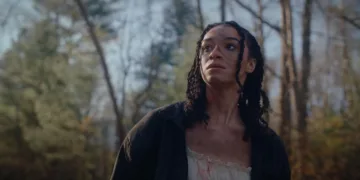
Bella Maclean continues to anchor the show’s quieter heart, with a more grown-up edge that includes a dance-bar moment of unexpected liberation. Victoria Smurfit is a surprise as a Maud reborn through her career, her theatrical scenes among the season’s finest writing for women. Emily Atack walks off with significant stretches of the first half, carrying the moral weight of the pregnancy storyline with bruised authority. Katherine Parkinson brings warmth and conflicted decency to Lizzie. Nafessa Williams gives Cameron real spiky complexity. Claire Rushbrook’s Lady Monica Baddingham, sweeping out of rooms with a brisk “Come on, dogs!”, is a small masterpiece of class-coded composure. Lisa McGrillis provides reliable comic fizz as Valerie.
The supporting men hold their own. Aidan Turner grounds the show with sensitivity as Declan, including a shower scene featuring perhaps the most magnificently anguished orgasm face ever televised. Danny Dyer is the show’s secret weapon, mixing comedy and heart as Freddie with a craftsmanship his earlier career rarely allowed him to display. Oliver Chris as the witless James Vereker, Rufus Jones as Paul Stratton, and Rupert Everett’s elegant Malise round out an ensemble where no one drops the ball.
Hyper-Saturated Cotswolds and the Last Days of Empire
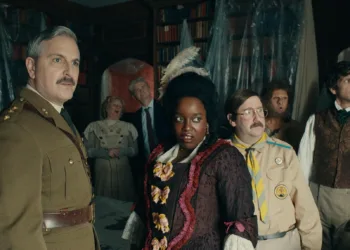
The visual world has been turned up another notch. The Cotswolds are shot with gauzy, sun-bleached luxury, every frame thick with cigarette smoke, hairspray, and shoulder pads broad enough to land aircraft on. The costuming carries thematic weight: crushed velvet, pinstripes, neon florals, jodhpurs, dressing-gowns deployed as armor. The houses compete for the title of tackiest interior decor, a status game that quietly comments on the Thatcher-era confusion of taste with money. Soundtrack cues from David Bowie and Rick James punctuate scheming, sex, and dance sequences. The turquoise indoor pool, the polo fields, the Corinium studio set, all function as a kind of memory-palace of late-eighties prosperity, real and imagined.

This run leans darker. Consequences arrive with more weight: pregnancy pressure, public ruin, marital collapse, the AIDS panic glimpsed through the era’s casual cruelty. The comedy survives intact. There are French-farce kitchen sequences, double-entendre character names (Muffy, short for Caroline, lands with a wink the size of Wiltshire), Neil Kinnock invoked as an anti-arousal mantra, and that synchronized twin polo player pool sequence I mentioned earlier. The show satirizes Thatcher-era hedonism, casual homophobia, AIDS panic, and tabloid cruelty without sanitizing the period or sneering at Cooper’s source material. The tribute to Cooper at the end of episode one is handled with the kind of warmth that has become rare on television.
The direction has ambition. A slow rotating camera captures a character’s life turning upside down. A tracking dinner-party shot reaches for something close to single-take fluency. Sometimes the visual metaphors land with the subtlety of a polo mallet to the temple, and certain editing choices undercut the rhythm of long takes. The hyper-saturated palette occasionally tips past good taste, deliberately I think, in keeping with the bonkbuster aesthetic. The show’s confident refusal to apologize for being soapy gives it an identity nothing else currently on television possesses. We have prestige drama, antihero misery, a thousand procedurals. We have only one Rivals.
The Imperfect Pleasures, or Where the Polo Mallet Hits a Toe
For all its pleasures, the season has rough patches.
The release model is the first irritant. Splitting twelve episodes into two halves with a three-episode opening drop followed by weekly installments before a mid-season break feels like a structural misjudgment. Episode three lands on a particularly grim low point, the kind of valley that may discourage weekly viewers and tempt them into waiting for the back half to materialize. Season 1 worked beautifully as a weekend binge. This new schedule fights the show’s own pleasure-delivery mechanics, what we might christen the bonkbuster paradox: tension that wants to be released keeps being prorated.
Storyline drag is the second issue. The TV franchise war, central to the engine of the plot, can feel sluggish next to the romantic and personal threads. The corporate scheming, a necessary skeleton, sometimes runs slower than the soapier capers it sits between. Taggie’s reduced presence in the opening run will frustrate viewers heavily invested in her arc with Rupert. The show promises her a larger role in the back half. Patience required.
A few smaller flaws. Hayley Atwell’s American accent wobbles. Tony’s flattening into a near-cartoon villain costs us some of the layered menace Tennant brought in Season 1, a point I keep going back and forth on, since the cartoon is also delicious. The show occasionally over-eggs its emotional beats with on-the-nose camera moves that feel like a director slightly distrusting the strength of his material.
These read as growing pains of an expanded scope. None of them touches the central pleasure of the show. The series knows exactly what it is, commits fully, and trusts its audience to ride along while the polo ponies thunder past.
Rivals is a British period comedy-drama based on Jilly Cooper’s iconic 1988 novel from the Rutshire Chronicles series. Set in the high-stakes, glamorous world of 1980s independent television, the show centers on the intense rivalry between the charismatic ex-Olympian Rupert Campbell-Black and his neighbor, the ruthless TV tycoon Lord Tony Baddingham. The first season premiered on Disney+ in late 2024 to critical acclaim for its witty dialogue and racy themes. The highly anticipated second season is scheduled to premiere on May 15, 2026, on Disney+ (and Hulu in the US), continuing the saga of ambition, romance, and betrayal in the fictional county of Rutshire.
Where to Watch Rivals Season 2 Online


Full Credits
Title: Rivals Season 2
Distributor: Disney+ (Global), Hulu (US)
Release date: May 15, 2026 (Season 2 Premiere)
Rating: TV-MA
Running time: 45–60 minutes per episode
Director: Elliot Hegarty, Dee Koppang O’Leary, Alexandra Brodski
Writers: Jilly Cooper, Dominic Treadwell-Collins, Laura Wade, Sophie Goodhart, Marek Horn, Mimi Hare, Clare Naylor, Dare Aiyegbayo, Kefi Chadwick, Tray Agyeman, Sorcha Kurien Walsh
Producers and Executive Producers: Dominic Treadwell-Collins, Alexander Lamb, Felicity Blunt, Jilly Cooper, Lee Mason, Elliot Hegarty, Eliza Mellor, Marco Petrucco
Cast: David Tennant, Alex Hassell, Aidan Turner, Katherine Parkinson, Bella Maclean, Victoria Smurfit, Nafessa Williams, Danny Dyer, Emily Atack, Luke Pasqualino, Hayley Atwell, Rupert Everett
Director of Photography (Cinematographer): John Lynch, Ashley Barron, Ed Rutherford, Carlos Catalán, Mark Nutkins
Editors: Oliver Parker, Matthew Gray, Adam Moss, Vicky Tooms
Composer: Jack Halama, Natalie Holt
The Review
Rivals Season 2
Rivals Season 2 takes everything that worked in its debut and stretches it across a larger, richer, more emotionally bruising canvas. The cast is exceptional, the writing sharper, and the period detail intoxicating. The show has grown a conscience without losing its sense of mischief, which is a difficult trick to pull off. The release schedule and occasional storyline drag keep it from perfection, yet the pleasures so far outweigh the gripes that quibbling feels mean-spirited. Soapy, smart, sexy television of a kind nobody else is currently making.
PROS
- Career-best work from Alex Hassell, who finds genuine vulnerability beneath Rupert's polish
- A meatier canvas for the women of Rutshire, with Emily Atack, Victoria Smurfit, and Claire Rushbrook standouts
- Lush production design, costuming, and period soundtrack
- David Tennant having visible, infectious fun as Tony Baddingham
- Lush production design, costuming, and period soundtrack
- Tonal balance of comedy, sex, and surprisingly tender drama
- Loving, unsneering treatment of Jilly Cooper's source material
- A confident, singular identity in a crowded TV landscape
CONS
- Awkward hybrid release schedule fights the show's natural binge rhythm
- TV franchise war storyline drags next to the romantic threads
- Taggie sidelined for much of the opening run
- Tony occasionally flattens into pantomime villainy
- Hayley Atwell's American accent slips