





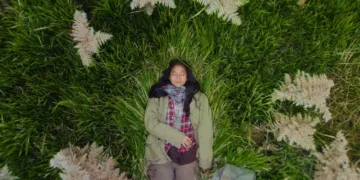

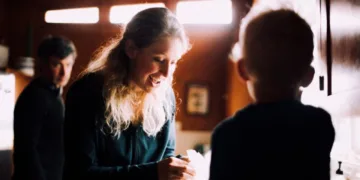













Leah Nelson’s animated feature Tangles faces the gradual collapse of identity, adapting Sarah Leavitt’s autobiographical graphic novel into a severe cinematic reflection on mortality. The year is 1999. Sarah, a twentysomething cartoonist, lives in the bohemian refuge of San Francisco, works at an alternative publication, and shares a life with her partner, Donimo. Her emerging independence fractures after her mother, Midge, is diagnosed with early-onset Alzheimer’s disease.
Pulled back through the map of her own past, Sarah returns to the family home in Maine, where her father Rob and sister Hannah are already standing inside a quiet domestic vanishing. Nelson rejects standard medical sentimentality.
Through hand-drawn 2D animation, the film opens an intimate window onto neurological decay, tracing the family’s response as the biological anchor of their shared world begins to disappear. With vocal work from Abbi Jacobson and Julia Louis-Dreyfus, the production turns a painful memoir into an inquiry into human fragility, where bleak existential recognition sits beside sudden sparks of household absurdity.
The Geography of Duty and the Erasure of Self
The narrative moves through a severe existential friction, charting the collision between a young woman’s self-invention and the ancestral pull of filial obligation. In San Francisco, Sarah shapes a life through artistic labor and her romance with Donimo. This western place becomes an illuminated terrain of acceptance, where her queer identity is met by familial warmth, seen through tender flashbacks of a childhood pride parade and comic phone calls with her mother. Time, still, has its own cruelty.
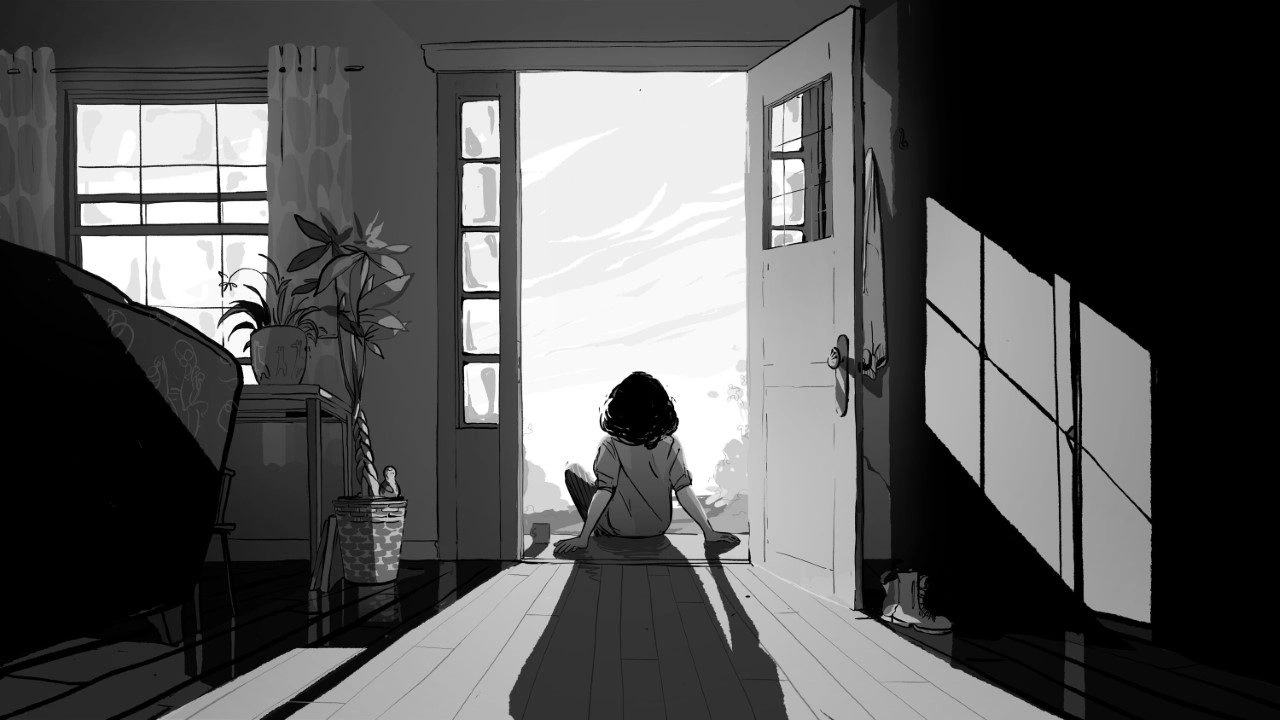
The biological crisis in Maine suspends Sarah’s independent adulthood with terrible force. Once she returns home, she finds a family splintering beneath grief that has no map. Rob withdraws into brittle denial, reading Midge’s cognitive errors as menopause, and Hannah clashes with Sarah over the daily burden of care. Through these altered relations, the film traces an agonizing psychological conversion.
Sarah moves from distant observer of her mother’s life into keeper of her mother’s fading consciousness. Memory becomes a fragile currency. Duty becomes a heavy philosophical necessity, requiring the child to become the parent to an elder slipping toward an absolute inner void. The sacrifice hangs in moral uncertainty, suspended between love and ancestral guilt.
Charcoal Shadows and the Interiority of Decay
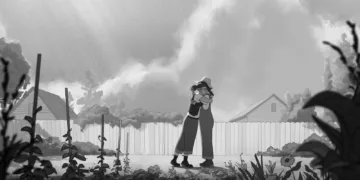
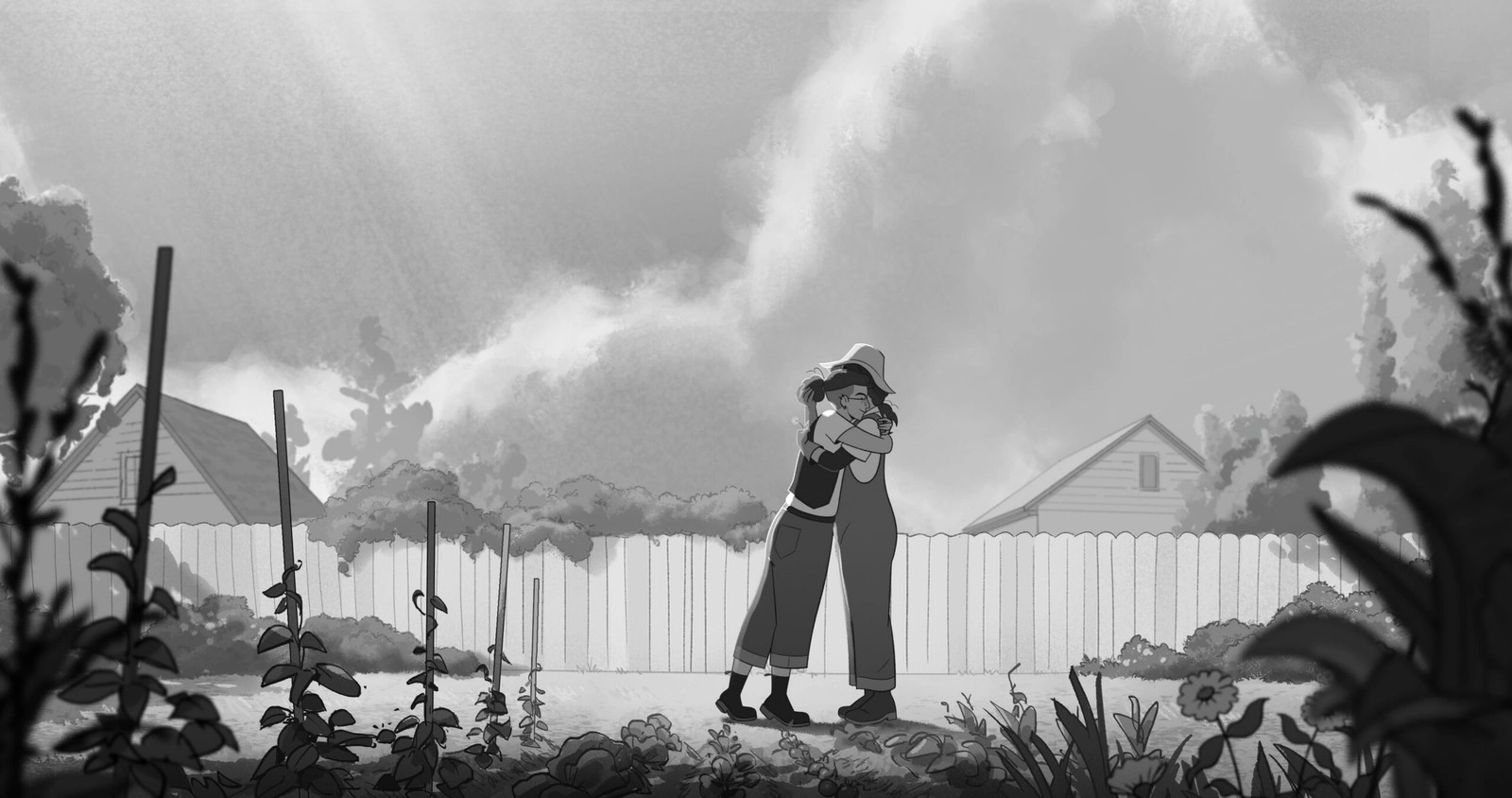
Animation finds its force by giving visible shape to the psychic interior, turning the screen into an extension of a mind coming apart. The visual design uses stark monochrome imagery, with charcoal tones that give the family tragedy a raw documentary texture. This black-and-white surface is pierced by sudden magenta and luminous violet, colors tied to emotional ruptures and memories held for one last instant before disappearance.
As Midge’s illness deepens, the film leaves realistic representation and enters bright expressionistic terror. A festive Mexican street parade mutates into a frightening hallucination after Midge vanishes into the crowd. The neurological clock-drawing test expands into an abstract vision of cognitive failure. Later, Sarah’s inner fears take the form of skeletal figures consuming her mother’s identity, and her physical return home appears as movement through deep, rising water.
Julia Louis-Dreyfus gives an extraordinary vocal performance, mapping Midge’s shifting consciousness from fierce maternal protection to a defensive and frightening fog. Abbi Jacobson grounds Sarah with restraint, joined by the authentic presence of Bryan Cranston and Beanie Feldstein. The auditory world is tied together by female-fronted 1990s rock music. The songs become Sarah’s private audio diary, a sonic shroud against the absolute silence of her mother’s encroaching cognitive winter.
The Absurdity of Grief and the Spaces Between Tears
Nelson balances the crushing weight of terminal decline with sharp, irreverent gallows humor, understanding laughter as a final psychic defense against despair. Inside the terrifying vacuum of a medical clinic, the family turns the pending diagnosis into a high-stakes casino game, clinging to any possible alternative outcome until Sarah cries out for a less permanent affliction.
The comic timing becomes a survival mechanism. It admits the absurdity of tragedy and preserves the sorrow beneath it. This psychic shielding returns during Sarah’s cross-country flights, where the airplane public address system gives voice to her hidden, despairing fears. The narrative rhythm slows during these emotional crises, taking on an impressionistic drift. The film grants its characters a rare quietude.
Sarah is given silent moments to pause, breathe, and weep alone after painful encounters with her mother. These pauses reveal the real weight of long-term caregiving, asking the audience to remain inside the hollow spaces of an unfolding loss. By lingering in silence, the film honors the cadence of mourning, forming a place where familial warmth exists beside unavoidable existential isolation.
The adult animated feature Tangles had its world premiere on May 14, 2026, at the Cannes Film Festival, screening within the prestigious Special Screenings section. Because the film recently completed its festival debut, it is currently seeking theatrical or streaming distribution, meaning it is not yet available for wide public viewing or streaming on standard platform schedules. Audiences keeping track of the release can expect updates as distribution rights are secured following its initial festival run.
Where to Watch Tangles (2026) Online
Full Credits
Title: Tangles
Distributor: Seeking distribution, Charades
Release date: May 14, 2026
Running time: 102 minutes
Director: Leah Nelson
Writers: Leah Nelson, Sarah Leavitt, Trev Renney
Producers and Executive Producers: Julia Louis-Dreyfus, Lauren Miller Rogen, James Weaver, Alex McAtee, Madeline Blair, Ross Murray, Jen Ray, Sophie Hoegh, Vicky Patel, Steve Barnett, Alan Powell, Seth Rogen, Evan Goldberg, Teresa Toews, Jay Grandin
Cast: Julia Louis-Dreyfus, Abbi Jacobson, Beanie Feldstein, Bryan Cranston, Seth Rogen, Samira Wiley, Pamela Adlon, Sarah Silverman, Bowen Yang, Wanda Sykes, Phil Rosenthal, Fern Grandin
Editors: David Avery
Composer: Dan Romer
The Review
Tangles
Tangles operates as a devastating, necessary piece of animated cinema, transforming private grief into a collective meditation on the fragility of human identity. Leah Nelson respects the quiet spaces of domestic life, anchoring absolute loss in sharp humor and stark imagery. While the visual landscape occasionally mimics the flat structure of its printed source material, the emotional depth remains undeniably profound.
PROS
- Julia Louis-Dreyfus delivers a remarkable performance, capturing the sliding states of cognitive decay with raw authenticity.
- The surreal nightmare sequences successfully literalize internal psychological horrors, moving far beyond realistic representation.
- The implementation of gallows humor serves as an organic, powerful coping mechanism rather than an unwelcome distraction.
- The stark charcoal aesthetic and purposeful magenta color splashes heighten the emotional weight of fading memories.
CONS
- The visual style occasionally feels pinned to the static panel structures of the original graphic novel, reducing cinematic movement.
- Certain narrative segments adopt a softer, family-oriented tone that occasionally leaves the audience wanting a more visceral, gritty look at the disease.