




















![Kingdom Hearts Collection [I-III] Review](https://gazettely.com/wp-content/uploads/2026/10/Kingdom-Hearts-Collection-I-III-1-360x180.webp "Kingdom Hearts Collection [I-III] Review: KHII Holds Steady as Newer Entries Fluctuate 37")



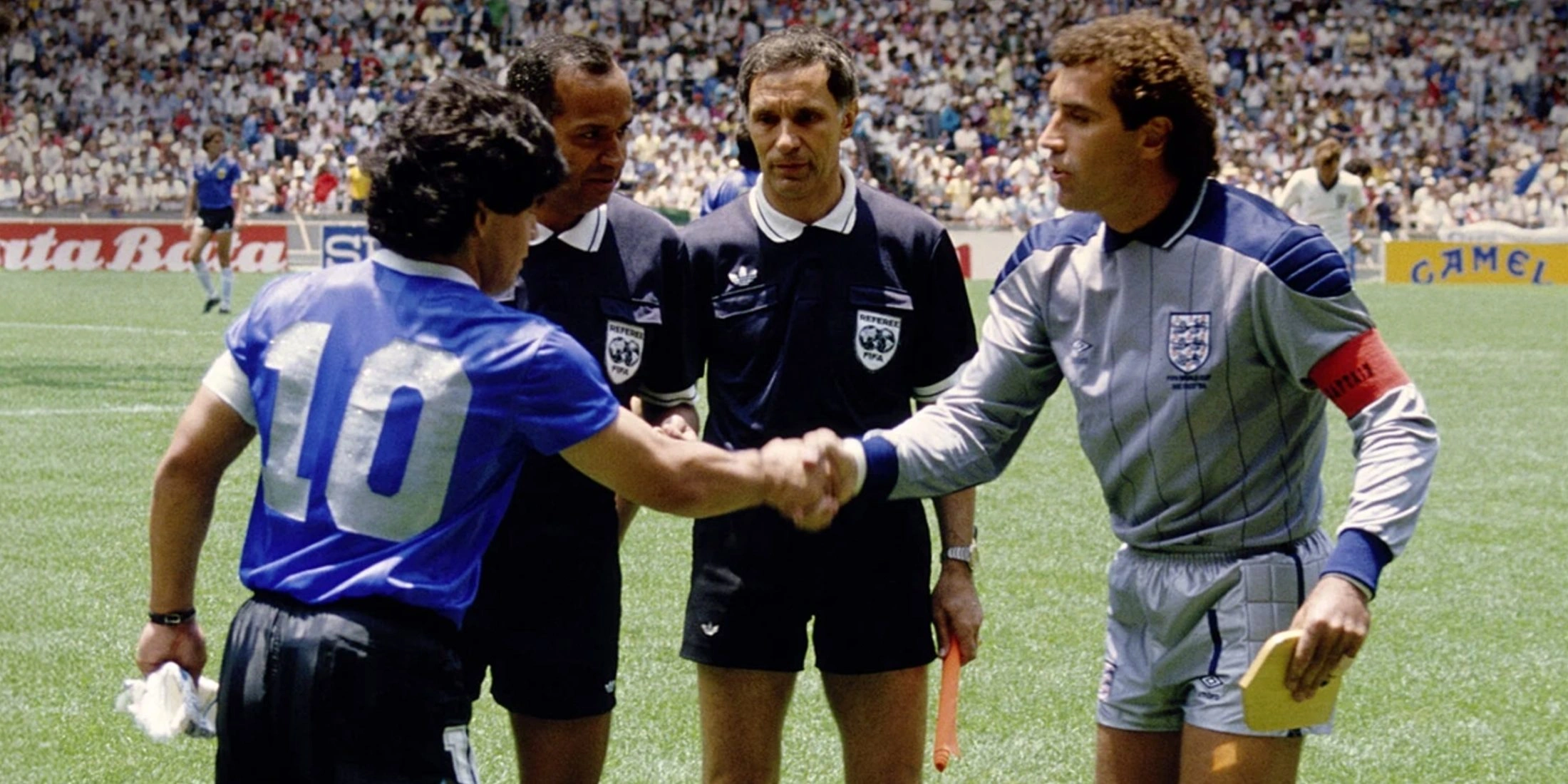

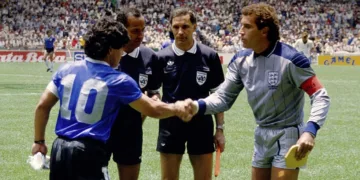
The cinema of athletic memory gains a severe, thoughtful entry with The Match. Directed by Juan Cabral and Santiago Franco, this non-fiction feature takes its historical plan from Andrés Burgo’s text and narrows its attention to one afternoon: June 22, 1986.
On that date, the Azteca Stadium in Mexico City staged the World Cup quarter-final fixture between Argentina and England, a game that escaped sport almost at once and entered the fever room of national myth. Diego Maradona stands inside that fever room like a saint with suspicious hands.
He performs two physical acts that permanently alter sporting mythology. The first is the rule-breaking, hand-assisted opening goal, a small crime committed under floodlights and then baptized by collective desire. Minutes later comes the breathtaking sixty-meter solo run through the frustrated English defense, a passage of movement so beautiful that it seems to demand absolution for the earlier fraud.
The film holds this brief span of time under glass, treating the ninety-minute fixture as a historical pressure chamber loaded with psychological force. It pursues the strange afterlife of two contradictory actions, both lodged in global memory like shrapnel.
The Pitch as a Proxy Theater
Cabral and Franco build a precise historical scaffold that turns this patch of green grass into a theater of proxy warfare. The shadow of the 1982 Falklands War hangs over the narrative with the heaviness of unfinished mourning.
The bloody conflict left deep national wounds, and citizens searched for an arena where damaged collective pride could speak without quite calling itself war again. Sport, that polite asylum for irrational feeling, was available. The pitch becomes a processing plant for geopolitical trauma. Efficient, muddy, absurdly well attended.
The film traces this fierce athletic enmity back past 1982, rooting the bitterness in the infamous 1966 World Cup quarter-final. That chaotic meeting became the primary catalyst for modern on-pitch hostility. It directly required the invention of the yellow and red penalty card system, a mechanism of bureau-athletic discipline designed to contain raw human rage. Through this timeline, the directors show history accumulating interest like a bad loan. The debt keeps rolling forward. Everyone keeps playing.
Political leaders such as Margaret Thatcher and Leopoldo Galtieri, along with sensationalist media outlets, actively weaponized the match. They framed the fixture as a chance for symbolic retribution, asking athletes to act as soldiers in short-shorts, which remains one of civilization’s sillier uniforms for vengeance.
A revealing disconnect appears. Fans and politicians hungered for metaphorical blood. The players experienced a simpler reality. They saw themselves as professionals trying to win a tournament. The documentary finds its structural charge in the gap between public mythmaking and athletic pragmatism.
Formalist Geometry and Chromatic Nostalgia
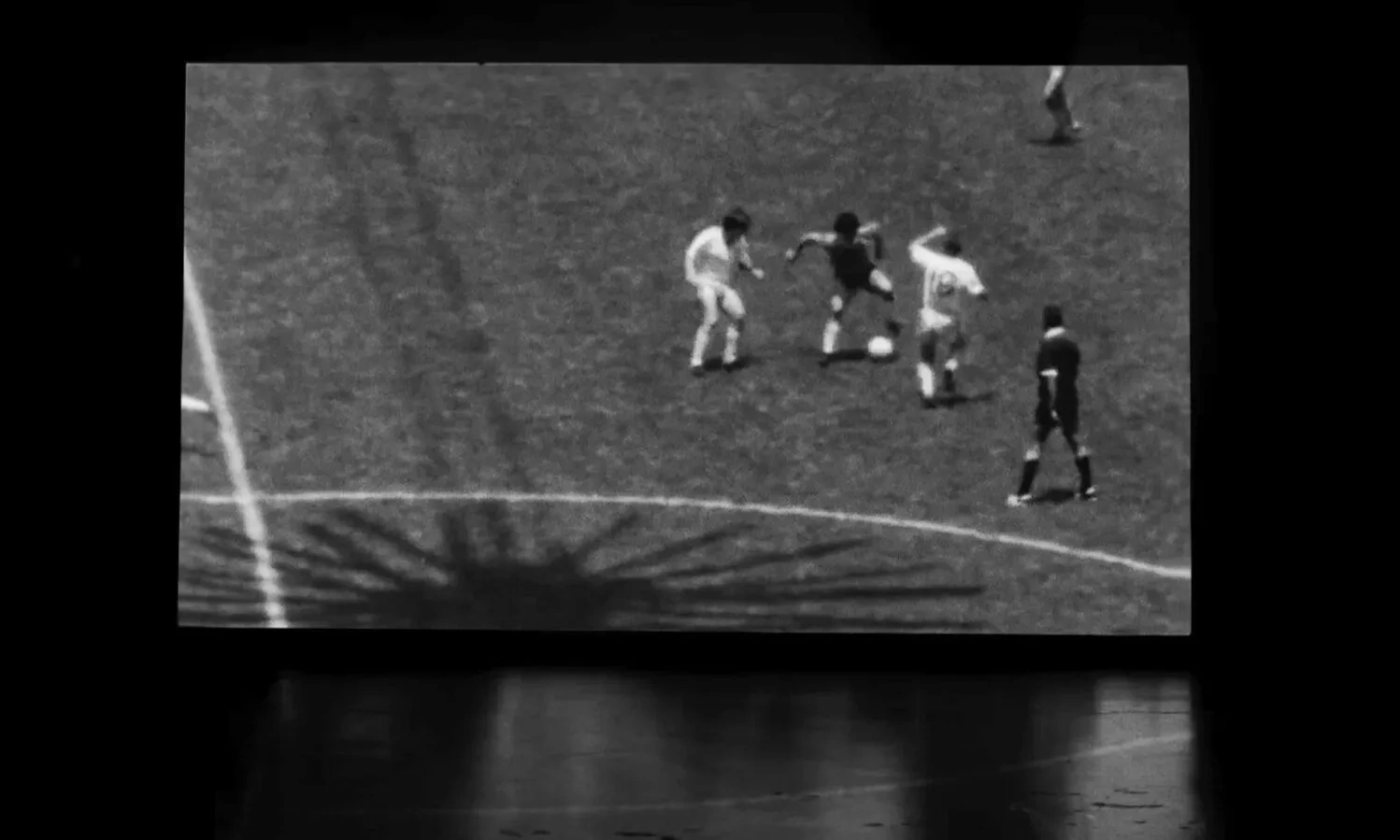
The documentary’s aesthetic design rests on a deliberate formalist strategy. Cabral and Franco isolate the surviving players from both nations inside a neutral black-box studio in Spain. Filmed in stark, high-contrast black-and-white, these men in their sixties look like weathered cinematic figures, almost characters from a revisionist Western. They sit in heavy stillness, cast as historical subjects and real-time spectators of their own youth. Then the archival footage arrives, and the monochrome hush fractures.
Projected onto immense theater screens behind the men, the historical tape erupts in vivid color. The visual design creates a sharp temporal split. The past appears electric, chaotic, alive with dangerous weather. The present appears quiet, reflective, drained of color, already half inside the museum. To deepen this temporal spell, the directors use a strict 4:3 aspect ratio. The square frame evokes the vintage television monitors of the mid-1980s, placing modern viewers behind the same retro portal through which the event first gained mass memory.
The film also mirrors the physical duration of a standard football match through its strict ninety-one-minute runtime. This structural alignment gives the narrative an accelerated rhythm. The electronic synth score by Nico Barry and Tomás Jacobi drives that momentum. Their music pulses beneath the images, keeping the chronology brisk and sparing the film from the dustiness that can settle over historical retrospectives.
Historical Trivia and Cross-Cultural Psychology
The project’s human force comes from the testimony of Gary Lineker and Jorge Valdano, two extraordinarily articulate men who dominate the vocal track. Players such as John Barnes and Peter Shilton provide localized memories around them. The interviews trace a heartening evolution away from old state-sanctioned hostility and toward a present-day baseline of mutual respect.
This reconciliation receives its clearest symbolic form in the final scenes, where the elderly former adversaries play table soccer together, an endearing miniature of their former battlefield. Then my view of the achievement changed with reflection.
The documentary shows clear intellectual limits. It repeatedly gives space to superficial trivia at the expense of deep cross-cultural analysis. Cabral and Franco spend substantial time on Carlos Bilardo’s intense superstitions, tactical management quirks, and the frantic last-minute modification of the light blue Argentine jerseys. These material details have flavor. They also let the film sidestep the richer psychological questions raised by the event.
The central philosophical divide concerns gamesmanship and sports honesty. British culture remains permanently wounded by Maradona’s deception. South American culture celebrates the trickery as a valid form of pop-tactical rogueism. Why do these reactions split so sharply?
The film treats this divide as a footnote, favoring smooth commercial polish over a rigorous excavation of national psyches. It remains an entertaining artifact. It chooses trivia over truth, which is fun until one remembers that truth was sitting there on the bench, fully warmed up.
The non-fiction film made its global debut at the Cannes Film Festival on May 13, 2026, screening inside the prestigious Cannes Premiere lineup. It expands to a wider audience with a theatrical launch in Argentina on May 21, 2026, perfectly timed ahead of the upcoming World Cup. Viewers can watch the release in theaters through Buena Vista International, while international distribution rights are managed globally by Mediawan and Goodfellas.
Full Credits
Title: The Match
Distributor: Buena Vista International
Release date: May 13, 2026
Running time: 91 minutes
Director: Juan Cabral, Santiago Franco
Writers: Juan Cabral, Santiago Franco, Andrés Burgo
Producers and Executive Producers: Flora Fernández Marengo
Cast: Gary Lineker, John Barnes, Jorge Burruchaga, Jorge Valdano, Oscar Ruggeri, Peter Shilton, Ricardo Giusti, Julio Olarticoechea
Director of Photography (Cinematographer): Pablo Gallego
Editors: Lucas Coppolechia, Sebastian Fasanelli, Juan Pablo Scaglione, Mauro Caporossi
Composer: Nico Barry, Tomás Jacobi
The Review
The Match
The film functions efficiently as a sleek, rhythmically precise piece of athletic commemoration, capturing the external historical scale of a mythic sporting fixture. Its visual design remains striking, contrasting heavy monochrome stillness against saturated color archives. However, its intellectual ambitions remain frustratingly shallow, prioritizing historical trivia and superficial artifacts over a genuine interrogation of cross-cultural psychology regarding gamesmanship. It operates as an exceptional primer for the curious, but remains a thin experience for those seeking deep philosophical insight.
PROS
- The clever implementation of a 4:3 aspect ratio and matching ninety-one-minute runtime creates an immersive structural echo of the period.
- Positioning the aged participants in a high-contrast black-and-white studio environment against color archival projections elevates the interview format.
- The feature benefits immensely from the highly literate verbal contributions of central narrators like Gary Lineker and Jorge Valdano.
CONS
- The narrative completely avoids analyzing national psyches, ignoring the highly divergent cultural perceptions of honesty, trickery, and deception.
- The script over-indexes on anecdotal material details, spending too much time on management superstitions and last-minute jersey alterations.
- The momentum relies heavily on a pulsing electronic score that occasionally masks a lack of narrative development.