




















The Mexican wilderness watches in silence, holding Esther and Junior inside a fragile pause. The couple’s path north from Haiti has stopped near an illegal logging camp, where survival has become a daily negotiation with fear, labor, and time. Junior gives his body to the timber trade.
Esther tries to make a home inside the rough hut offered by the foreman, Toño, pressing wildflowers into broken walls as if beauty might briefly overrule exploitation. Her daughters move through the glades with childhood wonder, and their innocence gives this waiting period its terrible pressure. The forest appears to shelter them, and its calm carries a buried threat. Around them, leaves tremble, trees fall, and human systems begin to feel as cold as nature itself.
The Aural and Visual Architecture
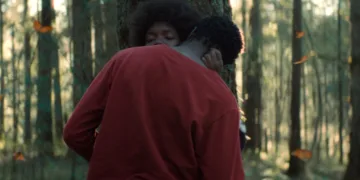
Gökhan Tiryaki’s widescreen images turn the forest into a vast, impassive presence. The greens are thick, almost heavy, swallowing the eye with their damp intensity. In the dawn scenes, light breaks through shadow with a strange tenderness, suggesting a world still forming itself before human damage fully arrives. The people inside these frames appear small, momentary, nearly accidental. They flicker against cycles older than their hunger, older than their hope.
The soundscape carries the same force. Lena Esquenazi and Valeria Mancheva build an acoustic world from tiny living signals. Insects chirp, foliage stirs, the forest seems to breathe before men enter with machines. Then the chainsaws arrive like wounds made audible. Timber falls with a dull, bodily violence. These sounds strike the viewer with blunt force, turning necessity into an assault on rhythm, habitat, and memory.
The film understands the forest as living space and commodity at once. That tension gives every image an ethical ache. Monarch butterflies recur as a delicate visual pulse, their orange movement passing through the trees like fragile embers.
Their migration echoes the family’s stalled passage, linking human displacement to biological instinct. The camera watches them with patience, as if it senses a common fate between winged bodies and uprooted people. The technical design makes the characters feel existentially small inside a landscape being cut apart by human need.
The Weight of Domesticity and Labor
Nehemie Bastien gives Esther a weary, watchful dignity. Her body seems tuned to danger before danger announces itself. She moves with maternal discipline, carrying fear without theatrical display. Esther understands the threats gathering around them, and her attention becomes a kind of moral intelligence. She listens, measures, protects.

Faustin Pierre’s Junior is shaped by the old burden of provision. He accepts the punishing work of the logging crew and fixes his mind on one final job that might carry the family forward. His hope narrows into a dangerous tunnel. The promise of future movement binds him tighter to a poisoned place. He believes labor can purchase escape, and the film lets that belief feel both necessary and tragic.
Toño resists the plain shape of villainy. He is practical, compromised, and useful to a corrupt machine. His decision to provide medicine for young Flor reveals a brief human warmth, and his role still remains exploitative. His comment about people condemning logging while living among wooden furniture cuts with philosophical precision. The film uses him to expose a shared guilt that cannot be placed neatly on one man. Destruction here is intimate. It sits in houses, tools, wages, furniture, and survival.
Flor and Aisha are drawn with clear naturalism. The film does not turn their vulnerability into easy sentiment. Their presence becomes a living fact pressing on every adult choice. They make the forest feel less like open space and closer to a moral test. Their wonder is real. The danger around that wonder is real too.
The Fragile Geometry of Hope
The Monarch butterfly migration becomes one of the film’s most mournful ideas. These insects cross immense distances through a world that offers no mercy and no acknowledgment. Their beauty covers a harsh biological command. In that image, the film finds a way to speak about migration through stillness. It studies the pause, the waiting, the suspended life between departure and arrival.
The central conflict grows from survival pressed against preservation. The logging camp destroys the world that shelters the family, and the family depends on the work that helps destroy it. This is where the film’s darkness becomes philosophical. It refuses easy purity. It asks what innocence can mean in a structure where each act of endurance carries a cost.
As the story moves forward, the mood tightens into survival thriller territory. Rainy season approaches. Flor’s asthma worsens. The forest begins to close around the family, less sanctuary than green enclosure. Local hostility deepens the anxiety, adding human suspicion to environmental danger. Esther’s faith in a better life remains a faint light inside the darkening frame. She dreams of a garden while living among trees marked for cutting.
The film leaves hope unsettled. It may be resistance. It may be self-deception. Perhaps it is both, depending on the hour, the body, the child gasping for air. Resilience appears here as a condition of being alive, stripped of romance. The final moments linger with an ache that has no clean answer: how does anyone find a permanent home in a world built on extraction, motion, and the quiet disappearance of shelter?
The Garden We Dreamed premiered at the Berlin International Film Festival on February 13, 2026, where it was showcased in the Panorama section. This Mexican migrant drama follows a Haitian family as they navigate the perils of life in a remote forest while caught in the crosshairs of an illegal logging operation. Following its successful festival run, where it also secured major awards at the Malaga Film Festival, the film is currently being screened at specialized venues such as the SIFF Film Center as of May 10, 2026. Viewers can keep an eye on curated arthouse streaming platforms and local independent theaters for wider availability.
Full Credits
Title: The Garden We Dreamed (Original Title: El jardín que soñamos)
Distributor: M-Appeal
Release date: February 13, 2026 (World Premiere at Berlinale)
Running time: 102 minutes
Director: Joaquín del Paso
Writers: Joaquín del Paso
Producers and Executive Producers: Joaquín del Paso, Fernanda de la Peza, Itzel Sierra, Eduardo Díaz Casanova, Juan Pablo Reinoso, John Moss, Zachary Derek, Lincia Daniel, Eréndira Núñez Larios, Daniela Maung, Beatriz Elena Herrera Bours, Gerardo Martínez Ruiz, Francisco Javier Padilla González, Noah Meisner, Eduardo Lecuona, Javier Sepúlveda
Cast: Nehemie Bastien, Faustin Pierre, Kimaëlle Holly Preville, Ruth Aicha Pierre Nelson, Carlos Esquivel
Director of Photography (Cinematographer): Gökhan Tiryaki
Editors: Raul Barreras, Andrés Tambornino, Joaquín del Paso
Composer: Rogelio Sosa, Kyle Dixon, Michael Stein
The Review
The Garden We Dreamed
Joaquín del Paso creates a haunting meditation on the fragility of sanctuary. The film succeeds through its visceral soundscape and Tiryaki’s expansive cinematography. It anchors the migrant experience in the physical reality of a temporary home. While the narrative occasionally leans on familiar genre transitions, the philosophical weight of the butterfly metaphor provides a profound emotional impact. It is a striking exploration of hope within an indifferent landscape.
PROS
- Visceral sound design that functions as a narrative score.
- Tiryaki’s expansive and textured cinematography.
- Nehemie Bastien’s grounded and powerful performance.
- The intellectual depth provided by the foreman’s moral paradox.
CONS
- The transition into the thriller genre feels somewhat traditional.
- Certain secondary character motivations remain slightly opaque.