
















High altitude steals oxygen with the efficiency of a seasoned pickpocket. It also clarifies. In Manon Coubia’s feature debut, the Ubine mountain hut at the foot of Mont Chauffé becomes a chamber of stripped perception, built from wood, stone, fatigue, and repetition. Shelter, yes. Comfort, hardly.
Coubia’s history with the place matters. Her decade of labor as a warden gives the film its grave physical authority. The refuge is never treated as scenic décor. It has floors to scrub, beds to prepare, tables to lay, fires to tend, supplies to manage, hikers to endure. The work gives the film its structure, and that structure has the steady pressure of weather. Tasks return. Seasons shift. The same walls receive different forms of loneliness.
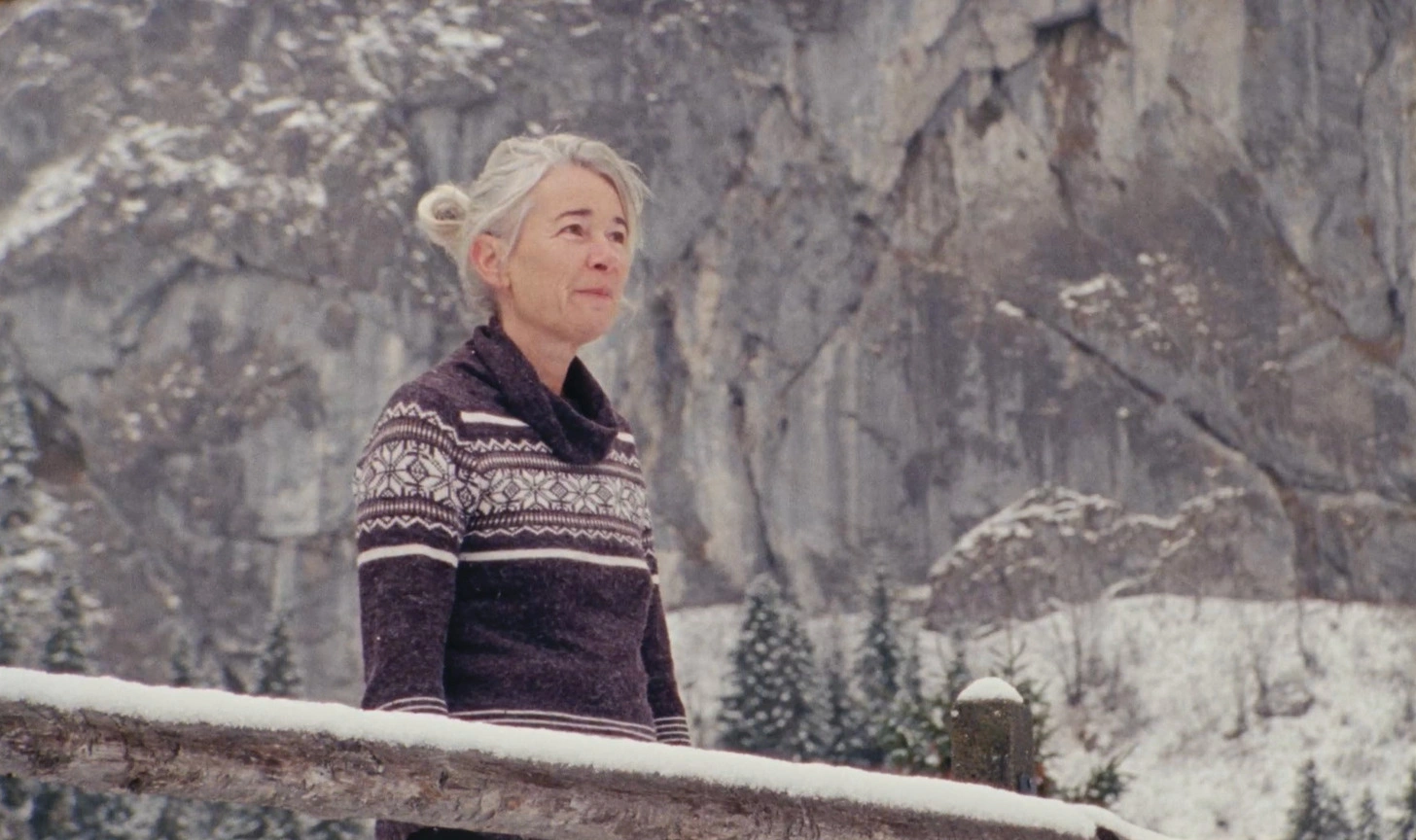
The film resists the summit myth. No heroic ascent, no swelling triumph over nature, no postcard worship of Alpine grandeur. The mountains here are gray, jagged, and magnificently uninterested. Coubia frames them less as spiritual reward than as existential fact. They do not redeem the women. They do not punish them. They simply remain. Human desire looks smaller in their shadow, though never meaningless.
Silence dominates the drama with the confidence of a veteran actor who knows it has the best lines. The pacing follows clouds moving across a ridge, slow enough to test the viewer’s appetite for stillness, precise enough to reward surrender. Coubia turns duration into pressure. The stakes are internal, yet the film never feels minor. A person can be stranded inside her own life without moving an inch.
A Triptych of Solitude
The year unfolds through three women, each bound to the hut by labor, temperament, or need. Spring belongs to Anna, a local whose intimacy with the terrain has curdled into restlessness. She knows the trails, the winds, the rock. That knowledge should anchor her. Instead, it has become a form of confinement. Her dream of departure hangs in the air like mist that refuses to lift.
Her encounter with Antoine, the birdwatcher searching for the Capercaillie, gives the spring segment its lightest movement. Their exchanges have the fragile charge of two people briefly stepping outside their private weather. The bird he seeks is already a phantom, a creature defined by absence, and that absence mirrors Anna’s own half-formed vanishing act. She prepares the hut with mechanical control, yet her mind has begun to leave before her body does.
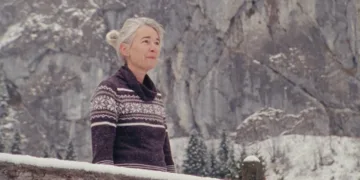
Summer shifts the film toward Hélène, a woman in her fifties whose calm has the texture of long practice. She handles the crowded season with the dry competence of someone who has seen every variation of human inconvenience. Hikers arrive with their noise, their needs, their cheerful presumption that the wilderness has been waiting for them. Hélène serves them, manages them, contains them. At night, she retreats into the woods and writes poetry in secret. A small rebellion, perhaps. A civilized one. No barricades, just a notebook.
The disappearance of a family of hikers during a storm gives the summer section its sharpest ethical weight. Coubia refuses melodramatic release. Hélène does not collapse into performative anguish. She waits. The waiting is the event. Her face becomes a register of dread, responsibility, and helplessness. The film understands that fear in remote places often arrives without spectacle. It sits at the table. It listens to the rain.
Then comes winter and Suzanne, an empty-nester who has chosen the refuge’s frozen isolation with a clarity that borders on defiance. Snow seals the place. Darkness thickens. A young deserter named Yoann appears, fleeing another kind of violence. Their connection is hushed, wary, and unexpectedly tender. Two fugitives share the same cold air, each carrying a private refusal. The film does not turn this into romance or redemption. It lets the meeting remain ambiguous, which is wiser and far less tidy.
The fades to black between seasons are simple, almost severe. They divide the women’s lives without overexplaining them. The structure forms a triptych rather than a chain of plot. Each panel reflects the others through gesture, labor, and silence. Anna wants escape, Hélène seeks hidden expression, Suzanne finds a kind of peace in withdrawal. Their isolation is never pure misery. It contains freedom, though the freedom is cold to the touch.
The Celluloid Skin of the Wild
Coubia’s choice to shoot on 16mm gives the film its body. Grain moves through the image like mineral dust, lending the moss, stone, timber, and skin a shared texture. Digital sharpness would have betrayed this world. The hut needs abrasion. It needs imperfection. It needs images that seem to have absorbed smoke from the stove and damp from the walls.
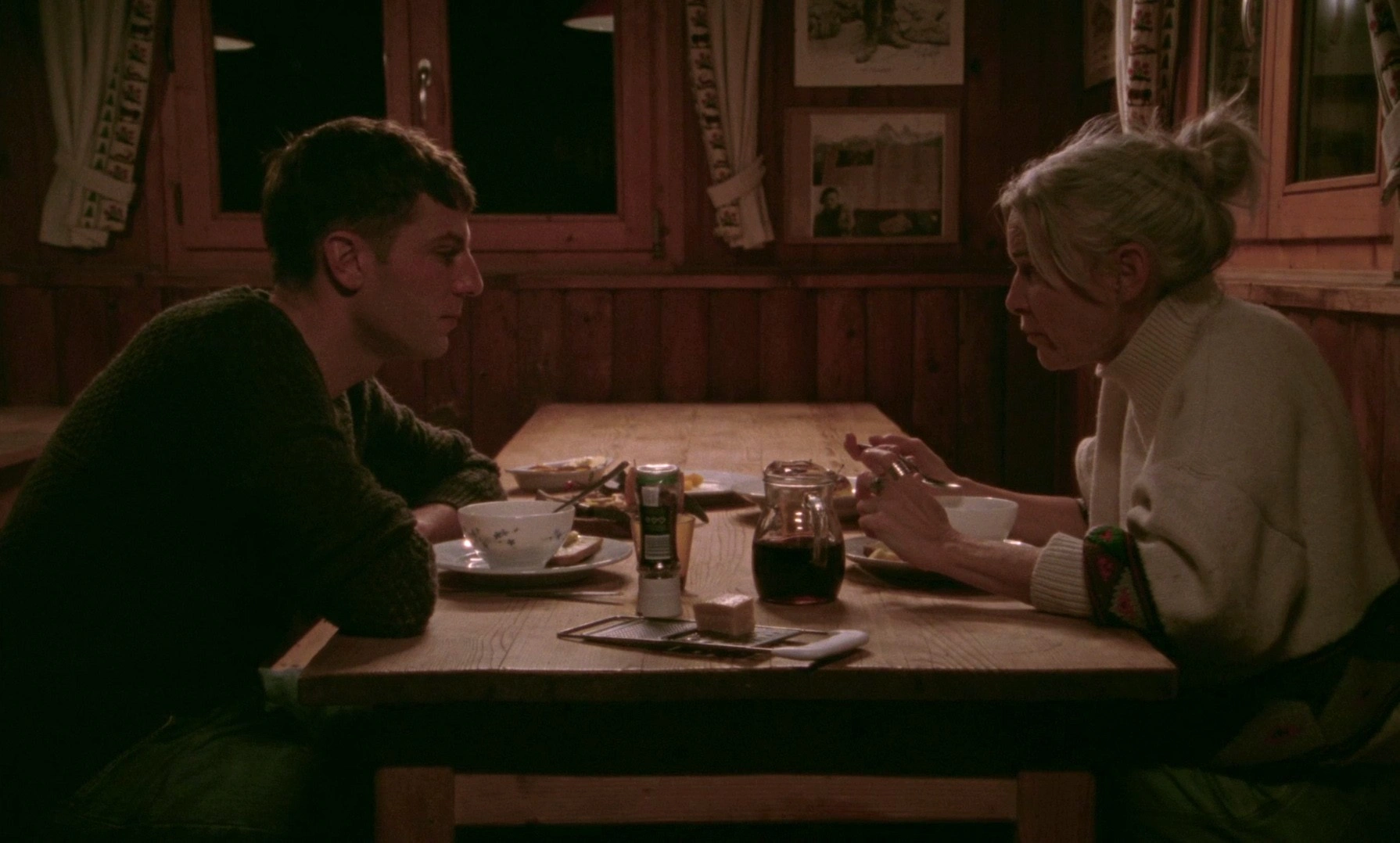
Robin Fresson’s cinematography treats the camera as a patient witness. Movement is sparse, never ornamental. Shot composition favors endurance over spectacle: faces held against rough interiors, bodies arranged within cramped rooms, windows opening onto horizons that feel less like escape than accusation. The frame often behaves like a moral instrument. It observes without consolation.
Natural light governs the visual field. The hut’s limited solar power becomes an aesthetic principle. Once the sun drops, the image sinks into deep chiaroscuro. The stove throws a trembling light across the women’s faces, carving them from darkness with a noir severity transplanted into the Alps. No Venetian blinds here, no wet city streets, no cigarette smoke curling under a cheap office lamp. Yet the lineage is clear. Light becomes judgment. Shadow becomes biography.
The expressionistic force of the interiors is striking because the film’s surface remains so restrained. A face beside firelight can feel as haunted as any alley in classic noir. The hut itself becomes a psychological chamber, its corners swallowing detail, its windows framing a world too large to negotiate with. The women are not detectives, criminals, or femmes fatales. They are workers. Still, Coubia borrows noir’s deepest lesson: environment can expose the soul better than confession.
Sound completes the enclosure. Birds call from the trees. Cowbells drift from unseen slopes. Wind moves across timber walls with a persistence that feels almost sentient. The sound design refuses emptiness. Silence here is layered, active, crowded with small signals. The viewer begins to listen harder, then to distrust what listening can prove. That is where the film’s psychological tension gathers. Perception becomes labor.
The documentary method deepens this effect. The performers carry out the actual duties of wardens, serve real hikers, and move among locals who seem to belong to the landscape as fully as the stone. Fiction and observation blur, yet the film never feels loose. The editing holds on work: laying tables, making beds, preparing food, cleaning rooms. Repetition becomes ritual. Ritual becomes thought. A lesser film might have mistaken this for dullness. Coubia knows boredom can be a doorway, provided one has the nerve to keep the camera still.
Noir at Altitude
The film’s genre identity is slippery, which is part of its quiet force. It borrows from psychological thriller grammar without adopting thriller machinery. There is suspense, yet no pursuit. There is danger, yet much of it occurs offscreen or inside the mind. There is mystery, though the mystery belongs to endurance, memory, and choice.
The missing hikers, the deserter, the vanishing Capercaillie, the hidden poems: each element carries the charge of absence. Coubia builds tension through withheld certainty. What happened? What will be chosen? What has already been lost? The questions accumulate like snow against a door. The film’s refusal to answer them cleanly may frustrate viewers trained to expect closure on schedule. Those viewers may want a plot receipt. The mountain, regrettably, does not issue one.
Free will appears here in modest, practical forms. Anna’s wish to leave is both rebellion and confession. Hélène’s poems create a private self outside service labor. Suzanne’s winter solitude suggests a choice that others might mistake for erasure. Yoann’s desertion turns refusal into moral crisis. Is flight cowardice, self-preservation, or the first honest act available to a person trapped inside inherited violence? The film leaves the question suspended, which makes it harder to dismiss.
Identity, too, is presented as seasonal rather than fixed. Each woman is defined by what she repeats and what she hides. Work gives them form, then threatens to absorb them. The hut asks them to become functions: cleaner, cook, caretaker, guide, witness. Their private lives push back in small ways. A glance. A poem. A walk into the trees. A decision to remain in winter darkness because the world beyond the snow may be louder, and not necessarily kinder.
Coubia’s moral gray zones are never announced with theatrical gravity. They surface through labor and weather. Duty to strangers, duty to oneself, duty to the dead, duty to the living: the film lets these claims rub against one another. The result is philosophical without turning into a lecture. A relief, since the altitude is already doing enough to make breathing difficult.
Ghosts in the Timber
The Capercaillie is the film’s most mysterious emblem, a bird that goes deaf and blind while singing. It suggests beauty as vulnerability, instinct as danger, song as self-erasure. Its presence as a vanishing motif gives the film an ecological sorrow that never feels decorative. By the time archival footage reveals the bird in its natural state, it appears less like an animal than like a remnant from a fading world.
Human history gathers in similar traces. The visiting performance troupe reads from an old visitors’ book, summoning voices left behind by travelers long gone. The tiny mountain chapel becomes a resonant chamber for the dead. The soldier’s account of ancestors fleeing war through the region folds political trauma into the terrain. The Alps, so often filmed as pure spectacle, become an archive of passage, fear, hunger, endurance, and loss.
The hut holds these traces without sentiment. Its timber seems saturated with prior lives. People arrive, write, speak, vanish, return as names, echoes, or stories. The women who work there are temporary custodians of a place built from other people’s departures. That is the film’s quiet paradox: a refuge exists for those passing through, yet the ones who maintain it are asked to stay.
Coubia’s great achievement lies in making the invisible perceptible. The wind begins to sound historical. The dark corners feel inhabited. The mountains become less empty than indifferent, which is worse, and funnier in a bleak sort of way. Nature is not hostile here. Hostility would imply interest.
The final movement refuses traditional resolution. Snow falls. The bird sings. The seasonal cycle continues with no dramatic punctuation. Human longing enters the landscape, leaves a trace, then thins into air. History settles into the permafrost. The silence remains absolute.
Forest High premiered at the 76th Berlin International Film Festival on February 15, 2026, within the Perspectives section. This Belgian-French co-production was filmed on 16mm stock and is currently screening at various international film festivals, including BAFICI and Visions du Réel. Viewers can presently find it at specialized festival venues or through select arthouse screenings. While it has not arrived on major streaming services like Netflix or Max as of May 2026, its international sales are managed by Rai Cinema, which suggests a future life on boutique platforms like MUBI.
Full Credits
Title: Forest High (Original Title: Forêt Ivre)
Distributor: Rai Cinema International Distribution
Release date: February 15, 2026
Running time: 102 minutes
Director: Manon Coubia
Writers: Manon Coubia
Producers and Executive Producers: Tom Durand-Bonnard, Jérémy van der Haegen, Nicolas Rincon Gille, Manon Coubia, Charlotte Vincent, Katia Khazak
Cast: Salomé Richard, Aurélia Petit, Anne Coesens, Arthur Marbaix, Yoann Zimmer, Jean-Claude Duret
Director of Photography (Cinematographer): Robin Fresson
Editors: Théophile Gay-Mazas
Composer: François Chamaraux
The Review
Forest High
Coubia rejects the hollow spectacle of the alpine thriller. She chooses a study of duration and physical labor. The film treats the mountain as a silent witness. Its 16mm grain and patient sound design create intimacy with the landscape. The lack of plot will frustrate those seeking tension. The rewards for the patient viewer are significant. It is a work of quiet power. It stays with the viewer like the chill of the evening air.
PROS
- Tactile 16mm cinematography and natural lighting.
- Authentic documentary-style performances from the lead cast.
- Immersive, three-dimensional sound design that builds a physical world.
- Nuanced exploration of female solitude and seasonal transition.
CONS
- Glacial pacing may alienate audiences expecting traditional drama.
- Minimal narrative drive.
- Elliptical storytelling leaves some thematic threads loose.