

























![Kingdom Hearts Collection [I-III] Review](https://gazettely.com/wp-content/uploads/2026/10/Kingdom-Hearts-Collection-I-III-1-360x180.webp "Kingdom Hearts Collection [I-III] Review: KHII Holds Steady as Newer Entries Fluctuate 40")


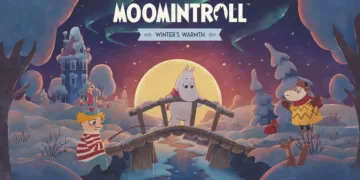
Moomintroll: Winter’s Warmth begins with a sharp break from the familiar comfort of its source material. The title character wakes before the thaw and finds his home unnervingly still, with Moominmamma and Moominpappa trapped in deep hibernation.
Beyond the house, Moominvalley’s usual greenery has disappeared beneath a dense white covering. That seasonal rupture gives the game its core dramatic and mechanical setup. Winter changes the land, changes movement, and pushes Moomintroll into action before he feels ready.
The main goal is organizing the Great Winter Bonfire, a ritual needed to restore spring. The Lady of the Cold blocks that effort, serving as a living form of the season itself. That makes the conflict feel less like a simple fight against a villain and closer to a child facing a force that feels permanent.
Moomintroll starts as frightened and unsure. Through helping displaced valley residents, he gradually grows into someone capable of acting without the protection of his sleeping parents. The writing treats renewal with a gentle sadness, asking players to sit with the idea that life continues under pressure, even under snow.
The Reactive Beauty of the Frozen North
The visual style leans into a hand-painted look that suits the harsh grace of a Nordic winter. The strongest mechanical touch comes from how the world responds to movement. Moomintroll leaves trails in the deep snow, and those tracks remain visible for the full experience. They work as a record of exploration and help speed up backtracking, turning a visual flourish into a useful navigation system. The valley feels physical because the player’s actions mark it.
The character portraits carry plenty of emotional weight. Since Moomintroll’s mouth is rarely shown, his feelings come through his eyes and brow. That small design choice asks the player to read him with care, which fits a story built around fear, patience, and quiet growth. The sound design supports the same mood. Footsteps crunch against packed ice, wind whistles across the landscape, and the audio gives the snow a real presence.
Movement also benefits from a smart map system. After the player selects a destination, a floating hand icon points toward the objective. It is a clean UI solution for a world that can easily blur into white shapes and soft edges. The system keeps exploration readable without flattening the pleasure of discovery. It guides the player through the drifts while preserving the feeling of moving through an unfamiliar winter world.
Environmental Problem Solving and the Survival Toolkit
The gameplay is built around a seasonal toolkit, with progress tied to items that open new sections of the linear world. Matches light lanterns and reveal paths, though wind gusts can put out the flame. The shovel clears snow-covered bushes. The axe cuts through ice and wood. Each tool feels tied to the climate, which helps the mechanics support the story’s focus on survival, persistence, and small acts of bravery.
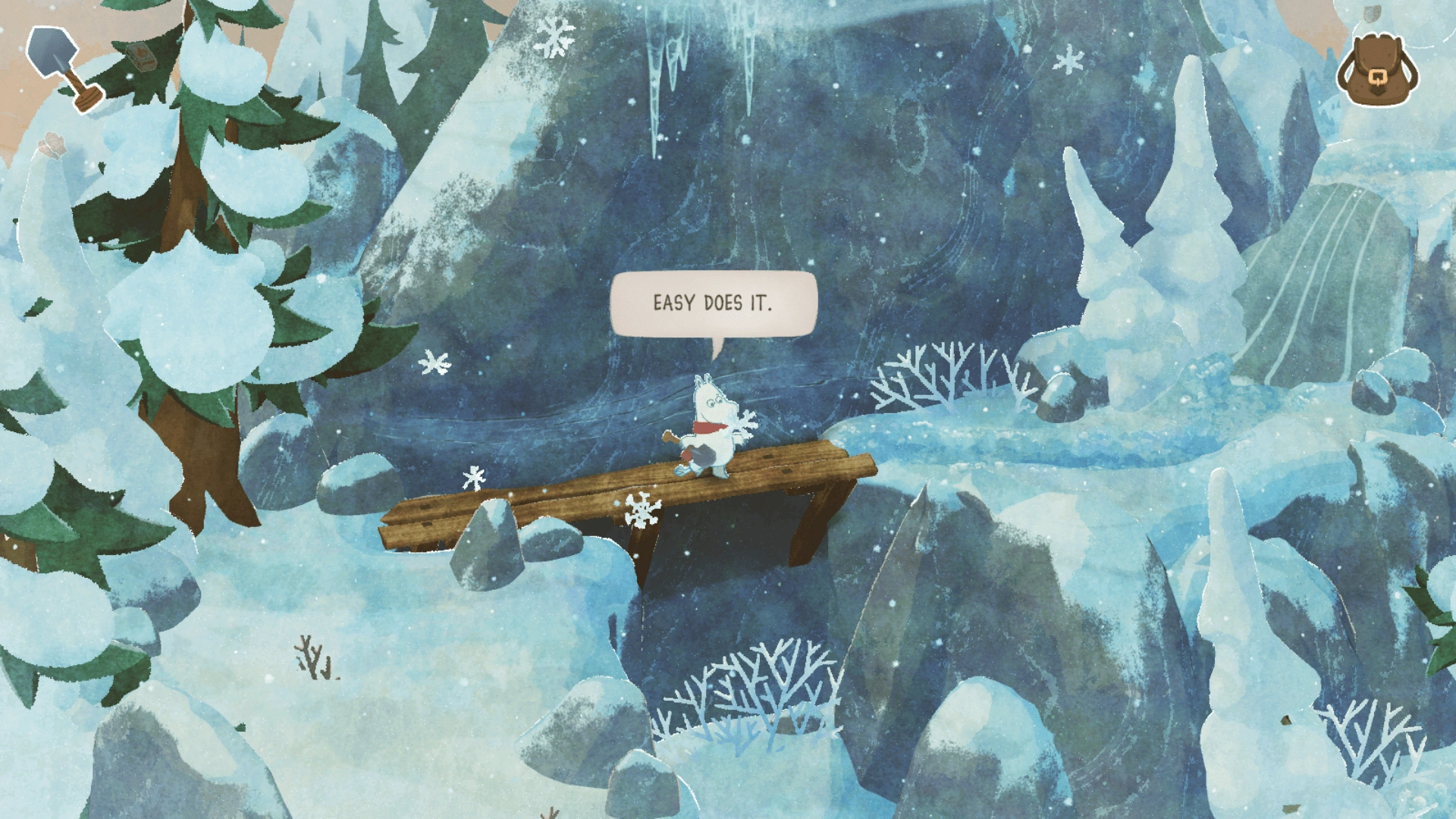
The mittens create one of the game’s livelier systems by allowing Moomintroll to throw snowballs. A visible arc with an X shows where each throw will land, making the mechanic easy to read without stripping away the satisfaction of aiming. Snowballs become puzzle pieces. Large ones can roll into gaps to create bridges. Smaller ones can knock down icicles or distract crows. The system is simple, readable, and closely linked to the environment.
The best puzzles fold these tools into character-driven moments. In a sequence with a small dog named Sorry-oo, the player has to time movement between light sources and safe zones to avoid being pushed back by freezing gales. The challenge adds tension while staying grounded in the story’s survival themes. It also shows the game at its strongest: mechanics, mood, and narrative pressure working together in a way that feels natural.
Tool upgrades add a light progression layer. By finding materials such as oil or a whetstone, the player can have Too-Ticky improve Moomintroll’s equipment. The upgrade loop gives the player a steady sense of growing competence in a hostile climate. The design favors accessibility over dense systems, which suits the game’s tone. Each improvement matters because it makes the next stretch of winter feel a little less impossible.
Social Dynamics and Late-Game Friction
Much of the game’s warmth comes from Moominvalley’s residents. Dialogue is crisp, and exchanges with characters like Little My bring snark and comic bite to the frozen setting. That humor gives the experience a necessary lift, especially in a landscape defined by silence, snow, and separation. The social writing helps the valley feel populated by personalities instead of quest markers.

The quest design stays thematically connected to the world, though it leans heavily on familiar fetch structures. The narrative rewards can be charming, yet some tasks take on the texture of chores. This issue becomes clearest near the end, when the bonfire requires a large amount of firewood. The search for wood slows the pacing after many of the stronger story beats have already landed. The player’s agency begins to feel narrower at the exact point where the narrative should feel most energized.
The snowball fights face a similar problem. Their basic strategy remains mostly fixed, so these encounters start to repeat after their first few appearances. The system works well as an environmental puzzle tool, and it loses some force when used in combat-like situations without enough change in rhythm or demand.
Technical performance holds up for most of the experience, with occasional graphical glitches. Characters may float near their intended positions, and Moomintroll can sometimes get stuck in the geometry while rolling large snowballs. These problems rarely break progress, yet they can interrupt the game’s carefully built atmosphere. The invisible autosave system may also create early uncertainty for players who want clear reassurance that their progress is secure, since there is no manual save or visible save icon.
Even with these friction points, Moomintroll: Winter’s Warmth remains a faithful, thoughtful adaptation of its world. Its best ideas come from making winter active rather than decorative: snow records movement, wind shapes puzzle logic, tools carry emotional meaning, and small choices help Moomintroll grow into the role the season demands.
The Review
Moomintroll: Winter's Warmth
Moomintroll: Winter’s Warmth is a visually stunning exploration of loneliness and community. It succeeds as a spiritual successor by prioritizing atmosphere and emotional resonance over complex combat. While the late-game resource gathering and repetitive quest design create occasional friction, the persistent environmental reactivity and sharp writing keep the journey grounded. It is a rare example of a cozy game that respects the philosophical depth of its source material while remaining accessible to newcomers. The experience provides a meaningful, if slightly uneven, winter adventure.
PROS
- Beautiful hand-painted art style with impressive snow reactivity.
- Expressive character writing and witty dialogue.
- Atmospheric sound design that enhances immersion.
- Thoughtful narrative themes about growth and renewal.
CONS
- Late-game firewood collection feels like a repetitive grind.
- Snowball fights lack mechanical depth and variety.
- Minor graphical glitches and lack of save clarity.