



















The romantic comedy is a genre that forgives a lot but rewards sincerity above all else. Get the bones right, believe in your characters, and audiences will meet you halfway. Mistake formula for substance, and the warmth curdles fast. Office Romance, Netflix’s latest star vehicle, positions itself as something of a throwback: directed by Ol Parker (Mamma Mia! Here We Go Again, Ticket to Paradise), co-written by and starring Brett Goldstein alongside his Ted Lasso collaborator Joe Kelly, with Jennifer Lopez heading the cast.
The setup is crisp. Jackie Cruz (Lopez) runs Air Cruz, a small but growing airline she built alongside her father. Daniel Blanchflower (Goldstein), a reserved British lawyer who has relocated to New Jersey for complicated family reasons, lands as second-string in-house counsel. A frivolous lawsuit from a rival airline throws them together professionally. A strict zero-tolerance policy on workplace relationships stands between them personally. Both characters, at the start, are genuinely disinterested in breaking that rule. The film lands, with some turbulence, somewhere between warmly serviceable and frustratingly uneven.
Foundations and Fault Lines
The film’s best structural decision is also its most basic: it gives its leads real reasons to resist each other. Jackie is a founder’s daughter who has spent years earning a CEO title her board still treats as inherited. Her father, Captain Jack (Edward James Olmos), sits on that board, a living reminder of where she started and how much she still has to prove. Daniel moved from the UK to support his imprisoned sister Lizzy (Jodie Whittaker), took a job he is overqualified for, and arrived with a firm conviction that personal and professional lives must remain entirely separate. These are people with something genuinely at stake. The zero-tolerance dating policy carries real weight precisely because both characters, in the opening reels, would never consider violating it.
That foundation matters more than any individual plot turn. Romantic comedies are not really about plot; they are about the plausibility of two people growing into better versions of themselves through each other. Here, that plausibility holds, and the film earns it by investing in character before chemistry. The genre’s familiar structure follows: a brace of bad first dates with other people, proximity manufacturing attraction, a secret relationship, the obligatory third-act rupture, a reconciliation. Parker steers these beats without ceremony.
Where the script deviates from convention, the results are mixed. A subplot involving a character with a startlingly violent past is played for deadpan comedy. Daniel’s sister Lizzy is positioned as a wild card, a foul-mouthed outlier in a film that otherwise keeps its quirks moderate. These elements are treated as novelties, but they never fully connect with the main narrative. The mid-section meanders, and the sister storyline floats loose from everything around it.
The British-American cultural friction is the script’s most reliable comic seam: different workplace cultures, different thresholds for oversharing, a certain four-letter word with radically different connotations on either side of the Atlantic. Less certain is Jackie’s revealed Anglophilia, a character detail that reads more convenient than earned. The office itself rarely feels inhabited. It exists as a backdrop for exposition and running jokes rather than a real environment with its own internal logic.
Also Read






Blue and Beige
Office Romance markets itself with the suggestion of something raunchier than the standard streaming product. The R-rating implies an edge. The reality is considerably more modest. Sex scenes are largely bedsheet-obscured; the adult content skews toward crude rather than sharp. There are repeated dick jokes, a transatlantic expletive running gag, and a graphic childbirth sequence treated as high comedy. The Judd Apatow influence is visible: a willingness to push a joke past the point of comfort, to stay in an awkward beat just a little longer than convention would allow. The effect is unpredictable, veering between productive jolts and scenes that simply stall.
The film’s most tonally contested moment is the very visible erection Daniel develops on first meeting Jackie. The script seems to regard this as charming ribaldry. The problem is that it sits poorly against the film’s warmer, more romantic register, which asks us to find these two people aspirationally together. A moment that belongs in broader farce sits awkwardly in a film also reaching for sincerity.
This is the structural difficulty. Office Romance wants two things simultaneously: the glow of a love story that might almost happen in real life, and the anarchic energy of R-rated comedy that refuses to behave. These impulses do not reconcile smoothly. The cringe-comedy strand, built around characters who overshare at catastrophically wrong moments, is deployed as a recurring joke and wears out its welcome well before the third act.
The film’s craft, paradoxically, supports the softer register far better. Cinematographer Robert Yeoman brings a lacquered, burnished visual warmth that most streaming productions lack. Production designer Kristi Zea and costume designer Caroline Duncan extend that care, particularly in how they present Lopez: earth-toned knits, ivory pantsuits with real drape and weight. It is the kind of attention to a star’s image that her recent vehicles have largely forgotten to provide.
Stars, Supporting Acts, and One Scene-Stealer
Lopez is given the full treatment here. The camera loves her, the wardrobe respects her, the cinematography is devoted to her. The film constructs itself around her star presence, which is both its strategy and its limitation. Jackie Cruz, as written, is a recognizable archetype: the high-powered professional who has traded personal life for corporate success. The script gives her capable scene work but stops short of the texture that would allow the role to become something specific. Jackie is described, repeatedly, as someone who inspires fear in her employees. Lopez, by disposition and performance, plays her warm and accessible from the first scene. The fearsome reputation exists in dialogue alone; it never appears in the room. That disconnect is never resolved.
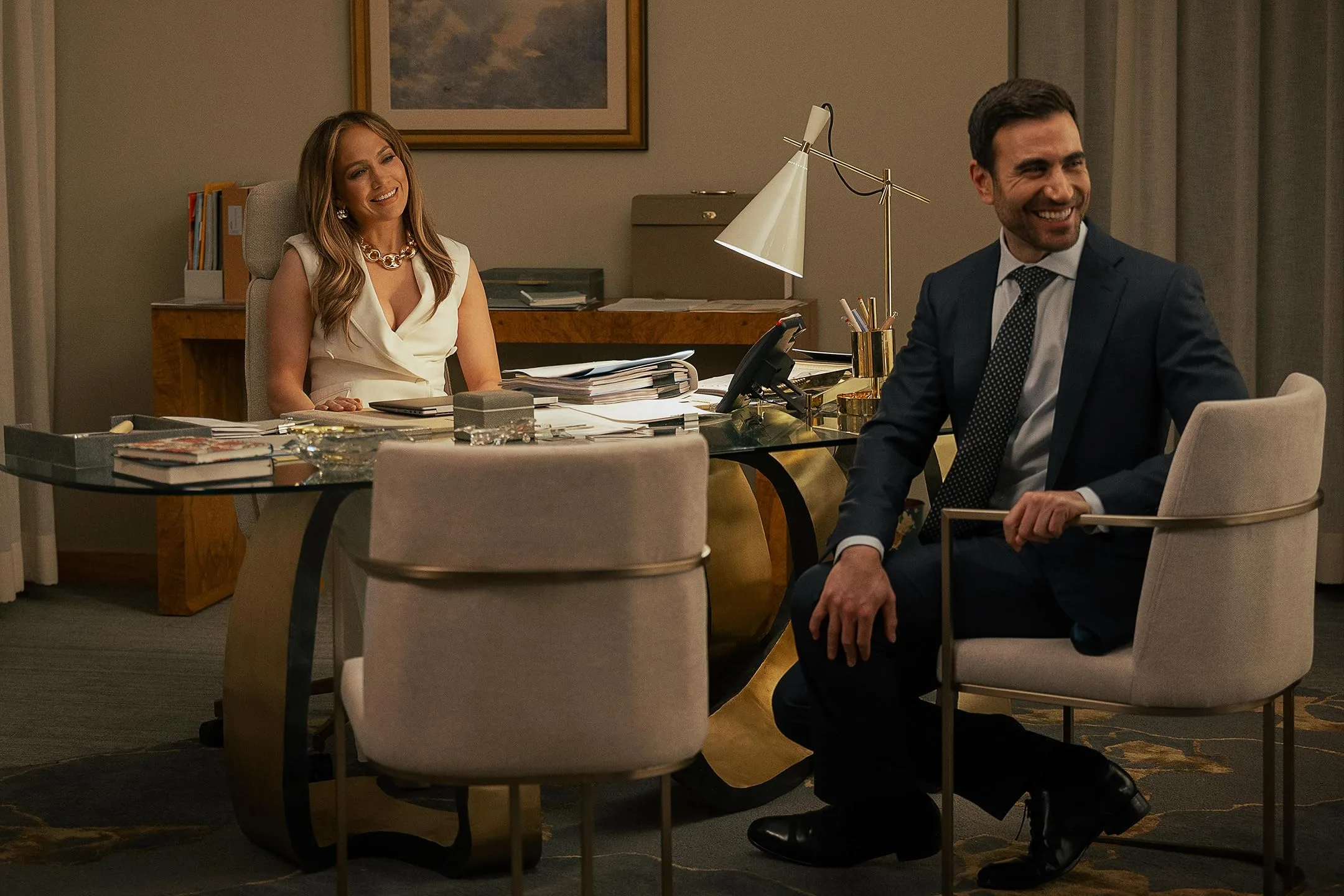
Her best-known romcom work had a bubbly, grounded specificity. Here, she is placed on a pedestal so high that her range contracts. The role asks her to react and endure rather than shape what is happening around her.
Goldstein, as co-writer and lead, serves his own performance loyally, though not without cost. Daniel’s British bafflement in the face of American workplace culture is a reliable comic register, but the character’s emotional interior is thinly sketched. Goldstein works best in quieter moments, when the awkward-Brit persona drops and something more honest surfaces. In the louder, more farcical scenes, the performance strains. The film’s own dialogue names the dynamic: Helen of Troy and Mr. Bean. That asymmetry is plausible onscreen, though the chemistry between the leads runs more functional than electric.
The ensemble deserves better than some of what it receives. Tony Hale, Amy Sedaris, Bradley Whitford, and Aly Stroker all register in brief appearances and are variously wasted or squeezed into gags that expire well before the editing does. Edward James Olmos brings quiet gravity as Captain Jack, and his scenes with Lopez carry genuine emotional charge, arriving almost entirely in the film’s final stretch.
Betty Gilpin, as Jackie’s heavily pregnant deputy Sydney, is the film’s sharp center of gravity. She takes a role that could easily read as stock and plays it with ferocious, specific intensity: hostile toward Daniel, almost irrationally opposed to the romance, spitting every line with concentrated force. She transforms what could have been a thankless supporting part into something with actual comic menace. Every scene she enters, the film finds itself.
What the Film Earns, and What It Misses
Parker’s directorial approach is the cinematic equivalent of professional charm: smooth, unobtrusive, reliably star-focused. The film moves without calling attention to its mechanics, which is a genuine skill. The weakness, applied here, is that it rarely lifts the material. Office Romance looks and feels competent, occasionally lovely, but seldom special. The romantic comedy has historically rewarded directors with a distinct visual or comic sensibility, a specific way of seeing their characters in love. Parker is too comfortable, perhaps, with being agreeable.
What saves the film from its own limitations is how seriously it takes its romantic architecture. The two leads arrive in the story as people credibly invested in their work. They meet as professionals trying to do their jobs. The attraction grows in the margins of their professional lives, which gives it a texture that more lazily constructed romcoms skip entirely. The film escalates the stakes deliberately: what exactly will Jackie and Daniel each sacrifice, and when will the cost become too high? That question is managed with real care.
When Office Romance trusts its quieter instincts, genuine warmth surfaces. The best scenes generate the charged, hovering energy that defines the genre at its best: two people simultaneously drawn together and fully aware they should not be, attempting to remain professional and failing by increments. That feeling, however briefly sustained, is what the romantic comedy exists to produce. The film produces it.
The frustrating thing is that these moments suggest what a more disciplined version of the same story might have looked like. The pleasures are real. The gap between what the film achieves and what its best moments suggest it could have achieved is equally real.
The romantic comedy film Office Romance officially premiered globally on June 5, 2026. Directed by Ol Parker and co-written by its leading man Brett Goldstein, the film offers a raunchier, modern spin on traditional workplace entanglements. It is available to watch exclusively online via streaming on Netflix. Because it is a direct-to-streaming Netflix original feature movie, it did not receive a wide cinematic theatrical rollout, meaning you can tune into it from the comfort of your home starting today.
Where to Watch Office Romance (2026) Online



Full Credits
Title: Office Romance
Distributor: Netflix
Release date: June 5, 2026
Rating: R
Running time: 94 minutes
Director: Ol Parker
Writers: Brett Goldstein, Joe Kelly
Producers and Executive Producers: Aaron Ryder, Andrew Swett, Jennifer Lopez, Elaine Goldsmith-Thomas, Benny Medina, Brett Goldstein, Joe Kelly
Cast: Jennifer Lopez, Brett Goldstein, Betty Gilpin, Amy Sedaris, Tony Hale, Bradley Whitford, Edward James Olmos, Rick Hoffman, Jodie Whittaker, Scott Seiss, Will Sasso, Mary Wiseman
Director of Photography (Cinematographer): Robert Yeoman
Editors: Peter Lambert
Composer: Michael Andrews
The Review
Office Romance
Office Romance gets the foundational work right: credible characters, genuine obstacles, enough warmth to sustain its runtime. The tonal inconsistency is real, and the gap between what the film promises and what it delivers is sometimes frustrating. Betty Gilpin walks away with the film; Lopez deserves sharper material; Goldstein the writer shortchanges Goldstein the lead. Parker keeps things moving but never ignites them. A flawed, functional romantic comedy that respects its genre enough to work, even when it cannot quite soar.
PROS
- Strong structural foundation with believable, character-driven obstacles
- Robert Yeoman's cinematography elevates the visual quality above typical streaming fare
- Betty Gilpin delivers a scene-stealing, genuinely funny performance
- Genuine warmth in quieter scenes between the leads
- Thoughtful costuming and production design, particularly for Lopez
CONS
- Tonal inconsistency undermines both the comedy and the romance
- Lopez's character is inconsistently written and the fearsome reputation never lands onscreen
- Supporting cast is frequently underused or trapped in overstayed jokes
- Daniel's sister subplot never integrates with the main narrative
- The R-rating promises an edge the film rarely delivers