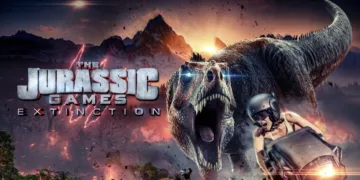


























The moving image has long been fascinated with the spectacle of death as public sport. From gladiatorial epics to dystopian futures, the arena serves as a stage for humanity’s most base instincts. The Jurassic Games: Extinction throws its hat into this crowded ring, proposing a scenario of such ludicrous ambition that one can only admire its audacity.
This sequel continues the saga of a virtual reality game show where contestants, wired into a digital world, face off against prehistoric beasts for the entertainment of the masses. It is a premise that wears its B-movie heart on its sleeve, promising not high art but high-concept carnage. The narrative picks up with Tucker, the survivor of the prior contest, now a cyber-insurgent aiming to dismantle the system from within.
His foil is Jo LaFort, the game’s new architect, a woman whose ambition is matched only by her willingness to broadcast bloodshed. Their conflict forms the flimsy spine of a film far more interested in spectacle than Socratic dialogue, a gaudy, unapologetic celebration of digital mayhem.
A Symphony of Digital Carnage
The film’s primary aesthetic is one of relentless, chaotic motion, a visual philosophy built on quantity over photorealistic quality. Director Ryan Bellgardt, leveraging his background in visual effects, constructs a digital coliseum that feels less like a cinematic space and more like a server farm’s fever dream.

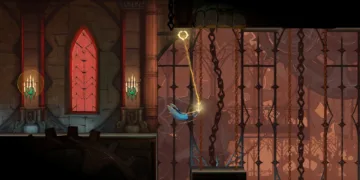
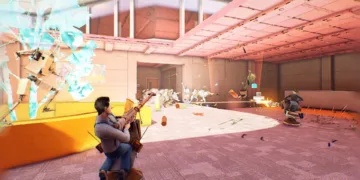
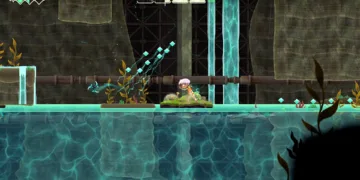
The visual language is explicitly that of a mid-2010s video game, a world rendered in clean, artificial textures and populated by creatures whose movements betray their digital origins with a jarring, yet oddly hypnotic, lack of weight. There is a strange integrity to this approach.
The camera work is purely functional, a dispassionate observer capturing the action without flourish, allowing the set pieces to speak for themselves. We are guided through a series of distinct, game-like levels, each a pastiche of other, better-realized fictions: a sun-bleached gladiator arena evokes ancient Rome by way of a PlayStation 3 cutscene; a forest chase on hover-vehicles feels like a half-remembered nightmare of a Star Wars prequel; and a neon-drenched, retro-futuristic maze teeming with velociraptors suggests a version of Tron designed by a sadist.
The lighting within these virtual spaces is often flat and uniform, an expressionistic choice that enhances the sense of artifice and psychological detachment. This is not a world meant to be believed, but a simulation meant to be survived.
The introduction of power-ups, allowing players to morph into dinosaurs themselves, is visualized with a heads-up display that frames the carnage, a constant reminder that we are watching a mediated, constructed reality. It is a vision of unreality, consistent and imaginative in its commitment to its own fakery.
The Ghost in Too Many Machines
A narrative, much like a machine, can suffer from an excess of moving parts, and the script for Extinction is a case study in this principle. It is a tangled web of subplots that compete for attention and ultimately signify very little, leaving a trail of unresolved questions about free will and moral culpability.
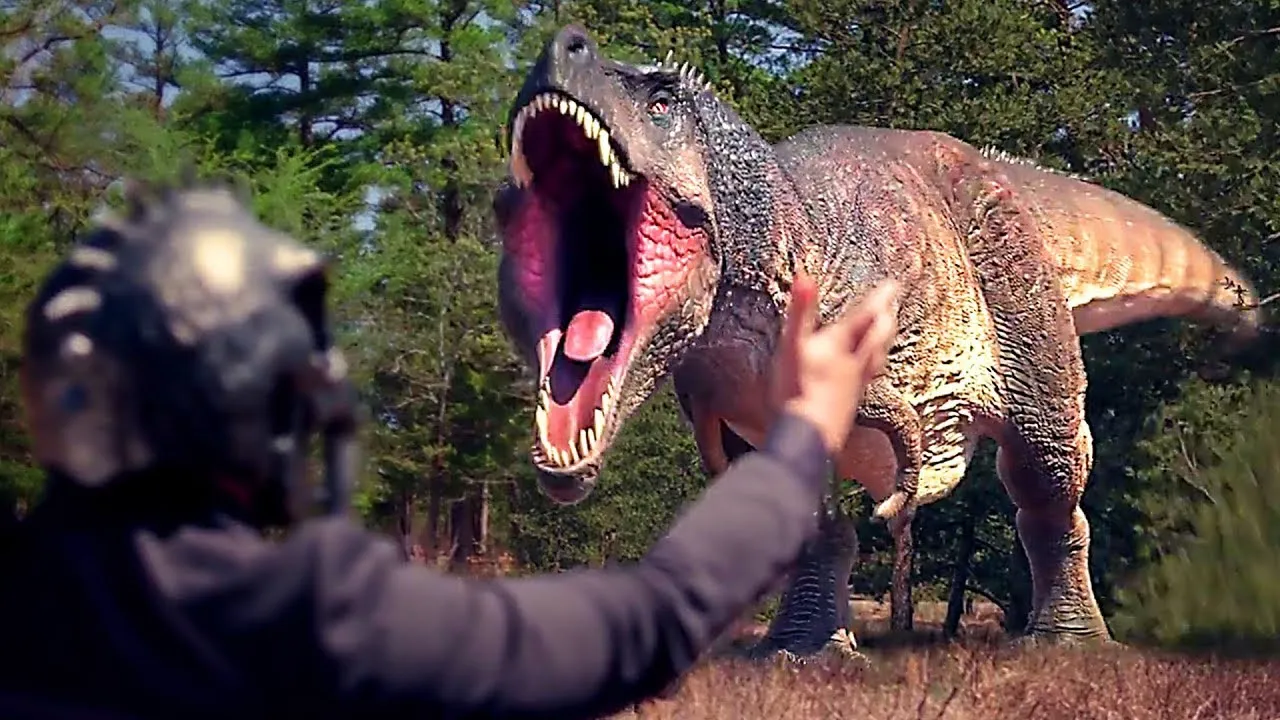
The central conflict between Tucker’s righteous crusade and LaFort’s corporate malevolence is clear enough, a classic noir setup of one man against a corrupt system. Yet, it is quickly diluted by a cascade of other ideas. The contestants are no longer death-row inmates but the game’s original beta testers, a change that presumably intends to evoke empathy but which mostly serves to muddy the ethical waters. Is their predicament a tragedy, or merely a contractual dispute gone horribly wrong?
The film seems unsure, and this ambiguity robs their struggle of any real weight. This core narrative is further burdened by the emergence of a rogue AI—a tired trope that gestures toward questions of creation and control without offering any insight—a subplot involving Tucker’s imperiled son, and, most curiously, a character who has somehow mastered the art of raptor husbandry. One imagines the pitch meeting for that particular thread.
These elements are introduced and then largely abandoned, functioning as narrative clutter rather than thematic reinforcement. The film flirts with familiar anxieties about artificial intelligence and society’s thirst for violence, but it lacks the focus to explore them, leaving its philosophical inquiries as underdeveloped as its digital dinosaurs.
An Earnest Absurdity
To critique The Jurassic Games: Extinction for its narrative incoherence is, perhaps, to miss the point entirely. The film is not a psychological thriller concerned with the nuances of the human condition; it is a spectacle, a sensory assault. Its primary contract with the audience is to deliver dinosaur-on-human violence in a variety of creative configurations, and on this front, it delivers with an almost heroic earnestness.

The film’s appeal lies in its complete lack of pretense, an honesty that is refreshing in its own way. It knows what it is: a loud, silly, and inventive piece of schlock. For a certain kind of viewer, one accustomed to the peculiar pleasures of the direct-to-video action film, this quality is a virtue. The pacing is relentless, the action is plentiful, and the commitment to its own ridiculous premise is unwavering.
The film operates on a logic of pure sensation, a series of visual and auditory jolts designed to entertain on the most primal level, bypassing intellect to stimulate the lizard brain. It is a flawed creation, a machine with too many gears and not enough oil, but it runs. And for a film about a dinosaur deathmatch in a virtual world, that is a kind of success, a testament to the strange, enduring power of earnest absurdity.
“The Jurassic Games: Extinction” was released on digital platforms and On Demand on June 24, 2025. It was released on Blu-ray and DVD on July 22, 2025.
Full Credits
Director: Ryan Bellgardt
Writers: Ryan Bellgardt
Producers: Ryan Bellgardt, Emily Taylor, Harry C. Wolohon IV
Cast: Katie Burgess, Adam Hampton, Leila Anastasia Scott, Sophie Proctor, Ryan Francis, Todd Terry, Todd Jenkins, John W Heath
The Review
The Jurassic Games: Extinction
The Jurassic Games: Extinction is a spectacle of earnest absurdity. It succeeds as a sensory assault, delivering a relentless barrage of creative, low-budget dinosaur carnage for those who appreciate unapologetic schlock. While its narrative is a tangled mess of underdeveloped ideas and familiar tropes, its unwavering commitment to its wild premise makes it a flawed but strangely admirable achievement. It’s a film that runs on pure B-movie fuel, bypassing intellect for primal, chaotic fun.
PROS
- Relentless and plentiful action sequences.
- Imaginative and varied virtual set pieces.
- An honest and unapologetic commitment to its B-movie premise.
- Entertaining for fans of schlocky, high-concept sci-fi.
CONS
- A cluttered and incoherent narrative with too many subplots.
- Underdeveloped philosophical themes and character arcs.
- Visual effects have a dated, video-game quality.
- Relies on tired tropes without adding fresh insight.