


















In the sprawling, indifferent metropolis of London, a familiar modern anxiety takes shape. We meet Mercy, an actress whose career momentum has stalled, marooned in that specific existential limbo reserved for creatives.
Fresh from a breakup and with the cultural specter of her thirtieth birthday looming, she represents a distinctly 21st-century predicament: the terror of being left behind by life’s prescribed timeline. In an act of resigned hope, she turns to the digital lottery of dating apps.
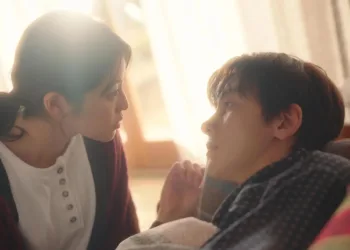
There, she encounters Blake, a charming American architect who materializes like a perfectly rendered answer to her desires. The film quickly establishes its central crisis. Mercy’s pursuit of this idealized connection begins to consume her, causing her ambitions, friendships, and sense of self to recede into the background. She starts to become a ghost in her own life.
The Ghost of Rom-Coms Past
The film wears its cinematic lineage like a family heirloom it doesn’t quite know how to carry. The structural DNA of Bridget Jones’s Diary is everywhere, from the confessional voiceover to the flustered, professionally struggling heroine. Yet, this is not a revival; it is an echo. The cultural conditions that made the 90s original feel charmingly naive are gone.
A direct imitation in 2025 feels hollow, a performance of a feeling rather than the feeling itself. The film’s greatest misstep is its narration. The stylistic tics, like the dropped pronouns in Mercy’s internal monologue, feel unmoored from the diary format that once justified them. Without the physical act of writing to ground them, the abbreviated thoughts become a purely aesthetic flourish, a cinematic phantom limb twitching where a diary used to be. It is a stylistic crutch that suggests a lack of confidence in the story’s ability to stand on its own two feet visually.
Its attempts at comedy are a similarly mixed affair. Some moments of social awkwardness possess a flicker of truth, but many of the larger set-pieces feel manufactured for a laugh that never quite arrives. A scene in a boxing gym, where a tiny woman predictably knocks out a large male trainer with a single girl-power punch, is so telegraphed it feels less like a surprise and more like a scheduled delivery.
This is humor as a checklist item. The dialogue suffers from its own kind of tonal whiplash, careening between lines of genuine, charming vulnerability and exchanges that sound as if they were written by an algorithm fed a diet of twenty-year-old television dramas. One moment Mercy will offer a keen insight into the absurdities of digital courtship; the next, she will utter a platitude so worn it is practically transparent. This inconsistency shatters any sustained sense of reality.
The Unbearable Lightness of Being Mercy
At the center of the film is Mercy, a character whose search for affection spirals into a feverish and often frustrating quest for external validation. Her choices are not merely imperfect; they border on self-erasure, making her a difficult figure to champion.

She is less a flawed heroine and more a case study in the modern compulsion to sacrifice oneself at the altar of a romantic prospect, to perform a version of a person who might be loved. It is a recognizable condition, even if her specific actions become progressively alienating. Her desperation feels real, a symptom of a society where one’s personal narrative must always appear successful.
Jade Asha, who also wrote and produced, performs with a raw sincerity that is occasionally powerful. You can feel the autobiographical ache in her portrayal, a personal investment that gives the film what heart it has. There is a fascinating self-referential loop at play here: an actress writing a film about a struggling actress who finds success by writing a play about her struggles, with both the film and the play sharing the same title. It’s a bold creative choice.
Yet this sincerity cannot fully salvage a character whose recklessness often outweighs her charm. Her friends exist as a Greek chorus of sanity, dispensing sensible advice that is, of course, promptly ignored. They represent the grounded world Mercy is so desperate to escape. The men in her life are less characters and more narrative functions—archetypal sketches of “Mr. Safe” and “Mr. Exciting.” Their shallowness is perhaps the point; they are projections of Mercy’s needs, not people in their own right.
An Imperfect Artifact
The film’s redemptive thesis, arduously reached after a long and winding path, is that the most significant relationship one can have is with the self. This idea is presented as a profound discovery, the endpoint of Mercy’s chaotic journey.

It is a laudable message. One must question, however, if the ending is truly earned. After nearly two hours of witnessing a character make consistently self-destructive choices, a final-act pivot to enlightened self-love feels less like an organic evolution and more like a convenient thematic exit ramp. The message is stated clearly, but the emotional groundwork for it feels shaky.
The production itself is a testament to the film’s independent spirit and its limitations. These technical shortcomings are not just flaws; they are the fingerprints of the film’s creation, constant reminders that this is not a slick studio product but something handmade. The cinematography veers between serviceable polish and the flat, unforgiving light of a student project, creating a visual dissonance that is at times distracting. A few key lines are swallowed by a muddy sound mix.
The pacing is often leisurely to a fault, forcing the audience to endure Mercy’s stasis with her. The film meanders because her life is meandering, a structural choice that mirrors the theme of being lost, even if it severely tests the viewer’s patience.
This is a personal document, a cinematic diary entry whose value is found not in its technical perfection but in its earnest, if flawed, attempt to capture a very modern form of heartbreak. It is a film less to be enjoyed and more to be considered—as an artifact of a particular type of ambition and a particular type of filmmaking struggle.
“Ghosted” (2023), directed by Daniel Pacquette, is a British romantic comedy drama. It was released on streaming platforms on April 1, 2023.
Full Credits
Director: Daniel Pacquette
Writers: Jade Asha
Producers: Jade Asha, Daniel Pacquette, Todd Von Joel, Omar Salhi
Cast: Jade Asha, Kevin de Groot, Byron Swiegers, Mark Denham, Alex Montagnani, Rosie Jane, Todd Von Joel, Shaeran Thomas, Chloe Adlerstein, Tara Hoyos-Martinez
Director of Photography (Cinematographer): Daniel Pacquette
Editors: Janathan Portelli
Composer: Grace Tito (as Grace Adlerstein), Grace Adlerstein
The Review
Ghosted
Ghosted is a curious artifact, a film whose sincerity is more memorable than its artistry. It presents a potent, painfully modern thesis on self-erasure in the age of digital validation, anchored by a raw performance from its creator, Jade Asha. However, its noble intentions are consistently undermined by a clumsy execution, a derivative structure that leans too heavily on its influences, and technical shortcomings that betray its low-budget origins. It is a film with a clear heart but an unsteady hand, worth considering as a document of independent ambition more than as a piece of successful cinema.
PROS
- A sincere and heartfelt lead performance from creator-star Jade Asha.
- Explores the relevant and potent theme of self-worth in the modern dating world.
- The personal, autobiographical nature provides an authentic emotional core.
CONS
- A derivative script that borrows heavily from better films without fresh insight.
- Inconsistent tone, with uneven dialogue and comedy that often fails.
- Supporting characters are largely one-dimensional and underdeveloped.
- Slow pacing and a long runtime make the film feel tedious.
- Noticeable technical flaws in cinematography and sound mixing.