





















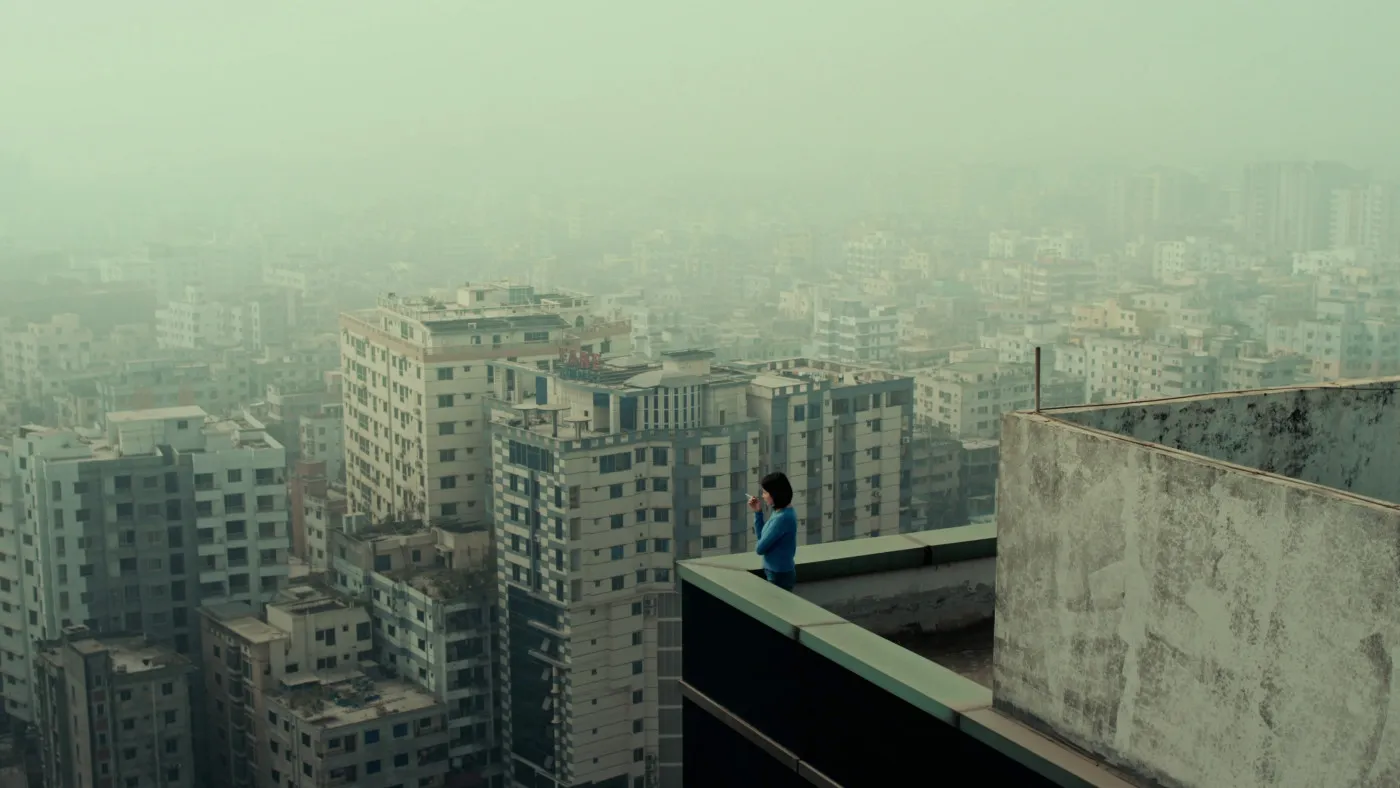

The air in Mahde Hasan’s Sand City is not merely air; it is a jaundiced, semi-solid presence. A permanent smog the color of lint and faded robin’s eggs presses down on Dhaka, a visual manifestation of the weight on its citizens. Within this oppressive atmosphere, the film identifies its core element: sand.
This is not the sand of idyllic beaches but the stuff of pure function. It is the raw material for a city in a constant, grinding state of construction, the silica for a glass factory, the cheap absorbent for a litter box. Yet this granular substance becomes the film’s central metaphor, representing the fragile, shifting foundation upon which modern urban lives are built.
We are introduced to two such lives, Emma and Hasan, solitary atoms vibrating in a metropolis of millions. They are connected by this dust, adrift in a story that promises no grand collisions, only quiet observation.
The Geometry of Alienation
The film presents its characters on parallel tracks that are doomed, by design, never to intersect. First, there is Emma (Victoria Chakma), a woman from one of Bangladesh’s ethnic minority groups. Her existence is a study in the slow erosion of the self. The daily discovery of racist graffiti on her scooter is not presented as a shocking event but as a predictable ritual, a form of ambient hostility as regular as the smog.
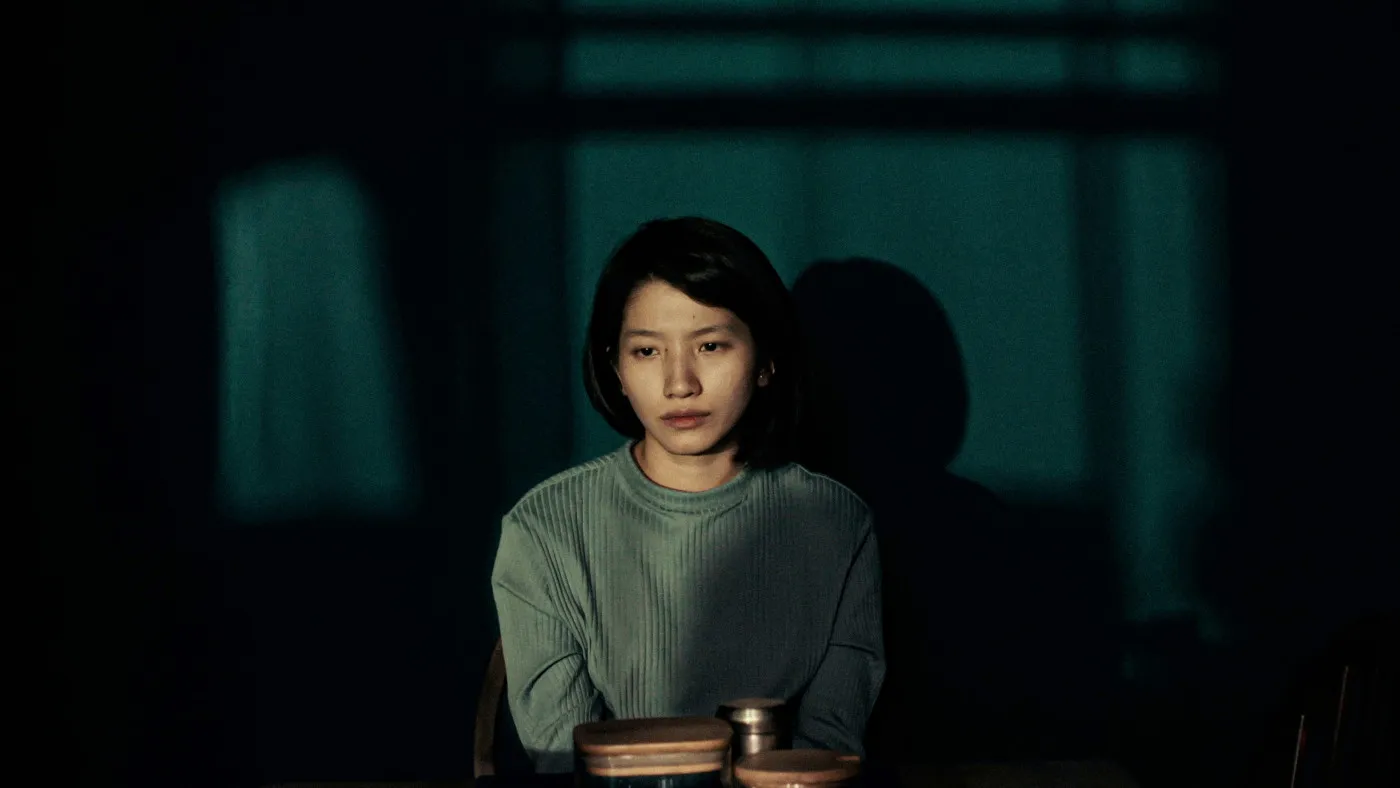
This is not the sharp pain of overt conflict but the dull, chronic ache of being perpetually othered. Her workplace, a supposedly modern office, offers no refuge, only a different flavor of isolation where she is a ghost in the machine. Her desire to leave the country is less a dream of a better future and more a simple animal instinct to flee a toxic environment. Her silence throughout much of the film is a form of self-preservation, a retreat into an inner world when the outer one offers nothing but abrasion.
Then there is Hasan (Mostafa Monwar), a middle-aged factory worker who clings to a small, capitalist dream: to start his own glass-making business. His secret theft of silica sand is a minor rebellion against his anonymous station, an attempt to gather the raw materials of a new life. This is the universal fantasy of agency, the belief that one can escape the gears of the system through sheer will and a little larceny. The system, of course, corrects this deviation.
He is caught on camera and fired without ceremony. His subsequent wandering through the city’s cheap bars and dusty street-side games is a portrait of a man unmoored from purpose. The director’s refusal to have these two lonely souls find solace in each other is the film’s most radical, and honest, choice.
It is a cinematic thesis against narrative convenience, suggesting that in the contemporary megacity—be it Dhaka or Tehran—physical proximity is a poor substitute for genuine community. The film argues that profound loneliness is the default state, not a problem to be solved.
The City as Abrasive Texture
The ideas in Sand City are communicated less through dialogue and more through a meticulously crafted sensory experience. This is a film of pure environmental expressionism, where the external world is a direct projection of internal states. The technical execution is the narrative. Mathieu Giombini’s cinematography gives the film its distinct visual signature.
The boxy 1.5:1 aspect ratio feels deliberately confining, trapping the characters within the frame just as the city traps them in their lives. The images possess a grainy quality that feels more like aged film stock than clean digital video, giving every surface a tactile, gritty reality. The palette—a specific brew of misty grays, hazy industrial blues, and muddy khakis—renders Dhaka as a suffocating organism, a place whose physical texture is both repellent and strangely beautiful.
This visual language is matched by Oronnok Prithibi’s sound design. The auditory landscape is a constant, low-level assault. The hum of traffic and the distant, ceaseless clang of construction create an inescapable pressure cooker of noise. This isn’t just background; it is the sound of a future being built that has no place for these individuals, the sound of their own obsolescence.
Against this ambient roar, specific, piercing sounds punctuate the characters’ deep silence, acting as sharp intrusions into their insulated worlds. This fusion of sight and sound creates the film’s substance. The feeling of stasis and the erosion of spirit are not just themes to be discussed; they are conditions to be felt, directly and physically, by the viewer.
Morbid Intimacy and Other Fragments
The film’s structure is deliberately fractured, a collection of moments that resist forming a neat causal chain. This narrative fragmentation mirrors the disjointed consciousness of its characters, whose lives are not stories but recurring loops of quiet struggle. Nothing better illustrates this than the film’s most unsettling symbol: a severed finger.
Emma discovers it in the sand she has collected for her cat. A lesser film would pivot here, turning into a crime story. Sand City does something far more strange and philosophically potent. Emma keeps the finger. This act is not about solving a mystery. The finger, with its chipped red nail polish, becomes a grotesque object of contemplation, a tangible piece of another person’s shattered story that has washed up in her barren life.
It represents a form of morbid intimacy, a connection that is safe because it demands nothing of her; she is a custodian to a tragedy, not a participant in a relationship. This is a symptom of alienation so extreme that a piece of a corpse feels more real than the living people nearby.
The film’s bleak perspective extends to all forms of hope. Hasan’s modest dream is crushed, and Emma’s only goal is escape. In this, the film serves as a vital antidote to the sort of nationalistic cinema that celebrates relentless progress, daring instead to show the human dust left behind by the bulldozers.
Its cultural value lies in this honesty, in validating a widespread feeling of disillusionment that official narratives ignore. It is a demanding, poetic work that forces a confrontation with the uncomfortable truth that modern life often promises connection while engineering isolation.
Sand City is a 2025 Bangladeshi drama film directed by Mahde Hasan. It premiered in the Proxima Competition at the 59th Karlovy Vary International Film Festival on July 7, 2025, winning the PROXIMA Grand Prix.
Full Credits
Director: Mahde Hasan
Writers: Mahde Hasan
Producers: Rubaiyat Hossain, Aadnan Imtiaz Ahmed, Mahajabin Khan (Co-producer), Mahde Hasan (Co-producer)
Cast: Mostafa Monwar, Victoria Chakma, Javed Kaiser, Apel Pavel, Satej Chowdhury, Mashrawi Muhammadi, Sajeeb A G
Director of Photography (Cinematographer): Mathieu Giombini
Editors: Mahde Hasan
The Review
Sand City
Sand City is a piece of demanding but essential viewing. It is an unapologetically atmospheric and philosophically dense film that offers no easy comforts. Its power lies in its masterful creation of a suffocating world and its uncompromising honesty about alienation in the modern metropolis. This is not a film for those seeking plot or resolution, but for viewers who appreciate cinema as a form of sensory and intellectual immersion. It is a bleak, beautiful, and unforgettable experience that confirms Mahde Hasan as a significant new voice in world cinema.
PROS
- Stunning cinematography and immersive sound design that work together to create a powerful, unforgettable atmosphere.
- An intellectually honest and uncompromising portrayal of urban alienation and social fragmentation.
- Deeply felt, restrained performances from the lead actors who convey immense internal struggle with minimal dialogue.
- Intelligent and haunting use of symbolism that rewards patient analysis.
CONS
- The deliberately slow pacing and fragmented narrative structure will be challenging for viewers accustomed to conventional storytelling.
- An overwhelmingly bleak tone and a lack of catharsis make for a difficult and emotionally draining watch.
- Its refusal to connect the two main characters, while thematically crucial, can leave the drama feeling intentionally inert.