



















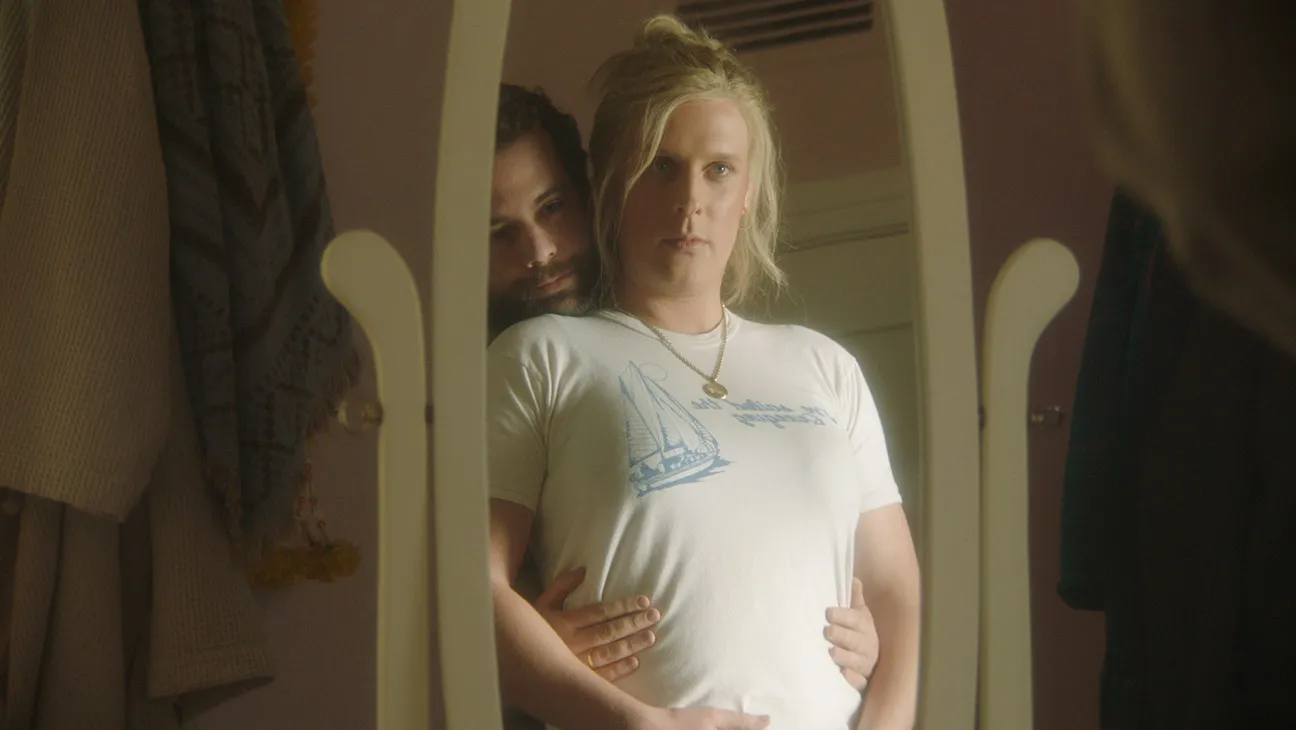

We first meet Maddie Ralph as a study in quietude. She is a talented vegetarian chef, though she hides this talent beneath the humble role of a dishwasher at Gourmaybe, a purveyor of fleeting digital food content. In this placid existence, she is a soul contained. The intrusion comes, as it so often does, through a screen. Her husband Jake, an avatar of doting support, captures her private grace on video, polishes it into consumable content, and releases it into the ether.
The world responds with the voracious, anonymous hunger of the viral gaze. Overnight, Maddie is seen. This sudden visibility is a kind of violence. The promotion to on-screen personality, the disembodied chorus of online praise and criticism, becomes a pressure that cracks the fragile shell of her selfhood.
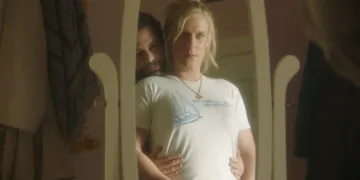
An old sickness, a long-suppressed bulimia, returns not as a choice but as a desperate ritual to expel the invading world. Maddie’s Secret announces its form as a phantom, a heartfelt resurrection of the disease-of-the-week television movie. Its drama is sincere, a purposeful wearing of a forgotten face. The first signal of its fractured reality is in its own body: the director and writer, John Early, inhabits the form of Maddie.
An Archeology of Feeling
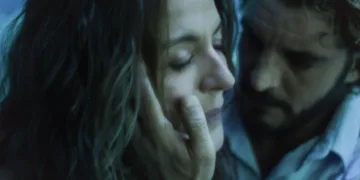
The film’s universe is a candy-colored cage, a meticulously designed prison of feeling. Every frame is bathed in the gauzy, soft-focus light of a half-remembered dream, a visual language that feels at once beautiful and profoundly unreal. This aesthetic is a deliberate archeology, excavating the visual grammar of Douglas Sirk’s 1950s melodramas and repurposing it for a new form of silent desperation.
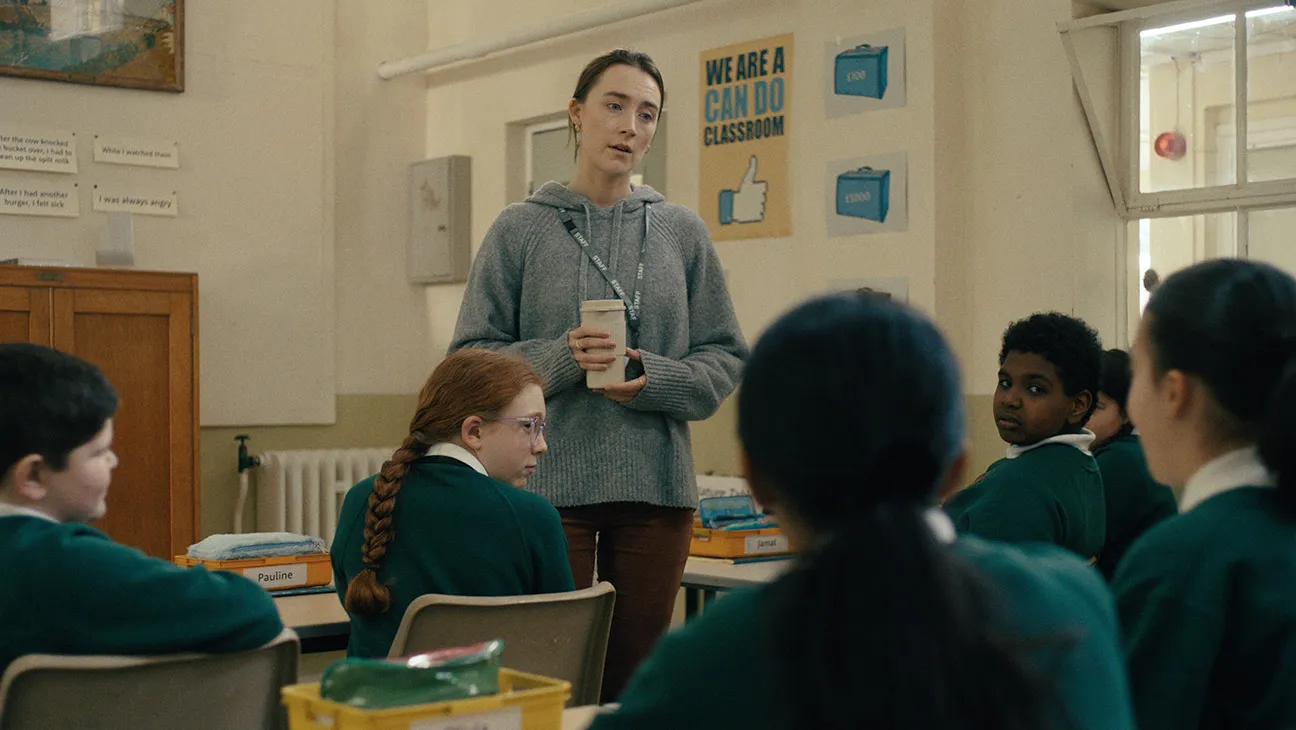
That historical style, a lexicon of repressed passion and suffocating social expectation, maps perfectly onto Maddie’s internal state. The vibrant, lacquered sets are hostile to her pale anxiety, their perfection a constant indictment of her own perceived flaws. The cinematography acts as a metaphor for dissociation; the world is seen through a psychological blur. The film’s tone is a complex maneuver. It employs an archaic sincerity, speaking in a lost language of heightened emotion to articulate a distinctly modern emptiness.
The humor is not a release of tension but a symptom of it, born from the absurdity of maintaining a flawless facade over a chaotic interior. The cast speaks in the hyper-expressive dialect of made-for-TV agony, performing the gestures of emotion with a desperate intensity, like actors who have forgotten they are on a stage.
Their broadness becomes a kind of existential armor against the quiet horror of their lives. The film holds a reverent space for real suffering. It treats Maddie’s bulimia with care, refusing to make a spectacle of the body’s violation. We see the aftermath, the bloodshot eyes and trembling hands, but the ritual itself remains private. The pain is real, even if the world it exists in is a perfect fabrication.
The Body as Ghost
John Early does not play Maddie so much as he allows the idea of her to possess him. His performance is a feat of sincere inhabitation, an absolute surrender to the character’s anxieties and warmth without a trace of irony. He is grounded in an emotional reality that the film’s style constantly seeks to escape. His physicality is key; he carries Maddie’s fragility in his posture, in the tentative movements of his hands, conveying a sense of a body at war with itself.
This is a performance free of vanity, a quiet channeling of another’s pain. The choice to cast a man in the role is the film’s central philosophical statement, a direct assault on the notion of an authentic self. It exposes the artifice of identity itself, suggesting that the self is a costume, a collage of borrowed parts, a script we learn to recite. Early’s body becomes a site of ontological confusion, a physical representation of the body dysmorphia that haunts the narrative.
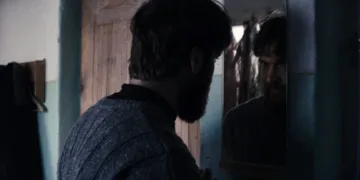
What is a person but a performance we give for others? As a director, Early is the meticulous architect of this beautiful ruin. His vision is supremely confident, his shot compositions thoughtful. He often frames Maddie as a small, isolated figure within her own impeccably designed home, visually reinforcing her imprisonment.
The film’s rhythm, which contrasts the slick, upbeat pace of online content with the slow, silent moments of Maddie’s distress, is controlled with precision. He maintains the film’s precarious tonal balance, ensuring the project never collapses into a simple parody because its questions about the agony of a performed self are too pressing, too real.
Satellites of the Self
The figures orbiting Maddie are not people so much as mirrors and distortions of her own fracturing psyche. They are satellites caught in the gravitational pull of her collapse, each reflecting a different aspect of the world’s demands. Kate Berlant’s Deena embodies a consuming, obsessive affection that is itself a form of consumption, another hungry gaze demanding something from Maddie.
Eric Rahill’s Jake represents the loving blindness of a world that refuses to see the darkness, his ignorance a comfortable cage that protects him from his wife’s reality. In a devastating late-film confrontation, Kristen Johnston as Maddie’s mother becomes the ghost of causality, the origin point of the central trauma, the first voice that taught Maddie her body was a thing to be judged.
These characters move with a shared theatricality, their lives dictated by the script of melodrama. The film’s gaze extends to the culture that created Maddie’s predicament. It is a quiet meditation on the tyranny of the curated self in the digital age, where life becomes content and the body is a project to be disciplined into a state of empty perfection.
Social media here is the existential battleground where the private self is forcibly made public, flattened into an image, and judged by an invisible tribunal. The film’s kindness is a strange, melancholy thing. It offers no easy cure. Instead, it suggests that tenderness can be found even within the artifice, that a radical compassion for the performer is its own form of grace.
“Maddie’s Secret” premiered at the Toronto International Film Festival on September 4, 2025. As of now, it does not have a wide release date or distribution details, so information on where to watch it is not yet available. It is not currently on any streaming services.
Full Credits
Director: John Early
Writers: John Early
Producers: Harris Mayersohn, Luca Intili, John Early
Cast: John Early, Kate Berlant, Eric Rahill, Kristen Johnston, Claudia O’Doherty, Connor O’Malley, Vanessa Bayer, Chris Bauer, Pat Regan, Mariah Robinson, Ruby McCollister
Director of Photography (Cinematographer): Max Lakner
Editors: Danny Scharar
The Review
Maddie’s Secret
John Early’s film is a beautiful, melancholic construction, a sincere performance of a forgotten style used to diagnose a modern sickness. It uses its gauzy, artificial world not to escape reality, but to reveal the profound unreality of the self in an age of digital surveillance. A work of strange compassion and intellectual rigor, it finds a startling truth in the heart of a perfect lie. It is a haunting examination of the pain required to maintain a flawless facade.
PROS
- A deeply committed and empathetic lead performance from John Early.
- Confident, visually precise direction that perfectly captures a specific aesthetic.
- Intelligent use of melodrama to explore serious themes of identity and suffering.
- A thought-provoking critique of influencer culture and the performance of self.
- A strong supporting cast that fully understands and executes the film's unique tone.
CONS
- The highly specific aesthetic may feel alienating to viewers unfamiliar with its TV-movie inspirations.
- Its deliberate artificiality could prevent some from forming a direct emotional connection.
- The delicate tonal balance, while impressive, might strike some viewers as strange or inconsistent.