





















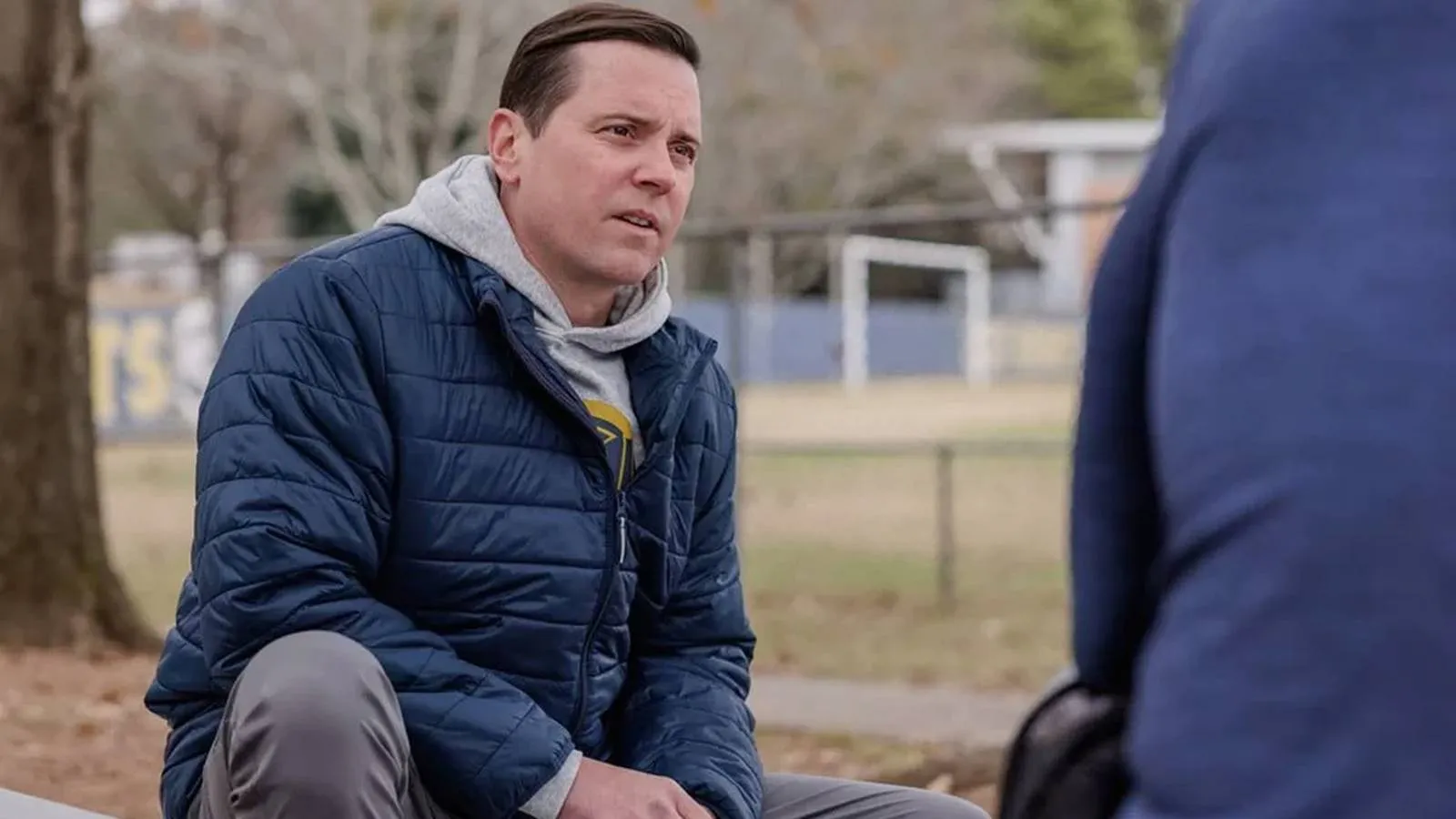

Glen Owen introduces Walt McFadden as a man stuck in the stagnant waters of mid-tier coaching. Walt works as the special teams coordinator for Louisiana University, living in the shadow of a legendary coaching father-in-law. His career reads like a string of frozen plays, repeated until the whistle. Head Coach Crew Marshall offers a desperate path to relevance, and the mission arrives with clean, brutal simplicity: Walt has four days to secure the signature of Tony Raymond. He carries a burner phone and a gym bag packed with fifty thousand dollars in cash.
Tony is the top defensive prospect in America, known to locals as “Country Hurt,” a generational force tucked away in the backwoods of Alabama. The setting slides from the clinical halls of big-money athletics into a landscape shaped by economic exhaustion.
Owen uses wide, lingering shots to lock in the rural isolation, letting the silence sit long enough to feel accusatory. A ticking clock keeps tightening the screws. Walt steps into a world where a teenager’s physical dominance functions as the only currency that holds. He moves through it like a salesman with a heavy bag and a very short deadline. His smile keeps slipping. The bag does not.
Capitalism in the Tall Grass
The film operates as a study of friction between athletic idealism and predatory capitalism. College football sells itself as a sanctuary built on love of the game; Owen shows a cold business cycle built on investment and aggressive returns. He frames the ecosystem with the nerves of a corporate thriller, where meetings feel like interrogations and every promise carries a hidden price tag.
Recruiters behave like underworld fixers with branded polos. They offer Ferraris. They promise early prison releases for family members. NIL deals function as legalised bribes, paperwork laid over instinct. Rich Akers embodies the peak of this ruthlessness, a former colleague who reads human beings as data points on a spreadsheet. Efficient. Bloodless. The kind of person who would put a dollar sign on a heartbeat and call it analytics.
Alabama’s visual palette stays deceptively bright. Rolling grasslands and tranquil lakes sit in saturated hues, beautiful enough to lull the eye. That beauty serves as camouflage for a harsher economic reality. Communities meet outsiders with a suspicion that feels earned, learned, and practiced. Owen’s camera captures the burden of poverty through cramped interiors and weathered faces, details that keep the satire tethered to something solid. The pursuit of a star player starts to erode the dignity of an entire town. The bidding war keeps escalating. The prize remains a human life.
Shadows of the Small Town
Michael Mosley plays Walt as a man defined by a dangerous lack of cynicism. He wants to be liked. He wants to do the right thing. In this industry, that reads like a structural defect. His honesty feels like an anatomical anomaly in the recruitment machine, and Owen uses that vulnerability to generate a psychological depth that sports dramas rarely earn.

The Raymond family functions as the film’s emotional anchor. Mira Sorvino gives Sandy jagged edges, a mother moving through the haze of addiction while fending off corporate vultures circling close. Her grit works like armor, scratched up, still holding. Rob Morgan provides a stabilizing counterpoint as Otis Henderson, a stepfather with a calm exterior that suggests a capacity for violence. The stillness lands like a warning sign. The casting of former athletes like Brian Bosworth and Marshawn Lynch adds authenticity, bodies that seem to carry the physical toll of the system even when they stand still.
Owen avoids the trap of rural caricature. These characters are observant. They are sharp. They understand they are being hunted, and they watch every visitor like they are counting bullets. Tony Raymond remains elusive for most of the runtime, kept stashed away like a MacGuffin. The choice heightens tension and redirects attention toward the adults who barter for his future, turning family conversations into negotiations and small talk into strategy.
The Morality of the Huddle
Recruiters treat the family unit as a collection of bargaining chips. They look for fractures to exploit. They search for weaknesses in the domestic structure that can facilitate a sale. The film pivots when Walt recognizes the genuine bond between Tony, Sandy, and Otis. They value the boy’s development over the immediate payout, and that detail lands like a moral interruption.
The realization triggers an existential shift in Walt. He begins to see the recruitment process as a machine that consumes the very passion it claims to celebrate, feeding on devotion while pretending to honor it. He finds solidarity with the Raymonds through their shared status as expendable parts in a larger hierarchy. His refusal to play the gangster becomes his most effective strategy. He chooses presence. He listens, and he stops pitching. Small move, huge risk. The kind of integrity that gets you mocked right up until it works.
The narrative shifts from R-rated satire into a sincere examination of integrity, with tension still humming underneath. The final stretch offers a sense of calibrated justice, placing characters where their actions lead rather than where their status says they belong. Owen frames the team as a metaphor for the nation, a collective that functions when built on respect. The film suggests that winning becomes hollow when the people involved remain strangers to one another. The scoreboard can light up. The room can still feel empty.
Signing Tony Raymond premiered at the Austin Film Festival on October 24, 2025, before making its theatrical debut in the United States on January 16, 2026. The film follows an ambitious but idealistic special teams coach from Louisiana University who is sent to rural Alabama on a high-stakes mission to recruit the nation’s top high school prospect. Armed with a bag of cash and a burner phone, he must navigate a landscape of rival recruiters and a protective, dysfunctional family. Currently, the movie is primarily available in theaters through Iconic Events Releasing and participating cinema chains such as AMC and Marcus Theatres.
Full Credits
Title: Signing Tony Raymond
Distributor: Iconic Events Releasing
Release date: January 16, 2026
Rating: PG
Running time: 105 minutes
Director: Glen Owen
Writers: Glen Owen
Producers and Executive Producers: John Thomas, Kristy Clabaugh, Don Mandrik, Cameron Boling, Glen Owen
Cast: Michael Mosley, Mira Sorvino, Rob Morgan, Marshawn Lynch, Brian Bosworth, Charles Esten, Jackie Kay, Champ Bailey, Richard Sherman
Director of Photography (Cinematographer): Daniel Friedberg
Editors: Patrick Perry
Composer: John Timothy Roberts
The Review
Signing Tony Raymond
Signing Tony Raymond works because it prioritizes the human cost of the recruitment machine over the statistics of the game. Glen Owen balances sharp satire with a sincere appreciation for rural resilience. While the tonal shifts occasionally feel as unpredictable as a gusty afternoon on the field, the performances of Mosley, Sorvino, and Morgan provide a sturdy emotional foundation. It is a thoughtful examination of integrity within a system that rarely rewards it.
PROS
- Sorvino and Morgan avoid rural stereotypes.
- Explores the "business" of sports with sharp wit.
- Saturated cinematography captures the Southern landscape.
CONS
- Flips rapidly between satire and earnest drama.
- The middle section slows significantly in the Alabama woods.
- The "honest man in a corrupt world" path feels familiar.