


























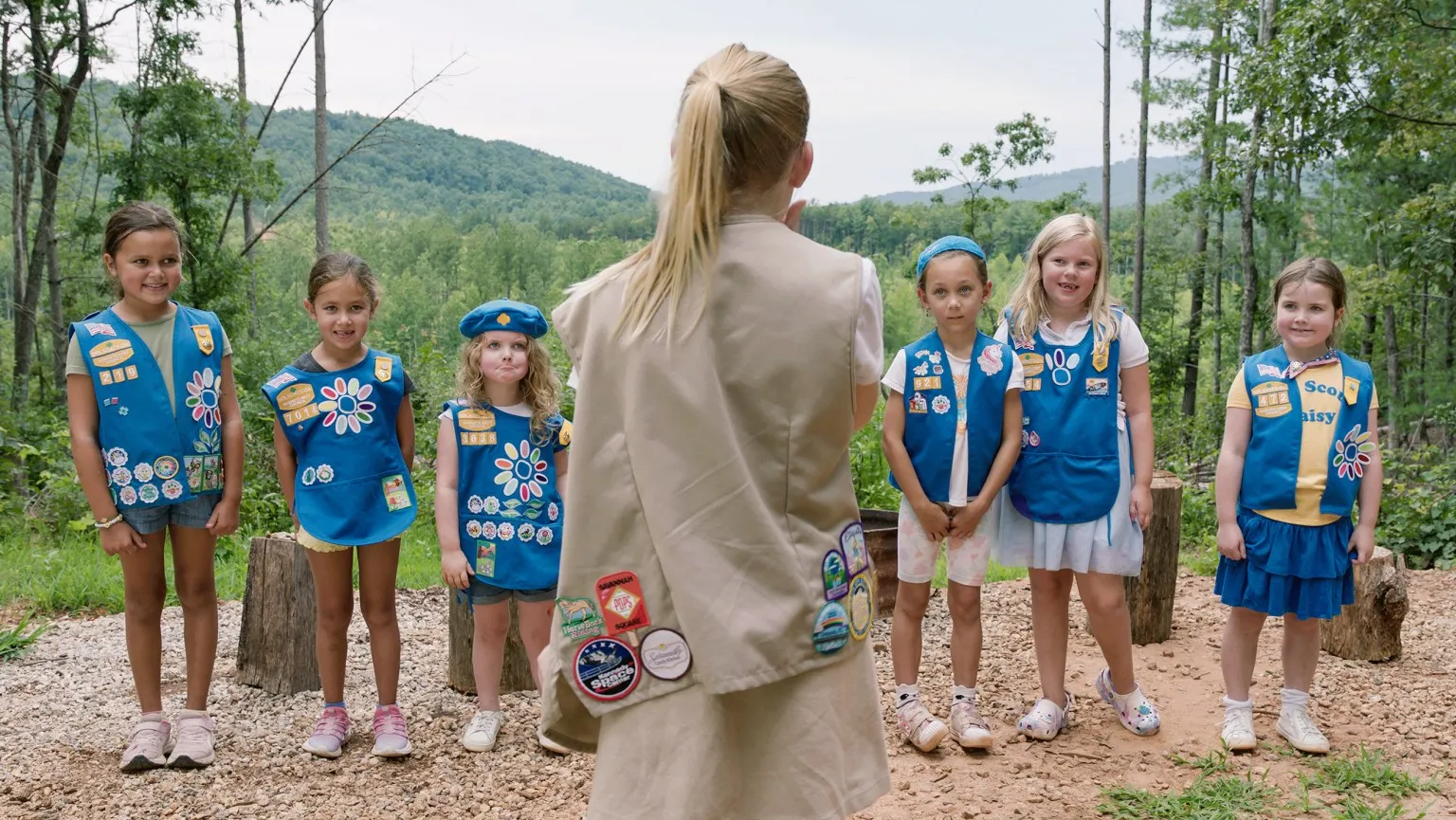

For six weeks each year, a familiar strain of entrepreneurial heat settles over American neighborhoods. The Girl Scout Cookie Program turns quiet suburbs and busy city corners into a marketplace with real stakes and real pressure. Alysa Nahmias documents that season in Cookie Queens, following four girls, ages five to twelve, as their world shifts from play toward professionalized selling.
The size of the enterprise lands with a jolt. The program generates about $800 million a year through the distribution of 250 million boxes. Executive produced by Prince Harry and Meghan Markle, the film watches that machine operate at ground level and lets the numbers speak through lived routine. Each box sells for $6. A local troop typically receives $1.
The remaining $5 moves upward into the workings of a vast organization. Nahmias keeps the camera trained on what that structure asks of children: social time traded for pitches, friendships folded into sales routes, goals that stretch far past the scale of ordinary youth activities. The film frames this as childhood labor wearing the mask of character education.
The Faces of Ambition
The documentary’s pulse comes from four sharply drawn lives. Olive, a twelve-year-old from North Carolina, carries the tactical focus of a seasoned executive. The film links her intensity to a young Tracy Flick, a comparison that fits her fast math and relentless planning.
Olive sets a record-level target of 10,000 boxes and treats it as identity, schedule, and scorecard. She questions the garnishing of her earnings with open frustration, then returns to the chase for top-seller status with the same hard discipline. Skepticism lives beside ambition here, and the film refuses to soften that contradiction.
In California, nine-year-old Nikki functions as the hook for a family sales team. She measures herself against older sisters and reads hierarchy in the language of prizes. Her fixation on a massive cookie queen trophy carries the weight of validation, a desire to be seen as equal inside the family’s internal ranking system. The camera catches how quickly performance becomes a family expectation, then a family routine, then a family identity.
Shannon Elizabeth, in El Paso, operates under a different pressure. Selling is tied to necessity. Her family needs these boxes to fund a summer camp trip, and the prize sits in the category of luxury, something unreachable through ordinary means. The documentary holds on the quiet violence of that arithmetic: a child’s dream weighed against household stability, hope translated into inventory and debt.
Five-year-old Ara supplies the film’s sharpest irony. She is diabetic, tasked with selling sugary snacks, and she carries the assignment with a precocious clarity that lands as both funny and bleak. Her schedule includes hobbies like piano and pilates, threaded around the demands of the cookie circuit. She moves through her environment with solitary focus, a small figure already trained to treat time as resource.
Celia, Olive’s best friend, becomes an essential secondary presence. Articulate and steady, she mirrors Olive’s intellectual maturity and offers a supportive calm that reads as companionship and partnership. Together, Olive and Celia embody a generation learning to grow up through performance and profit, with adulthood arriving as a script handed down early.
The Silent Lens of Observation
Nahmias commits to a strictly observational approach and strips away the genre’s usual safety rails. The film avoids talking-head interviews and avoids archival sequences that might package meaning into tidy explanation. The camera stays a quiet witness in cluttered living rooms and dusty flea markets, present without commentary, close without forcing confession. That choice protects the girls’ authenticity. Their voices remain the primary guide, delivered through unguarded conversation, quick bargaining, and the casual honesty children use when adults stop narrating for them.
Antonio Cisneros’ cinematography leans into pastels and warm light. The softness of the image sits against harder truths spoken in plain language, creating a visual counterpoint that never turns sentimental. The film lets narrative emerge through small gestures and candid exchanges: a practiced smile, a tired pause, a recalculated goal, a parent’s strained encouragement. Vulnerable moments between children and parents build sincerity without manufactured catharsis.
The absence of adult experts pushes the audience into direct contact with what is shown. No professional voice arrives to translate the ethics into something comfortable. The sugary surface of the footage often carries a sharper undercurrent, and the film trusts viewers to notice the fracture. These girls speak about doubt and fatigue with startling clarity. By staying close to immediate surroundings, the documentary captures the weight of expectation as a physical presence in rooms, cars, and sales sites. The visual language emphasizes intimacy in their struggle and foregrounds the distance between cheerful branding and the lived reality of the organization’s youngest workers.
The Cost of the Cookie-Industrial Complex
The film functions as an examination of a cookie-charitable-industrial complex and the way risk slides downhill. Families with fewer financial cushions absorb the strain first. Shannon Elizabeth’s parents face the stress of pre-buying 2,750 boxes of inventory, a decision that places a child’s ambition beside the mortgage in the same anxious calculation. The documentary presents this as mechanism, not anomaly: a system that rewards middle-class stability and punishes households without slack.
The film also treats cuteness as commodity and shows how quickly children learn that lesson. Nikki and her sisters understand appearance as a tool for profit. They deploy charm with intention, using it to secure sales and sustain momentum. The documentary does not scold them for adapting; it shows the market training them to adapt, then applauding the results.
Olive hits a quieter crisis as the logic tightens. She recognizes her self-worth becoming tied to output and begins asking what remains when the selling stops. The question lands with existential force because it arrives inside a child’s body, spoken without flourish, sharpened by exhaustion. The film names the lesson clearly: late-stage capitalism teaches these girls that achievement measures value, then asks them to internalize that metric as identity.
Ara responds through invention. She creates a sugar-free side business and turns her disability into an opportunity within the same marketplace that exploits her. The documentary tracks that move as survival strategy, a child learning to monetize what the world already marks as difference.
Across all four stories, the disparity between labor and return persists as a constant. These girls absorb the pressures of an adult economy before middle school, and the film watches that pressure shape their speech, their friendships, and their sense of self. Identity becomes tangled with productivity, ambition becomes obligation, and childhood becomes a training ground for commerce.
Cookie Queens is an insightful documentary that premiered at the Sundance Film Festival on January 25, 2026, where it received a standing ovation. Directed by Alysa Nahmias and executive produced by Prince Harry and Meghan Markle, the film follows four young Girl Scouts during the high-stakes six-week cookie-selling season. It explores the intersections of childhood innocence and the $800 million business of sales, highlighting themes of ambition, resilience, and economic reality. Following its successful festival debut in Park City, the film is expected to be available on major streaming platforms later this year through the Sussexes’ Archewell Productions banner.
Full Credits
Title: Cookie Queens
Distributor: Archewell Productions, AJNA Films, Beautiful Stories
Release date: January 25, 2026
Rating: Family Matinee, Suitable for All Ages
Running time: 91 minutes
Director: Alysa Nahmias
Writers: Alysa Nahmias
Producers and Executive Producers: Alysa Nahmias, Gregory Kershaw, Michael Dweck, Jennifer Sims, Prince Harry Duke of Sussex, Meghan Duchess of Sussex, Chanel Pysnik, Regina K. Scully, Hallee Adelman, Ann Lewnes, Stephen G. Hall, Ruth Ann Harnisch, Geralyn Dreyfous, Tegan Acton, Emma Pompetti, James Costa, Trevor Burgess
Cast: Nikki, Olive, Ara, Shannon Elizabeth, Nala, Nyah, Carrie, Celia
Director of Photography (Cinematographer): Antonio Cisneros
Editors: Kim Roberts, Jeanne Applegate, Fátima de los Santos
Composer: Amanda Jones
The Review
Cookie Queens
Cookie Queens is a sharp, observational study that strips away the sugary veneer of a celebrated American tradition. By centering the voices of the girls rather than the adults, Alysa Nahmias reveals the heavy machinery of capitalism operating within the playground. It is a visually warm yet intellectually chilling portrait of how early we teach children to view themselves as commodities. The film succeeds as a beautiful, nuanced exploration of girlhood and a necessary critique of the labor hidden behind a familiar box of treats.
PROS
- Authentic, observational storytelling without "talking head" experts.
- Exceptional casting of diverse and articulate young subjects.
- Striking cinematography that contrasts sweetness with systemic pressure.
CONS
- The lack of adult context can leave some financial questions unanswered.
- The pacing occasionally mirrors the repetitive nature of the sales grind.
- Some viewers may find the "saccharine" visuals too heavy at times.