
























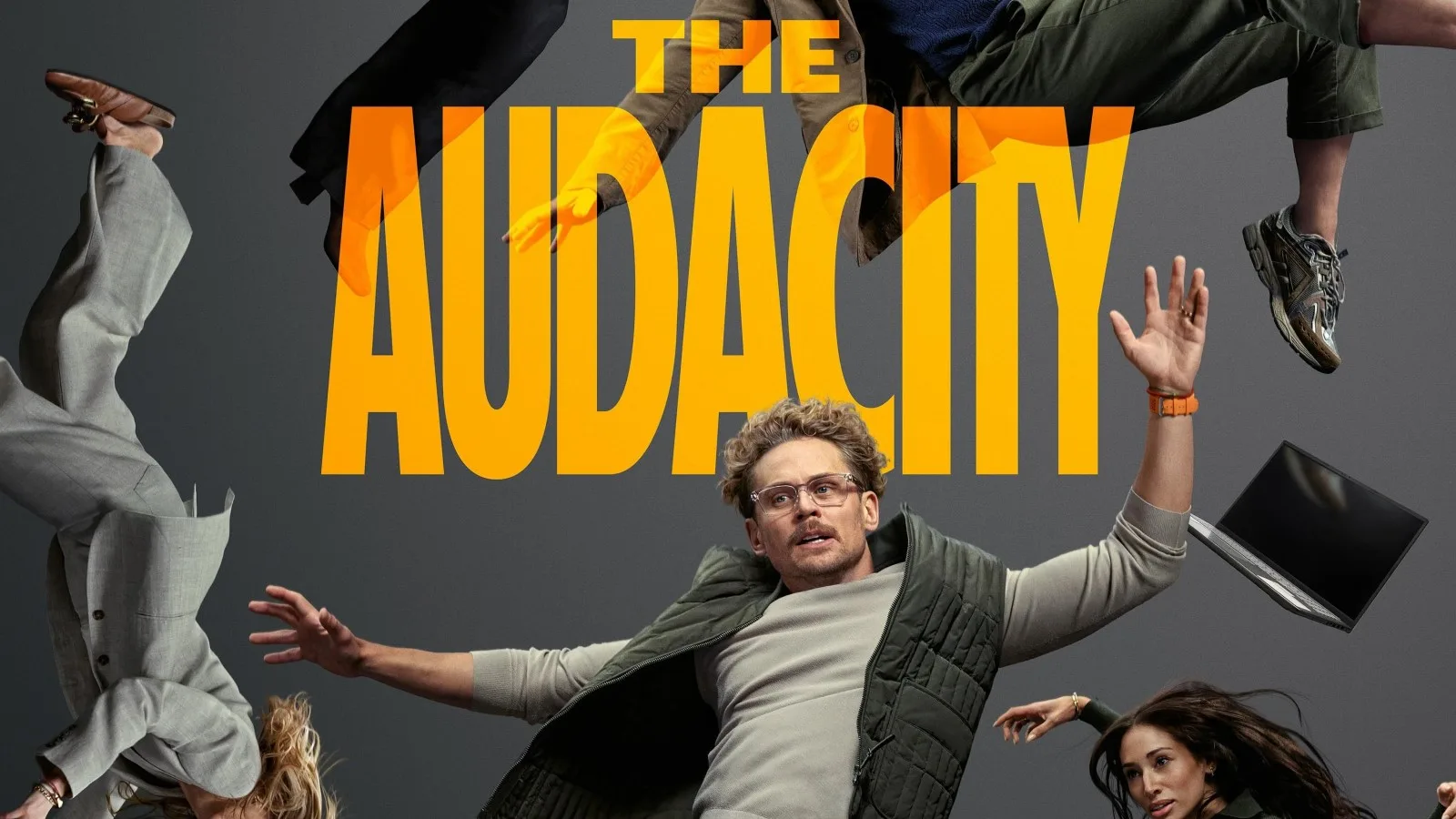

The Audacity opens like a data center with a pulse. AMC’s eight-episode drama drops us into a Silicon Valley where wealth has turned into a kind of weather system, always present, always toxic, always changing the air. At the center is Duncan Park, the founder of HyperGNOsis, a man who radiates neediness through layers of success. He is rich, volatile, self-regarding, and still desperate for more attention, more status, more proof that he matters.
The show’s setup is immediately recognizable, yet it has its own sour flavor. Jonathan Glatzer builds a world where therapy sessions become business intel, family dinners feel like hostile negotiations, and every conversation has a price tag hiding in the corner. That approach gives the series a brisk satirical charge, while the personal damage gives it a steadier dramatic beat. The tech world here is polished, curated, and deeply rotten. The people inside it have convinced themselves they are shaping the future, while the series keeps asking what kind of future gets built by people who cannot even manage their own lives.
Plot Threads That Keep Colliding
The writing leans into structure as a kind of pressure cooker. Duncan’s professional life is already wobbling when the series begins, and the strain around HyperGNOsis sends him into damage-control mode. Failed deals, shaky alliances, and his hunger to stay relevant give the story a jagged momentum. He is surrounded by people who want leverage, and once that becomes clear, the series starts playing like a chain reaction.
JoAnne Felder gives the show its most unusual hinge. As a therapist to the tech elite, she sits in the room where private weakness becomes valuable information. Her choice to mine that access for financial gain creates a deliciously ugly setup, and her connection to Duncan turns the entire series into a mutual blackmail arrangement with better clothes. Their scenes have the tension of two people who understand each other too well and trust each other far too little.
The show keeps widening from there. Martin’s work on his AI creation opens a lane into the culture’s obsession with machine intelligence, while Anushka’s role as an ethical voice inside the industry gives the series a chance to test how much morality can survive inside a system built to monetize every concern. Carl Bardolph, with his bruised veteran status inside the tech world, arrives like a ghost from an earlier phase of Silicon Valley’s self-mythology. Meanwhile, the government angle through Veterans Affairs adds a blunt reminder that the consequences of all this private greed spill outward.
The first stretch can feel crowded. The series asks for patience as it establishes its players and the pressure points between them. That makes sense, because The Audacity is less interested in a neat chain of plot turns than in the mess that forms when ambition, shame, and money keep brushing against each other. Once the parts begin to click, the show finds a harsher rhythm, and the later episodes carry a sharper sense of payoff.
Also Read






A Cast Built on Friction
Billy Magnussen makes Duncan work because he understands the difference between a big personality and a hollow one. Duncan is all performance, all projection, all brittle confidence wrapped around private panic. Magnussen gives him a restless energy that feels almost combustible. He moves like a man trying to outrun the fact that he may not be as smart, visionary, or special as he thinks he is. That insecurity gives the character shape. Without it, Duncan would be just another satirical tech tyrant. With it, he becomes a very specific kind of modern failure: the founder who cannot survive without being seen as exceptional.
Sarah Goldberg is just as important to the series’ balance. JoAnne has a professional calm that never fully hides her own compromise. She speaks with the authority of someone trained to listen, yet she uses that skill as a tool for self-interest. Goldberg keeps the role edged with fatigue, vanity, and intelligence. She also gives JoAnne a touch of defensive humor that makes her easier to watch than she ought to be. Her scenes with Duncan carry a crackling adversarial energy, and the show often feels most alive when they are circling each other.
The ensemble helps the series widen its reach without losing its bite. Lucy Punch gives Lili a hard, controlled surface that makes her feel like a force inside both the marriage and the social ecosystem around it. Zach Galifianakis plays Carl Bardolph as a man who has made cynicism his native language, and he uses stillness and threat in equal measure.
Simon Helberg brings an anxious, inward quality to Martin, which works well against the show’s louder figures. Meaghan Rath’s Anushka has the burden of sounding ethical inside a world that treats ethics as branding, and she handles that contradiction cleanly. Rob Corddry gives the VA material a welcome groundedness, a reminder that the tech world’s self-importance depends on institutions it tends to dismiss.
The younger characters carry a quieter pain. Jamison and Orson feel like children raised in the shadow of adult appetite, and the show uses them to underline the cost of all this status-chasing. They do not exist as sentimental relief. They are part of the damage report.
The series’ one limitation is that its people are often built from sharp traits before deeper emotional layers arrive. That works for satire, but it keeps some characters from becoming fully unpredictable. You can admire the precision and still feel a little distance.
What the Show Is Really After
The real target here is tech culture as a belief system. The Audacity treats Silicon Valley less as a place than as a moral atmosphere, where money, influence, and public language all blur together. The show is alert to the way founders talk about innovation while guarding their power, and it understands how easily idealism gets folded into branding. Every public good has a private angle. Every promise of progress carries a hidden invoice.

That gives the series a strong cultural pulse. It speaks to an era in which people distrust the platforms that shape their lives, even while relying on them. Data privacy, AI, surveillance, and the language of optimization are all folded into the drama with a kind of grim familiarity. The show knows this world has stopped feeling futuristic. It feels invasive, ordinary, and already too late.
What interests me most is how the series links this culture to self-deception. Duncan wants to see himself as a visionary. JoAnne wants to see herself as a pragmatist with standards. Martin, Carl, and the rest all maintain some version of this fantasy. The series keeps showing that the real product is not technology. It is permission. Permission to avoid accountability. Permission to turn private insecurity into public power. Permission to call exploitation innovation.
That is why the family material matters. The children are not there as decorative contrast. They are evidence. Every skipped dinner, every manipulative conversation, every selfish decision leaves a mark. The adults speak in the language of the future, yet their homes are full of neglect, resentment, and loneliness. It is one of the show’s sharper insights.
Dialogue with a Poisoned Smile
The script has a taste for barbed, fast-moving dialogue, and that gives the series much of its lift. People here speak in polished attacks, half-jokes, self-justifications, and little bursts of corporate poison. The humor comes from how casually everyone normalizes the unacceptable. That is a smart satirical move, because it mirrors how much of modern tech culture relies on euphemism. Harm gets dressed up as disruption. Greed gets called strategy. Surveillance gets described as insight.
What the writing does especially well is let the characters reveal themselves through tone. Duncan’s bluster tells us almost everything we need to know about his fragility. JoAnne’s clipped professional language hides a lot of compromise. Carl’s bitterness carries real intelligence, while also exposing how badly his self-image has curdled. The show understands that people in this world rarely say exactly what they mean, and that makes the verbal sparring feel alive.
There are moments when the satire feels a little familiar. The corporate absurdity, the wellness hypocrisy, the obsession with smart people behaving badly, all of that has been done before. Yet the series still lands enough clean lines and ugly little truths to keep its voice distinct. It has a nasty ear for the way privileged people excuse themselves.
What I appreciate most is that the writing never tries to soften the rot with charm. It lets the ugliness sit there. That can make the series uncomfortable, but it also gives it a firmer point of view.
A Prestige Drama with Scratches on the Surface
Visually, The Audacity leans into the glossy geometry of power. The campuses, homes, offices, and sleek communal spaces all feel engineered to project calm, even as the people inside them are falling apart. That contrast does a lot of the show’s thematic work. Silicon Valley in this series looks expensive enough to anesthetize its inhabitants, which makes the emotional chaos pop harder.
The production design helps sell the world as a closed ecosystem. The endless glass, neutral furniture, curated art, and digital surfaces give the series an institutional chill. It is all very clean until the human messes start leaking through. That is a useful visual strategy for a show about surveillance and control, because it keeps reminding us that the whole place is built to conceal as much as it reveals.
The pacing is more uneven than the look. Early episodes spend a lot of time introducing players and setting up collisions, and the show can feel overstuffed while it does that. Still, the structure starts to pay off once the various storylines begin pushing against one another. By the later stretch, there is a real sense of pressure gathering.
In a broader TV sense, the series sits between old-school prestige drama and the newer, more fragmented mode of ensemble satire. It has the polish of the former and the sprawl of the latter. That balance is imperfect, but interesting. There is enough bite here, and enough performance strength, to make the whole thing feel worth following even when the seams show.
For a show about people who want to control the future, The Audacity is at its best when it admits how little control anyone truly has.
The Audacity is a darkly comedic drama series that premiered on April 12, 2026, on AMC and the AMC+ streaming platform. Created by Jonathan Glatzer, who previously worked on acclaimed hits like Succession and Better Call Saul, the show is set within the high-stakes, eccentric bubble of Silicon Valley. It follows the story of an ambitious tech CEO and his ethically compromised therapist as they navigate a world of data-mining scandals, AI-fueled depravity, and the pursuit of extreme wealth. The series has already garnered significant attention for its sharp satire of big tech culture and was renewed for a second season ahead of its television debut.
Where to Watch The Audacity Online









Full Credits
Title: The Audacity
Distributor: AMC, AMC+, AMC Studios
Release date: April 12, 2026
Rating: TV-MA
Running time: 60 minutes
Director: Lucy Forbes, Dan Sackheim, Dan Longino, Alex Buono
Writers: Jonathan Glatzer
Producers and Executive Producers: Jonathan Glatzer, Gina Mingacci
Cast: Billy Magnussen, Sarah Goldberg, Zach Galifianakis, Lucy Punch, Simon Helberg, Rob Corddry, Meaghan Rath, Paul Adelstein, Everett Blunck, Thailey Roberge, Ava Marie Telek, Randall Park, Jess McLeod
Director of Photography (Cinematographer): Benedict Spence
Editors: Arttu Salmi
Composer: Jed Kurzel
The Review
The Audacity
The Audacity is a sharp, uneasy Silicon Valley satire powered by strong performances and a clear sense of moral decay. Its best moments come from the friction between Duncan and JoAnne, and from the way it turns tech-world arrogance into drama. The show can feel crowded and a little familiar, with some ideas stretched thin, but it still lands enough smart lines and pointed observations to hold attention.
PROS
- Strong lead performances, especially Billy Magnussen and Sarah Goldberg
- Sharp dialogue with a biting satirical edge
- Strong sense of setting and cultural relevance
- Distinct supporting ensemble
- Good tension between personal drama and corporate scheming
CONS
- Overcrowded plot with many moving parts
- Some characters feel defined more by traits than depth
- Familiar Silicon Valley ideas
- Uneven pacing in the early episodes