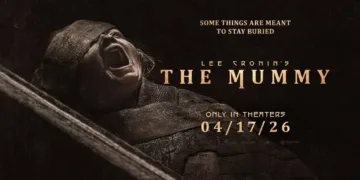


























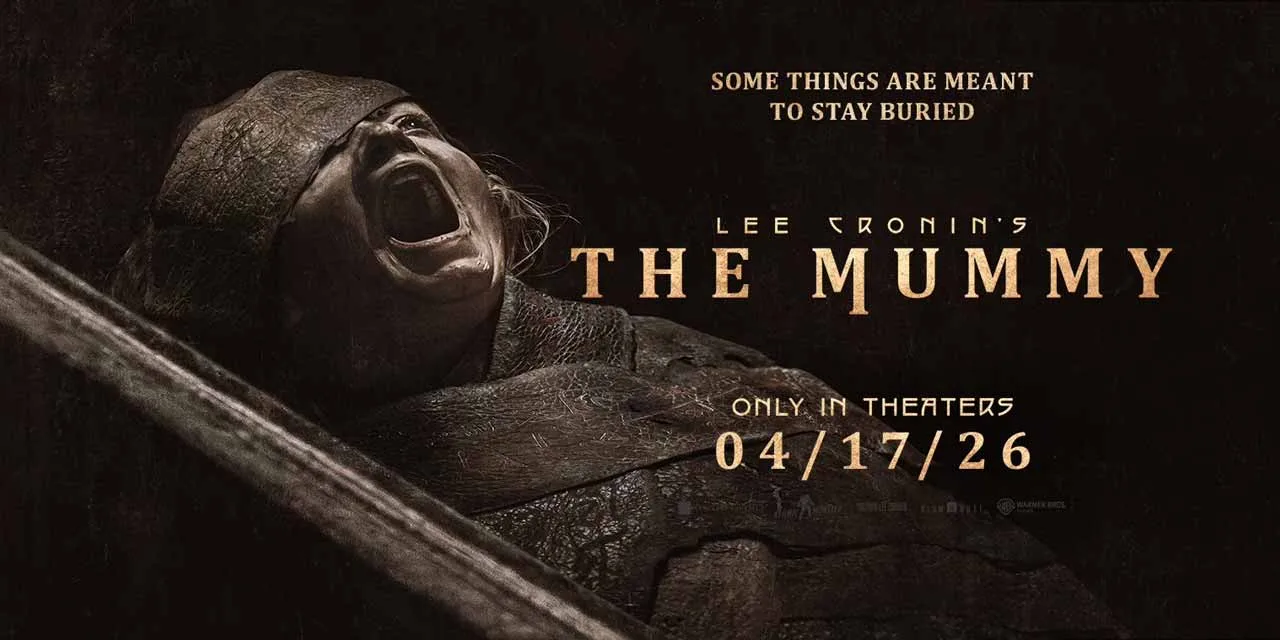

Blumhouse’s ongoing project of retrofitting Universal’s classic monster catalogue for contemporary anxieties has produced diminishing returns with each entry. Leigh Whannell’s The Invisible Man was a sharp domestic thriller disguised as a creature feature. Wolf Man was a softer, fuzzier riff on fatherhood and generational damage. Now comes Lee Cronin’s The Mummy — the title itself a statement, a brand, a dare — directed by the Irish filmmaker who made Evil Dead Rise, released by Warner Bros., running 133 minutes, and rated R for reasons that will become aggressively apparent.
Cronin is three films deep and already claiming the possessory credit. There is something admirable about that, even when the film itself offers only partial justification. What he has made is a hybrid creature: part Exorcist clone, part body-horror spectacle, part family trauma drama, wrapped loosely in Egyptian mythology that the film treats as decorative rather than foundational. There is craft here, and occasional genuine power. There is also a 133-minute runtime that earns every complaint it is about to receive.
Cairo, Candy, and the Worst Eight Years Imaginable
The film opens on an Egyptian family mid-car journey — cheerful, singing along to Arabic hip hop — before the mood curdles the instant the mother (Hayat Kamille, radiating a stillness that is immediately alarming) refuses to join in. It is a quietly effective prologue that establishes Cronin’s central obsession: the mother who has shed her warmth. Something ancient is buried beneath their farmhouse, and that something will have consequences.
We then meet the Cannons: American journalist Charlie (Jack Reynor), his pregnant wife Larissa (Laia Costa), and their children Katie (Emily Mitchell) and Sebastián (Dean Allen Williams). They live in Cairo in the comfortable, provisional way that expat families do, with a move back to the US perpetually on the horizon. Katie, curious and trusting, has been visiting the neighbors — lured by a strange adult woman’s steady supply of candy. A sandstorm. A chase through the streets. And then Katie is gone.
Eight years pass. The Cannons have resettled in an isolated house in Albuquerque, with Larissa’s devout mother Carmen (Verónica Falcón) now firmly embedded in the household and a new daughter, Maud (Billie Roy), filling some of the silence Katie left behind. Cairo detective Dalia Zaki (May Calamawy) calls with news: Katie has been found alive inside a 3,000-year-old sarcophagus recovered from a plane crash. She is malnourished, barely communicative, her limbs contorted, her skin beginning to fail. She comes home.
The premise’s most productive question — whether… scratch that, the film’s most productive question — is raised early and set aside just as quickly: can the answer to a desperate prayer itself become a source of horror? The film reaches toward grooming and human trafficking as partial explanations for what Katie endured, which is a bold gesture for studio horror, but it gestures and then retreats. As for the mummy mythology: it is thin to the point of transparency. This is a possession film wearing a mummy’s bandages as a costume. The title is brand positioning. The Egyptian setting is atmosphere, not architecture.
The Guilt That Dares Not Speak Its Name
What Cronin has positioned as the dramatic core of his film — and what he consistently flinches from fully examining — is parental guilt of a specific and shattering kind. Not the general ambient guilt of imperfect parenting, but the guilt of parents who feel responsible for their child’s disappearance, who spend eight years constructing a version of themselves that can survive that guilt, and who are then handed a return they are structurally unprepared to receive.
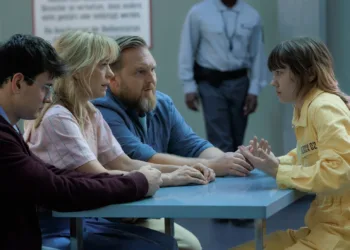
Larissa’s “I can fix her” is the film’s most human line of dialogue. Laia Costa delivers it with enough conviction to briefly suggest a different, harder film struggling to get out. Denial as a survival mechanism is well-trodden dramatic territory, but it is emotionally true, and the film had an opportunity to sit inside it and let it do real damage. It does not. Charlie and Larissa respond differently to Katie’s return — one investigates obsessively, the other imposes normalcy — a credible split, and a dramatically rich one. The film sketches it and moves on.
The sexual trauma subtext deserves acknowledgment, if only because it represents Cronin taking a risk that most studio horror would refuse. Katie cannot speak about what was done to her. Words like “grooming” and “trafficking” hover in the air. Her body bears evidence of prolonged violation. This is the film at its most genuinely disturbing, precisely because it refuses the comfort of the supernatural as a clean explanation. The demon may be real, but the things done to Katie before the demon arrived may also be real. That ambiguity is the film’s most uncomfortable idea — and the one it handles with the least confidence.
Then there is the structural observation the film never makes about itself: three women — Larissa, Detective Zaki, and the antagonist — are each defined entirely by their relationship to one small girl. The thematic implications of three distinct expressions of female will converging on a single female child are considerable. Cronin does not pursue them.
A Horror Movie About Being in a Horror Movie
Dave Garbett’s cinematography gives the film a low-lit, mustard-filtered gloom that is technically accomplished and practically counterproductive. Every room in the Cannon household looks dressed for a horror film from the first frame. There is no visual innocence to violate, no movement from light into dark — only dark, lit by other dark. The split diopter shots, used liberally to place Katie in the foreground while her family occupies a separate plane of focus, are the film’s most interesting visual idea: her presence literally distorts the image, as if she is a lens error in her own family’s life.
Peter Albrechtsen’s sound design is the film’s genuine technical triumph. Punishing, relentless, physical — you feel it as much as hear it. Stephen McKeon’s score builds on this foundation, creating an atmosphere that outpaces the imagery in generating real dread. The aural experience of this film is the experience of something ancient and wrong pressing in from all sides.
The runtime is 133 minutes. Evil Dead Rise was 96. The inflation is felt in every slow corridor walk, every cautious door opening, every scene of Charlie moving carefully around the house. The third act, when Cronin finally allows himself to be the filmmaker he clearly wants to be, arrives as genuine release: a Raimi-adjacent carnival of gore and dark comedy. A funeral sequence that descends into full splatter is the film’s comedic and chaotic peak. It arrives late. It is worth the wait. Just barely.
The Cast and the Varying Degrees of Survival
Jack Reynor, as Charlie, has been directed to project continuous low-level alarm. This works for approximately twenty minutes. After that, the wide-eyed, rarely blinking vigilance becomes the face of a man who has exhausted his expressions rather than one escalating toward breakdown. Charlie is written as the film’s emotional center of gravity but given almost no interior life to work with, and Reynor, a capable actor, cannot manufacture one from the available material.
Laia Costa fares considerably better. Larissa’s denial is the film’s most emotionally coherent throughline, and Costa plays it with controlled desperation that earns genuine sympathy.
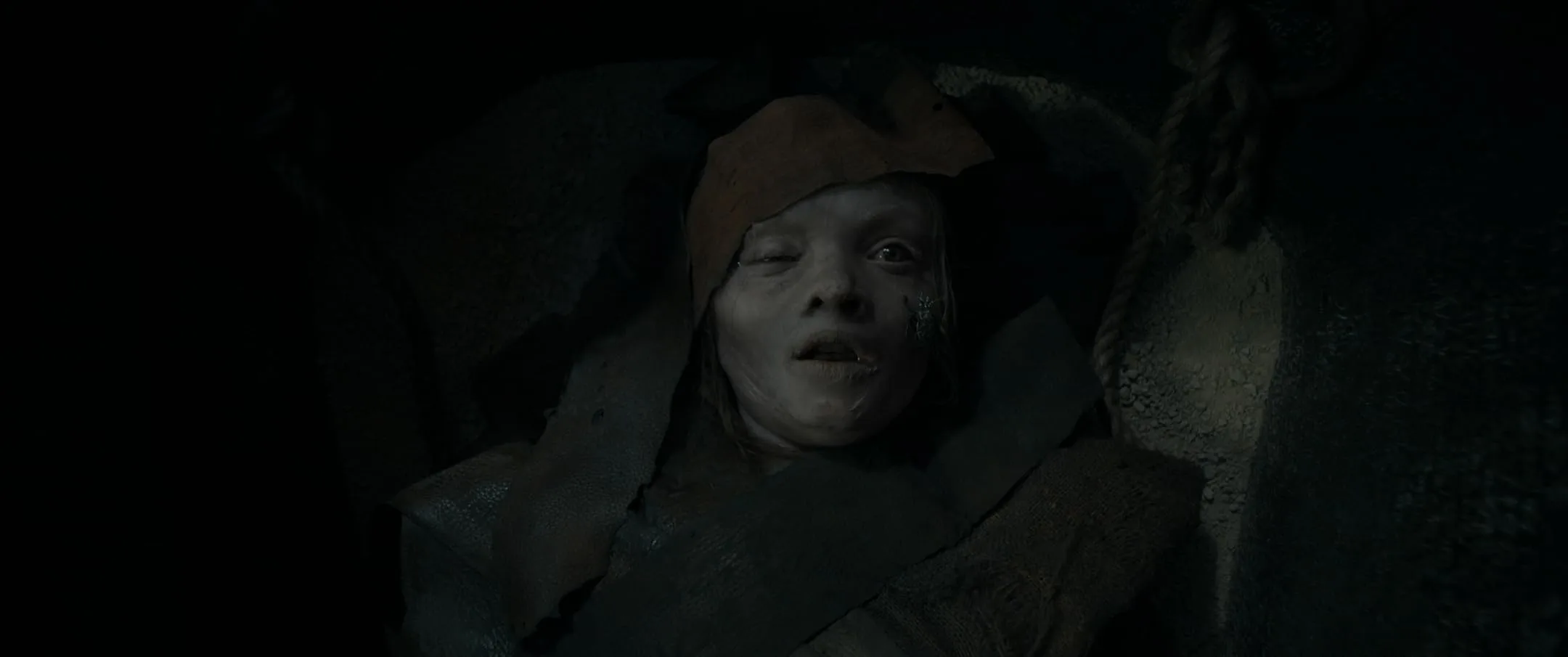
Natalie Grace, as the returned Katie, carries the film’s most physically demanding role. The prosthetics and makeup work is impressive — contorted angles, failing skin — and the performance is committed throughout. The structural problem: the film requires Katie to remain ambiguous for so long, just deniable enough that her parents can cling to hope, that Cronin has effectively tied Grace’s hands. A possessed child who must behave as if she might simply be traumatized is a child who cannot truly frighten anyone.
May Calamawy, as Detective Zaki, is given a parallel storyline set in Cairo that accounts for roughly a third of the film. It is the most interesting third. A two-person scene in which Zaki interviews a woman with crucial information is the film’s best set piece — precise, tense, conducted without the noise dominating the main storyline. Verónica Falcón brings real force to Carmen, whose fate functions as the film’s darkest joke. Hayat Kamille is cold and immediately unsettling, asking almost nothing of herself beyond controlled menace — and delivering exactly that.
Gore, Ghosts, and the Limits of Pastiche
The Exorcist is this film’s primary ancestor, and Cronin does not attempt to disguise the genealogy. Specific dialogue choices, specific physical performance beats, the entire architecture of the possession sequence — all trace back to William Friedkin’s 1973 original. The Omen, Poltergeist, and Hereditary are also present and accounted for in the production design and narrative structure. The film functions as a horror greatest-hits remix, assembled with craft and without any pretense of originality.
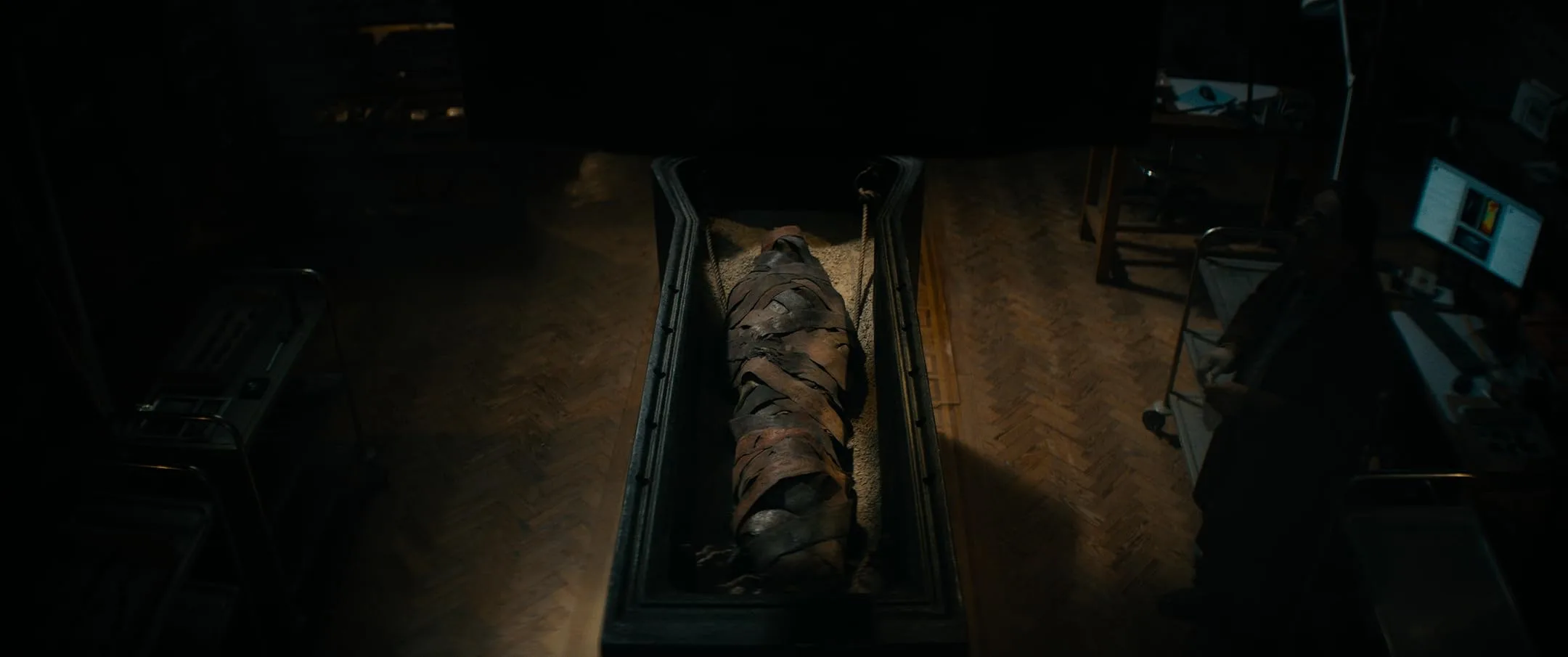
Cronin’s visual signature, across three features, is wet body horror: loose flesh, extracted teeth, black vomit, embalming fluid. There is plenty of all of it here. The sound design gives these moments genuine physical presence, and two set pieces — one involving a scorpion used inventively, one centered on torn vocal cords — earn their place as original gross-out beats. The rest sits toward the cartoonish end of the spectrum.
The film’s fundamental problem, as a horror exercise, is the difference between the unsettling and the merely unpleasant. The unsettling requires engagement with human consciousness. The unpleasant simply assaults. Lee Cronin’s The Mummy is relentless in its assaults, and it mistakes that relentlessness for escalation. Individual moments of genuine dread are scattered across 133 minutes. They are good moments, and they are thoroughly buried.
Lee Cronin’s The Mummy is a supernatural horror film and a modern reimagining of the classic Universal monster franchise. Directed by Lee Cronin, known for his work on Evil Dead Rise, the story follows a journalist and his wife whose young daughter disappears into the desert. Eight years later, she suddenly returns to them, but the initial joy of the reunion quickly dissolves into a terrifying nightmare as the family realizes something ancient and malevolent has returned with her. The film premiered in Los Angeles on April 9, 2026, and officially hit theaters worldwide on April 17, 2026. It is currently available to watch exclusively in cinemas and IMAX.
Where to Watch Lee Cronin’s the Mummy (2026) Online








Full Credits
Title: Lee Cronin’s The Mummy
Distributor: Warner Bros. Pictures
Release date: April 17, 2026
Rating: 18 (UK), R (US – Expected)
Running time: 133 minutes
Director: Lee Cronin
Writers: Lee Cronin
Producers and Executive Producers: Jason Blum, James Wan, John Keville, Michael Clear, Judson Scott, Macdara Kelleher, Lee Cronin
Cast: Jack Reynor, Laia Costa, May Calamawy, Natalie Grace, Verónica Falcón, Emily Mitchell, Hayat Kamille, May Elghety, Shylo Molina, Billie Roy, Lily Sullivan
Director of Photography (Cinematographer): Dave Garbett
Editors: Bryan Shaw
Composer: Stephen McKeon
The Review
Lee Cronin's the Mummy
Lee Cronin translates his visceral style to a classic monster with mixed results. The film excels as a sonic and physical assault, benefiting from a chilling performance by Laia Costa. The 133-minute duration feels excessive, often burying sharp observations on parental trauma under standard possession tropes. While the craft remains high, the script frequently hesitates before its most provocative ideas. This results in a technically superior but narratively thin remake that prioritizes atmosphere over substance.
PROS
- Peter Albrechtsen’s work creates a physical, punishing atmosphere of dread.
- Laia Costa provides emotional depth and grounded desperation to the role of Larissa.
- Effective use of split diopter shots visually isolates the characters.
- Several practical set pieces deliver genuine, tactile shocks.
CONS
- The 133-minute length leads to pacing issues and unnecessary repetition.
- Heavy reliance on The Exorcist and other genre staples limits originality.
- The Egyptian elements feel like decorative branding rather than a core narrative foundation.
- The film retreats from its most uncomfortable ideas regarding grooming and parental guilt.