



























Directed by Daniel Goldhaber and written by Isa Mazzei, this 2026 film pulls a notorious title from underground horror and places it inside the machinery of contemporary digital life. Margot, played by Barbie Ferreira, works for a social media platform called Kino as a content moderator, spending her days sifting through endless flagged videos and deciding what remains visible and what disappears.
During one of those shifts, she comes across a series of grotesque clips that restage famous moments from the 1978 cult film Faces of Death. These uploads carry an unnerving realism. Graphic violence slips past corporate filters, while educational material gets treated like contamination.
As Margot traces the source of the videos with her horror-fixated roommate, she discovers that a serial killer named Arthur is using the platform to stream actual murders. The film begins inside a corporate sorting system and gradually tightens into a suburban pursuit set in Florida. Along the way, it studies the uglier appetites of online culture and the mechanical appetites of the attention economy through the framework of a classic exploitation property.
The Architecture of the Modern Snuff Film
Kino’s office is built like a fluorescent mausoleum for the soul. Goldhaber shoots Margot’s cubicle with chilly precision, and the composition carries the same emotional vacancy as the platform she serves. The frame holds her in rigid partitions and sterile light, turning the workplace into a digital panopticon where pain has been processed into workflow. Human suffering appears as data.
Carnage operates as a valuable commodity. Educational videos on Narcan use or safe sex get flagged for removal, while footage of bodily ruin remains active because it feeds engagement. The joke is vicious, and the film knows it. One could call it satire, though that feels generous to the people signing Margot’s timesheets.
That airless system becomes the incubator for Arthur’s recreations of the 1978 film. Goldhaber stages the hammer beatings and the monkey brains dinner with deliberate formal care, almost as if he were reconstructing a lost ritual. Arthur records the acts with a fidelity that unsettles the eye and scrambles certainty. Margot starts connecting the new uploads to the older material through her roommate’s VHS archive, and the contrast between formats matters.
The analog tapes carry grain, damage, and the ghostly texture of an earlier media era. The new footage arrives in punishing clarity. That visual gap sharpens the film’s central anxiety. What does the image prove now? Practical effects, genuine death, digital fabrication, all of it bleeds together inside the same stream. The film lingers in that uncertainty with real menace. In a culture trained by deepfakes and endless reposting, trust moves away from the image and toward the body watching it. Revulsion becomes evidence. It makes for a queasy night at the movies.
Character Profiles: The Censor and the Creator
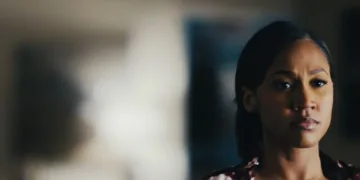
Margot carries the burden of a public image she never chose. Her past is tied to a viral tragedy on train tracks, where her sister died in front of a camera, and that history makes her into a grim emblem of the culture she now polices for a living. Ferreira gives her a fragile, tightly coiled presence. She moves through the office like someone trying to avoid the light while trapped inside it all day.

Goldhaber uses that withdrawn quality well. Margot’s arc into final-girl territory feels shaped by guilt, by self-surveillance, by the need to revise a life built around watching catastrophe unfold. She pursues Arthur with the force of someone trying to answer for surviving.
Arthur stands at the opposite pole, though the film treats that opposition with some sly instability. He sees murder as an aesthetic practice, a performance, a form of authorship. Dacre Montgomery’s character has an aristocratic baby face and the wounded vanity of a man who experiences criticism as personal collapse.
His insecurity spills into the internet. He defends his work through assorted pseudonyms and obsesses over punctuation in comment threads, convinced that two question marks project confidence while three signal desperation. The detail is absurd, hilarious, and chilling. It reveals the film’s understanding that modern monstrosity often arrives wrapped in petty self-curation.
His masks deepen that fracture. Arthur wears a white death mask for abductions, as though he wants the process stripped of intimacy and reduced to ritual procedure. He switches to a stocking mask for the killing itself, where the work turns physical and ugly. Goldhaber underscores this split with expressionistic framing, cutting between Arthur’s suburban domestic setting and the basement where he stages his theater of cruelty.
The visual design gives him a divided existence, one half blandly local, one half infernal. He emerges as a man who has traded interior life for performance metrics and audience response. Sympathy briefly flickers. Then he reaches for the hammer, and the film closes that door with admirable firmness.
The Socio-Economic Critique: The Attention Economy
The film treats the attention economy as a moral disease with excellent branding. Arthur speaks like a killer who has read too much platform rhetoric and decided to take it seriously. He argues that his work thrives because institutions profit from destruction at every level. Fear drives sales of security systems. Paranoia expands state power. Public appetite sustains the cycle. Inside that logic, the serial killer becomes a producer meeting demand. It is rancid reasoning, though the film presents it with enough structural clarity to sting.
Kino embodies the larger system. Productivity outranks ethics. Volume outranks judgment. The platform runs on a rhythm that leaves no room for sustained moral response, and that pace creates a deadening effect in workers and viewers alike. Goldhaber keeps returning to that point without sermonizing. Forbidden material no longer circulates through whispered rumor or back-alley exchange. It fills the ordinary scroll. Grotesque imagery has settled into the baseline texture of entertainment. The old taboo survives mainly as branding language.
The kidnapping of influencers, including the character played by Josie Totah, gives the critique a sharper edge. Arthur chooses people who have already turned their lives into content and drags that process into open brutality. His violence reads like the terminal point of self-commodification.
That idea lands with force because the film directs its accusation outward and inward at the same time. The viewer is implicated. Curiosity feeds the mechanism. Attention becomes endorsement, or close enough to it for the algorithm. Identity in this world depends on visibility, and visibility depends on participation in the spectacle. The film delivers that thesis with a cold smile. Apparently, flesh remains excellent for engagement.
Visual Language and Atmospheric Tension
The visual design works through a sharp duality. In the Kino offices, the lighting is cold, flat, and spiritually punishing. Faces look washed by institutional glare, and the compositions trap characters inside a geometry of partitions and monitors. The effect is numbing by design. Once the story moves into the Florida suburbs, the cinematography shifts into deceptive radiance.
Isaac Bauman builds the frames with a Kubrickian exactness, using clean lines and measured balance that make the violence feel even harsher. The camera does not leer. It observes. That choice matters in material like this. It keeps the film aligned with procedural dread and psychological corrosion instead of crude sensationalism.
The vintage film-grain texture adds another formal wrinkle. It recalls the mock-documentary aura of the 1978 source while introducing a faint sense of temporal slippage, as though old media refuse to stay buried and new media have absorbed their ghosts. The image keeps asking what era of horror we are seeing, and the answer seems to be all of them at once.
Sound does its own manipulative work. The synth-heavy score gives the investigation a steady pulse and nudges the film toward psychological thriller territory without flattening its contemporary setting. Pacing is central here. The first section moves with procedural discipline, then tightens and accelerates as Margot gets closer to Arthur.
A pursuit through a grassy suburban neighborhood lands as one of the strongest sequences because the tension emerges from exposure. The southern sun is harsh, direct, and merciless. Light floods the frame. No protective darkness appears. Chiaroscuro belongs to the basement later. Florida gets full illumination and nowhere to breathe.
That basement is where the noir inheritance becomes explicit. Arthur keeps victims in cages, turning domestic architecture into a private dungeon with suburban carpeting and serial-killer intent. Goldhaber leans into the ugliness of that transformation. The atmosphere grows heavy and claustrophobic. The camera lingers on the cages with the same detached scrutiny Arthur brings to them, which makes the viewer feel caught inside his warped method of looking. Sustained anxiety is hard to maintain. This film manages it with grim control.
Technical Execution and Casting
The technical work holds steady across the film, and the performances meet it with equal discipline. Barbie Ferreira gives Margot an exposed, wounded presence that never slides into stock horror-heroine behavior. Trauma sits on her face and in the way she occupies space. She looks like someone carrying private wreckage into a public machine. That specificity gives her arc its emotional force.
Dacre Montgomery proves equally sharp as Arthur. He shifts from affable suburban presence to cold executioner with alarming smoothness, and the film draws much of its unease from that elasticity. He understands that Arthur’s menace lives in style, insecurity, vanity, and cruelty all at once. The supporting cast fills out the world with useful texture. Jermaine Fowler plays the supervisor with exhausted corporate practicality. Charli xcx appears as an edgelord coworker and sketches a quick, nasty little portrait of internet numbness.
Goldhaber’s direction integrates digital artifacts into the frame with unusual confidence. Reddit threads and geolocation tracking function as real narrative devices, fully embedded in the plot’s logic, and their presence keeps the horror tied to an immediately recognizable media environment. The practical effects deserve equal attention. The gore has weight, tactility, and strong craft behind it.
Dummies and mannequins are used to recreate scenes from the 1978 film, and that method strengthens the line back to the original material while marking the present film’s own technical identity. Violence lands with force here. It feels physical, ugly, consequential. That gravity keeps it from drifting into empty spectacle.
Goldhaber seems to understand what gave the earlier film its nasty cultural afterlife, and he builds from that understanding with clear purpose. This remake carries the old property’s diseased pulse into a new media ecosystem and finds fresh menace there. A rare accomplishment. Horror cinema usually asks for blood. This one asks for bandwidth too.
This cinematic release reached audiences on April 10, 2026. The film is currently playing in theaters. IFC Films and Shudder handled the distribution. Viewers can find the movie at local cinemas, and it will likely transition to the Shudder streaming platform after its theater run concludes.
Where to Watch Faces of Death (2026) Online










Full Credits
Title: Faces of Death
Distributor: IFC Films, Shudder, Legendary Pictures
Release date: April 10, 2026
Rating: R
Running time: 97 minutes
Director: Daniel Goldhaber
Writers: Daniel Goldhaber, Isa Mazzei
Producers and Executive Producers: Don Murphy, Susan Montford, Greg Gilreath, Adam Hendricks, John Burrud, Isa Mazzei, Rick Benattar
Cast: Barbie Ferreira, Dacre Montgomery, Josie Totah, Jermaine Fowler, Charli XCX, Aaron Holliday, JD Evermore
Director of Photography (Cinematographer): Isaac Bauman
Editors: Taylor Levy
Composer: Gavin Brivik
The Review
Faces of Death
This 2026 update transforms a relic of analog shock into a sharp indictment of our digital reality. Goldhaber balances visceral slasher demands with a biting critique of corporate negligence. The narrative occasionally leans into familiar genre beats. However, the performances and clinical precision of the direction elevate the material. It remains a grim, necessary update for an era where the line between content and cruelty has blurred into a single stream of engagement.
PROS
- Vulnerable lead performance by Barbie Ferreira.
- Sharp analysis of content moderation and corporate ethics.
- High-precision cinematography avoiding cheap voyeurism.
- Tactile practical effects honoring the 1978 original.
CONS
- Standard slasher tropes dominate the final act.
- The satirical edge occasionally feels understated.