

















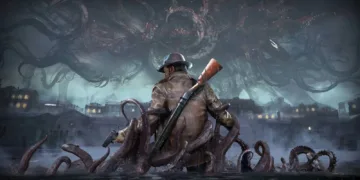



A train arrives at a desolate station, bringing a nameless outlaw back to a frontier of dust, rot, and bad memories. The protagonist returns after nine years because of a letter from Flintwood, his former partner. Flintwood now works as the sheriff of Tombwater, yet the better life he promises has collapsed into ruin.
The sun-struck desert leads into a ghost town consumed by a supernatural plague. Eldritch horrors and warped townsfolk fill the space once expected to belong to western bandits. Tombwater turns the shape of a frontier tale into cosmic dread, using western imagery as the shell for something far more diseased.
The storytelling works through fragments. The game gives players environmental details and mystical pools of spilled blood, which trigger visions tied to the town’s past. These glimpses reveal the settlers’ suffering and the force behind the curse.
This structure makes the player an investigator by action, since movement through the world becomes part of the storytelling system. The opening hours set a bleak, eerie mood, with every empty street and violent echo pushing the player to assemble the history piece by piece.
The Dance of Blades and Bullets
Survival in Tombwater depends on aggression, restraint, and a willingness to get dangerously close. Players begin by choosing one of seven character classes, each built around three primary stats: Life, Lucidity, and Stamina. The gunslinger frame suggests ranged dominance, yet combat relies on a tight exchange between melee pressure and limited firearm use. Short swords, axes, and other melee tools carry the main damage role. Successful close-range hits reload the character’s scarce ammunition, turning every swing into a chance to earn another shot.
That system gives the game a sharp action-RPG identity. The player cannot solve every encounter from safety. The mechanics pull them into the same hostile world the story describes. Combat becomes a narrative expression of Tombwater itself: desperate, ugly, and transactional. Every bullet has to be won through risk.
Also Read






Eldritch magic expands the toolset through a madness meter. Spells offer strong advantages, yet repeated casting fills the meter and raises the damage the player receives. Once the meter reaches its limit, magic shuts down until rest. This gives character progression a thematic edge. Power exists, yet it carries a visible cost, and the player has to decide how much danger is worth a short-term gain.
The game follows familiar action-RPG rules. Campfires act as checkpoints where players spend experience points to raise attributes. Resting restores health flasks and brings defeated enemies back into the world. Death drops currency and experience at the place where the player fell. Recovering those losses requires a return to the remains, which gives exploration a steady pressure. The system ties consequence to movement, making each risky push into a new area feel costly.
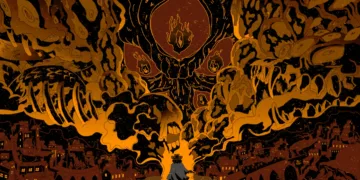
The challenge reaches its sharpest form across over 20 bosses and mini-bosses. Their grotesque pixel-art designs often start with simple shapes, then mutate into tentacles and viscera. Fights demand pattern recognition and careful stamina control across long, punishing encounters. Like the stronger corners of indie action-RPG design, Tombwater finds tension through readable systems that still leave room for panic.
Secrets of the Desert Ruins
Exploration follows a structured route through 20 distinct biomes. Tombwater uses metroidvania design, tying progress to specific charms and movement abilities. New tools open paths through environmental barriers and lead back to regions that were previously locked. This gives the world a satisfying loop of discovery, return, and re-interpretation. A blocked path rarely feels like decoration. It becomes a future decision point.

The top-down perspective gives the level design a classic feel, especially inside the dungeons. These spaces lean on environmental puzzles, asking players to study the surroundings and interact with the world to move forward. The streets of Tombwater can be hard to read, since the in-game map offers limited detail. Discovery comes through shortcuts that connect distant spaces, giving the layout a logical structure once the player learns its rhythm.
Resource management keeps exploration active. The refillable health flask creates a baseline of survival, and trinkets and charms reshape combat options. The crafting system lets players dismantle gadgets and reclaim materials for new recipes, giving repeated or unwanted items a practical use. Hidden secrets across the biomes can unlock fast travel, reducing the strain of backtracking.
This design makes the desert ruins feel like a large mechanical puzzle. Understanding the environment carries the same weight as defeating the monsters inside it. The game’s progression systems, combat choices, and world structure support the same idea: Tombwater rewards players who pay attention, take risks, and learn from failure.
Atmosphere and Accessible Design
Tombwater uses retro visuals to create a grim, memorable mood. The pixel art carries strong detail, especially during the grisly enemy transformations. Foreboding locations stay sharp through simple visual foundations, giving the world a stark, haunted texture.

The audio design deepens that loneliness. Spanish guitar brings out the melancholy of a classic western film, and the absence of voice acting leaves space for quiet, reactive sound. Tombwater feels abandoned because it sounds abandoned.
Some technical quirks appear. Enemies may get stuck on stairs, and interacting with items can require exact positioning. These issues remain minor beside the game’s accessibility features. The settings menu includes difficulty sliders that let players tune the experience with care. Damage dealt and damage received can be adjusted to suit different skill levels. Players can also disable resource loss after death, making the game easier to approach for those drawn to the story and exploration.
That flexibility matters because Tombwater’s systems can be severe. Its combat, corpse recovery, boss patterns, and madness meter create real pressure. The accessibility options let players engage with those systems at a level that fits them, keeping the haunted frontier within reach without stripping away its identity.
The Review
Tombwater
Tombwater successfully merges the desolate atmosphere of a western with the punishing mechanics of a souls-like. The combat system forces a tense balance between melee and ranged tactics. While navigation can be difficult due to a vague map, the accessibility options ensure that the haunting world remains open to all skill levels. It is a polished and memorable addition to the genre.
PROS
- Engaging melee-to-ammo combat loop.
- Evocative western-horror atmosphere.
- Extensive accessibility and difficulty customization.
- Deep customization through classes, spells, and charms.
CONS
- Vague map makes navigation frustrating.
- Technical issues with enemy pathfinding on stairs.
- Interaction points require exact positioning.