


























The opening moments of Another Day, originally titled Garance, place the viewer inside the cramped, sweaty backstage routines of contemporary French theater. Director and screenwriter Jeanne Herry strips away the glossy romance often attached to the acting profession and builds a patient, unsparing character study of a creative worker slipping into severe alcoholism.
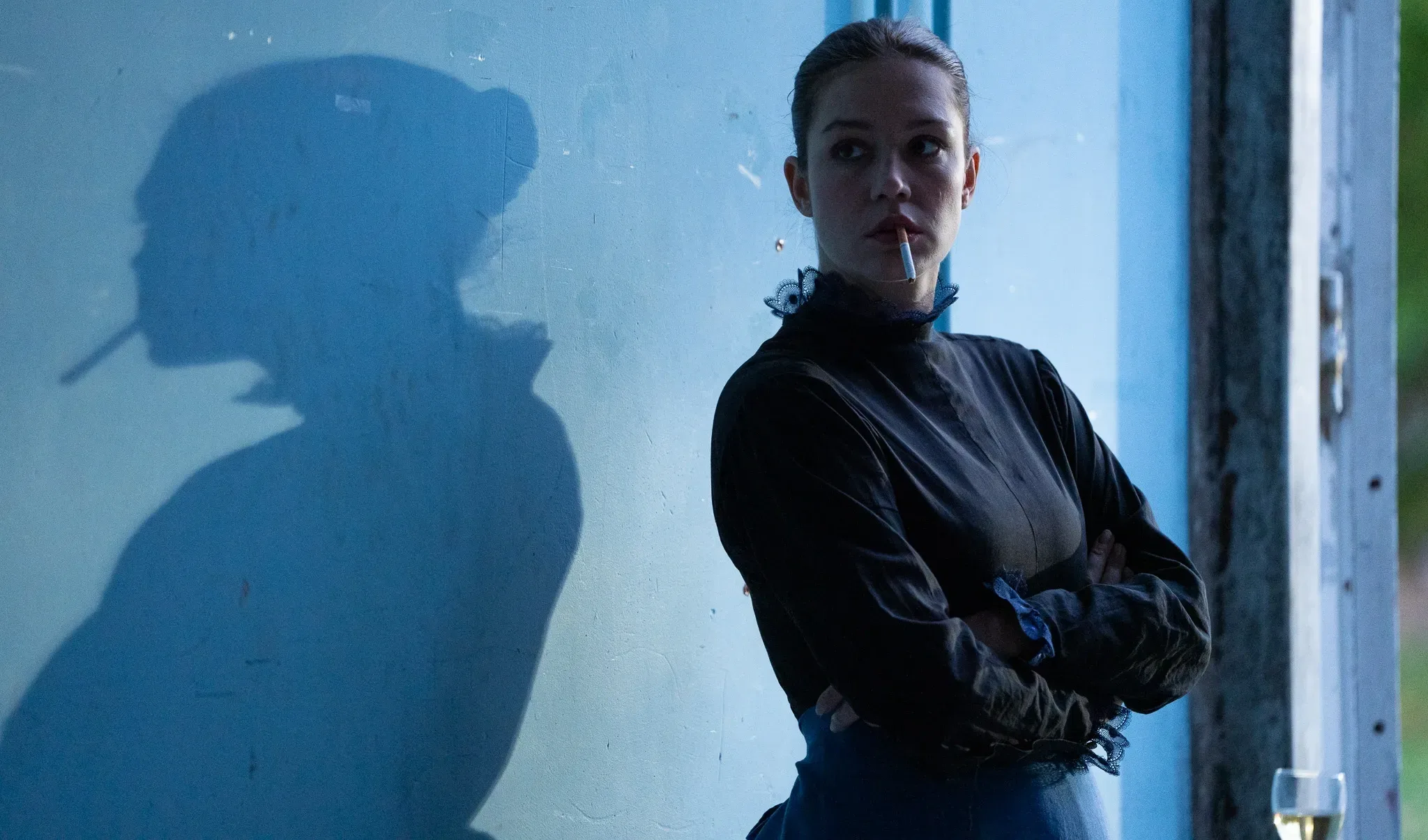
Adèle Exarchopoulos plays Garance, a gifted Parisian stage actress whose open, magnetic personality hides a growing dependence on white wine. The story covers roughly eight years, tracing unstable homes, worsening tension inside a local children’s theater troupe, and changing relationships across the Parisian queer scene.
That restless life finds brief steadiness after Garance meets Pauline, played by Sara Giraudeau, a gentle theater scenographer who becomes her partner. Pauline offers safety and calm as Garance’s illness begins to take over every part of her life. Herry roots the film in psychological realism, treating addiction as an accumulation of small daily concessions, private evasions, and quiet collapses.
The Anatomy of High-Functioning Denial
Adèle Exarchopoulos gives a remarkable performance because she treats Garance’s alcoholism with calm precision and lived-in naturalism. She relies on casual conversational rhythms, physical restraint, and her deep vocal register to suggest constant pressure under the surface. In the early stretches, Garance still appears structurally stable. She attends rehearsals, pays bills, accepts extra voice work for money, and hides her daily drinking from friends who read her behavior as ordinary bohemian excess.
Her decline becomes visible through sharp, carefully observed scenes where control disappears. During a visit to a local school, she tries to speak to grade schoolers while visibly disheveled, her makeup smeared from the night before, turning a simple community talk into a test of endurance.
Later, she reaches an audition entirely unprepared, and her alcohol-driven confusion gets misread by casting directors as bold Method acting. The physical truth of her collapse arrives when she wakes at dawn on a public bus depot bench, fishnets torn, with no memory of the previous hours or how she got there.
Exarchopoulos captures denial with painful exactness. Garance repeatedly reframes her drinking as a normal, useful part of acting life. Her scenes with Sara Giraudeau give the portrait real texture. Their different speech patterns and temperaments make the romance feel grounded, with Pauline’s soft, measured voice pressing against Garance’s unstable energy.
The supporting performances deepen this social world, especially Mathilde Roehrich as Garance’s sister, whose private health crises echo the protagonist’s physical decline, and Jehnny Beth as the writer who guides Garance into the queer dating scene.
Fluid Chronologies and Visual Cues
Jeanne Herry steps away from familiar storytelling layouts by presenting eight years in chronological order without on-screen dates, text cards, or firm chapter breaks. The choice gives time a slippery quality, matching the way days, months, and years blur inside the repetitive cycle of substance dependence. Editor Laurence Briaud shapes this flow through fast, brief sequences that catch the rush of daily life, an editing pattern that reflects Garance’s fragmented sense of her own timeline.
The staging tracks the illness with quiet visual signals. In early rehearsal scenes, bottles sit deep in the background or at the edges of the frame, treated as ordinary social objects in an artistic circle. As years pass, the camera gives those bottles greater visual weight until they begin to crowd the actors around them.
Costume designer Ariane Daurat uses relaxed, sharply defined silhouettes to mark Garance’s emotional shifts, moving her from easy, edgy Parisian style into rumpled, mismatched clothes that reflect her inner disorder. Production design and makeup carry much of the time-lapse work, registering the toll on Exarchopoulos’s face as the bright energy of the early scenes hardens into a pale, exhausted mask.
Herry also folds in a graceful reference to classical cinema by having the characters watch Marcel Carné’s Children of Paradise (1945), which includes the iconic character Garance. The reference works as an artistic mirror, placing France’s romanticized theatrical history beside the insecure, gritty labor of modern creative work.
Repetition, Melodrama, and Narrative Layouts
The screenplay runs into structural strain through its repeated cycles of benders, blackouts, confrontational hangovers, and empty promises. Across the two-hour runtime, this pattern can test the viewer’s patience. The middle section begins to feel stalled, a quality that still reflects the lived rhythm of chronic addiction with uncomfortable accuracy. Herry brings the domestic pandemic lockdown into the final third, using the global shutdown as a backdrop for Garance’s deepening isolation and showing how public anxiety intensifies private coping rituals and secret binges.
The script has a harder time balancing Garance’s character study with the sister’s cancer treatments. That subplot sometimes presses the film toward standard melodrama, adding predictable sentiment to material that works best through clear-eyed realism.
The drama regains force during a key intervention scene between Garance and her theater troupe. The scene marks one of the film’s strongest dramatic passages, catching Garance’s defensive panic as her professional safety net disappears and she faces the exhausted patience of her peers.
The final act brings in a blunt addictologist to help push Garance toward sobriety. This late movement risks taking on a clean, instructional shape, closer to an educational program than the messy psychological study that came before it. The screenplay remains caught between raw observations of human behavior and the familiar patterns of addiction drama, leaving the final reading of Garance’s recovery for a separate verdict.
Another Day officially premiered as a Cannes Competition entry on May 17, 2026, generating immediate praise for its central performance. Following its festival run, the film is scheduled for a wide theatrical release by StudioCanal in September 2026, meaning it is currently hitting the international festival circuit before making its way to streaming platforms and physical media later in the year.
Full Credits
Title: Another Day (originally titled Garance)
Distributor: StudioCanal
Release date: May 17, 2026
Running time: 105 minutes
Director: Jeanne Herry
Writers: Jeanne Herry
Producers and Executive Producers: Alain Attal, Hugo Sélignac, Nicolas Dumont
Cast: Adèle Exarchopoulos, Sara Giraudeau, Rudgy Pajany, Raya Martigny, Mathilde Roehrich, Sara-Jeanne Drillaud, Anne Suarez, Jehnny Beth, Brigitte Sy
Director of Photography (Cinematographer): Antoine Cormier
Editors: Laurence Briaud
Composer: Pascal Sangla
The Review
Another Day
Another Day emerges as an uneven character study that succeeds on the strength of its leading performance. Adèle Exarchopoulos anchors the production with a naturalistic portrayal of functioning denial, ensuring the protagonist remains human throughout her harrowing spiral. While Jeanne Herry demonstrates immense skill through fluid temporal progression and subtle visual framing, the screenplay falters during the middle acts due to repetitive narrative loops. A clichéd final resolution and melodramatic subplots flatten what begins as a sharp, clear-eyed exploration of creativity and codependency within the modern gig economy.
PROS
- Adèle Exarchopoulos delivers a deeply internal, raw performance that completely avoids typical Hollywood addiction clichés.
- Laurence Briaud's swift, unannounced chronological jumps beautifully capture the disorienting, rapid passage of years.
- The striking vocal and behavioral contrast between Exarchopoulos and Sara Giraudeau provides a grounded, believable emotional center.
- The clever, slow migration of alcohol bottles from the distant margins to the center of the frame elegantly charts her losing control.
CONS
- The circular pattern of benders and severe blackouts creates a stagnant pacing dynamic during the middle sections.
- The inclusion of the sister's escalating health crises adds a layer of heavy-handed melodrama that distracts from the core character study.
- The introduction of the addictologist shifts the tone into an educational broadcast, resolving the crisis too neatly.