







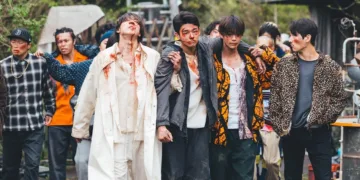

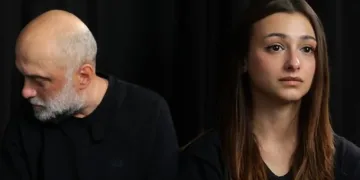


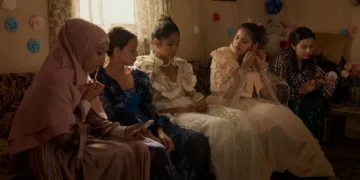





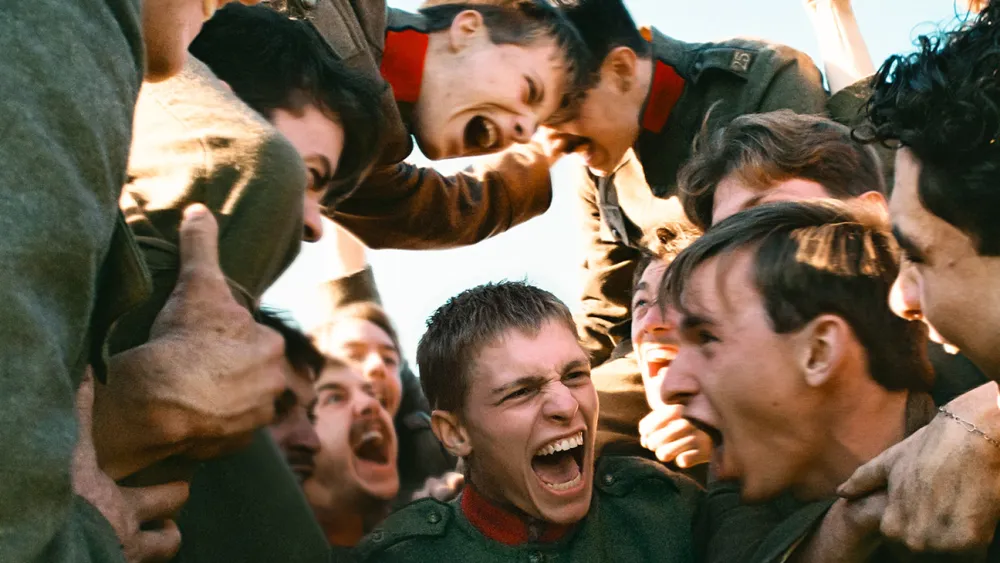

War films have always known what they are selling: sacrifice, camaraderie, the body under extreme duress. Lukas Dhont’s third feature knows this too, and declines the offer. Set on the Belgian front line in 1916, Coward is, almost defiantly, a love story, one that locates its drama in whispered conversations and stolen glances rather than in the churn of artillery. Two soldiers, Pierre (Emmanuel Macchia, in his screen debut) and Francis (Valentin Campagne), find each other amid the mud and the dying, their attraction made possible by an unlikely wartime institution: a drag theatre troupe, performing original shows to keep the regiment’s spirits intact.
Dhont, who built his reputation with Girl (2018) and Close (2022) by pressing hard on the bruises of queer identity, works with a different pressure here. The film is quieter, more patient, and more willing to let its characters breathe. That restraint is both its greatest strength and, occasionally, the source of a certain deliberate mildness that some will mistake for caution.
Freedom in the Worst Possible Place
The film’s central paradox is the most genuinely interesting thing about it, and Dhont has the sense not to over-explain it. Francis tells Pierre, simply, “We are free here.” He means the front. He means the war. The logic, perverse and lucid at once, is that the military, that monument to compulsory masculinity, has accidentally created a pocket of liberation for men who would have been suffocated by peacetime convention. Francis performs in dresses. Pierre watches him with barely concealed longing. Nobody, remarkably, much cares, at least not about the performances.
The title’s irony cuts in several directions. The men dismissed as cowards (the theatrical “rejects,” excused from frontline combat) are the ones showing the most complex form of courage on screen, which is the courage of self-disclosure. Meanwhile, the film quietly insists that bravery is a much stranger quantity than the recruiting posters suggested. One soldier reaches for a German helmet abandoned on the front line, a tiny transgression that Dhont shoots with as much gravity as any charge across open ground. Pierre, in perhaps the film’s most morally ambiguous beat, stabs his own hand with a bayonet to get himself off the battlefield and closer to an injured Francis. The gesture is simultaneously an act of self-preservation, devotion, and what any commanding officer would call cowardice. The film sits comfortably with all three readings.
There is a structural irony running beneath the tolerance the soldiers show for Francis’s drag performances (applauded, celebrated, eventually sent on tour by the commanding officers) and the absolute necessity of keeping the actual romance invisible. Spectacle is permitted. Love is not. The distinction says something about how institutions absorb transgression: they will take the show, and prosecute the feeling behind it.
The question of desertion, raised in low voices late at night, never fully resolves. Switzerland. Spain. A cabin in the mountains. The men test these possibilities against each other and find them mostly theoretical. The world outside offers no obvious sanctuary.
Also Read





Two Registers, One Frame
Dhont’s regular cinematographer Frank van den Eeden operates the film in two distinct visual modes that function almost as a grammar. The battlefield sequences are shot in hard, clear light, handheld and close, their scale deliberately compressed. There are no sweeping vistas here, no grandeur in the carnage. The theatre sequences, by contrast, are bathed in soft pastels, powdery and slightly unreal, as though the stage exists in a different atmospheric pressure from the trenches surrounding it. The contrast is not subtle, but it is effective.
Sound designer Yanna Soentjens contributes one of the film’s best moments: a performance at a military hospital, the troupe singing while screams drift in from the wards. It is the film’s sharpest juxtaposition, and it lands without comment or underlining, which is exactly right. Composer Valentin Hadjadj keeps the score chiming and restrained, trusting the images to carry weight.
Macchia, making his debut, gives Pierre a knowing sadness that operates almost entirely below the surface. He barely speaks. He watches. His face does the architectural work of a character who has spent years learning to conceal himself, and the gradual softening that occurs around Francis is registered in small physical adjustments rather than any declarative moment. Campagne’s Francis is all projection and velocity, spirited and theatrical even when he has no audience, but Campagne threads genuine grief through the performance. Francis loves the war because the war is the only place he has ever been permitted to exist. That is the film’s most quietly devastating idea, and Campagne carries it without fanfare.
Their chemistry is built from contrast, two bodies that balance rather than mirror each other: one still, one restless; one formed by concealment, the other by display. Their intimate scenes convey years of suppressed desire as much as present-tense lust.
The Band of Rejects and Their Strange Gift
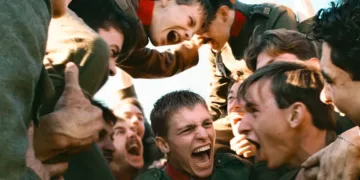
Francis’s theatrical ensemble, a self-styled Band of Rejects, performs across an unusually wide range of contexts. Rowdy singalongs for enlisted men. An elaborate drag revue for high-ranking officers (who respond with a boorish friskiness that is its own kind of revelation). Gentle entertainments for the gravely wounded. Stirring, patriotic tableaux for troops about to march into battle. The variety of these audiences gives the troupe’s work a genuine dramatic scope.
The historical substrate matters here. Cross-dressing military performance troupes were a documented feature of WWI, though rarely examined in film. Dhont uses the tradition to illuminate something specific: the remarkable, temporary loosening of gender convention that occurred within the most aggressively masculine institution in Western history. The army, that machine of enforced conformity, somehow became a place where men in hessian-sack dresses could receive standing ovations.
Francis, it should be noted, runs these performances with the discipline of a sergeant. He demands commitment. He does not tolerate sloppiness. The theatrical scenes have a backbone because of this, and it keeps them from drifting into mere spectacle or period nostalgia.
Coward is an intimate 2026 war drama film that had its world premiere in the main competition at the 79th Cannes Film Festival on May 21, 2026, where it won the Prix du Cinéma Positif. Directed by Lukas Dhont, the movie explores a hidden romance between two Belgian soldiers who find comfort and escape by forming a drag theatrical troupe behind the front lines of World War I. Following its acclaimed festival debut, global distribution rights were acquired by Mubi, meaning audiences will be able to watch it on Mubi’s streaming platform and in select theaters globally, alongside regional releases by Lumière and Diaphana Distribution.
Full Credits
Title: Coward
Distributor: Lumière, Diaphana Distribution, Mubi
Release date: May 21, 2026
Rating: Not Rated
Running time: 120 minutes
Director: Lukas Dhont
Writers: Lukas Dhont, Angelo Tijssens
Producers and Executive Producers: Michiel Dhont, Juliette Schrameck
Cast: Emmanuel Macchia, Valentin Campagne, Jonas Wertz, Willem De Schryver
Director of Photography (Cinematographer): Frank van den Eeden
Editors: Alain Dessauvage
Composer: Valentin Hadjadj
The Review
Coward
Coward is a war film that earns its quietness. Dhont has made something genuinely tender here, a romance built on paradox and restraint, anchored by two debut performances of real distinction. It is not a film that burns, but it glows steadily. The theatrical troupe conceit could have felt gimmicky; instead it illuminates a historical truth about how institutions absorb what they cannot name. The film's deliberate mildness will frustrate some, but that mildness is a choice, and largely a defensible one.
PROS
- Macchia and Campagne's complementary, physically expressive performances
- Van den Eeden's dual-register cinematography
- The central paradox (war as liberation) handled with intelligence and restraint
- Rich historical detail around the drag theatre tradition
- Tonal maturity compared to Dhont's previous work
CONS
- Deliberately muted pacing may leave some viewers at arm's length
- Dramatic conflicts occasionally defuse before fully igniting
- Battle sequences feel familiar rather than distinctive
- Supporting characters remain underdeveloped