



























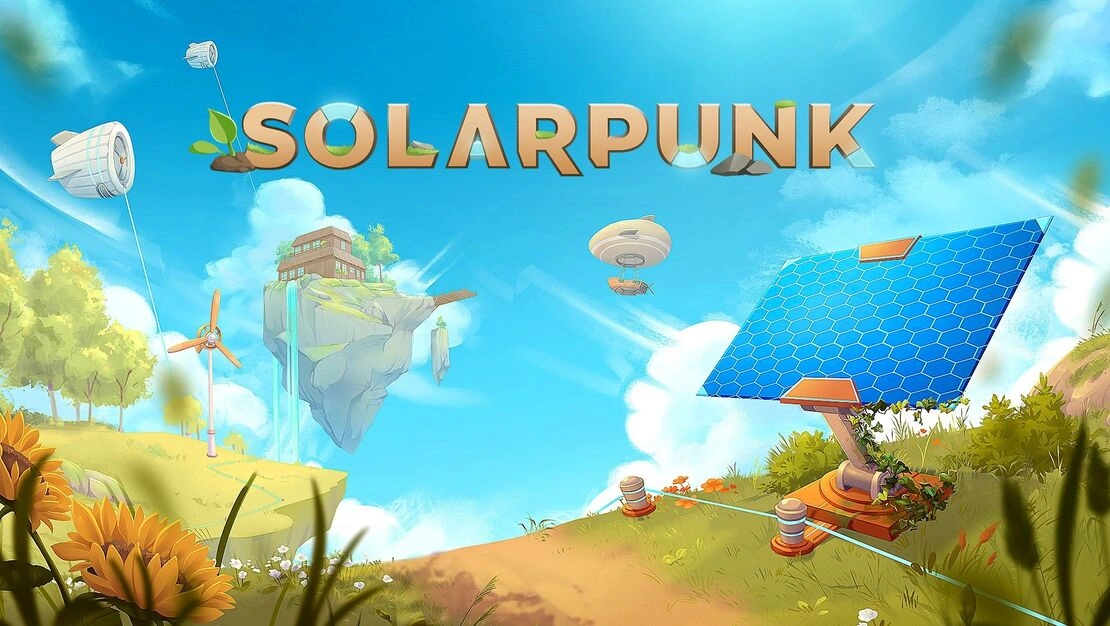

Solarpunk imagines survival without teeth. That sounds like criticism, and sometimes it is, yet it also defines the game’s soft appeal. Cyberwave’s cozy first-person crafting adventure places players on floating islands where the goal is less about conquering nature and more about living beside it, one berry patch, solar panel, and wooden foundation at a time.
The setup is instantly readable for anyone who has played Minecraft, Stardew Valley, Raft, or the calmer edge of the survival-crafting genre. You gather resources, build tools, expand your home, grow crops, raise animals, and chase the next upgrade. The twist is the skybound setting. Your farm sits above the clouds, and your airship becomes the bridge between small islands scattered across a pastel horizon.
This is survival by vocabulary rather than pressure. Hunger, thirst, fatigue, and item recovery after death all exist, yet danger rarely enters the frame. There are no monsters at the gate, no wolves circling the farm, no raids smashing your careful work. Solarpunk wants to be peaceful, approachable, and lightly methodical. That makes it pleasant company, though sometimes too quiet for its own good.
Crafting With Clear Steps and Few Surprises
The opening hours are familiar in the most literal sense. You wake on a compact island with a few supplies, a nearly broken axe, food, drink, and a short tutorial pointing you toward the basics. Pick berries, chop trees, mine stone, craft a pickaxe, place workstations, plant crops, build shelter. It is the genre’s handshake, warm and predictable.
Progression is built around research tables, crafting stations, and a robot trader stationed on a floating structure nearby. TraderBot becomes a quiet guide through the upgrade chain, asking for resources in exchange for blueprints that unlock airship improvements, automation parts, animal tools, and later machines.
The design has a practical clarity: the next important material tends to sit on the next island your airship can reach. Iron leads to stronger tools. Copper leads to sprinklers. Quartz opens new automation options. The path is clean, almost diagrammatic.
That clarity helps Solarpunk avoid the confusion that can sink weaker survival games. There is usually an obvious task in front of you, and the requirements are easy to parse. It also limits experimentation. The game rarely feels like a sandbox full of strange possibilities; it feels like a gentle checklist stretched across the sky. Players who enjoy the sprawling improvisation of Minecraft or the dense machinery chains of Satisfactory may find the rhythm too narrow.
The survival mechanics sit in a strange middle space. Hunger and thirst need attention, yet they almost never create tension. Once crops are planted, food and drink become routine maintenance. Death sends you back to base, with dropped items recoverable in standard mode. Soft mode makes the experience even lighter by reducing hunger and thirst drain and removing inventory loss. The result fits the cozy tone, though the meters can feel like minor chores rather than meaningful systems.
Inventory management adds rougher friction. Crafting requires materials to be carried directly, so resources sitting in nearby chests do not count. That means repeated trips between storage and workstations. Limited sorting and awkward stack movement, especially on controller, turn basic organization into a small irritant that lingers across the whole experience.
Building a Home, Flying Away, Finding Less Than Expected
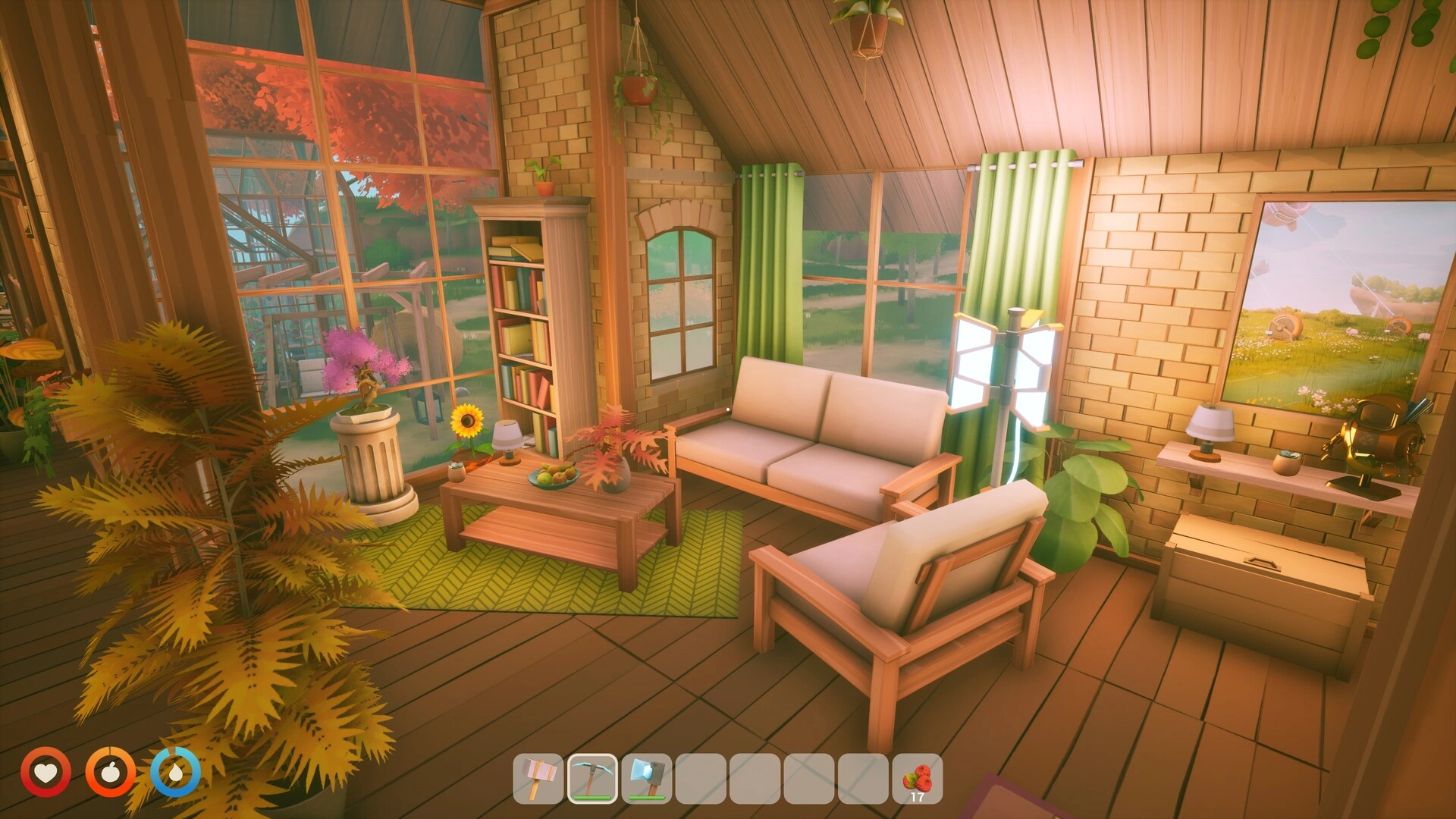
Base building is where Solarpunk feels most confident early on. Foundations, floors, roofs, stairs, walls, decorations, farms, animal pens, and work areas allow players to shape the starting island into something personal.
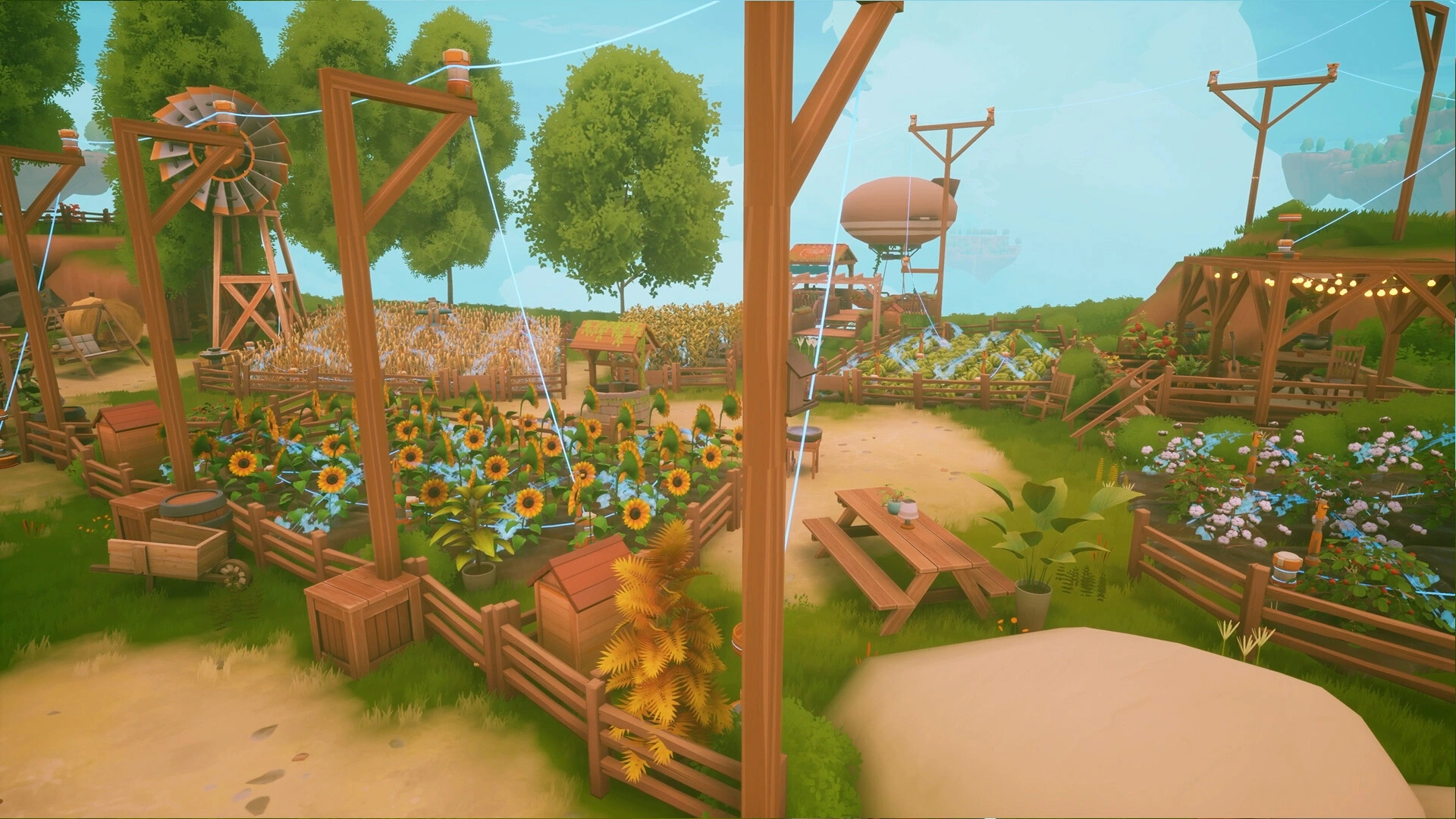
The snapping system is understandable, and demolished pieces return their resources, which encourages tinkering without punishment. A simple wooden shack can become a functional farmstead, then a decorative eco-home with work zones, animal spaces, and carefully placed paths.
The game understands the pleasure of visible progress. A bare island slowly gains structure. Crops fill empty ground. Chickens, sheep, and pigs make the place feel less sterile. Saplings and seeds need replanting to keep materials flowing, so farming becomes part of the broader crafting economy rather than a side activity tucked away for flavor.
The airship is the best single idea here. Building the first one after exploring the home island gives Solarpunk a welcome lift, both mechanically and emotionally. Flying in first or third person through open sky has a breezy charm that separates the game from countryside farming sims and grounded survival sandboxes. For a while, the airship makes the world feel larger than it is.
Then you land.
Many islands look lovely from a distance, with their green hills, lakes, cliffs, and soft lighting. Up close, too many function as resource depots. Mine the new ore, collect the new material, search for the next upgrade requirement, return home. Hidden caves, memorable landmarks, strong environmental storytelling, and strange discoveries are rare. Later snowy areas add some visual variety, but the core loop remains tightly tied to resource progression.
Co-op helps soften that repetition. Up to four players can work together, and shared building projects naturally create better stories than the game writes on its own. Gathering, farming, and construction are easier to enjoy with friends. The lack of crossplay is disappointing, and the airship setup undercuts shared adventure when players need separate docks and upgrades instead of simply boarding together.
Renewable Machines, Pretty Skies, and Persistent Rough Edges
Solarpunk takes time to become fully itself. The title’s ecological fantasy lands with greater force once renewable technology enters the picture. Solar panels, batteries, wind turbines, switches, weather stations, sprinklers, drills, and drones shift the experience from hand labor to small-scale systems design. That is where the game’s identity sharpens.
The best automation setups are simple to understand and satisfying to watch. Solar panels feed power during clear weather. Wind turbines thrive during storms. Batteries store surplus energy. Rain sensors can stop sprinklers from wasting power. Mining drills can extract ore from distant islands.
Drones can move materials back to base. These systems are not as deep as Factorio or Satisfactory, and they are not meant to be. They work as cozy automation, giving players enough control to feel clever without turning the island into a spreadsheet with clouds.
The issue is pacing. Some of the most enjoyable technology arrives many hours in, after long stretches of manual watering, harvesting, smelting, waiting, and flying back and forth. With no combat, no narrative drive, and limited exploration rewards, downtime becomes noticeable. At its best, the game feels meditative. At its weakest, it feels like standing beside a smelter while time politely refuses to move faster.
Presentation carries a lot of weight. The comic-book art style gives the world a clean, welcoming look. Grass sways, sunlight washes across the islands, storms crackle with style, and the lo-fi music stays calm without vanishing into nothing.
Environmental sound is especially effective, from rain-soaked footsteps to furnace crackle and thunder. Night can be too dark, storm flashes may bother some players, and handheld interface text can feel cramped, but the sensory mood is one of the game’s strongest assets.
Technical issues cut into that charm. Stable 60 fps performance on PS5 is welcome, yet bugs can interrupt the flow: airships hovering awkwardly after landing, animation glitches, animals stuck on terrain, customization settings failing to save, misleading lost-item messages in soft mode, and controller or menu quirks. The animal bugs are especially risky because progression can depend on eggs or other resources.
Solarpunk works best for patient players who want a peaceful crafting retreat with a pretty sky, gentle building, and late-game automation. It is less convincing as an exploration game, a survival game, or a story-driven adventure. Its future is calm, sustainable, and occasionally beautiful, though it could use a little more life between the clouds.
The Review
Solarpunk
Solarpunk is a gentle, visually lovely crafting retreat with rewarding base building, soothing flight, and satisfying late-game automation. Its survival systems lack bite, its islands rarely reward curiosity, and its progression can feel too linear, yet the game still has charm for players who enjoy peaceful self-directed projects. It works best as a cozy eco-building sandbox, less so as a deep survival or exploration adventure.
PROS
- Beautiful skybound world
- Relaxed crafting loop
- Enjoyable airship flight
- Satisfying automation systems
- Strong cozy co-op potential
CONS
- Exploration feels thin
- Weak survival pressure
- Repetitive resource grind
- Limited narrative drive
- Bugs can affect progress