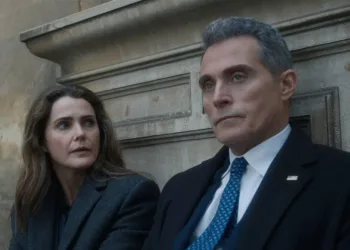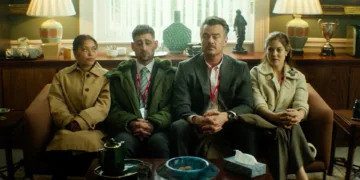



























Brian Young and Alan Williams begin fatherhood with the same mistake: they look at newborn children and see future evidence of their own success. Josh Duhamel’s Preschool understands that parental ambition can become vanity with astonishing speed, then spends most of its running time converting that vanity into bruises, sabotage, and increasingly deranged acts of social warfare.
Brian, played by Michael Socha, has built his own construction business after growing up without much. He wants his son Dylan admitted to Puggsley Academy of Excellence because the school represents access to the life he had to earn the hard way.
Alan, played by Duhamel, wants the final available place for his daughter Grace. He carries himself like hereditary nobility, which would be slightly easier to tolerate if his fortune did not largely come from his wife Lauren’s family. The children barely participate in this conflict. That absence is one of the film’s better choices. Puggsley becomes a screen onto which both fathers project every anxiety they refuse to examine directly.
One Vacancy, Two Egos
The feud gains shape during a tour of Puggsley, where headmistress Mrs. Lawrence informs the families that Grace and Dylan are competing for one remaining opening. The parents must write an essay defending their child’s suitability, followed by a vaguely defined “father’s presentation.” Nothing inspires irresponsible behavior like ambiguous admission criteria. Brian and Alan immediately begin studying one another rather than their children.
A dinner at Alan and Lauren’s expensive home sharpens the class tension. Lauren invites Brian and Sarah out of genuine friendliness, while Brian treats the evening as reconnaissance. Alan responds with the defensive swagger of a man accustomed to letting expensive surroundings speak on his behalf. His ostentatious home, including a particularly strange Michelangelo statue, becomes part of the contest.
There is a stronger satire hiding here. Brian sees elite education as a mechanism for escaping the limitations of class. Alan sees the same institution as confirmation that his family belongs above everyone else. Both therefore require Puggsley to validate them personally.
Duhamel rarely allows that idea to remain still long enough to become genuinely cutting. The screenplay prefers collision to examination. Soon Brian is sneaking through classrooms and accidentally destroying student science projects, transforming socioeconomic resentment into sitcom wreckage.
Escalation Without Brakes
The film operates according to escalation logic: once Brian and Alan cross one line, the next line exists mainly to be crossed faster. Brian hires a booming movie-trailer narrator to make his admission essay sound absurdly important. A padel match turns recreational competition into physical theater, with each father treating points on the court as measurements of masculine legitimacy.
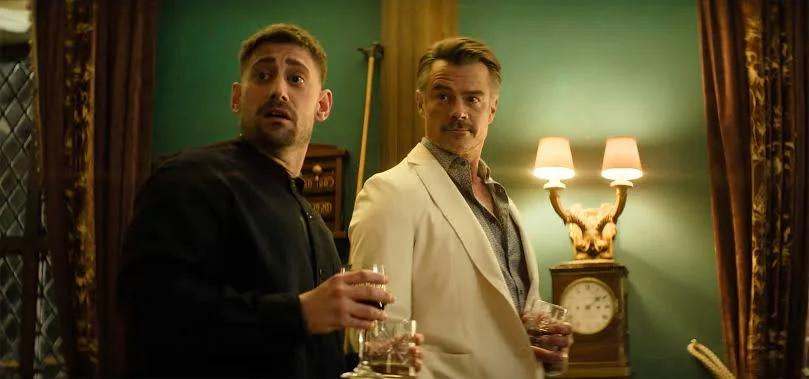
Later schemes involve bribery, deception, sabotage, injuries, poisonous bites, damaged reputations, and eventually fists. The comic geometry is simple. Put two insecure men in the same space, add an audience, and remove every reasonable exit.
Socha gives Brian a useful volatility. His anger rarely feels polished, which suits a character whose resentment keeps outrunning his judgment. Watch how quickly his posture changes around Alan’s wealth. He arrives wanting information and leaves needing victory. Duhamel plays Alan differently. His arrogance has a decorative quality, almost like another fixture in his house. When Brian threatens that image, Duhamel lets irritation puncture the performance of effortless privilege.
Their commitment keeps several scenes alive when the material becomes thin. The problem arrives when humiliation becomes the film’s primary unit of measurement. A children’s television group called the Wild & Crazies, complete with animal costumes and songs about flatulence, pushes the picture toward a strain of juvenile comedy that feels strangely cautious beneath all its apparent vulgarity. The material grows louder without becoming much stranger.
Duhamel’s direction shares that limitation. The classroom destruction, television-show chaos, and later physical confrontations are staged for immediate readability. Bodies enter, disaster occurs, reaction shot follows. The clarity helps the gags land, yet it gives the film very little visual danger. For a story about men losing control, the camera remains remarkably well behaved.
The Children in the Room
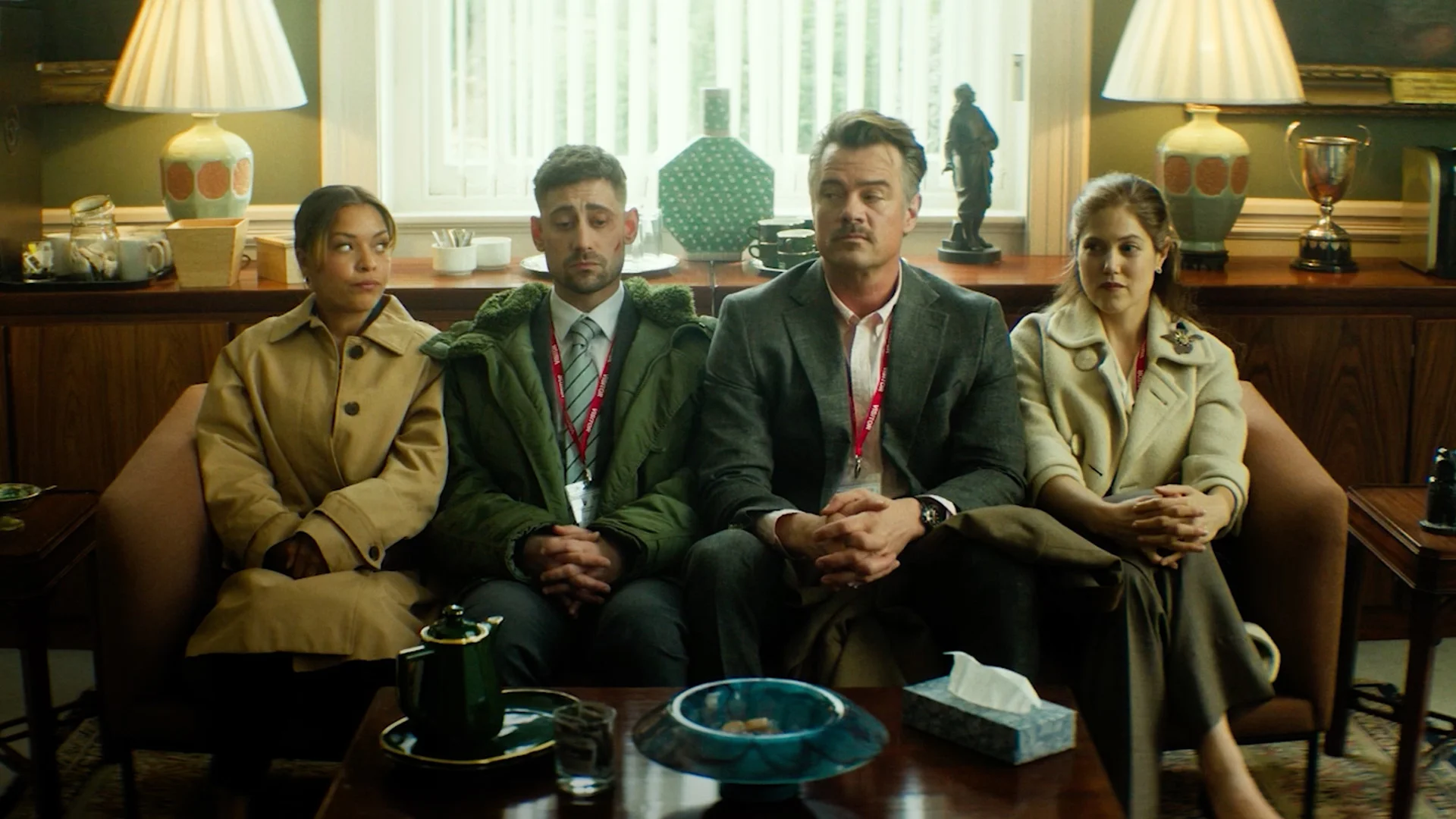
Sarah and Lauren recognize the insanity almost immediately. Antonia Thomas and Charity Wakefield play them with enough intelligence that their limited agency becomes increasingly conspicuous. Their friendship develops while their husbands wage war, and the economic gap between the families matters far less to them than it does to Brian and Alan. They spend much of the film watching the men self-destruct.
That choice fits the joke, but it weakens the characters. Sarah and Lauren possess the clearest understanding of what Puggsley has done to their households, yet the screenplay repeatedly positions them beside the conflict instead of inside it. The fathers generate action. The mothers absorb consequences.
Brian’s family provides a harsher mirror. His better-educated brother needles the insecurity Brian pretends not to have, while James Cosmo’s outspoken father refuses to decorate his criticism. These scenes clarify why Dylan’s admission becomes psychologically necessary for Brian. A child’s success offers him the chance to rewrite his own history. Grace and Dylan, meanwhile, prove perfectly capable without all this adult intervention. Their competence makes their fathers look even smaller.
The film’s smartest visual joke waits nearby. Opposite the severe, prestigious Puggsley sits a cheerful preschool filled with the sort of noisy life Alan and Brian have spent the entire film overlooking. Puggsley resembles an institution designed to manufacture impressive résumés before its pupils can properly spell their names. Across the road, children appear to be having fun. For once, the architecture gets the joke before the fathers do.
Preschool debuted digitally via Republic Pictures on March 17, 2026. The comedy film follows two determined fathers engaging in a wildly escalating rivalry as they fight over the final open spot at an elite London preschool.
Where to Watch Preschool (2026) Online







Full Credits
Title: Preschool
Distributor: Republic Pictures
Release date: March 17, 2026
Rating: PG-13
Running time: 1 hour 44 minutes
Director: Josh Duhamel
Writers: Richard D’Ovidio
Producers and Executive Producers: Josh Duhamel, Michael J. Luisi
Cast: Josh Duhamel, Michael Socha, Antonia Thomas, Charity Wakefield, Fenella Woolgar, James Cosmo
Director of Photography (Cinematographer): Arthur Mulhern
Editors: Mark Williams
Composer: Adem Ilhan
The Review
Preschool
Preschool turns parental ambition into a comic arms race, and its sharpest joke is how quickly Brian and Alan mistake prestige for proof of personal worth. Josh Duhamel and Michael Socha commit fully to the escalating humiliation, especially during the padel match, the disastrous school sabotage, and the increasingly reckless attempts to ruin each other. The film loses force when those set pieces become interchangeable and Sarah and Lauren are left observing the wreckage. Still, the cheerful school opposite Puggsley supplies a nicely cruel visual punchline about everything these fathers have misunderstood.
PROS
- Duhamel and Socha commit to the absurdity
- Strong class tension beneath the rivalry
- Several effective escalation set pieces
- Smart visual joke surrounding Puggsley
CONS
- Repetitive sabotage structure
- Sarah and Lauren are underused
- Crass humor frequently misfires
- Sitcom-like staging limits the chaos