












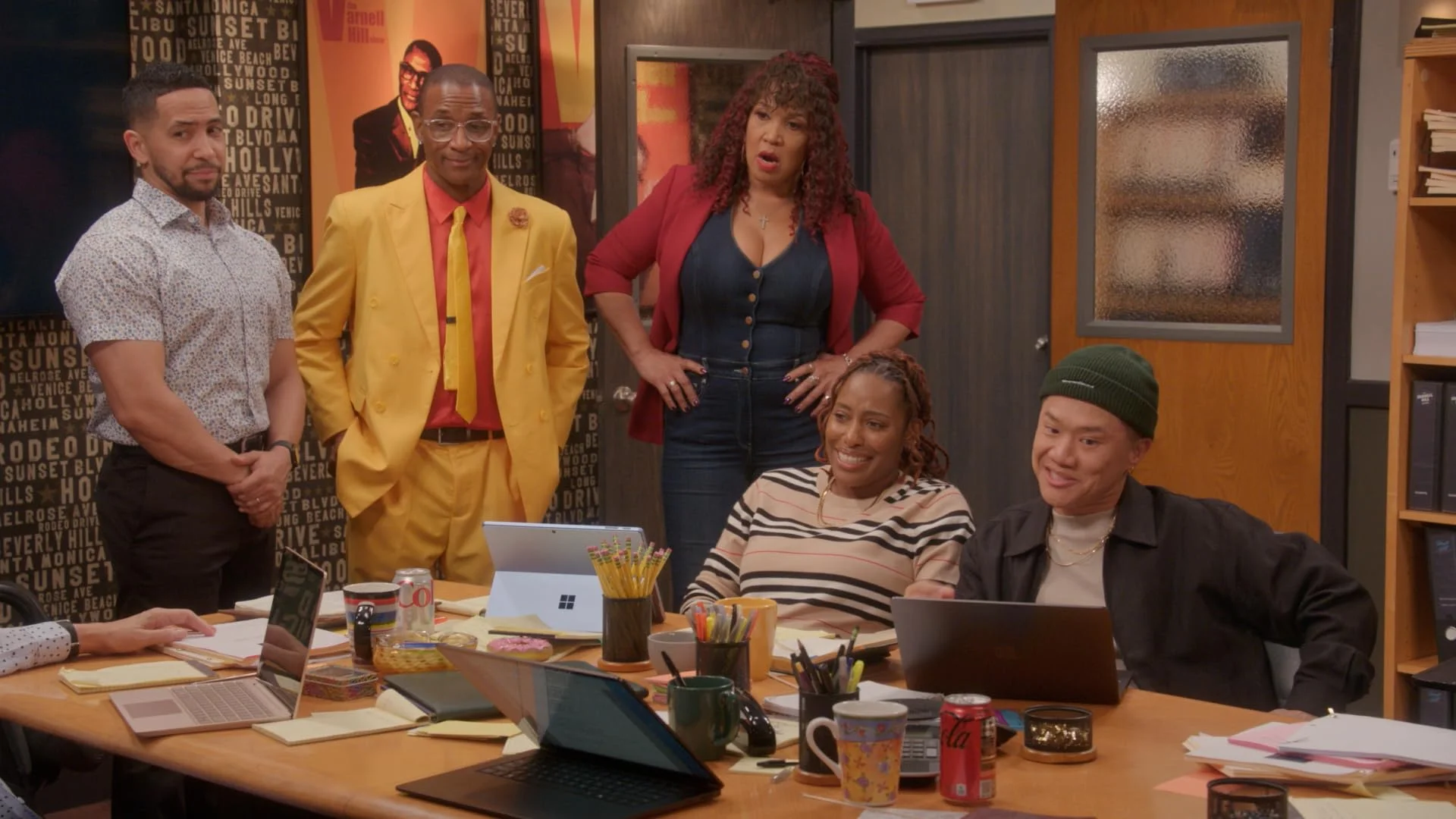

Varnell Hill has spent three decades sitting behind the same late-night desk, repeating the same catchphrase to an audience that has apparently been shrinking right along with him. That makes The Varnell Hill Show a strangely appropriate streaming revival. Paramount+ has taken a character Tommy Davidson played for two episodes of Martin in 1993 and built an eight-episode workplace sitcom around the question of what happens when television refuses to retire its past.
Created by Kevin G. Boyd, Sherri McGee McCovey, and Bentley Kyle Evans, the series finds Varnell hosting his increasingly irrelevant talk show on Mammoth Television. Interim CEO Jonah Michaelson wants him gone, largely because his father adored Varnell, so he installs Rachel Perkins as executive producer and quietly hopes creative friction will force the host to quit.
Rachel, played by Wendy Raquel Robinson, has other ideas. She starts tearing apart Varnell’s set, changing his wardrobe, questioning his staff, and informing him that the network’s data suggests his audience is dying. His response is to defend the Flintstones because they never changed clothes. Television history has rarely been summarized so efficiently.
Updating the Update
The joke running through the season is that Varnell needs modernization. The stranger joke is that the sitcom delivering this message looks determined to preserve nearly every convention of the television era that created him.
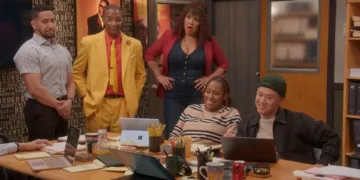
The lighting is bright and flat. Performances are broad. The laugh track works overtime. Characters frequently step toward caricature, then wave from the edge. This is fluent multicamera television made by people who clearly understand its rhythms. The issue lies in what the format is being asked to say.
Rachel assembles a younger writers’ room where generational disagreement becomes a reliable source of conflict. Varnell struggles with social media, younger staffers roll their eyes at him, and jokes involving pronouns or the revived “PAUSE” routine arrive with the dusty confidence of material nobody thought to question during rehearsal. A Kato Kaelin reference at least makes sense coming from Varnell. Younger characters sounding equally stranded in another decade is harder to explain.
The fourth-wall breaks create similar problems. Rachel occasionally drops her polished corporate register and addresses the audience in a rougher voice, hinting at the code-switching demanded from Black professionals operating inside white corporate structures. That is rich territory for a workplace comedy. The series usually treats the switch itself as the punchline.
There is an intermittently sharper idea underneath all this. Varnell and his mostly Black staff are being judged by a company controlled by white executives who determine what counts as current, marketable, and acceptable. Jonah’s attempt to manufacture Varnell’s exit could have given the modernization plot some real bite. Instead, that scheme fades into the background while Varnell throws out his back trying to prove he remains youthful.
A Better Cast Than Room
Davidson has wisely changed Varnell rather than trying to recreate his younger performance. The manic physical confidence of the Martin character has settled into something slower and more vulnerable. Varnell still sees himself as the man in the neon jacket, yet his body keeps filing formal objections.
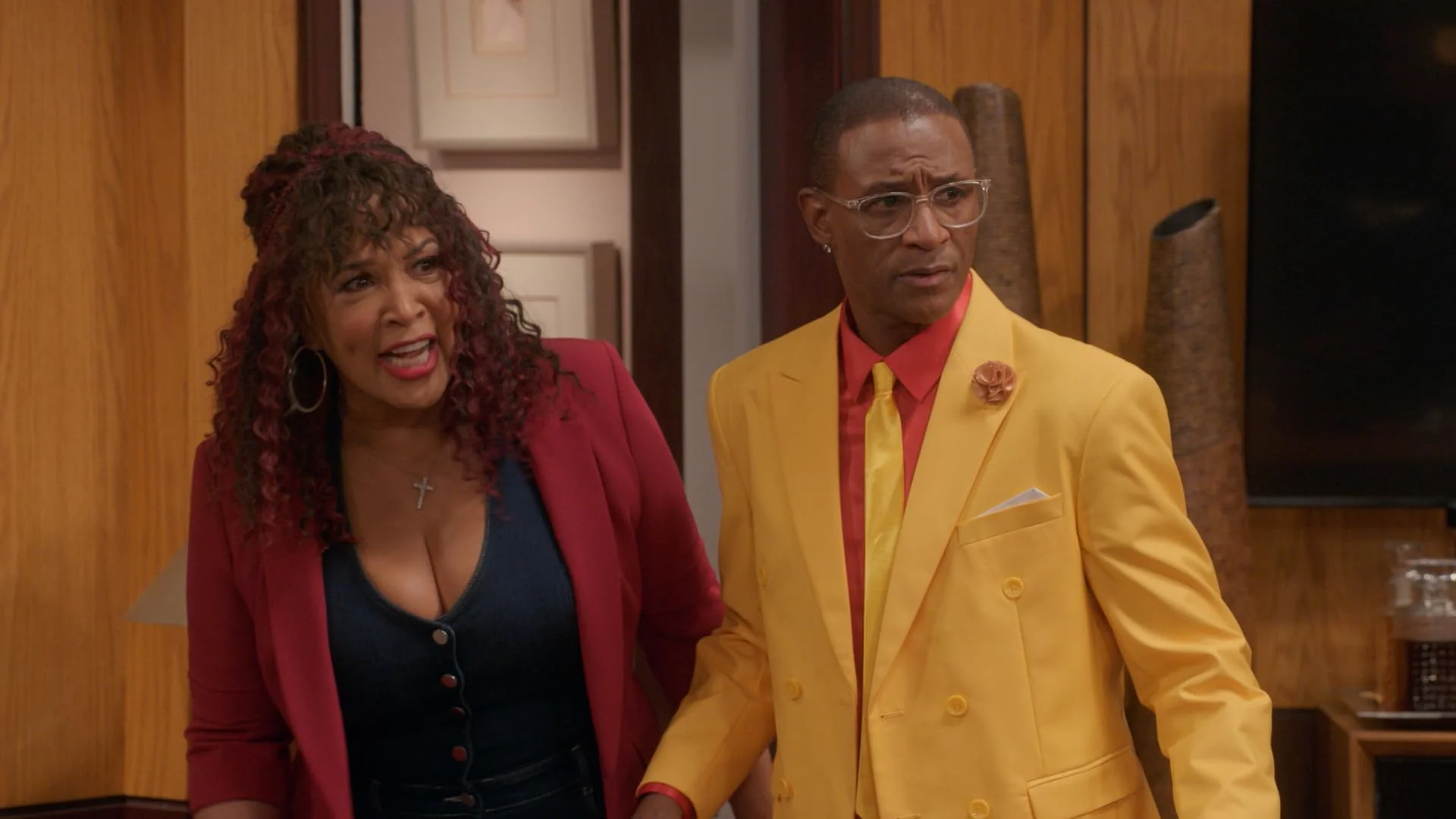
His funniest defense against age comes when he declares himself a grown man and proudly cites his scheduled colonoscopy as evidence. Davidson understands the contradiction perfectly. Varnell wants respect for surviving this long and immunity from everything survival has done to him.
Robinson gives Rachel the authority needed to challenge him without turning every disagreement into a shouting contest. Kym Whitley brings practiced timing to Kim, the assistant holding Varnell’s professional life together, while Chris Williams makes Tre amusing largely through presence. Oscar Miranda goes much broader as ex-con production assistant Gus, committing so completely to the mugging that it becomes a recognizable comic language of its own.
The crowded ensemble gets less fortunate treatment. A.J., Varnell’s irresponsible nephew, owes money to Martin Lawrence’s Mr. Dupree, a gangster-like businessman who arrives with two lackeys and a catchphrase. The storyline creates periodic trouble without giving A.J. much dimension. The younger comedian Marshay fares better because her rising popularity threatens Varnell’s identity directly, yet the scripts rarely define her beyond being younger, hotter, and potentially replaceable with him.
Eight half-hours leave little room for a writers’ room this large. Streaming once promised television freedom from rigid episode counts. Here, freedom apparently means introducing a dozen people and hoping eight episodes are enough.
The Show Inside the Show
The most persuasive argument for bringing Varnell back appears whenever the sitcom loosens its grip and allows Davidson to behave like an actual host. His conversation with Kirk Franklin shifts when Franklin begins discussing how he constructs a song. Davidson starts riffing with him and the house band, and the scripted machinery briefly disappears. The pleasure comes from watching one performer recognize another’s craft in real time.
Damon Wayans turns up so Varnell can repeatedly confuse him with his brothers. Matt Barnes plays ping-pong with him. Omarion performs. Doug E. Fresh gives the fictional talk show an unmistakable musical identity.
The anniversary roast goes further. Deon Cole, Ms. Pat, Lavell Crawford, and Mike Epps trade insults with the loose aggression of comics who know exactly how far they can push one another. Their laughter feels spontaneous because the scene permits personality to outrun plot.
Those appearances reveal a version of The Varnell Hill Show with genuine cultural purpose: a television space where Black comedians, musicians, actors, and performers from several eras can occupy the same stage without being treated like artifacts from separate generations. The sitcom keeps searching for comedy in Varnell’s fear of becoming obsolete. Put Davidson behind the desk with people who share his history, and obsolescence stops looking like the interesting question.
The Varnell Hill Show premiered on Paramount+ on September 1, 2026. Serving as a spin-off to the classic sitcom Martin, the comedy series follows veteran talk show host Varnell Hill as he navigates network executives, a chaotic writers’ room, and his own outsized ego to keep his late-night empire afloat.
Where to Watch The Varnell Hill Show Online





Full Credits
Title: The Varnell Hill Show
Distributor: Paramount+
Release date: September 1, 2026
Rating: TV-MA
Running time: 30 minutes
Director: Bentley Kyle Evans
Writers: Alyson Fouse, Jonathan M. Howard, Stacey Evans Morgan
Producers and Executive Producers: Martin Lawrence, Tommy Davidson, Bentley Kyle Evans, Jesse Collins, Dionne Harmon, Stacy Lyles, Rae Proctor, Robert Lawrence, Mark Greenberg, Andrew Horne
Cast: Tommy Davidson, Kym Whitley, Wendy Raquel Robinson, Nick Cafero, Emmanuel Hudson, Chris Williams, Martin Lawrence
Editors: Russell Griffin
Composer: Matthew Head
The Review
The Varnell Hill Show
The Varnell Hill Show is funniest when Paramount+ stops asking its veterans to impersonate 1990s television and simply gives them room to perform. Tommy Davidson’s easy chemistry with Kirk Franklin and the joyous anniversary roast reveal what this revival could be: a gathering place for several generations of Black entertainment talent. Yet the eight-episode season keeps reducing its modernization debate to stale generational jokes, thin supporting characters, and a writers’ room that rarely earns its crowded roster. Television nostalgia can preserve history. Here, it too often prevents the show from making any.
PROS
- Davidson remains naturally charismatic
- Strong veteran comedy ensemble
- Excellent celebrity guest chemistry
- Energetic anniversary roast
- Valuable showcase for Black entertainers
CONS
- Dated generational humor
- Underwritten supporting cast
- Weak writers’ room material
- Uneven fourth-wall breaks
- Eight episodes limit character development