












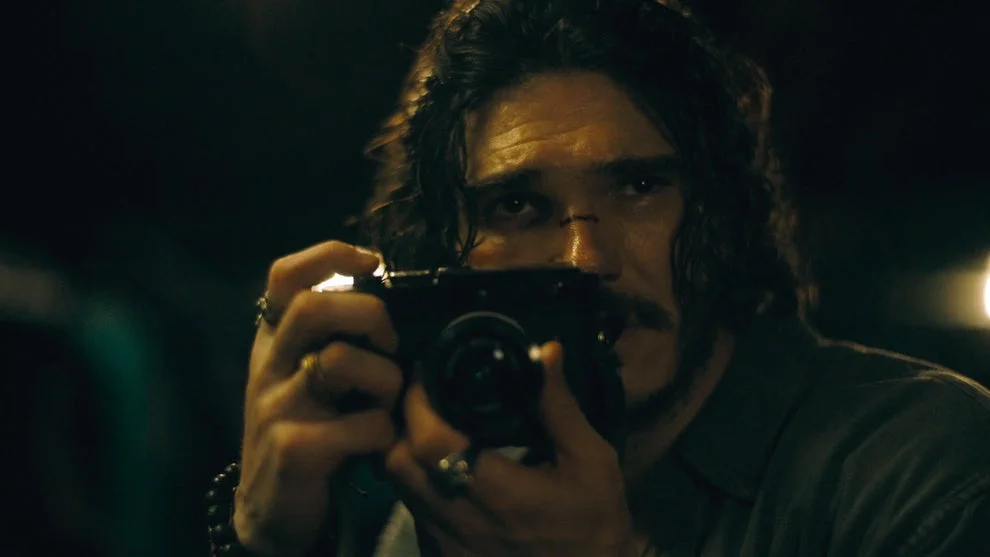

The Last Photograph keeps asking you to recoil from violence, then gives you an image composed carefully enough to admire. That tension is uncomfortable, sometimes productively so. Zack Snyder has made a film about a photographer who can look at a dead body and think first about the picture it might become, yet Snyder himself remains irresistibly drawn to blood, skin, movement, and suffering as visual material. For a while, that contradiction gives the film a strange emotional charge. Eventually, it starts to feel like a trap the movie cannot escape.
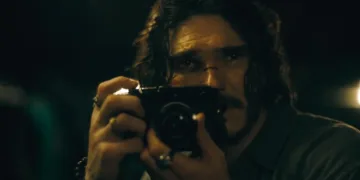
Joe Wallace, played by Fra Fee, is introduced having sex while his attention wanders toward a butterfly. His camera follows. Moments later, gunfire erupts at the birthday party upstairs, and Joe rushes toward the massacre with the same instinct. Adults are killed, two children are abducted, and Catherine, their mother, dies while Joe photographs what happens. Sex, beauty, drugs, death, photography: the sequence throws them together so aggressively that subtlety never gets invited to the party.
Yet there is something revealing in how Joe reacts. He does not process horror like everyone else because he barely seems able to process anything without placing a lens between himself and the world. The camera is his shield, his addiction beside the heroin he carries with him, and eventually his moral problem.
Ethan Black has a different relationship with violence. Stuart Martin first appears tending sheep with surprising gentleness before slaughter becomes part of the routine. Soon he learns that his brother and Catherine have been murdered and their children taken. Catherine mattered to Ethan for another reason. The two had an affair, and she left him with a topless Polaroid carrying the message, “This is a photograph from that other world.”
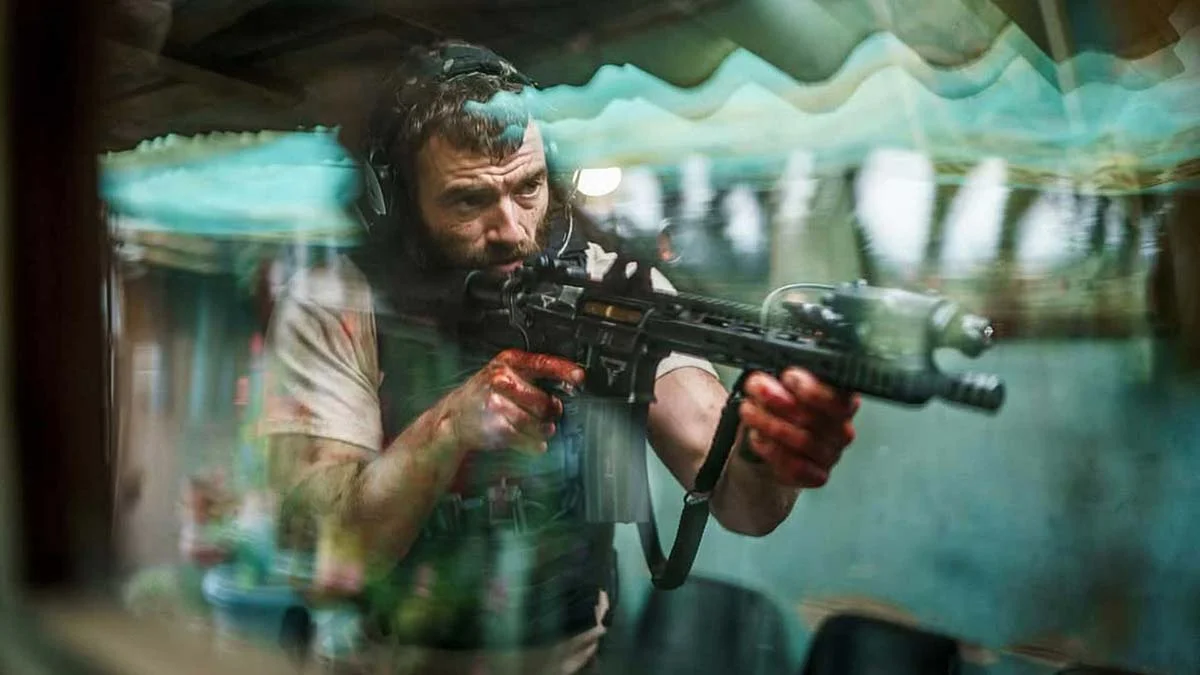
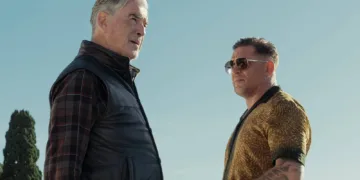
That photograph stays with him when he travels to find Joe and offers him $10,000 to help identify the killers. The pairing initially works because Ethan and Joe respond to pain from opposite directions. Ethan turns grief into action, almost instantly converting emotion into mission. Joe turns pain into distance. Ethan wants him to look up from the camera. Joe seems happiest when the camera means he does not have to look directly at anything at all.
Their trip through the country gives The Last Photograph its strongest stretch. Snyder strips away much of the mythology and digital enormity associated with his recent films and sends two damaged men through roads, towns, armed checkpoints, and jungle territory. Violence arrives abruptly. People appear dangerous before their loyalties are clear. Ethan falls back on skills from an earlier life involving American operations in the region, while Joe trails behind with his drugs and camera.
There are moments when this simpler setup produces exactly the kind of nervous momentum the film needs. A road journey can suddenly turn into an attack. A driver asking about “the king” creates one of the movie’s rare bursts of absurd humor. Ethan’s competence during gunfights makes sense without requiring pages of explanation, and Martin has the physical presence to sell the idea that this man once survived places like this.
The trouble is repetition. The closer Ethan and Joe seem to get to their destination, the less the emotional distance appears to change. Another confrontation arrives. Another body drops. Another memory of Catherine intrudes. Ethan talks about guilt, faith, violence, or his past. Joe shoots up, takes pictures, listens, and keeps moving. You can feel the film waiting for the relationship to transform.
Joe eventually articulates the idea that should unlock everything. As a photographer, he can encounter terrible suffering and find himself wondering how it might look through the camera. That confession gives language to the numbness Fee has been playing from the start. It also turns the camera back toward Snyder.
Snyder shoots the film himself, and his eye is still capable of finding striking compositions. Shallow focus isolates faces from blurred spaces. Bodies fill the frame. Strange lenses distort encounters. Butterflies drift through the imagery. Blood occasionally reaches the lens. He can make one second feel tactile and immediate, but those images do not always deepen what comes before or after them.
That becomes especially difficult in a story asking us to question the consumption of violence as imagery. Joe is criticized for converting suffering into pictures, while The Last Photograph repeatedly converts suffering into visual stimulation. Shootouts pile up. Heads are hit with blunt efficiency. Bodies fall. The film can condemn Joe’s detachment in dialogue and then seem fascinated by exactly what fascinates him.
The same problem affects Catherine. She is emotionally central to Ethan, yet the film gives us surprisingly little sense of her outside male memory and male desire. She survives as a photograph, a lover, a murdered woman, and a source of guilt. Other women receive similarly limited space. Snyder photographs male bodies obsessively as well, with Ethan and Joe frequently shirtless, so the gaze is hardly confined to women. Still, Catherine is being asked to carry much of the story’s grief without receiving enough life of her own.
The unnamed South American setting creates another emotional gap. Ethan’s earlier presence there hints at intervention, armed factions, old loyalties, and violent consequences returning years later. The story wants some degree of political guilt hanging over his rescue mission. Yet the competing groups and local conditions remain so indistinct that the country begins to feel like a dangerous stage built for Ethan’s redemption.
That matters because The Last Photograph keeps reaching for ideas about responsibility. Ethan wants to undo something. Joe needs to decide if witnessing is enough. Violence seems to circle back toward those who helped create it. Those are strong pressures for a revenge film, and the upstream journey naturally creates the expectation that all of them will collide. They never quite do.
At roughly 135 minutes, the movie does not lack time. It lacks enough change inside that time. Flashbacks, speeches, recurring symbols, and firefights keep expanding the emotional vocabulary without producing a corresponding emotional progression. Snyder can make the next encounter feel immediate, yet the destination keeps becoming harder to care about.
That is why the final stretch hurts the film so badly. Ethan and Joe have travelled far enough that some kind of reckoning feels inevitable, even if it arrives in an ugly form. Instead, the payoff lands without the force the journey has been storing. The story slows rather than tightens, and the feeling left behind is less tragedy than incompletion.
I kept coming back to Joe, who begins as a man hiding behind an image because participating in the world is harder. Snyder seems to understand exactly what is frightening about that impulse. The Last Photograph is strongest when it makes us feel the cost of looking without connecting. It weakens whenever the film itself becomes too enamored with the beauty of what it is looking at.
For all its violence, that may be the movie’s deepest wound: it knows a photograph can preserve a person, exploit them, distance us from them, or make us remember them. It just cannot decide what its own images are doing.
The Last Photograph had its world premiere at the Toronto International Film Festival on September 13, 2026. The action thriller follows a former DEA operative who travels into a dangerous South American jungle to rescue his missing family members.
Where to Watch The Last Photograph (2026) Online
Full Credits
Title: The Last Photograph
Distributor: Netflix
Release date: September 13, 2026 (Toronto International Film Festival)
Running time: 2 hours 15 minutes (135 minutes)
Director: Zack Snyder
Writers: Kurt Johnstad
Producers and Executive Producers: Zack Snyder, Deborah Snyder, Gianni Nunnari, Wesley Coller
Cast: Stuart Martin, Fra Fee, Jackie Kay, Sergio Herrera, Marlon Moreno, Costanza Andrade, Gustavo Angarita Jr., Carolina Henao
Director of Photography (Cinematographer): Zack Snyder
Editors: Melissa Remenarich-Aperlo
Composer: Hans Zimmer, Omer Benyamin, Steven Doar
The Review
The Last Photograph
The Last Photograph finds real tension in the distance between witnessing suffering and feeling it. Fra Fee’s detached photographer gives Zack Snyder a strong emotional question to chase, while bursts of brutal action and striking compositions keep the journey alive. Yet repetition steadily drains that tension, Catherine remains trapped inside other people’s memories, and the political setting never gains enough definition to support the film’s larger ideas. By the time Ethan and Joe reach their reckoning, the images have accumulated faster than the meaning behind them.
PROS
- Strong central idea around photography and detachment
- Fra Fee gives Joe convincing emotional numbness
- Several tense, immediate action sequences
- Snyder still finds striking individual images
CONS
- Repetitive middle stretch
- Weak emotional payoff
- Catherine remains underdeveloped
- Political setting lacks definition
- Visual fascination sometimes undermines the film’s critique