
























The story of the individual who births a world-altering technology only to be hunted by its corporate parent is a foundational myth of our digital age. It’s the modern Prometheus story, except Zeus is a CEO with a venture capital fund and the eagle is a team of heavily armed mercenaries. Off the Grid wades directly into this narrative stream with a kind of gritty, unvarnished sincerity.
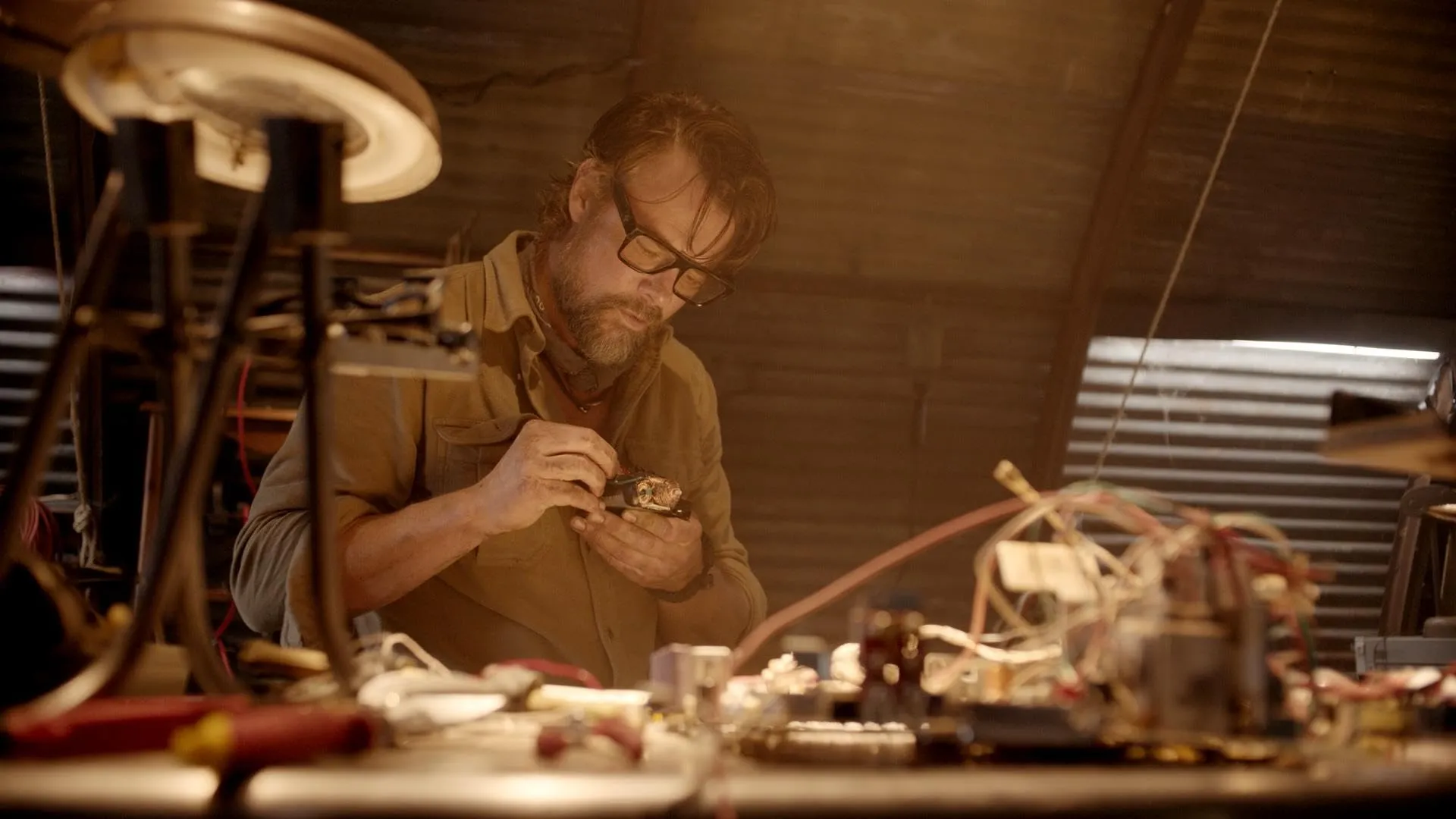
Our reluctant titan is Guy (a suitably grizzled Josh Duhamel), an engineer of apparently transcendent genius who has created… something revolutionary. He now lives a life of enforced techno-primitivism in the Tennessee backwoods, a man who built the future and then promptly ran screaming from it.
His former employer, the ominously named Belcor Industries, wants its paradigm-shifting intellectual property back, and Guy along with it. The company dispatches its hounds, believing no one can truly unplug from a world they are so intent on wiring.
What follows is a tense setup, a juxtaposition of two Americas: the quiet, green world of self-reliance against the cold, blue glow of the screens that track and command the hunt. The film establishes itself not merely as a chase movie, but as a conflict of ideologies played out with traps and tactical gear.
The Saint, The Suit, and The Sociopath
At the center of this conflict is Guy, an embodiment of a uniquely American paradox. He is the intellectual as frontiersman, a man equally capable of rewriting firmware and felling a tree with an axe. This is the film’s central symbolic gesture: the fusion of mind and body, a rejection of the hyper-specialization that defines the very corporate world from which he has fled.
He is a walking contradiction, the ghost in the machine who now lives among the pines. His connections to the small town, a sharp kid named Chase and a friendly bar owner, Josey, are not mere plot conveniences. They are his anchors to humanity, preventing his self-imposed exile from souring into pure misanthropy. They are the people his abstract principles are actually for. Against him is arrayed a triptych of corporate decay.
First, there is the CEO, Belcor, played by Peter Stormare with the apoplectic rage of a king whose court magician has vanished. He is capital personified: loud, demanding, and utterly without patience, a tantrum in a suit.
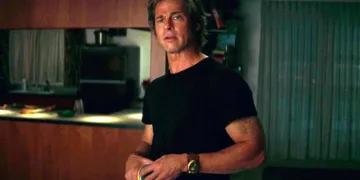
Then we have his emissary, Ranish (a delightfully exasperated Greg Kinnear), the ultimate company man adrift in a sea of dirt and insects. He is the film’s most potent source of commentary, his complaints about the rural environment representing the profound disconnect between the sterile boardrooms that make world-changing decisions and the actual, messy world itself. He detests his mission but is too embedded in the system to refuse.
Finally, there is the muscle, Marcus. Played by Ricky Russert as a collection of leftover tics from better movie villains, he is the company’s violent impulse given form. A grim reaper in tactical gear who proves more lethal to his own subordinates than to his target, he is a perfect representation of corporate brutality: clumsy, inefficient, and theatrical in its cruelty.
An Exercise in Applied Violence
The film’s narrative architecture is, to put it kindly, peculiar. In an act of profound narrative self-sabotage, it opens by showing us the explosive fate of a primary antagonist. This flash-forward effectively decapitates any future suspense regarding his character, a curious choice for a thriller that suggests a fundamental lack of faith in its own ability to hold an audience’s attention through conventional storytelling.

What remains is not a question of if, but simply of how we will arrive at this preordained conclusion. The journey there settles into a kind of Sisyphean action loop: the corporate goons advance, Guy’s cleverness thwarts them, they regroup with diminished numbers, and the cycle begins anew. It is less a chase and more a rhythmic, attritional process.
Yet, within this repetitive structure, there are moments of genuine craft. The conflict is at its most engaging when it becomes an extension of Guy’s intellect. He weaponizes the forest itself, turning the wilderness into a collaborator.
The booby traps and improvised devices are not just defensive measures; they are brutalist works of art, the physical application of a scientific mind. It’s here the movie finds its footing, in the small details of a well-placed snare or a cleverly rigged explosive. The execution of the more direct combat, however, is serviceable at best.
The hired guns suffer from a terminal case of Imperial Stormtrooper Marksmanship Syndrome, spraying bullets with a heroic disregard for their target and thereby lowering the stakes considerably. The local townsfolk, Chase and Josey, are periodically pulled into this vortex, forcing Guy’s hand. Their endangerment transforms his war of principle into a messy, immediate fight for people, the one variable his isolated system hadn’t fully accounted for.
Human Variables in a Mechanical Plot
In a film built on such a rigid, almost algorithmic, premise, the performances become the unpredictable elements that give the equation life. Josh Duhamel, as Guy, provides the necessary stoic anchor. He carries the role with a weary physicality that sells the character’s years of self-imposed exile.
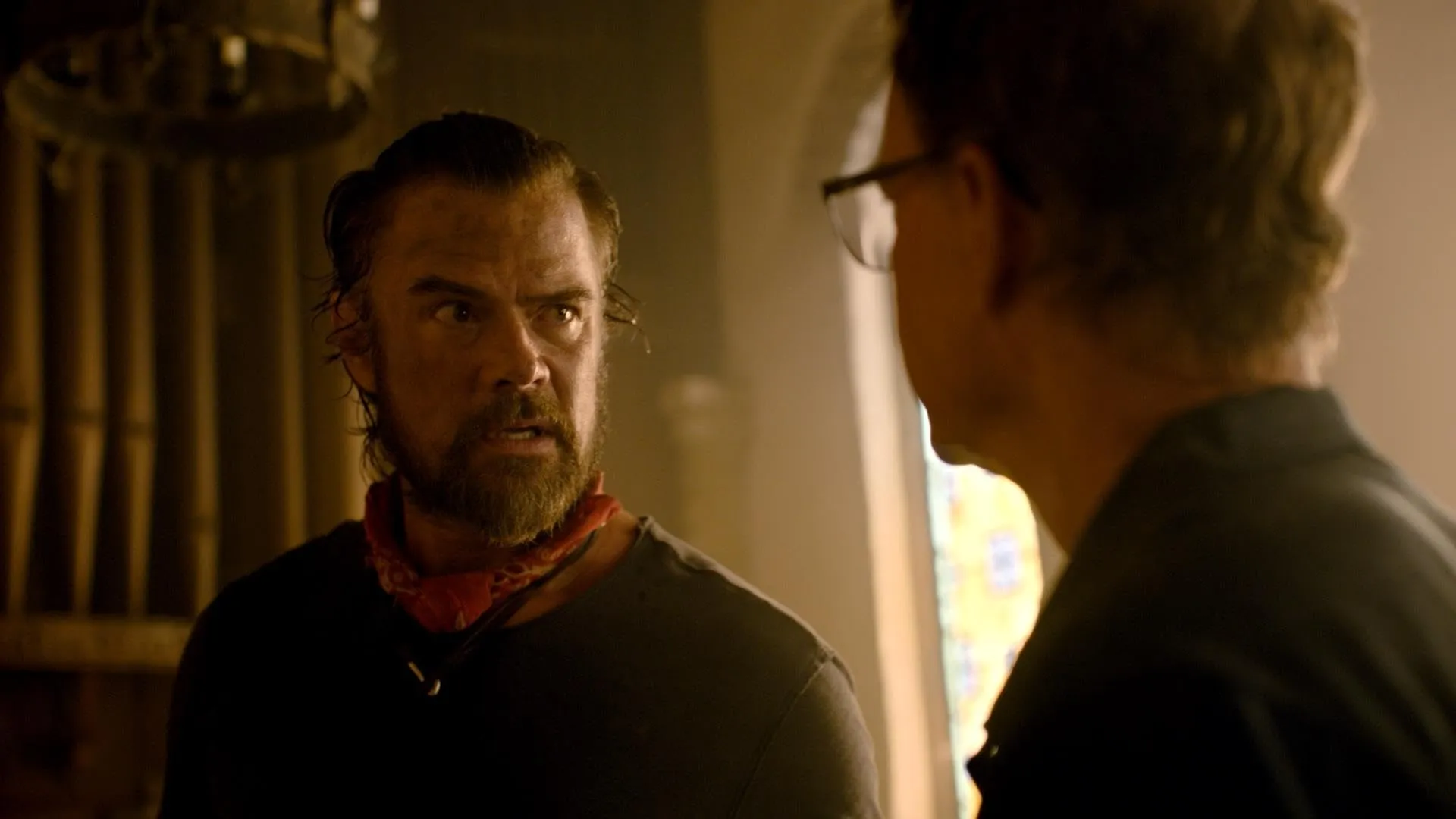
There is a grounded quality to his work; he is the believable human center required to prevent the entire enterprise from floating away on a cloud of its own absurdity. He does not overplay the genius nor the survivalist, instead finding a quiet, competent middle ground. He is the film’s straight man. Which allows everyone else to be varying degrees of unhinged.
Greg Kinnear, in particular, seems to have understood the assignment perfectly. His Ranish is a masterpiece of impotent, urbanite frustration. Every complaint about mosquitos, every disdainful glance at the rustic surroundings, is a small comic jewel.
He is a man whose entire identity is being assaulted by the natural world, and Kinnear plays this existential crisis for all its worth. His bizarre, almost loving, monologue on the myriad ways a broomstick can be used to inflict pain is a moment of sublime, out-of-place brilliance—a brief glimpse into the repressed violence simmering beneath the corporate veneer.
The other villains operate as purer archetypes. Peter Stormare appears briefly as Belcor, less a performance and more a sustained explosion of pure capitalist rage. He is a force, not a character. And then there is Ricky Russert’s Marcus, the field operative.
He is a walking collage of cinematic villainy, from his haircut to his all-black attire. His performance is so theatrical, so consciously evil, that it transcends mere imitation and becomes its own commentary. He is not a person hunting Guy; he is the cinematic idea of a henchman made flesh, a collection of tropes sent to do battle with a man of substance.
The Nuts and Bolts of a B-Movie Machine
There is a certain aesthetic of frugality at play in the film’s construction, a sense that every creative choice was governed by practicality. Johnny Martin’s direction is functional, aiming for the lean intensity of a classic survival thriller but often landing on something more restrained, almost hesitant.

The camera work follows suit; it captures the scruffy woodland setting with an unvarnished eye, giving the proceedings a gritty, tangible feel that a larger budget might have polished away. This enforced naturalism, while likely unintentional, gives the film a texture that paradoxically feels more authentic than many of its slicker cousins. It looks cheap because, for the characters, life is cheap.
The post-production choices are less defensible. The editing commits its most egregious sin in the opening minutes with the aforementioned flash-forward, a structural decision that kneecaps suspense before the story can even stand.
During the action sequences, the cutting strains to create a sense of kinetic energy but sometimes just creates a choppy visual soup. Accompanying this is a musical score so perfectly generic it borders on self-parody. It is the sonic equivalent of clip art, dutifully swelling and receding on cue without leaving any lasting impression.
The Sum of Its Scrappy Parts
So what is Off the Grid? In the final analysis, it is a film that knows exactly what it is: a sturdy, direct-to-video-style actioner. It harbors no illusions of being high art. Its narrative is a straight line, a simple tale of a good man with a particular set of skills pushed too far by bad men in black vests. The machine is refreshingly free of any complex moral calculus.
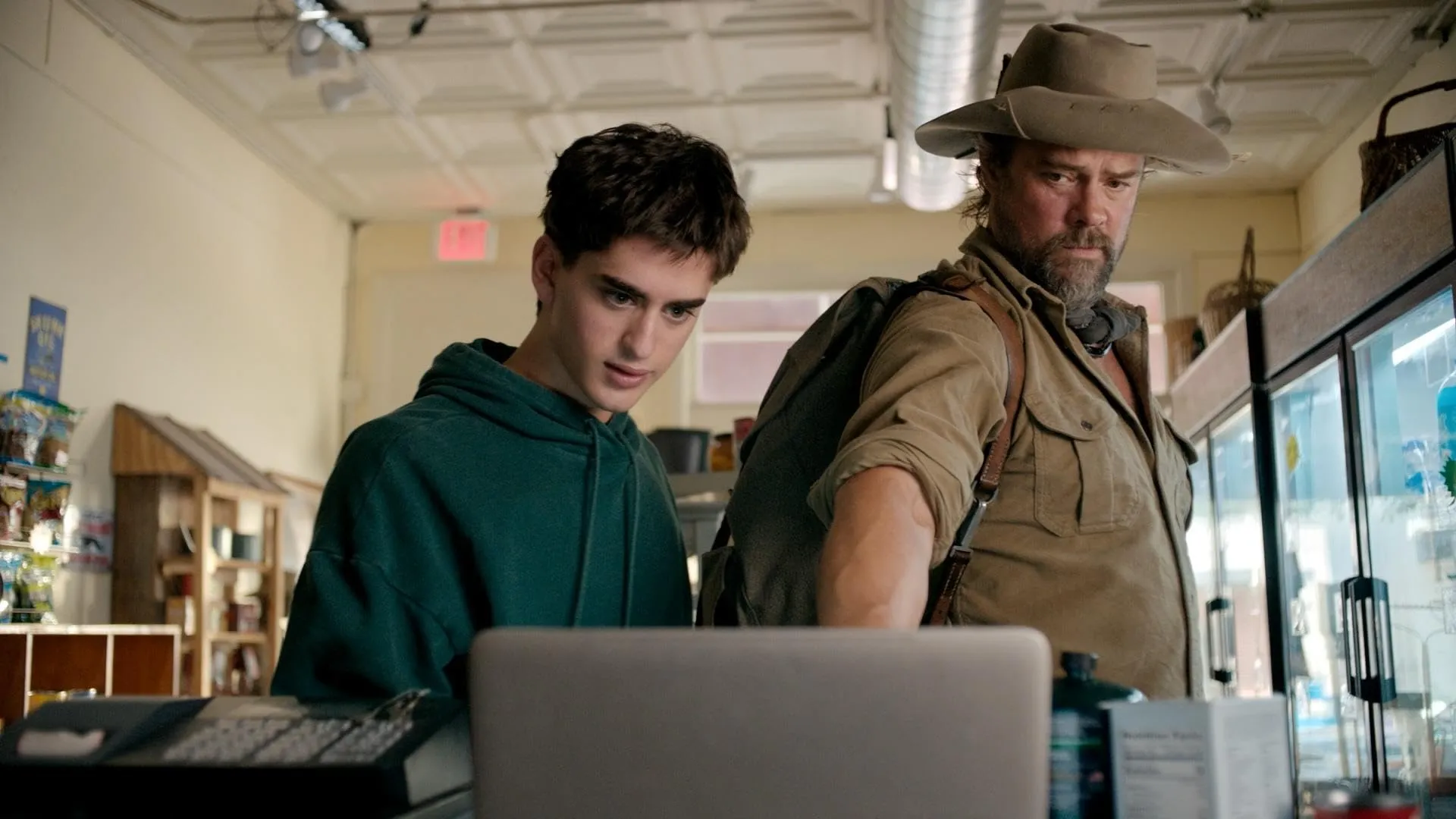
Faint thematic ghosts do haunt the edges of the frame. There are whispers of a critique against corporate overreach and a palpable sense of the cultural chasm between the urbanites and the rural folk, embodied almost entirely in the person of Ranish. Yet these feel less like deliberate explorations and more like fortunate byproducts of a formulaic script.
The film’s capacity for entertainment rests squarely on its unpretentious shoulders and the spark of life provided by its cast, chief among them a wonderfully out-of-place Greg Kinnear. It is a functional piece of genre filmmaking, a perfectly serviceable, if ultimately forgettable, way to spend an hour and a half watching a system get a well-deserved wrench thrown into its gears.
Off the Grid is an action-thriller film that was released in select theaters and on video on demand on June 27, 2025, in the United States. You can rent or buy the movie on platforms like Amazon Video, Apple TV, Fandango At Home, Spectrum On Demand, and Plex. It is also available in theaters.
Full Credits
Director: Johnny Martin
Writers: Jim Agnew
Producers: Luca Matrundola, Richard Salvatore, David Lipper, Robert A. Daly Jr., Rick Moore.
Executive Producers: Jim Agnew, Wendy Benge, Barry Brooker, RJ Collins, Grady Craig, Michael Joseph Dutton, Daniel Farag, Matthew Helderman, Roman Kopelevich, Danielle Maloni, Luca Matrundola, Travis Myers, Oliver Scott, Ryan Donnell Smith, Andrew Stevens, Luke Taylor, Oliver Trevena, Stan Wertlieb, Ryan Winterstern, Imteaz Ahamed, Erik Donavan Brown, Allen Cheney, Josh Duhamel, Crystal Hill, Patrick Josten, Walter Josten, Brian Keefe, Jengweei Lin, Josh Spector, Natasha Stassen, Michael R. Steele, Roman Viaris-de-Lesegno, Anita Wiest.
Cast: Josh Duhamel, Greg Kinnear, María Elisa Camargo, Peter Stormare, Ricky Russert, Michael Zapesotsky, Joe Bucaro III, Daniel Farag, Paul Sampson, Talia Asseraf, Michael Papajohn, David Lipper, Tana Ireland, Isaiah LaBorde, Kipp Tribble.
Director of Photography (Cinematographer): David Stragmeister
Editors: Vincent Tabaillon
Composer: Frederik Wiedmann
The Review
Off the Grid
Off the Grid commits to its nature as a simple, unpretentious action vehicle. It is a cinematic machine assembled from familiar parts, but it runs well enough, powered by a workmanlike script and the high-octane performance of Greg Kinnear, who single-handedly elevates the material every time he is on screen. While hobbled by some clumsy filmmaking choices, the film provides a functional, if forgettable, dose of righteous, backwoods vigilantism. It is a movie made for a Saturday afternoon, and it succeeds on exactly those terms.
PROS
- Greg Kinnear’s darkly comedic performance.
- The straightforward, easy-to-follow B-movie premise.
- Creative use of improvised traps and survival tactics.
CONS
- Clumsy editing that spoils suspense from the start.
- Uninspired direction and a generic musical score.
- A formulaic script with mostly one-dimensional characters.