


























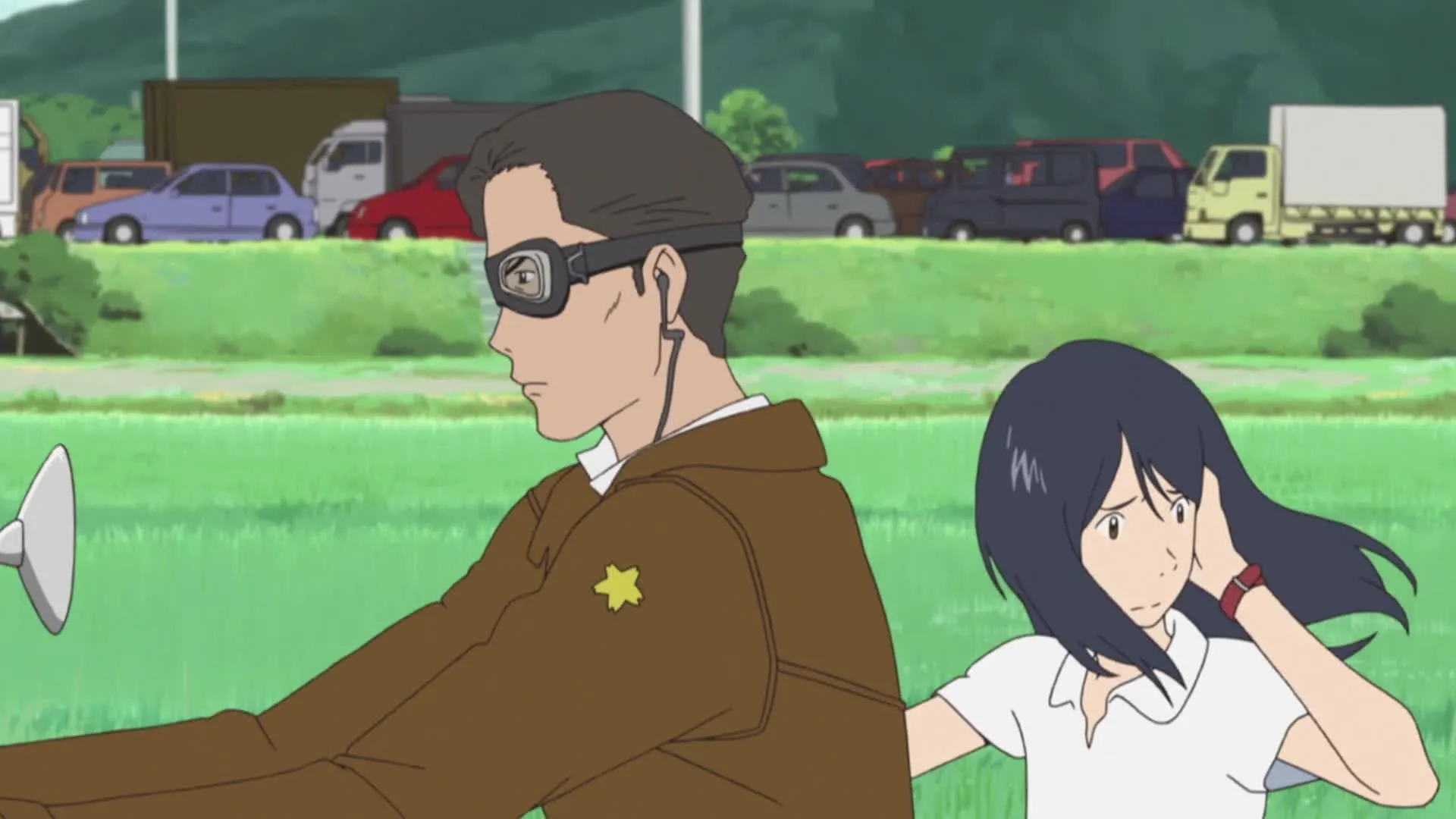

Mamoru Hosoda’s 2009 animated feature Summer Wars opens on two fronts: one is a sun-drenched pocket of the Japanese countryside, steeped in tradition; the other is the sleek, globally interconnected virtual world of OZ. Into this first world walks Kenji Koiso, a shy high school student with a prodigious gift for mathematics.
He is recruited by the popular Natsuki Shinohara for a delicate mission of social deception: to pose as her fiancé during her great-grandmother’s ninetieth birthday celebration. The second world, OZ, is the digital scaffold upon which modern society is built. It is the singular platform for global commerce, government, and communication—a utopian convenience of immense power.
The film’s conflict ignites when Kenji, staying with Natsuki’s family, applies his mathematical acumen to a mysterious encrypted message. His solution unwittingly unlocks a digital Pandora’s Box, releasing a rogue Artificial Intelligence that begins to systematically dismantle OZ, threatening a worldwide systems collapse. The small, personal stakes of a teenage lie are immediately dwarfed by an immense, impersonal threat.
The Analog Anchor
The film’s real-world action is anchored at the Jinnouchi family estate, a sprawling ancestral home that feels like a living character. It is a bastion of history where the scent of summer and the sound of cicadas mix with the constant chatter of the clan.
This is no quiet gathering; the family is a boisterous, multi-generational tribe with proud samurai roots, their lively dynamics filling every frame with energy. At their center is the great-grandmother, Sakae Jinnouchi, the clan’s powerful matriarch and emotional core.
Her authority is absolute, yet wielded with a quiet confidence that radiates through the household. Her tools are not digital devices but an old rotary phone and a well-worn address book—a testament to a more durable social network built on decades of trust and mutual respect.
Kenji, an outsider, finds himself navigating this cacophony of colorful personalities, from a boisterous fisherman uncle to a stern police officer cousin. The arrival of Wabisuke, the family’s estranged black sheep who earned his fortune in America, adds a sharp note of discord. His presence introduces a tension between modern ambition and the family’s deep-rooted values, foreshadowing his complicated connection to the digital crisis.
This rich domestic setting grounds the film’s high-concept plot. The story’s heart beats not in the abstract code of OZ, but in the tangible soil of these human interactions, the budding affection between Kenji and Natsuki, and the steadfast celebration of familial bonds. The threat to a virtual world becomes a direct threat to this specific family and their entire way of life.
The Immaculate Void
The virtual realm of OZ offers a stark aesthetic contrast, a digital frontier rendered in the clean lines and bright palette of Japanese “superflat” pop art. Initially, it is a pristine, minimalist white space brought to life by a riot of colorful, custom avatars.

These digital proxies range from sleek anthropomorphic animals to heavily armed robotic warriors, each a user’s idealized self. Yet this digital paradise is also society’s single greatest point of failure. The film makes clear that OZ is the invisible architecture of modern life, its code managing not just social media and commerce but also vital infrastructure like public utilities, health monitors, and even the trajectories of satellites. Its seamless integration is both its primary appeal and its critical vulnerability.
The antagonist, Love Machine, is not a villain with a plan but a force of pure algorithmic chaos. It operates as a voracious glitch, a digital cancer that spreads by hijacking user accounts to absorb their permissions and data. With each stolen identity, it grows exponentially more powerful. Its visual form mirrors this parasitic growth, evolving from a simple avatar into a grotesque, constantly shifting amalgamation of its thousands of victims.
The action within OZ is not traditional combat but a war of information, fought through frantic keystrokes and complex code-breaking. The film excels at turning these intellectual battles into kinetic visual spectacles, a fever dream of digital warfare that stands in sharp opposition to the textured realism of the Jinnouchi estate.
The Human Algorithm
The clean chaos of the digital world soon spills into reality, creating tangible and messy consequences that ripple across the globe. The abstract threat becomes concrete as traffic grids seize, turning cities into parking lots, and emergency systems trigger false alarms, sowing widespread confusion.
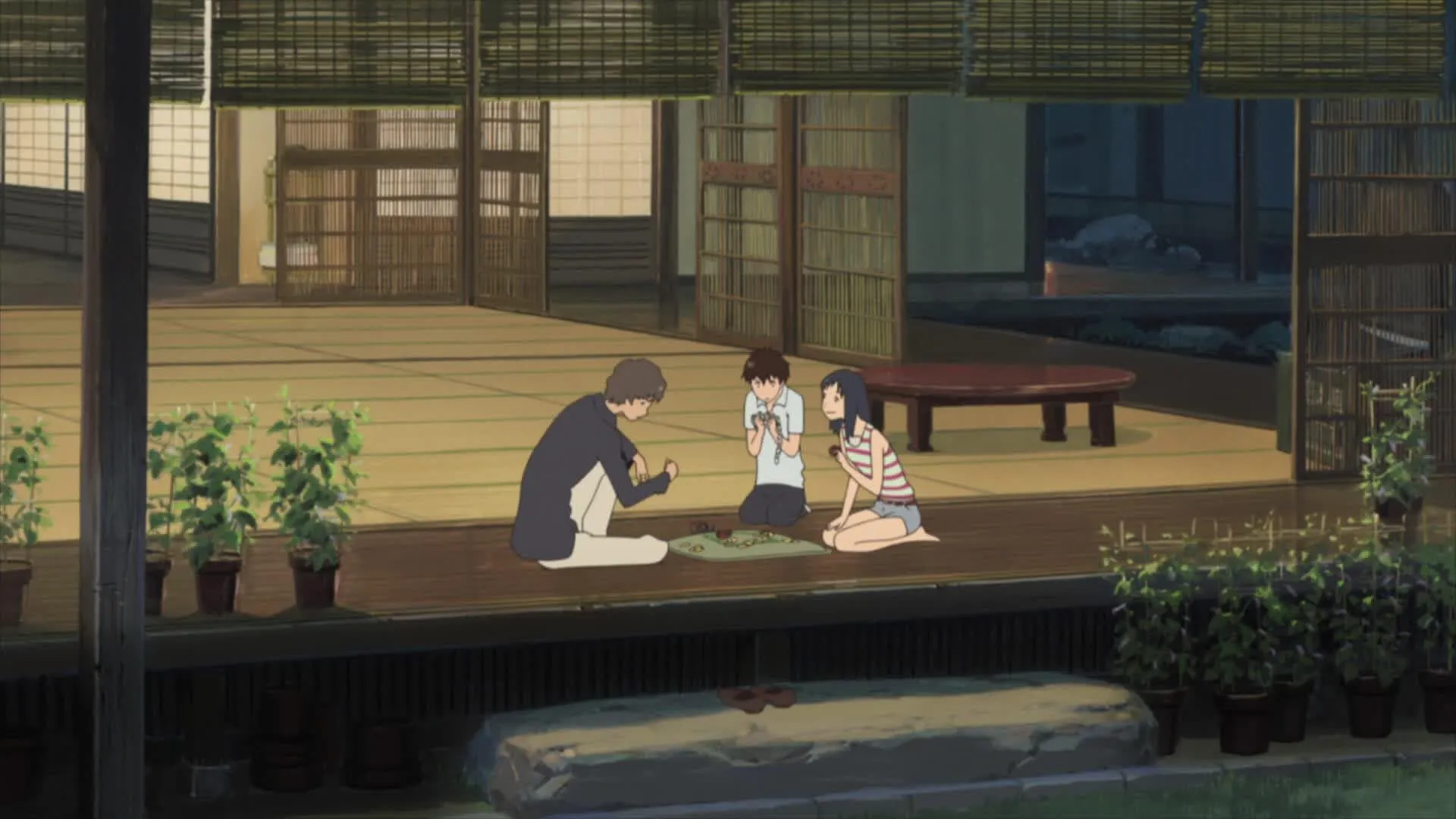
The crisis is no longer confined to a screen; it has breached the firewall between worlds. The film’s climax sees the Jinnouchi family home, with its traditional paper screens and wooden floors, transform into an ad hoc mission control. This ancient setting housing a cutting-edge digital war creates a powerful visual juxtaposition.
The fight that ensues is a masterful blend of old and new tactics. Sakae’s analog network is activated as phones ring off the hook, calling powerful figures into service. This old-world influence works in tandem with Kenji’s mathematical brilliance as he sits before a whirring supercomputer borrowed from a relative. Natsuki, in a stroke of genius, repurposes her skills at the traditional card game Hanafuda as a high-stakes battle strategy against the AI.
The entire Jinnouchi clan, united in a symphony of managed panic, wages war against the digital entity. The film’s final statement is a nuanced one about integration. It suggests technology is a powerful tool, but its value is determined by the community that wields it. The family does not reject the digital world; they tame it, reclaiming it through the profound strength of their human connections.
“Summer Wars” is a Japanese animated science fiction film released on August 1, 2009, in Japan.
Full Credits
Director: Mamoru Hosoda
Writers: Satoko Okudera, Mamoru Hosoda
Producers: Takuya Ito, Yuichiro Saito, Nozomu Takahashi, Takafumi Watanabe
Executive Producers: Hiroyasu Asami, Fumihiro Hirai, Shin’ichirô Inoue, Jungo Maruta, Seiji Okuda, Shin’ichirô Nishigaki
Cast: Ryunosuke Kamiki, Nanami Sakuraba, Mitsuki Tanimura, Sumiko Fuji, Ayumu Saito, Takahiro Yokokawa
Director of Photography (Cinematographer): Yukihiro Matsumoto
Editors: Shigeru Nishiyama
Composer: Akihiko Matsumoto
The Review
Summer Wars
Summer Wars is a brilliant and energetic piece of animation that successfully merges a heartfelt family drama with a high-stakes cyber-thriller. Its true strength lies in grounding its spectacular digital conflicts in the authentic, messy, and deeply human world of the Jinnouchi clan. While its plot occasionally juggles numerous genres, the film's visual invention and its potent message about the enduring power of community make it a profoundly resonant and exhilarating cinematic work. It is a vibrant celebration of family, tradition, and the analog heart that keeps the digital world in check.
PROS
- A rich and heartfelt depiction of a large, multi-generational family.
- The imaginative and visually distinct virtual world of OZ.
- A successful fusion of a traditional family story with a modern science-fiction plot.
- A powerful and affirming message about community and human connection.
CONS
- The antagonist is a motiveless force of chaos rather than a developed character.
- The frantic pace of the finale can feel slightly rushed.
- The narrative combines many genres, which may feel unfocused at times.