
























![Kingdom Hearts Collection [I-III] Review](https://gazettely.com/wp-content/uploads/2026/10/Kingdom-Hearts-Collection-I-III-1-360x180.webp "Kingdom Hearts Collection [I-III] Review: KHII Holds Steady as Newer Entries Fluctuate 37")





We’ve all heard the phrase “life imitates art,” but what happens when the imitation becomes a full-scale reenactment? Gianluca Matarrese’s The Zola Experience throws us headfirst into that question. We meet Anne Barbot, a talented actor-director whose life is in pieces following a divorce.
Seeking refuge in her work, she decides to mount a stage adaptation of Émile Zola’s gritty 19th-century novel, L’Assommoir. She sees her own struggles for independence reflected in the book’s heroine, Gervaise. The situation gets complicated when she casts her new neighbor, the charming and unemployed actor Benoît “Ben” Dallongeville, as her character’s husband.
As rehearsals begin, so does a real-world romance. Soon, the boundary separating their personal relationship from their stage roles begins to dissolve, creating a volatile feedback loop where the drama of the play starts to dictate the course of their lives in ways neither could anticipate.
Erasing the Line Between Stage and Life
The film’s true genius lies in how it completely dismantles the wall between fiction and reality. This isn’t just a movie about making a play; it’s a radical experiment in narrative structure. It abandons traditional plot points for a fluid, almost stream-of-consciousness approach that mirrors the characters’ own psychological confusion.
I’m reminded of my days in college theater, watching actors work through emotionally draining scenes and wondering how they could possibly shed those feelings when the director yelled “cut.” This film makes that question its central subject. Matarrese achieves this through incredibly clever, almost invisible editing.
A line shouted in anger during a rehearsal cuts directly to a silent, tense dinner scene, the emotional residue carrying over so seamlessly that you question the origin of the conflict. The dialogue becomes a tangled web; a lover’s whisper could be a tender moment between Anne and Ben, or a line fed from Zola’s text.
This structural choice feels particularly relevant today, in an age where we all curate online personas and the line between our authentic selves and our public performance grows ever finer. The film’s “game of mirrors” forces a more active kind of spectatorship.
We are not passive observers; we are detectives, constantly searching for clues to what is real, a task made impossible when the characters themselves have lost the thread, best expressed when Anne admits, “I don’t know what we’re playing anymore.”
The Unblinking Eye of the Camera
This film looks and feels like few other narrative features, fully embracing the raw aesthetic of independent European cinema. It’s a world away from the composed gloss of Hollywood. Matarrese shoots it with the immediacy of a documentary, a style known as cinema verité, that gives every frame a feeling of authentic discovery.
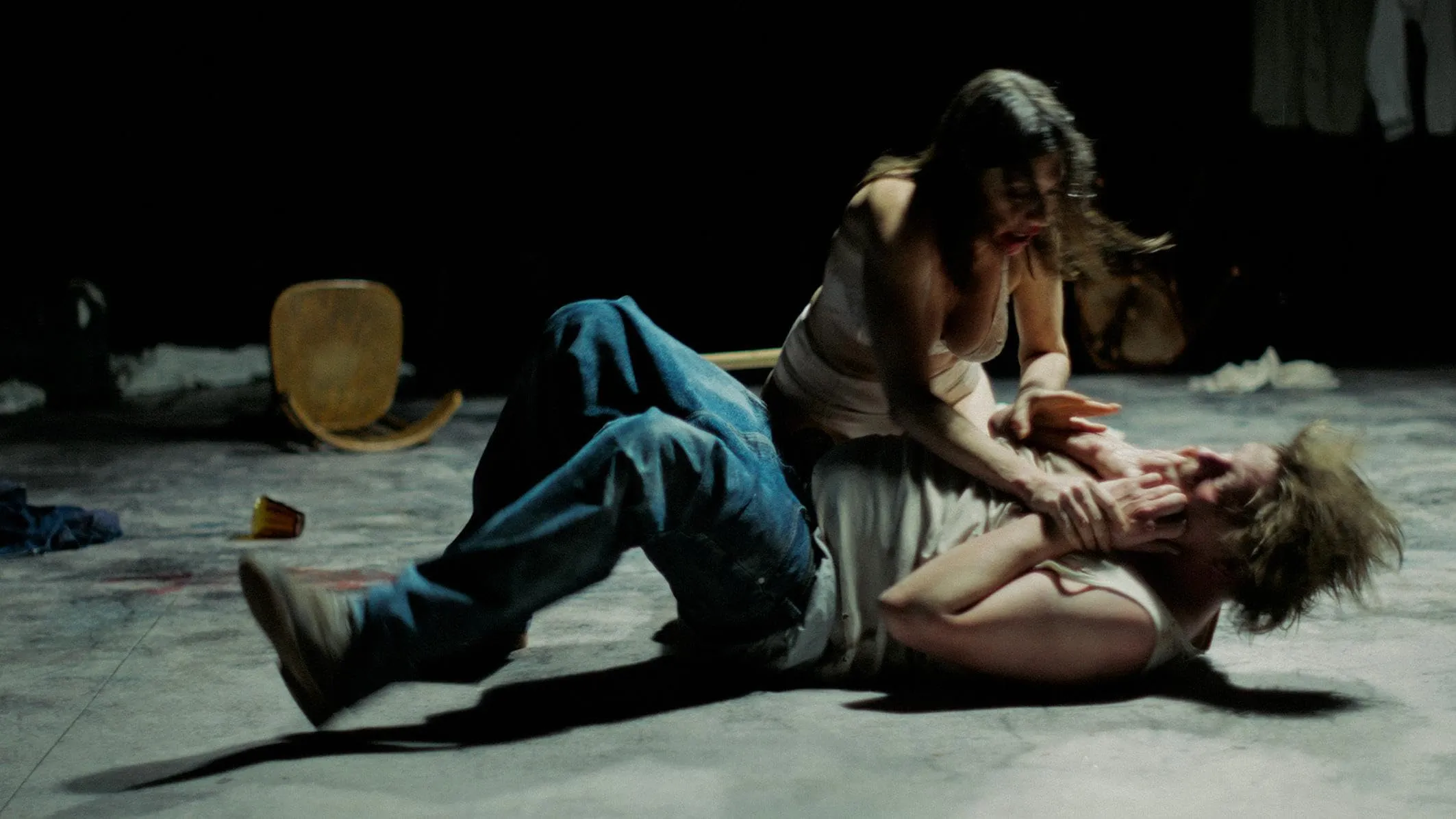
Where a conventional drama might use a swelling score to signal emotion, this film relies on the sharp sound of an actor’s intake of breath or the scrape of a chair. The camera is a restless participant in the story. It’s handheld, often shaky, and stays uncomfortably close to Anne and Ben.
This isn’t just a stylistic quirk; the technique makes the viewer feel like a fly on the wall, an intruder in these intensely private moments. The persistent, tight close-ups capture every subtle flicker of emotion, every involuntary micro-expression, revealing a universe of feeling that dialogue alone could never touch.
The decision to move rehearsals from a formal stage to natural settings—a windy beach, a dense forest—further dismantles any separation between the theatrical and the real. This raw style feels incredibly spontaneous, though a fascinating tension arises because the thematic neatness of certain moments reveals the director’s guiding hand, a small crack in an otherwise immersive illusion that reminds you that even this ‘reality’ is a construction.
The Beautiful Wounds of Performance
Ultimately, the film is held together by the two magnetic and brutally honest performances at its center. Anne Barbot and Benoît Dallongeville are fearless, putting every piece of themselves on screen in a way that feels both exhibitionistic and deeply vulnerable.

Barbot’s portrayal of Anne is a masterclass in guarded fragility; you see her fight to maintain professional control while her personal world crumbles. Dallongeville’s Ben is a compelling mix of boyish charm and a quiet desperation that slowly surfaces as their lives intertwine with Zola’s tragic text.
We witness the entire arc of a connection: Ben’s confident pursuit, Anne’s deep reluctance to repeat past mistakes, and the undeniable chemistry that ignites between them. The film presents art as a double-edged sword.
Anne speaks of the “wounds that come out on stage” as being “beautiful,” framing performance as a way to process real trauma. But the film leaves you asking if this process is truly therapeutic, or a form of self-destruction masked as creation.
It pulls you into this emotional vortex, forcing you to feel the claustrophobia and empathy of their situation. The raw style, the disorienting structure, and the exposed performances all combine to create a singular, unforgettable experience that makes you feel the thrill and the terror of their experiment.
The Zola Experience premiered at the Venice Film Festival in 2023 in the Venice Days section. It was also an official selection at the International Documentary Film Festival Amsterdam (IDFA) in 2023 and Cinéma du Réel in 2024.
Full Credits
Director: Gianluca Matarrese
Writers: Gianluca Matarrese, Anne Barbot, Benoit Dallongeville
Producers and Executive Producers: Dominique Barneaud, Hind Saïh, Paolo Colombo
Cast: Anne Barbot, Benoît Dallongeville, Jean-Christophe Laurier, Nikolai Delawarde, Agathe Peyrard, Philippe Risler, Minouche Nihn Briot, Romain Cottard, Jan Czul, Anthony Fulrad, Benoît Seguin, Ira Rubini
Director of Photography (Cinematographer): Gianluca Matarrese
Editors: Gianluca Matarrese, Fabrice Droullers, Sarah Ternat
Composer: Sylvain Moreau
The Review
The Zola Experience
A demanding yet fascinating film, The Zola Experience is a must-see for viewers who appreciate bold, experimental cinema. It forgoes conventional storytelling for an immersive and disorienting look at the chaotic intersection of art and life. Anchored by two fearless performances and a raw, documentary-style approach, it's a powerful and thought-provoking piece that lingers long after it ends, even if its intense style proves challenging.
PROS
- An innovative narrative that powerfully blurs fiction and reality.
- Exceptionally raw and vulnerable lead performances.
- Intimate, vérité-style cinematography creates a strong sense of immediacy.
- A deep, thought-provoking exploration of the creative process.
CONS
- Its disorienting structure may alienate viewers seeking a traditional plot.
- Some cathartic scenes can feel self-consciously directed.
- The intense focus on its central theme can feel relentless.







