






























Kaizen: A Factory Story begins with a classic fish-out-of-water premise. You are David Sugimoto, a young American arriving in Japan during the economic boom of the late 1980s, ready to start a career in sales for Matsuzawa Manufacturing.
A simple clerical error, however, lands you not in a cushy office but on the factory floor. Your new, unexpected job is to design automated production lines. With no prior experience, you are tasked with assembling everything from plastic food replicas to toy robots and VCRs.
This narrative setup perfectly frames the gameplay; as David, you are an outsider, forced to rely on pure intuition and improvisation to solve problems you were never trained for. The game immediately establishes a feeling of being dropped into a highly specialized world, armed with nothing but your own wits.
Clockwork Creations
The heart of Kaizen is the factory floor, a deceptively simple grid that serves as the canvas for your industrial machinations. The fundamental task is to use a discrete set of tools to transform raw components into a finished product. Mechanical arms, the workhorses of your operation, can push, pull, and grab objects.
Welders and riveters fuse parts together with decisive finality, while cutters and drills perform precise modifications. Your role is that of a choreographer, dictating every move from a multi-lane timeline that runs along the bottom of the screen.
This interface is where the game’s true nature as a programming puzzler reveals itself. Each lane on the timeline corresponds to a specific tool, and placing a command—extend an arm, activate a welder—creates a single step in a sequence. By placing commands in different lanes at the same point in time, you can achieve parallel processing, creating a complex and simultaneous dance of machinery.
The true genius of this system, and what elevates it beyond a simple logic puzzle, is its unwavering commitment to physicality. Every tool you place on the grid has a tangible presence and occupies valuable real estate. An arm can only extend so far.
A component being pushed cannot pass through a welder. If two moving parts attempt to occupy the same square at the same time, the result is a jarring crunch and a failed sequence. This constant spatial negotiation is the central challenge. You are not merely writing abstract code; you are designing a physical machine where clearance, timing, and positioning are paramount.
This focus on physicality is masterfully amplified by the game’s core duplication mechanic. Unlike other factory games where you might draw from an infinite source of materials, Kaizen provides only one of each required component at its designated spawn point. To create a second button for a calculator, for instance, you must use a mechanical arm to push the first button out of its starting square.
The moment that square becomes vacant, a new button materializes in its place. This single, elegant rule transforms every puzzle into a profound exercise in resource and space management. It creates a necessary rhythm of action and reset; you must constantly clear space to generate the very materials you need. Suddenly, the empty squares on the grid become as important as the occupied ones, serving as both pathways and potential sources.
The process of discovery is one of pure trial and error, but the game equips you with the perfect tool for debugging: the timeline itself. When a machine inevitably fails, you can scrub back and forth through the sequence, watching your plan unfold and collapse in slow motion.
This allows you to pinpoint the exact moment of failure—that one arm that retracted a fraction of a second too late, or that component that collided with another by a single pixel. Finding and fixing these minute errors provides a deep, intellectual satisfaction.
This is all reinforced by a superb layer of sensory feedback. The controls are intuitive and direct, but it is the sound design that truly brings your creations to life. Each action is punctuated by a crisp, satisfying sound: the thwack of a riveter, the hiss of a pneumatic arm, the decisive clack of a finished piece slotting into place.
These sounds turn an abstract set of instructions into a tangible, reactive machine, making the moment your convoluted contraption finally runs flawlessly from start to finish a genuinely entrancing and rewarding spectacle.
The Pursuit of Perfection
Kaizen masterfully manages its learning curve, beginning with a gentleness that borders on deceptive. The initial set of puzzles function as expertly disguised tutorials. A new tool or concept, like rotating a component, is introduced in a controlled environment, allowing you to grasp its function without pressure.

These early stages build a solid foundation of mechanical principles, teaching you the basic grammar of the game’s automation language. This slow burn is essential, because the game does not hesitate to ramp up its complexity.
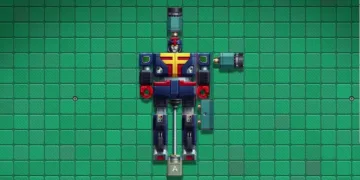
Soon enough, you will hit what feels like a “brainteaser blockade”—a single puzzle, like constructing a toy Gundam or a pocket calculator, that seems utterly impossible with the tools at hand. These levels demand a significant leap in creative thinking, forcing you to use tools in unexpected ways and combine simple mechanics into elaborate, multi-stage processes.
A crucial design choice that prevents this difficulty from becoming frustrating is the game’s acceptance of any working solution. The only binary goal is to produce a complete, correctly assembled product. Your machine can be a sprawling, inefficient mess that takes hundreds of steps, but if it gets the job done, the game gives you a checkmark and allows you to progress.
This freedom is liberating. It removes the fear of failure and encourages pure experimentation. The joy of simply finding a solution, any solution, is preserved as a victory in its own right. This design decision perfectly embodies the game’s central theme, the Japanese business philosophy of “Kaizen,” or continuous improvement. Your first clumsy solution is not an endpoint; it is merely the first draft.
The true long-term challenge reveals itself after that initial success. Upon completing a puzzle, your design is graded against three distinct metrics, each representing a different ideal of industrial efficiency. The first is cost, the total price of the tools used in your layout.
The second is area, the amount of grid space your machine occupies. The third is steps, the number of discrete time units it takes for your assembly line to run. Your scores are then plotted on a histogram showing how your solution compares to those of all other players. This is where the pursuit of perfection begins. Seeing your solution as an outlier—perhaps your cost is low but your cycle time is high—provides a powerful and immediate incentive to dive back in.
This scoring system creates fascinating strategic trade-offs. Should you use two arms working in tandem to save time, even though it increases cost and takes up more space? Or is a slower, cheaper, and more compact solution using a single arm on a track more “elegant”? The game provides no single answer, allowing the player to define what optimization means to them.
One player might chase the lowest possible cost, another might strive for the world record in speed, and a third might take pride in a balanced, jack-of-all-trades design. This is where the game’s loop of continuous improvement becomes so compelling. The challenge is no longer just against the puzzle; it is against yourself and a global community of engineers, all striving to shave off one more step, one more yen, or one more square of factory floor.
More Than Just Machines
While the intricate puzzles are the main course, Kaizen’s narrative provides the context and character that make the experience whole. The story unfolds in charming, visual novel-style cutscenes that act as welcome palate cleansers between bouts of intense problem-solving.

These interludes are light and brief, never overstaying their welcome, but they effectively build a world and a cast of characters you grow to appreciate. The story follows David’s journey of professional and personal growth as he navigates the nuances of Japanese work culture.
His interactions with his encouraging manager, Ohyama, and his quietly ambitious assistant, Tomoe, add a vital human element to a game about cold machinery. These characters represent different facets of the work ethic David is slowly learning to understand and embrace.
The narrative framework does more than just break up the gameplay; it enriches it. David’s position as an inexperienced outsider provides the perfect justification for the player’s own fumbling and unorthodox solutions. He doesn’t know the “right” way to build a factory line, so he is free to invent his own, just as the player is.
The story’s themes of finding purpose and pride in one’s work, no matter how niche, mirror the player’s own experience of transforming a chaotic mess of parts into an elegant, functioning machine. Brief, humorous anecdotes, like David’s coworkers being baffled by the American concept of a six-pack of beer, add levity and texture to the cultural exchange at the heart of the story.
This thematic cohesion is supported by a wonderfully realized aesthetic. The clean, functional art style is easy to read, ensuring that even the most complex mechanical layouts remain clear. The user interface is a model of clarity. But it is the 1980s setting that ties everything together.
The retro products you assemble—from blocky camcorders to simple electronic toys—are not just random objects; they are artifacts from a specific era of manufacturing innovation, grounding the abstract puzzles in a tangible, nostalgic history. This feeling is cemented by a superb synth-pop soundtrack, a funky and upbeat companion that perfectly captures the optimistic, forward-looking spirit of the time.
For players needing a different kind of mental break, the game even includes Pachi-Sol, a clever minigame that fuses the rules of Solitaire with the randomized physics of a Pachinko machine. It is a light, enjoyable distraction that further contributes to the game’s friendly and approachable feel. This welcoming nature is perhaps Kaizen’s greatest strength.
While its predecessors in the genre can often feel obtuse and intimidating, Kaizen lowers the barrier to entry with its intuitive physical logic rather than demanding players learn a complex coding language. It successfully serves as an ideal gateway for newcomers, yet the high skill ceiling of its optimization challenges ensures that puzzle veterans will find more than enough depth to keep them tinkering for dozens of hours, striving for that one, perfect, automated creation.
The Review
Kaizen: A Factory Story
Kaizen: A Factory Story is a masterclass in puzzle design, brilliantly blending accessible mechanics with an incredibly high skill ceiling for optimization. It wraps its deep, satisfying automation challenges in a charming narrative and a wonderfully realized 1980s aesthetic. By making its puzzles about physical logic rather than abstract code, it stands as a perfect entry point for newcomers to the genre while offering the profound depth that veterans crave. It’s a smart, stylish, and deeply rewarding experience that proves building a better machine is one of the most satisfying challenges in gaming.
PROS
- Deeply satisfying and physically intuitive puzzle mechanics.
- Excellent learning curve that welcomes newcomers.
- Charming narrative and characters that complement the gameplay.
- High replayability through optimization and leaderboards.
CONS
- The initial puzzles may feel overly simple for genre veterans.
- The lack of a hint system can lead to frustrating roadblocks on tougher puzzles.