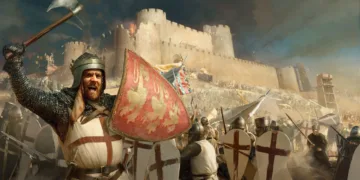
























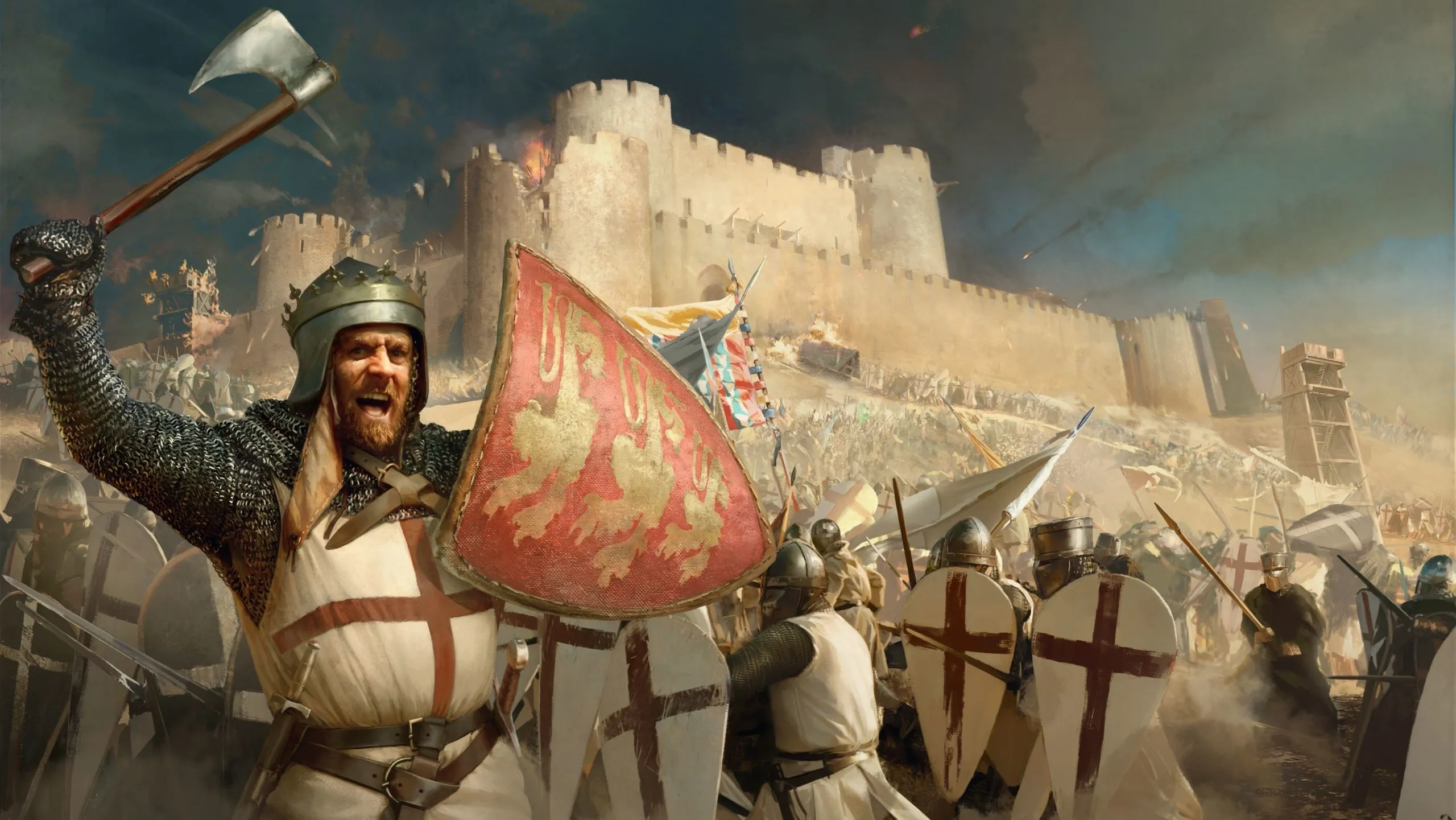

Stronghold Crusader occupies a specific space in the real-time strategy pantheon. It is not a game about sweeping conquests across a continent, but about the dirt, stone, and logistics of holding a single piece of land. Set against the backdrop of the Crusades, its focus is the castle itself—a living entity that must be fed, managed, and defended.
Every conflict is a direct result of your decisions as an architect and an economist. The core challenge is a delicate act of balancing the needs of your people against the demands of war. You must establish intricate production lines to supply everything from bread to crossbows, all while anticipating an enemy battering ram at your gates.
This Definitive Edition seeks to reintroduce the 2002 classic to a new era. It rebuilds the game with modern visual fidelity and injects a great deal of new content, testing if the foundation of this beloved castle simulator remains as solid as its virtual walls.
The Granary is Full, M’Lord
The economy of Stronghold Crusader is a story told through supply chains, a complex web of dependencies where a single broken link can spell disaster. Your fortress begins with a pool of idle peasants near the keep, a human resource that automatically fills jobs the moment you place a new workshop or farm. The game’s narrative emerges from how you direct this workforce.
Creating a single loaf of bread is a multi-stage process that demands resources, space, and manpower: a wheat farm requires a peasant, a mill needs another to grind the grain into flour, and a bakery requires a third to produce the final good. Each building must be placed with care. This chain can be expanded with other food types, like apples from orchards or cheese from dairy farms, which not only feed your people but increase their happiness through variety.
Building an army is even more demanding. A swordsman, the backbone of a strong infantry, cannot be trained until an iron mine is productive, a blacksmith has forged a sword from that iron, and an armory has a space to store the finished weapon. Each step requires a dedicated worker. To create a bowman, a woodcutter must chop trees and a fletcher must craft the bow.
This system of tangible production, where weapons are physical objects that must be crafted and stored, makes every economic decision feel weighty and consequential. Your choices in the first ten minutes directly determine the army you can field thirty minutes later.
The desert setting intensifies these choices. Arable land exists only on small, precious oases, making these green patches instant flashpoints for early-game conflict and a defining strategic feature of every map. Deciding whether to use that fertile ground for food production or for hops to make ale becomes a critical choice that dictates your entire strategy.
Your castle’s survival depends on managing these interlocking systems of production and popular opinion. Happiness is a currency, influenced by factors like tax rates, food variety, religious coverage from churches or mosques, and the availability of ale at the inn.
You can also manipulate the “fear factor” with structures like gallows and dungeons, which improve worker productivity at the cost of combat effectiveness. A happy populace means more peasants spawn, while an unhappy one leads to people leaving your castle, shrinking your workforce and your recruitment pool. This entire economic engine must be managed through a simple but effective interface, monitoring your stockpile of goods and the contents of your granary, making every decision a calculated risk.
They’re Scaling the Walls!
Combat is the violent punctuation to your economic and architectural planning, the ultimate test of your fortress’s design. In this game, fortifications are not just helpful; they are the absolute center of military strategy.
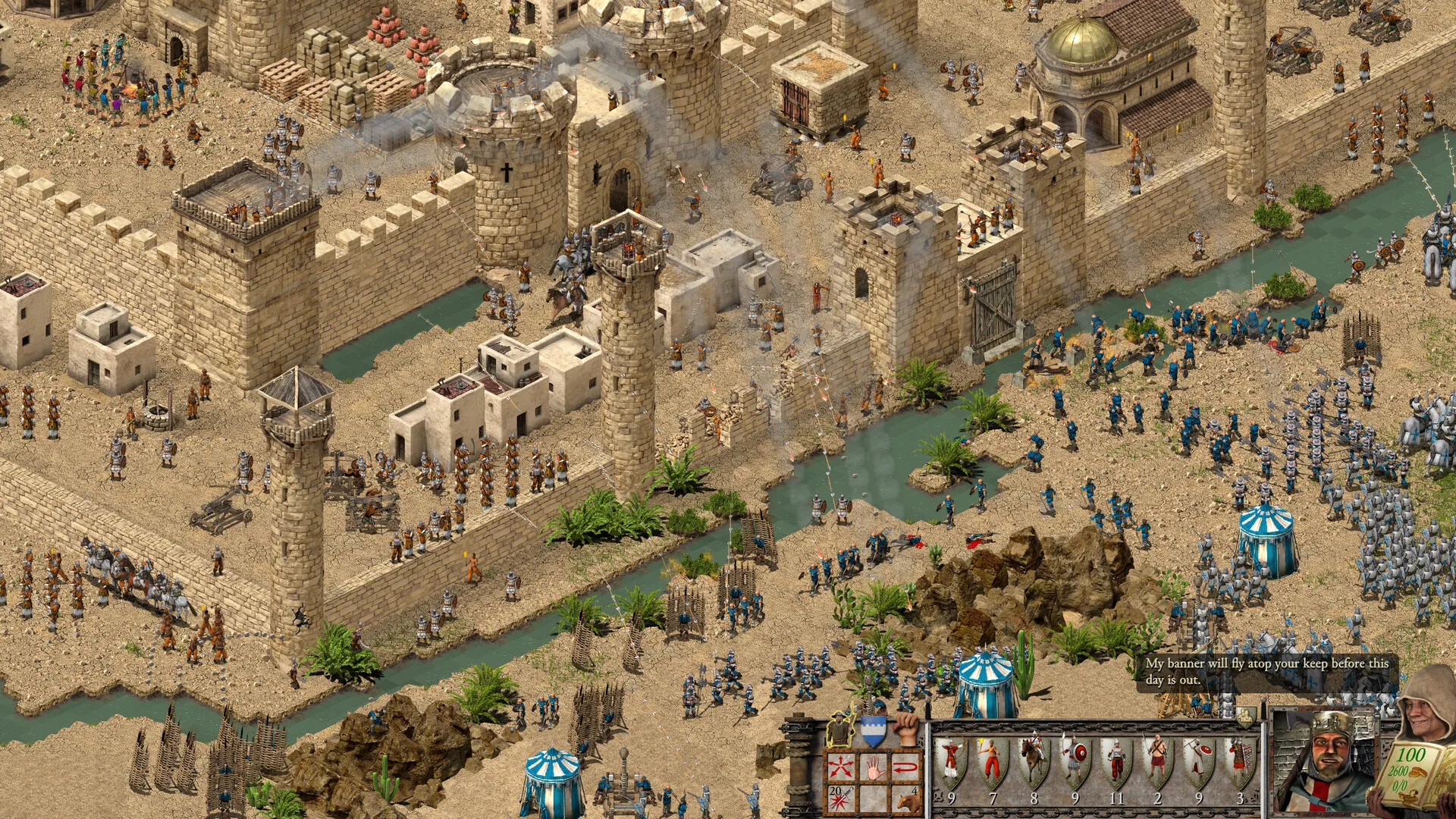
You are not just building simple walls, but designing a defensive system. You must consider the placement of gatehouses, the height of your towers, and the pathing of your enemies. Digging a watery moat can stop siege engines in their tracks, while a ditch filled with pitch can be ignited by your archers to create a terrifying wall of fire.
Placing your own bowmen atop these fortifications to rain death upon an approaching army is fundamental to survival. A well-designed castle can repel an army twice its size, while a poorly designed one will crumble at the first sign of trouble.
The game’s unit roster is split between two distinct factions. The European Crusaders feature units like durable spearmen, pikemen who excel against cavalry, and heavily armored swordsmen and knights, all of whom require their specific weapons and armor to be crafted in your workshops.
The Arab mercenaries are recruited directly from a special building for gold, offering tactical flexibility with units like the fast horse archer, the stealthy assassin who can climb enemy walls, and the destructive fire thrower. This Definitive Edition introduces new Bedouin units, like the fortification-destroying Sapper and the durable Heavy Camel cavalry, which provide new tactical options for cracking open enemy strongholds.
Attacking is a methodical process. A frontal assault on a walled castle is suicide. Success requires the use of siege engines to create a breach. Catapults and trebuchets can hurl rocks from a distance to smash stone walls, while rams can be used to break down gatehouses under heavy arrow fire.
Once a path is cleared, you send your troops through the breach to fight inside the castle grounds. This strategic depth is often undercut by the game’s most glaring technical issue: its pathfinding. Units, especially in large groups, frequently get stuck on one another or on bits of the environment.
They take bizarre, inefficient routes to their destination, and can fail to engage enemies intelligently. An intended flanking maneuver can dissolve into a confused mob walking into a kill zone. This is a frustrating limitation that feels like the game itself fighting against your strategic expression, a ghost of older game design that a fresh coat of paint cannot fully exorcise.
A Crusade Without End
The sheer volume of things to do in this package is its greatest strength. It is a treasure chest of content for any fan of the genre. All the historical campaigns from the original game and its Extreme expansion are present, taking you through a series of missions that serve as an extended tutorial on the game’s complex mechanics.
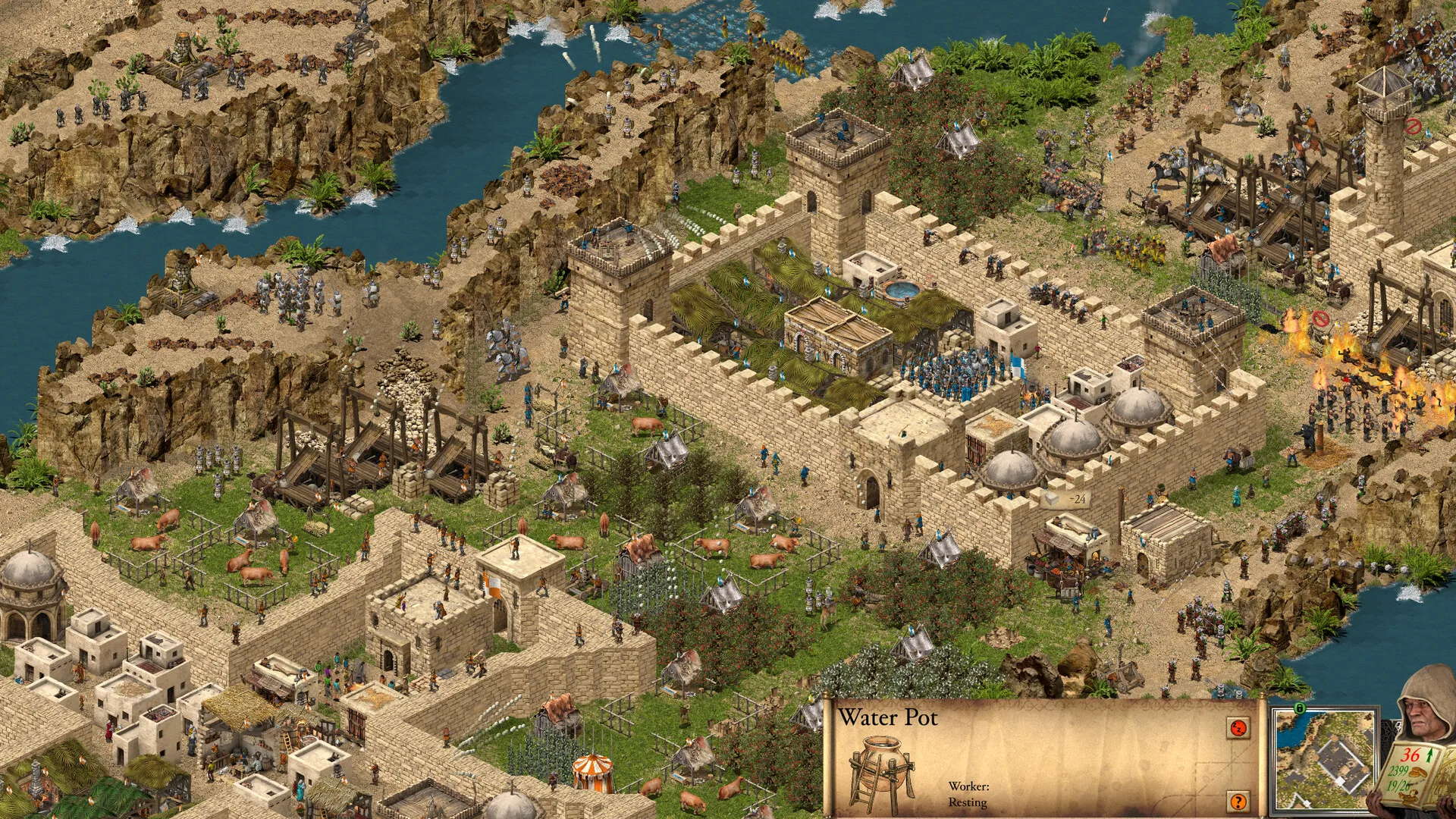
On top of that, two entirely new campaigns focus on the newly introduced Bedouin faction, providing fresh scenarios built around their unique units and strategies. The true heart of the single-player experience, however, lies in the Skirmish Trails. These are long chains of standalone missions against various AI opponents that progressively increase in difficulty.
Here, you will face off against lords with distinct personalities, from The Rat’s love of cheap spearmen swarms to The Wolf’s preference for heavily fortified castles and elite troops. Learning to counter each one is a satisfying strategic puzzle.
This edition adds even more. For players seeking a specific type of challenge, the “Sands of Time” trail presents missions that must be completed within a strict time limit. These scenarios demand peak efficiency and optimized build orders, forcing you to master the economic engine under intense pressure.
A new 10-mission co-op campaign lets you share the burden of command, allowing you and a friend to manage a fortress, coordinate defenses, and launch pincer attacks against enemy castles. This mode transforms the experience, adding a layer of communication and shared strategy.
Beyond these structured modes, a sandbox option gives you unlimited resources to design and build your dream castle without any military threat, a purely creative outlet. The inclusion of a full map editor and Steam Workshop support ensures a near-endless stream of community-made maps and scenarios, giving the game immense replay value. The unit cap has also been raised to a massive 10,000, allowing for battles on a scale the original engine could never have handled.
Old Walls, New Mortar
This remaster is a careful and respectful restoration, more akin to an archaeologist cleaning a priceless artifact than a builder knocking down old walls. The graphics have been completely redrawn, with new 2D sprites for every building and soldier that are significantly cleaner and more detailed than their pixelated ancestors.
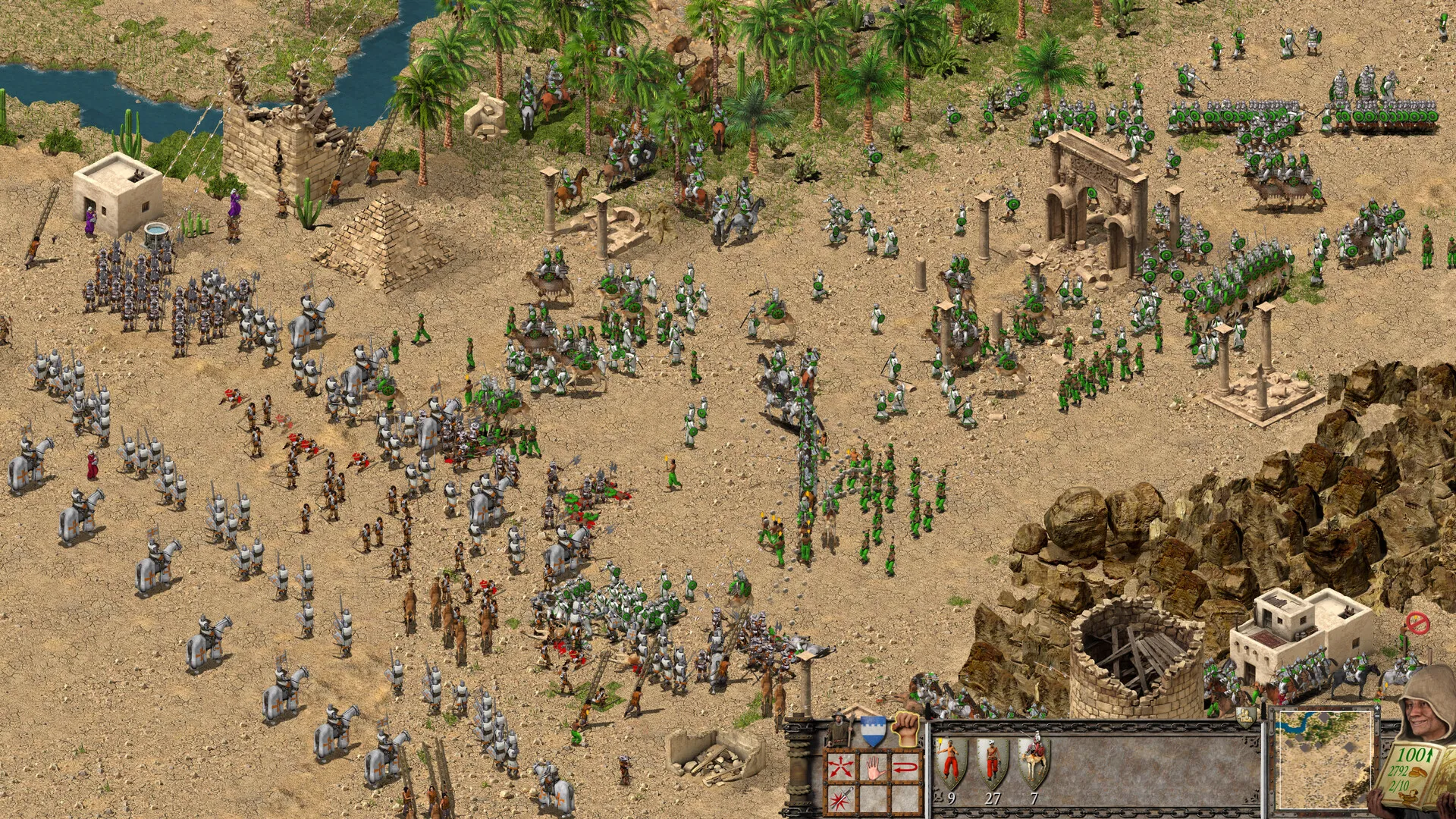
You can see the individual stones in a wall and the intricate patterns on a swordsman’s armor. New details, like heat haze shimmering over the desert sand and a greater variety in the appearance of horses, add to the atmosphere. Animations are smoother, and a much-needed continuous zoom function allows you to inspect your bustling castle up close or pull back for a tactical overview. The developers succeeded in updating the look without sacrificing the original’s distinct visual identity.
The audio has also been cleaned up. The classic soundtrack, with its mix of medieval fanfares and ambient Middle Eastern themes, sounds crisp and clear. The iconic voice alerts from your advisors—”The granary is empty, sire!”—return with perfect clarity, a welcome sound for any returning veteran. The sound mixing, however, can be uneven.
Character speech and battle sounds sometimes drown out the background music, creating a slightly jarring audio experience. While the presentation is improved, some elements still show their age. The user interface, though functional, feels basic by modern standards. The cursor remains a sword icon at all times, providing poor contextual feedback when you are trying to place a building versus command a soldier. This is a small but constant annoyance.
The core design is also a product of its time, which can be unforgiving. Recovering from a significant setback is nearly impossible. Because your population is your core resource for both industry and recruitment, losing a group of villagers in a raid can cripple multiple production chains simultaneously.
This often leads to a “death spiral” from which there is no escape, a punishing mechanic that can frustrate newcomers. Unlike modern strategy games that may have comeback mechanics, Stronghold Crusader is brittle.
One major mistake can cost you the entire match, which can stifle experimentation. The game also lacks modern control conveniences like intelligent unit formations or a dedicated attack-move command, making large-scale army management more cumbersome than it needs to be. This is a game that honors its past, for better and for worse.
The Review
Stronghold Crusader: Definitive Edition
Stronghold Crusader: Definitive Edition is a masterful restoration of a beloved classic. It successfully updates the presentation for the modern era while packing in an immense amount of new and old content, creating a near-endless well of strategic challenges. The intricate economic simulation remains deeply satisfying. However, the experience is held back by legacy issues, most notably the frustrating unit pathfinding and unforgiving mechanics that can feel punishing. It’s an essential purchase for veterans, but newcomers should be prepared for a trial by fire.
PROS
- Deep and rewarding economic simulation.
- An enormous amount of content offers exceptional value.
- Visual and audio remaster is respectful to the original art style.
- Unique focus on siege warfare and castle design.
CONS
- Unit pathfinding remains extremely poor and frustrating.
- Unforgiving design makes it difficult for new players to learn.
- Lacks many modern quality-of-life features.
- The pace can feel slow, especially in the early stages of a match.