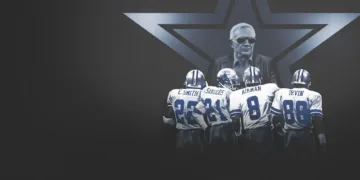





























The sports documentary has evolved into a study of modern mythmaking, and Netflix’s America’s Team: The Gambler and His Cowboys is a prime specimen. The series positions the Dallas Cowboys of the 1990s as a cultural phenomenon, a story of excess and ambition perfectly suited for its era. At its center is owner Jerry Jones, presented as the narrative’s primary architect and gambler.
In 1989, he acquired a failing franchise with the stated goal of building a dynasty. The series meticulously chronicles the result: a stunning run of three Super Bowl championships in four years. This achievement, however, serves as the setup for a more complicated story.
The eight-part series is less a highlight reel and more an examination of the immense egos and fractured relationships that fueled this machine. It deconstructs how a team became a brand, and how the architects of that brand nearly destroyed each other in the process. The narrative it unspools is one of brilliant success built on a foundation of profound conflict.
A Duel of Architects
Every compelling narrative requires a central conflict, and this series finds its emotional engine in the relationship between Jerry Jones and Head Coach Jimmy Johnson. The documentary does not treat their partnership as a simple footnote; it is the primary text. It carefully establishes their shared history, tracing their path from being alphabetically-paired teammates on a national championship team at the University of Arkansas to the joint architects of a football dynasty.
Their bond was forged in collegiate glory, creating a foundation of mutual respect that would later make their public schism all the more dramatic. The early episodes portray their reunion in Dallas as a perfect fusion of on-field tactical genius and off-field promotional savvy. Johnson was the demanding, detail-obsessed coach who built the roster, while Jones was the charismatic showman who sold the vision to the world.
The story’s turning point, predictably, arrives with success. The series frames their subsequent falling out as a bitter, public feud over authorship. Who truly built the Cowboys? The question hangs over the middle episodes, with each man offering his version of the truth in contemporary interviews. The documentary excels in showcasing the pettiness that success can breed. It leans on key moments to illustrate the depth of the animosity, most notably Jones’s infamous remark that “500 coaches” could have achieved what Johnson did with that roster.
Another sequence recounts Johnson pointedly refusing to raise his glass when the rest of a table toasted Jones at an NFL owners’ event. These are not grand betrayals, but the sort of deeply personal slights that fester. Through interviews filmed decades later, the documentary reveals the still-simmering tensions. Jones often appears emotional, his voice cracking as he revisits old wounds. Johnson is more stoic, recounting events with a cold precision that feels just as revealing.
The filmmakers effectively show how this personal battle, amplified by a hungry sports media, became the team’s defining off-field drama. Johnson’s eventual induction into the team’s Ring of Honor is presented as a necessary, if somewhat belated, piece of narrative closure. The ceremony is captured with a sense of formal resolution, yet the preceding hours of testimony leave the viewer to question the authenticity of the reconciliation. It feels less like a heartfelt reunion and more like a carefully managed epilogue designed to protect the integrity of the brand they both created.
Parallel Narratives of Triumph and Turmoil
The series structures its on-field story with methodical detail, giving the football itself a sense of weight and consequence. It recounts the championship seasons through a blend of pristine archival footage and sharp player testimony.

The decision to include interviews with key rivals, like 49ers legends Steve Young and Jerry Rice, is a strong storytelling choice that elevates the documentary beyond a simple hagiography. Hearing the respect and frustration from the men they defeated provides external perspective and raises the narrative stakes of the Cowboys’ victories, particularly in the sequences breaking down the monumental NFC Championship games that were the era’s de facto Super Bowls.
The recollections from the core players, “The Triplets,” are the heart of these sections. Troy Aikman’s commentary is intense and analytical. Emmitt Smith speaks with a quiet authority. Michael Irvin provides the poetic, passionate color commentary on his own life.
These accounts of athletic achievement run parallel to a darker, more chaotic narrative of off-field behavior. The documentary does not shy away from the team’s reputation, dedicating significant time to the subplots that defined their “Bad Boys” image. It explores the legend of the “White House,” a rented home near the team facility that became a hub for parties and controversy. The filmmakers cleverly use the players’ reactions to this topic as a storytelling device.
Most former Cowboys offer a nervous laugh or a swift “no comment,” a wall of silence that speaks volumes. Only Irvin seems willing, even gleeful, to recount the exploits, positioning himself as the group’s unapologetic id. The series gives Irvin’s story its own dedicated episode, a compelling character study of a man whose brilliance on the field was matched by his destructive behavior off it.
It covers his trial for cocaine possession, allegations of a murder-for-hire plot, and the infamous incident where he stabbed a teammate with scissors. Other arcs, such as the high-profile signing of superstar Deion Sanders or the unsettling presence of the volatile pass rusher Charles Haley, are woven in to complete the portrait of a locker room that was a delicate ecosystem of talent and trouble. The series successfully balances these two threads, suggesting that the team’s on-field greatness was not achieved in spite of the chaos, but was perhaps inextricably linked to it.
The Unwritten Final Act
In its final sections, the documentary shifts its focus to legacy, and the narrative becomes one of profound, uniquely American irony. It details how Jerry Jones fulfilled his promise of making the Cowboys a global brand, a project that became more important than the game itself. The series explains his business acumen, showing how he fundamentally changed the league’s financial model by striking independent sponsorship deals with giants like Nike and Pepsi.

This move broke the NFL’s collective marketing structure and positioned Jones not just as an owner, but as a revolutionary capitalist within a socialist league. The franchise is now worth a staggering $11 billion, a commercial triumph that stands in stark contrast to three decades of athletic futility. The documentary captures this strange reality by showing an octogenarian Jones watching his hyper-valuable team suffer yet another embarrassing playoff loss.
This financial success is juxtaposed with the lingering sense of unfulfilled potential. The series captures this through surprisingly emotional interviews with Jones and his former stars. Their visible disappointment over the long championship drought provides the story with its most human moments. One of the most affecting scenes features Emmitt Smith tearfully recalling the day he broke the NFL’s all-time rushing record.
He confesses that he always envisioned his original teammates, Aikman and Daryl Johnston, being there with him for that moment of triumph. Their absence serves as a microcosm for the dynasty’s premature end. The documentary is, however, selective in its scope. It offers a detailed account of the dynasty’s peak but deliberately avoids a deep analysis of the subsequent failures.
This is a significant narrative omission. There are no interviews with Tony Romo or Jason Garrett, no exploration of the questionable draft picks or coaching hires that defined the years since. It is a story of a glorious past without a connecting thread to the present. The result is a portrait of a team whose mythic past feels disconnected from its current state, a story whose most interesting chapter may be the one it chose not to write.
America’s Team: The Gambler and His Cowboys is an eight-part sports documentary series focusing on the Dallas Cowboys during the 1990s under Jerry Jones’ ownership. Directed by Chapman and Maclain Way, known for Wild Wild Country and Untold, the series premiered on Netflix on August 19, 2025, aligning with the Cowboys’ NFL preseason. It is exclusively available for streaming on Netflix.
Full Credits
Director: Chapman Way, Maclain Way
Producers and Executive Producers: David Ellison, Chapman Way, Maclain Way, John Skipper, Jon Weinbach, Keith Cossrow, Ross Ketover, Ken Rodgers, Jesse Sisgold
Cast: Jerry Jones, Troy Aikman, Michael Irvin, Emmitt Smith, Deion Sanders, Jimmy Johnson, Barry Switzer, George W. Bush, Phil Knight, Rupert Murdoch
Director of Photography (Cinematographer): David Bolen
Composer: Brocker Way
The Review
America’s Team: The Gambler and His Cowboys
America’s Team is a masterfully constructed, often riveting examination of a sports dynasty's rise and the ego-driven conflict that defined it. While its narrow focus on the glory years leaves the larger story of the Cowboys' subsequent decline frustratingly unexplored, it succeeds as a compelling portrait of ambition, success, and the bitter ironies of legacy. It’s essential viewing for understanding how a team became a modern myth.
PROS
- In-depth exploration of the central Jones/Johnson conflict.
- Excellent use of player interviews and archival footage.
- Effectively balances on-field action with off-field drama.
- Strong narrative structure and pacing.
- Provides a sharp analysis of the team's business and cultural impact.
CONS
- Largely ignores the three decades of failure following the dynasty.
- Feels like a carefully managed, owner-approved narrative at times.
- Avoids deeper examination of some of Jones's personal controversies.